

Why does a household sustained by miraculous food still face the death of a child?
Study overview
God’s Word Confronts the Palace, Sustains a Widow’s Table, and Answers a Cry from the Upper Room
Key passage: 1 Kings 17:16 — The flour remains available and the oil does not fail, according to the word of the LORD spoken through Elijah. (Summary, not a direct quotation.)
The king cannot command the rain. The prophet cannot keep the brook from drying. Beside a widow’s hearth, tomorrow receives bread. Upstairs, a desperate prayer reaches the God of life.
Introduction — When the Next Meal Becomes the Whole Horizon
A small measure of flour can carry the weight of an entire household. The container looks ordinary until the remaining handful becomes the distance between a child and hunger. At such a moment, tomorrow may feel too large to imagine.
First Kings 17 moves from the king’s court to a brook and then a widow’s home. Elijah announces drought before Ahab, receives food through ravens, and follows God’s direction beyond Israel’s border. The journey reaches a mother preparing a final meal before expected death.
The promised provision is remarkable. Yet the story refuses a painless ending after the miracle of food. The widow’s son becomes gravely ill and dies. A household sustained through scarcity now faces a loss no full container can repair.
Can God’s word sustain life when familiar provision disappears and death enters a protected household? First Kings 17 portrays threatened life becoming a witness to God’s faithfulness through daily provision, honest prayer, and restored life.
The chapter brings theology close enough to sit beside a cooking fire. The contest with Baal concerns rain and life, but the evidence enters a kitchen and an upstairs room. God’s authority reaches the land, the table, and the child held in a grieving mother’s arms.
Historical and Literary Context — The Living God beyond the Royal System
Ahab has established worship for Baal in Samaria (16:29–33). Elijah appears abruptly, without an account of childhood, training, or appointment. The prophet’s name expresses allegiance to the LORD, and the opening declaration places the prophet in service before the living God.
The drought confronts a religious claim. Baal was associated with storms, fertility, and rain in Canaanite religion. Provan explains the challenge: the LORD governs rainfall, sustains life, and finally restores life where Baal’s supposed authority would be expected to prevail (Provan 2012, commentary on 1 Kgs 17:1–24). The background clarifies the narrative’s polemic without reducing the widow’s suffering to an abstract argument.
Deuteronomy had warned that worshiping other gods could bring closed skies and failed crops (Deut 11:16–17). The covenant also required care for widows, orphans, and foreigners (Deut 10:18–19; 24:17–22). Judgment against false worship and concern for vulnerable households therefore belong within the same theological world.
The chapter also opens the sustained prophetic narratives within Kings. Leithart emphasizes the shift toward prophets receiving and obeying God’s word, with prophetic ministry becoming a means of gathering and sustaining life amid royal disobedience (Leithart 2006, commentary on 1 Kgs 17:1–24). The king remains powerful, but the decisive initiative comes from beyond the palace. The narrator repeatedly identifies the word of the LORD as the source of direction, provision, and validated testimony.
Walking Through the Text
A Word Stops the Palace’s Confidence — 17:1
Elijah the Tishbite, from Gilead, announces the absence of dew and rain except according to the prophetic word. The declaration begins with the life of the LORD, the God of Israel. Elijah stands in service before God.
The prophet does not enter as an independent controller of the weather. The following scenes repeatedly place Elijah beneath God’s command. The authority belongs to the living God, and the messenger must also listen.
The announcement challenges Ahab’s religious policy at the point of livelihood. A temple for Baal cannot command the rain required by crops, animals, and households. The dispute concerns the source of life. Brueggemann places the drought within the confrontation between divine authority and royal claims to secure the people’s well-being (Brueggemann 2000, 207–9).
Obedience Leads to a Drying Brook — 17:2–7
God directs Elijah toward the brook Cherith near the Jordan. The prophet is to drink from the brook and receive food through ravens. Elijah obeys. Bread and meat arrive morning and evening, while the brook supplies water.
The scene recalls wilderness provision in Exodus 16. Life depends on a gift received repeatedly rather than a storehouse controlled by the recipient. Elijah’s message about dependence becomes part of Elijah’s daily experience.
Then the brook dries because rain has not fallen. The prophet also lives within the drought. Obedience has not placed Elijah outside the conditions affecting the land.
The narrator identifies a direct cause for the drying water: the absence of rain. No accusation against Elijah accompanies the loss. The next direction will come through another word from God. A real provision can be temporary, while the faithfulness of the provider continues beyond a particular stream.
A Prepared Meeting Looks Like an Impossible Assignment — 17:8–12
God sends Elijah to Zarephath in the region of Sidon and announces provision through a widow. The location matters: the prophet enters the region associated with Jezebel’s origins (16:31). God’s authority and care cross the political and religious boundary.
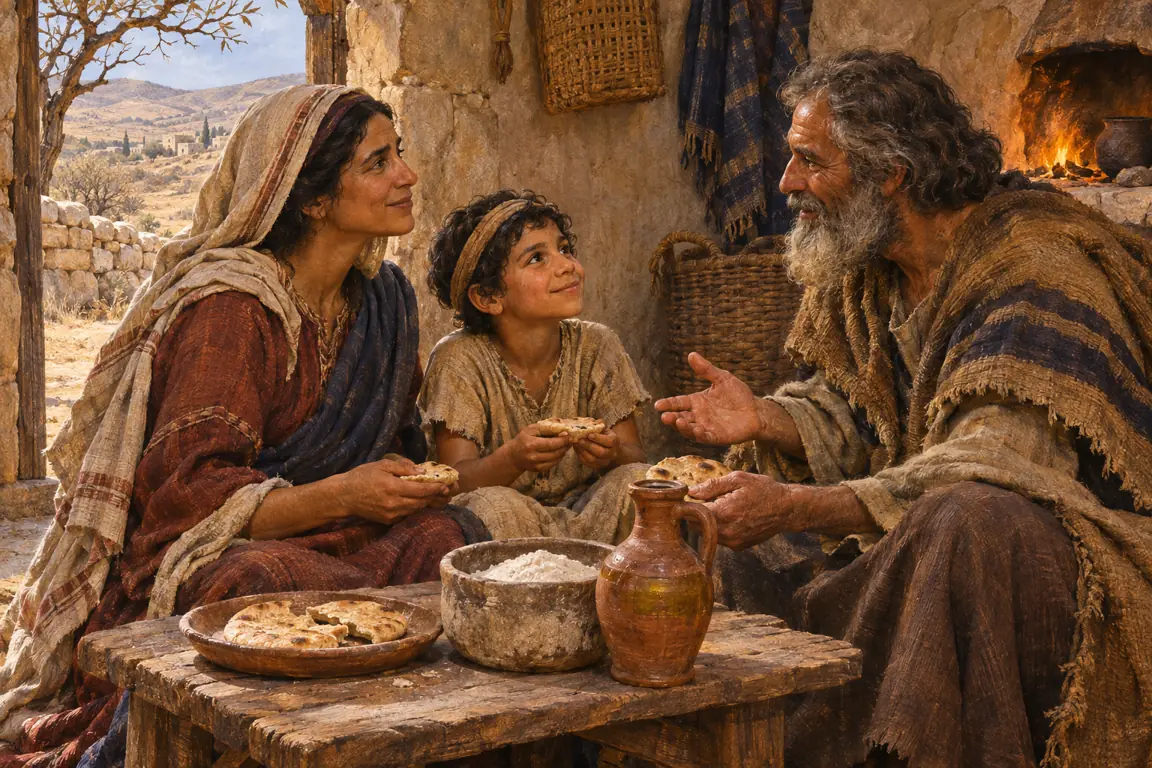
At the city gate, Elijah finds the widow gathering sticks. A request for water is followed by a request for bread. The widow explains the household’s condition: a handful of flour, a little oil, and a meal intended for the mother and son before death.
God’s announced arrangement does not mean the widow possesses hidden abundance or reports a prior revelation. The dialogue contains no statement of an earlier divine instruction received by the widow. Provan treats the language of God’s command as the ordering of provision, while preserving the desperation disclosed at the gate (Provan 2012, additional note on 1 Kgs 17:9).
The prospective provider also needs provision. The meeting places prophet, mother, and child within shared dependence on God’s word.
The Last Handful Opens into Daily Bread — 17:13–16
Elijah answers the fear with assurance and asks the widow to make a small cake for the prophet first, then prepare food for the household. The request is demanding because the supplies appear insufficient for survival.
The request also rests on a specific promise from the LORD: the flour will not run out and the oil will not fail until rain returns. The assurance concerns the continued feeding of the household. The widow acts according to the word, and the provision continues.
The narrator does not describe a warehouse suddenly filled with riches. The emphasis falls on reliable food across the days. The word sustains a table where the mother had expected a final meal. Brueggemann highlights the life-giving assurance and the inclusion of a vulnerable widow within God’s provision (Brueggemann 2000, 210–11).
The scene cannot become a general rule requiring poor families to feed a religious leader before children. Elijah’s particular request belongs to an explicit promise providing for the family. Faithful ministry should serve the life-giving purpose of the account.
A Sustained Household Still Meets Grief — 17:17–20
After the continuing provision, the widow’s son becomes severely ill until no breath remains. The narrative moves from protection against hunger to the reality of death. Yesterday’s miracle has not prevented today’s agony.
The mother challenges Elijah and connects the loss with remembrance of sin. The words reveal grief searching for an explanation. The narrator does not confirm a specific sin as the cause of the child’s death.
Elijah does not interrogate the mother or deliver a lecture about the complaint. The prophet receives the child, carries the body upstairs, places the child on the bed, and cries to the LORD. The prayer brings the widow’s loss before God as a difficult question.
The scene gives lament a place within faithful prayer. Elijah’s first response is compassionate action joined to an honest appeal. The household needs help before speculation. Provan notes the prophet’s concentration on seeking life rather than explaining the mother’s guilt (Provan 2012, additional note on 1 Kgs 17:18).
The God Hearing Prayer Gives the Child Back — 17:21–24
Elijah stretches across the child three times and cries for the child’s life to return. The exact purpose of the physical action is not explained. The narrator identifies the decisive response: the LORD hears Elijah’s cry, and the child revives.
The language describes the restoration of the child’s life. The result is concrete: a living child is carried downstairs and returned to the mother. The account centers on God’s power to give life rather than an explanation of an invisible afterlife.
The mother then affirms Elijah as a man of God and the word of the LORD spoken through Elijah as truth. The confession grows from a household’s encounter with sustaining and restoring mercy. The messenger’s authority is confirmed through God’s action.
The scene prepares the public confrontation ahead, but the private joy retains importance. The child is restored to a mother, beyond becoming evidence in a debate. The God confronting the king has heard a cry from an upstairs room.
Theological Reflection
The Living God Rules Creation and Life
Rain, ravens, water, flour, oil, and restored breath form a single witness to God’s authority. The chapter challenges Baal’s claims through the ordinary conditions sustaining households and the extraordinary restoration of a child. Creation remains responsive to the Creator. The prophet’s importance comes from service to God’s word; the messenger cannot become the ultimate object of trust. The story invites gratitude for daily provision alongside wonder at the miracle.
Grace Crosses a Border and Enters a Vulnerable Home
Zarephath stands beyond Israel’s territory, yet God’s mercy sustains a widow there. The woman is an active participant, offering hospitality and acting on the promise. The foreign household cannot be dismissed as spiritually irrelevant to Israel’s God. The chapter prepares a larger biblical horizon: God’s covenant purpose reaches outward toward the nations. Faithful communities should recognize the neighbor beyond familiar boundaries as a recipient of divine care and a possible partner in mutual service.
Trust Learns the Rhythm of Daily Bread
The brook and the jar both teach dependence through time. Elijah receives meals, and the household receives continued supplies. Neither scene turns faith into personal command over resources. The promise is sufficient provision in a particular crisis, not a universal guarantee of wealth. Christian trust can become visible through gratitude, practical sharing, careful stewardship, and persistence in prayer. A community’s shared table can become part of the answer to a neighbor’s hunger.
Lament Belongs within Faithful Prayer
The widow’s accusation and Elijah’s question keep sorrow audible. The prophet carries grief toward God instead of demanding a polished religious performance from a bereaved mother. The answer comes as restored life, but the narrative does not promise an identical immediate outcome after every prayer. Hebrews 11:35–40 holds miraculous restoration alongside faithful endurance through suffering. Prayer can seek healing boldly, accompany sorrow patiently, and rest final hope in God’s promised resurrection. Bereavement cannot serve as proof of inadequate faith.
Canonical and Christological Horizon — Bread, Welcome, and Resurrection
Jesus explicitly recalls the widow of Zarephath in Luke 4:25–26. The reference challenges a restricted understanding of divine favor. God’s grace reaches beyond familiar claims of religious privilege, calling the community toward humility and a wider welcome.
Luke 7:11–17 also echoes Elijah’s ministry through the restoration of a widow’s son. Jesus approaches the grieving mother with compassion, raises the son, and returns the son to the mother. The crowd’s recognition of divine visitation gives the earlier story a fresh resonance.
The provision of food belongs within the same gospel horizon. Jesus teaches prayer for daily bread and feeds hungry crowds (Matt 6:11; Mark 6:34–44). Compassion addresses actual bodies and households. The cross and resurrection carry the promise further: Jesus’ resurrection is the firstfruits of the final victory over death (1 Cor 15:20–26). The child at Zarephath returns to ordinary mortal life; Christian hope reaches toward death’s ultimate defeat and creation’s renewal. The table and the upstairs room become windows toward God’s life-giving kingdom.
Life Application
- Name the need beneath the religious language. In prayer or pastoral conversation, state the concrete shortage, fear, or loss. Clear words about food, rent, caregiving, or grief can open a path toward practical help.
- Make daily provision communal. A congregation or study group can identify a struggling household and arrange a reliable contribution of food or essential support. Agree on a realistic schedule and review the need with dignity.
- Receive help beyond familiar boundaries. Look for cooperation with a neighbor outside the usual circle. Accept mutual service without assuming compassion belongs only inside a preferred community.
- Protect vulnerable families in giving appeals. Leaders should communicate needs honestly and avoid promises turning a poor household’s sacrifice into a guaranteed return. Review a current appeal through the chapter’s concern for sustained family life.
- Accompany grief before offering explanations. Visit, listen, provide a meal, and make space for difficult questions. Refuse an accusation linking a family’s bereavement to insufficient faith or a presumed hidden sin.
- Pray boldly and remain present. Bring a serious need before God with a trusted prayer partner. Combine prayer with sustained companionship and appropriate practical assistance, while anchoring hope in the risen Jesus.
Reflection Questions
- Which temporary source of provision has become confused with the faithfulness of God?
- What concrete need is difficult to admit in prayer or community?
- Which overlooked neighbor could become a partner in mutual care?
- How could a church’s giving practices better protect children and vulnerable households?
- What compassionate action could accompany prayer beside a grieving family during the coming week?
Response Prayer
Living God, the brook can dry while divine faithfulness remains. Give anxious households courage for the next obedient step. Provide daily bread, patient companions, and practical help where cupboards are nearly empty. Teach congregations to share resources with dignity and to recognize neighbors beyond familiar borders.
Lord Jesus, bring compassion close to the cooking fire and the sickroom. Protect vulnerable families from religious pressure. Give leaders integrity to serve the life of the household rather than the comfort of the leader. Where grief asks painful questions, let patient love make room for honest prayer.
Hear the cries rising from homes, hospital rooms, and places of lonely sorrow. Grant healing according to divine wisdom, strengthen faithful care, and sustain hope through unanswered questions. Through the cross and resurrection, hold communities within the promise of renewed life. Let the word of God become visible through bread shared, tears honored, and steadfast love. Amen.
Window into What Comes Next — From a Widow’s Table to a Mountain’s Question
Chapter 17 closes with a mother recognizing the truth of God’s word. Chapter 18 will carry the question into public life. Elijah will return toward Ahab, and the long drought will lead toward a confrontation on Mount Carmel.
Watch the movement from the hidden household to the gathered nation. The God sustaining flour and restoring a child will confront the competing claims shaping Israel’s worship. The coming scene will also reveal faithful service within dangerous circumstances. What response will emerge when the question settled beside a widow’s table is placed before a kingdom?
Bibliography
- Bible. 1769. The Holy Bible: King James Version. 1 Kings 17. BibleGateway. https://www.biblegateway.com/passage/?search=1%20Kings%2017&version=KJV. Scripture wording in the study is paraphrased unless otherwise indicated.
- Brueggemann, Walter. 2000. 1 & 2 Kings. Smyth & Helwys Bible Commentary. Macon, GA: Smyth & Helwys. See “Elijah, Man of Power for Life,” especially 207–12.
- Leithart, Peter J. 2006. 1 & 2 Kings. Brazos Theological Commentary on the Bible. Grand Rapids: Brazos Press. See commentary on 1 Kings 17:1–24.
- Provan, Iain W. 2012. 1 & 2 Kings. Understanding the Bible Commentary Series. Grand Rapids: Baker Books. See “Elijah and the Drought (1 Kgs. 17:1–24),” including additional notes.

Be the first to leave a comment.