

Why does Elijah rebuild an altar with twelve stones before praying for fire?
Study overview
God Restores a Broken Altar, Calls Divided Hearts Home, and Gives Rain to a Thirsty Land
Key passage: 1 Kings 18:36–37 — Elijah asks God to make the LORD’s identity known, confirm the servant’s obedience, and bring the people’s hearts back to God. (Summary, not a direct quotation.)
Bread reaches prophets hidden in caves. Twelve stones remember a people divided by kings. Fire answers a prayer for returning hearts. Beyond the mountain, a small cloud carries the promise of rain.
Introduction — Keeping Every Door Open Can Divide a Heart
A household can hang a sign of faith near the door while arranging daily decisions around a different master. The language of trust remains, but fear, wealth, approval, or power begins directing the life beneath the sign.
First Kings 18 confronts divided allegiance. Ahab’s kingdom has welcomed Baal while retaining Israel’s inherited identity. The drought has exposed the crisis of provision. Now Elijah returns, and a national question takes public form on Mount Carmel.
The chapter contains fire, a broken altar, a crowd’s confession, and the return of rain. Yet the prayer at the center identifies a deeper purpose: the people must recognize the LORD and return in heart. The contest serves covenant restoration.
What happens when a people try to keep God’s name while following a rival allegiance? First Kings 18 portrays divided devotion becoming a public summons to return, as God’s answering presence restores the claim of the covenant upon Israel.
The story also honors service beyond the public platform. Before Elijah stands on the mountain, Obadiah has carried bread and water to endangered prophets. Courage appears in a royal confrontation and in hidden care. Faithfulness can speak boldly before a crowd and quietly keep threatened people alive.
Historical and Literary Context — The Promise of Rain Comes First
Chapter 17 established the LORD’s authority through drought, daily provision, and restored life. Chapter 18 begins with a new word: Elijah must appear before Ahab, and God will send rain. The promise precedes the contest. The initiative belongs to God’s purpose, beyond a contest devised to force a reluctant deity into action.
Baal’s association with storms and rain gives Carmel a pointed theological setting. The land depends on a gift the royal religious system cannot deliver. The question concerns the identity of the true provider and the allegiance governing Israel’s life.
The covenant supplies the background. Deuteronomy links false worship with withheld rain, while Solomon’s prayer anticipates confession, renewed obedience, and restored rainfall (Deut 11:16–17; 1 Kgs 8:35–36). The twelve stones also recall Israel’s covenant identity across political division. Leithart connects the altar and public renewal with the covenant scenes of Exodus 24 (Leithart 2006, commentary on 1 Kgs 18:1–46).
The narrative develops through preparation, confrontation, fire, and rain. Repeated references to answering expose the contrast between Baal’s silence and the LORD’s response. Provan traces the link between the widow’s recognition in chapter 17 and the public recognition now sought for Israel (Provan 2012, commentary on 1 Kgs 18:1–46). The private household has prepared the reader for the national gathering.
Walking Through the Text
Hidden Courage Carries Bread into the Caves — 18:1–15
The famine is severe when God sends Elijah toward Ahab. The king and Obadiah, the palace steward, search for water and grass to preserve horses and mules. The search reveals the strain upon the kingdom’s resources.
The narrator introduces Obadiah as deeply reverent toward the LORD. During Jezebel’s killing of the LORD’s prophets, Obadiah has hidden a hundred prophets in two groups of fifty and supplied bread and water. Royal employment has not erased covenant allegiance.
Elijah meets Obadiah and requests a message to Ahab. Obadiah fears death if the king arrives and Elijah has disappeared through the Spirit’s action. The concern arises from danger, not a narrator’s verdict of faithlessness. Elijah’s solemn assurance finally enables the meeting.
Leithart highlights the different forms of service: Elijah confronts the court from outside, while Obadiah protects life from within a dangerous institution (Leithart 2006, commentary on 1 Kgs 18:1–46). Faithfulness cannot be measured only by visibility. The bread in the caves matters before the fire on the mountain.
The Accusation Returns to the Throne — 18:16–24
Ahab calls Elijah the troubler of Israel. Elijah returns the accusation to the royal house: the trouble comes through abandoned commandments and worship of the Baals. The dispute concerns responsibility for the nation’s condition. Exposing a wound differs from creating the wound.
Elijah calls for Israel to gather at Carmel, including 450 prophets of Baal and 400 prophets of Asherah supported at Jezebel’s table. The subsequent contest explicitly follows the prophets of Baal; the text does not detail the participation or fate of the Asherah group.
The people face a decision about following the LORD or Baal. Initial silence reveals the difficulty of relinquishing divided allegiance. Elijah then proposes two offerings, with the answer by fire identifying the true God.
Elijah describes a single prophetic witness facing the Baal prophets. The earlier account of Obadiah’s hidden hundred prevents interpreting the statement as proof that no other faithful prophets exist. The public confrontation places Elijah alone before the rival group.
Great Activity Meets No Answer — 18:25–29
The prophets of Baal prepare the offering and call from morning onward. The activity intensifies, accompanied by ritual movement and self-wounding. Elijah’s mockery exposes the claim of a deity requiring an excuse for absence.
The narrator repeats the decisive result: no voice, no answer, no response. The description strips the royal religious system of the power claimed for Baal. Persistent effort cannot create life in an empty object of trust.
The theological issue is the living God’s responsiveness. The story does not turn the volume or length of a prayer into a universal test of sincerity. Nor will Elijah’s shorter prayer become a technique for controlling God. The question remains the reality of the God addressed. Provan emphasizes the repeated language of answering across the scene (Provan 2012, commentary on 1 Kgs 18:25–40).
Twelve Stones Rebuild the Memory of the Covenant — 18:30–37
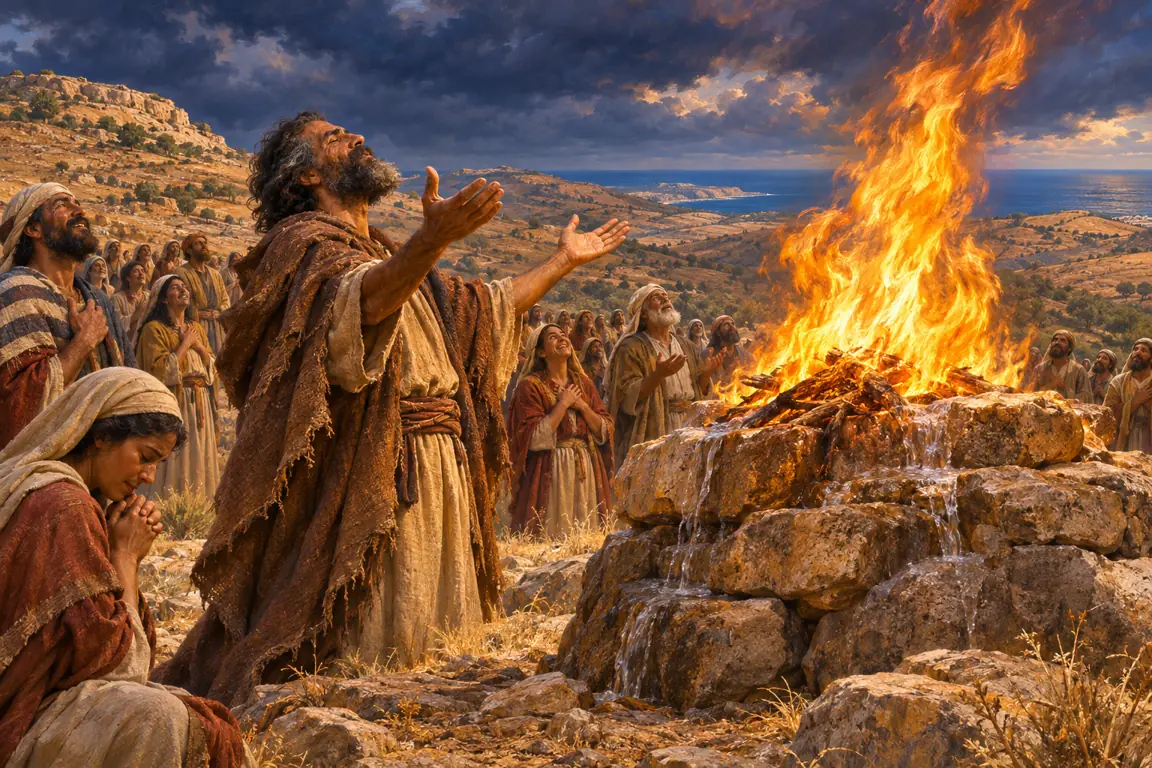
Elijah invites the people closer and repairs the broken altar of the LORD. Twelve stones correspond to the tribes descended from Jacob, renamed Israel. The divided kingdom is summoned to remember an identity rooted deeper than the rivalry of royal houses.
The sacrifice and wood are arranged, a trench is prepared, and four jars of water are poured three times. Water saturates the offering and fills the trench. The text does not identify the source of the water; speculation about seawater or a separate miracle is unnecessary.
At the time of the offering, Elijah addresses the God of Abraham, Isaac, and Israel. The prayer links the present gathering with God’s covenant history. Elijah asks for recognition of the LORD, confirmation of the servant’s obedience, and the return of the people’s hearts.
The purpose is explicit. The prophet seeks renewed allegiance rather than personal applause. The repaired altar prepares a people to receive a restored relationship. Brueggemann emphasizes the twelve-tribe memory and the decisive divine answer to the prayer (Brueggemann 2000, 225–26).
Fire Brings Confession and a Severe Judgment — 18:38–40
The fire of the LORD consumes the sacrifice, wood, stones, and dust, and takes up the trench’s water. The people fall facedown and confess the LORD as God. The answer reaches beyond an isolated spectacle toward the public acknowledgment sought in the prayer.
Verse 40 then records the capture and killing of Baal’s prophets at the Kishon. The scene is severe and must remain part of the reading. The narrator presents the act within Israel’s covenant judgment against false prophecy and rival worship (cf. Deut 13:1–5). The passage cannot be reduced to an encouraging story about answered prayer alone.
The ancient judgment setting also requires careful Christian application. The church receives no commission to kill religious opponents. Jesus teaches love for enemies (Matt 5:43–48). The seriousness of idolatry remains, while allegiance to Jesus governs the means of Christian witness.
A Small Cloud Follows Persistent Waiting — 18:41–46
Elijah announces the sound of approaching rain and sends Ahab to eat and drink. The prophet goes to Carmel’s summit, bends low, and sends a servant to look toward the sea. The first report shows no visible sign.
The servant returns repeatedly. On the seventh observation, a small cloud appears, compared with a human hand. Elijah sends Ahab a warning to depart before the rain hinders the journey. Soon cloud, wind, and heavy rain cover the scene.
The promise at the chapter’s opening now receives fulfillment. The God answering by fire also gives water to the thirsty land. The story ends with the LORD’s empowering hand upon Elijah as the prophet runs before Ahab toward Jezreel.
The restored rain belongs to God’s gift rather than a king’s achievement. James 5:17–18 later reads Elijah’s story as encouragement toward prayer. Persistent dependence can remain faithful before the first visible sign appears.
Theological Reflection
Divided Allegiance Eventually Requires a Decision
The question at Carmel reaches beyond uncertainty about ideas. The people have participated in a rival system while carrying Israel’s covenant identity. Provan notes the verbal link between the people’s wavering and the Baal prophets’ ritual movement (Provan 2012, additional note on 1 Kgs 18:21). Belief becomes visible through following. Present-day discernment asks about the authority directing money, ambition, relationships, and public conduct. God’s name cannot simply decorate a life governed by another master.
Faithful Service Includes Hidden Protection
Obadiah’s food and water continue the chapter 17 pattern of sustaining life. The narrator recognizes reverence expressed through dangerous practical care. Service within a compromised institution requires discernment, but employment inside the institution does not prove disloyalty to God. A public prophet and a quiet protector can belong to the same faithful purpose. Communities should honor patient care and the protection of threatened neighbors alongside visible preaching.
God’s Answer Seeks Returning Hearts
The fire serves a covenant purpose named before the miracle. Elijah acts under God’s word and prays for the people’s recognition and return. Spiritual power must therefore be evaluated through truth and restored allegiance, beyond excitement or a leader’s reputation. God’s initiative comes first in the promise of rain. Repentance responds to the God already seeking the people. Prayer joins divine mercy rather than manufacturing divine willingness.
Renewal Needs More than a Mountain Moment
The crowd’s confession and restored rain are real, but the next chapter will expose continuing danger. A decisive experience does not complete the formation of a faithful people. Twelve stones remember a shared identity; daily practices must learn to live within the covenant again. Worship needs to grow into honesty, justice, mercy, and endurance. A congregation should prepare for patient discipleship after a moving gathering, including care for exhausted servants and vulnerable members.
Canonical and Christological Horizon — Covenant Renewal under the Faithful King
The repaired altar and twelve stones recall the covenant gathering in Exodus 24:4–8. Jesus later appoints twelve disciples, a sign associated with the renewal of Israel, and gives the cup of the new covenant (Mark 3:13–19; Luke 22:20). The biblical hope reaches toward a people gathered in faithful relationship with God.
Jesus also governs the church’s response to rejection. In Luke 9:51–56, the disciples’ proposal to call down fire meets a rebuke. The road continues toward Jerusalem and the cross. The church witnesses to the kingdom through truth, enemy-love, and the saving message of the crucified and risen King.
The crowd at Carmel acknowledges God after an extraordinary sign. At the cross, the revelation of faithful divine love takes a different form: the Son gives life for sinners, and the resurrection vindicates the saving mission (Rom 5:6–11; 1 Cor 15:3–4). Christian prayer for returning hearts rests within the mercy revealed in Jesus. The aim is a reconciled people learning faithful love under the true King.
Life Application
- Name a divided allegiance. Examine one area involving money, approval, fear, or control. Name a specific decision expressing obedience to Jesus in the present situation.
- Honor a hidden protector. Recognize a person quietly caring for vulnerable neighbors in a difficult workplace or institution. Offer practical support and protect confidentiality where needed.
- Hear correction before blaming the messenger. When challenged about a harmful practice, write down the actual concern. Investigate the evidence and make a concrete repair before defending a reputation.
- Repair a neglected practice of faith. Restore a realistic pattern of Scripture reading, household prayer, reconciliation, or shared care. Invite participation rather than using spiritual pressure to secure compliance.
- Test the purpose of public ministry. Before a gathering, ask whether the plan helps people know God and grow in faithful love. Remove one feature mainly designed to magnify the leader’s importance.
- Continue prayer with practical faithfulness. Bring an ongoing need before God with a prayer partner. Agree on a useful next action, keep reviewing the need, and provide companionship during the waiting.
Reflection Questions
- Which competing allegiance most strongly shapes a current decision?
- Where has the community overlooked a quiet form of faithfulness?
- What truthful correction has been dismissed as troublemaking?
- How could a powerful worship experience become a lasting practice of justice, mercy, and obedience?
- What faithful action remains possible while the horizon still shows no sign of rain?
Response Prayer
God of Abraham, Isaac, and Israel, gather divided hearts into truthful devotion. Expose the rival loyalties hidden beneath religious language. Give courage to return, humility to receive correction, and patience to repair neglected patterns of prayer, justice, and love.
Lord Jesus, honor the quiet servants carrying bread into places of fear. Strengthen caregivers, protect threatened neighbors, and grant wisdom within difficult institutions. Free public ministry from the hunger for applause. Let preaching and worship direct attention toward God’s character and the healing of human relationships.
Teach the church to witness with courage and love for enemies. Where the horizon remains empty, sustain prayer without manipulation and faithful action without despair. Through the cross and resurrection, restore hope in God’s mercy. Let the rain of renewal reach beyond a single gathering into households, workplaces, and the shared life of the community. Amen.
Window into What Comes Next — After the Fire, a Weary Prophet
Chapter 18 closes with rain and extraordinary energy on the road to Jezreel. Chapter 19 will open with a renewed threat from Jezebel. The public confession on Carmel has not ended the conflict, and Elijah will enter a season of fear, weariness, and painful questioning.
Watch the change from the gathered crowd to a solitary servant, from answering fire to a searching encounter at another mountain. The God restoring the nation’s rain will also attend to the prophet’s need for rest, nourishment, and renewed direction. How does faithful service continue after a great moment fails to resolve the whole struggle?
Bibliography
- Bible. 1769. The Holy Bible: King James Version. 1 Kings 18. BibleGateway. https://www.biblegateway.com/passage/?search=1%20Kings%2018&version=KJV. Scripture wording in the study is paraphrased unless otherwise indicated.
- Brueggemann, Walter. 2000. 1 & 2 Kings. Smyth & Helwys Bible Commentary. Macon, GA: Smyth & Helwys. See “Troubler of Israel,” 219–27.
- Leithart, Peter J. 2006. 1 & 2 Kings. Brazos Theological Commentary on the Bible. Grand Rapids: Brazos Press. See commentary on 1 Kings 18:1–46.
- Provan, Iain W. 2012. 1 & 2 Kings. Understanding the Bible Commentary Series. Grand Rapids: Baker Books. See “Elijah and the Prophets of Baal (1 Kgs. 18:1–46),” including additional notes.
Be the first to leave a comment.