

Why does Elijah repeat the same complaint after the mysterious quiet at Horeb?
Study overview
God Sustains a Weary Prophet, Challenges a Narrowed Vision, and Opens the Work to Another Generation
Key passage: 1 Kings 19:15–18 — God gives Elijah renewed instructions involving future rulers and a prophetic successor, while revealing the preservation of seven thousand faithful Israelites. (Summary, not a direct quotation.)
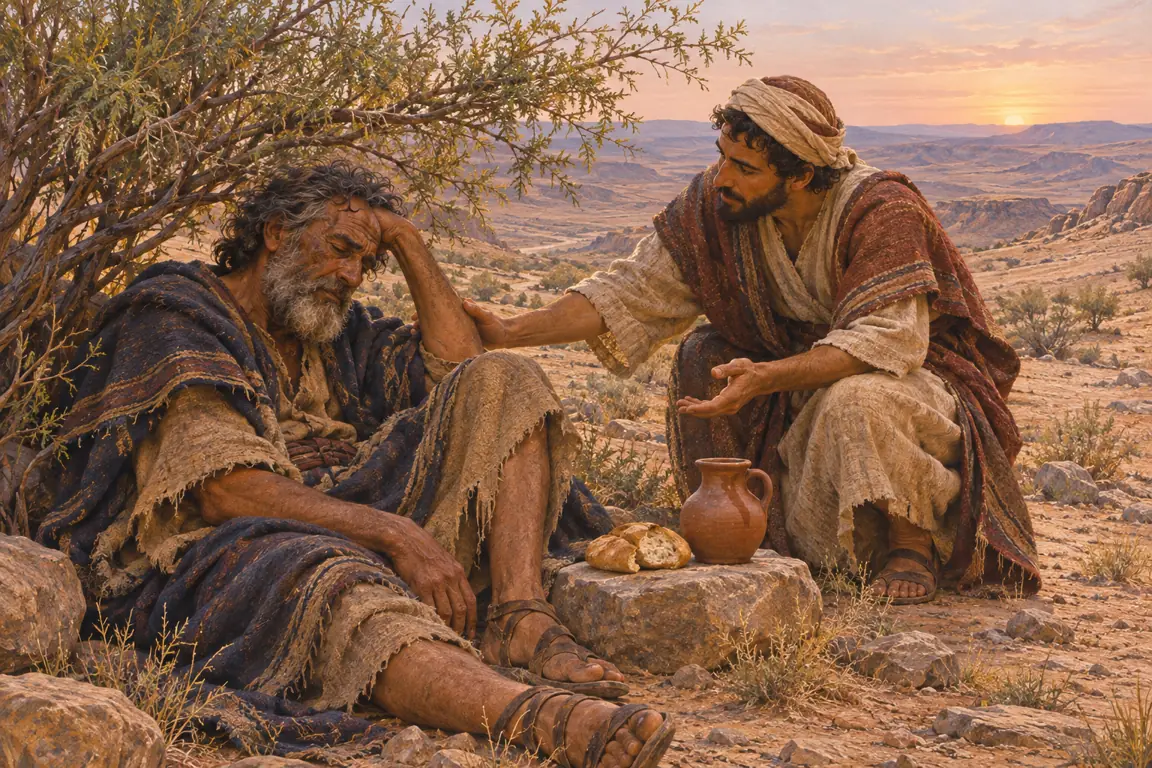
Rain has returned, but the threat remains. Beneath a desert tree, a prophet has no strength left. Bread arrives before the long conversation. Beyond the cave, God’s work is larger than one weary life.
Introduction — After a Great Moment, the Struggle Can Continue
The morning after a demanding achievement can feel strangely empty. The work has consumed strength, the hoped-for change remains incomplete, and another difficulty arrives before rest becomes possible. Public courage does not make a servant inexhaustible.
First Kings 19 follows the fire and rain of Carmel with a threat against Elijah’s life. The prophet leaves Jezreel, travels south, and enters the wilderness alone. Beneath a tree, Elijah asks God for death. The contrast with the previous chapter is painful and deliberate.
The story then moves through sleep, food, a mountain journey, repeated questions, a mysterious quiet, and a renewed commission. God neither abandons the servant nor treats the servant’s interpretation of events as the whole truth. The body receives care, the complaint receives a hearing, and the future receives a wider horizon.
How does God meet a faithful servant convinced the work has reached a dead end? First Kings 19 portrays exhaustion becoming an occasion for sustaining grace, corrected perspective, and shared service beyond a single prophet.
The chapter invites tenderness toward weary people and humility about personal importance. A servant may need nourishment before another task, honest speech before a settled answer, and the discovery of fellow workers before courage returns. God’s work can continue beyond the limits of a single life.
Historical and Literary Context — From Carmel to the Mountain of the Covenant
The public confession on Carmel has not removed Jezebel’s hostility. The queen’s threat recalls the earlier killing of the LORD’s prophets (18:4, 13), giving the danger a concrete history. Elijah’s flight therefore arises within a genuine conflict, even as the narrative raises questions about the prophet’s response.
The movement from Jezreel to Beersheba takes Elijah south into Judah, followed by a further wilderness journey. Horeb, the mountain of God, recalls Sinai and Israel’s foundational covenant encounter. The forty days and nights, the cave, the passing presence, and the covered face invite comparison with Moses (Exod 24:18; 33:18–23; 34:5–8).
The comparison also contains a difference. Moses interceded for Israel after the golden calf, while Elijah’s speech emphasizes Israel’s disloyalty and prophetic loss. The supplied BibleProject mountain transcript draws attention to the tension between a mediator’s calling and a complaint becoming an accusation against the people (BibleProject n.d., 25–34). The interpretation should retain the actual danger and grief within Elijah’s words.
The chapter’s ending also prepares the future. Hazael, Jehu, and Elisha belong to developments continuing well beyond the immediate scene. The encounter concerns more than private consolation. Brueggemann emphasizes the movement toward a demanding public commission, while Provan highlights God’s purposes extending beyond Elijah’s expectations and efforts (Brueggemann 2000, 235–39; Provan 2012, commentary on 1 Kgs 19:1–21).
Walking Through the Text
A Real Threat Reaches a Spent Servant — 19:1–4
Ahab reports the events at Carmel, including the killing of Baal’s prophets. Jezebel responds with a threat to Elijah’s life by the following day. The confrontation has not ended with the crowd’s confession or the restored rain.
Elijah travels to Beersheba, leaves the attendant there, and continues a day into the wilderness. Beneath a desert tree, the prophet expresses an exhausted desire for death and a painful comparison with the ancestors.
The wish must retain the seriousness of despair. The chapter does not provide a clinical diagnosis, and a modern label cannot replace the narrated danger, isolation, and anguish. Neither should a teacher turn the scene into ridicule of weakness after courage.
The flight also differs from earlier journeys: no divine travel instruction appears before departure, unlike 17:2–3 and 18:1. Provan notes the difference (Provan 2012, commentary on 1 Kgs 19:3–9). God’s later care will not necessarily validate every conclusion formed during the retreat. Compassion and correction will remain together.
Bread and Water Arrive before the Next Demand — 19:5–8
Elijah sleeps beneath the tree. An angel touches the prophet and directs eating. A cake and water are available nearby. Elijah eats, drinks, and sleeps again.
The angel of the LORD returns and provides another summons to eat, acknowledging the journey’s weight. The repeated provision is important. The text allows bodily need and renewed sleep to remain visible within a story of prophetic faith.
Strengthened by the food, Elijah travels forty days and nights to Horeb. The sequence recalls wilderness nourishment and the Moses tradition. The narrator does not supply a command prescribing a forty-day fast for later readers.
The provision also continues the chapter 17 pattern. God has fed Elijah through ravens and a widow; now the prophet receives care again. The servant carrying God’s word remains a recipient of God’s gifts. A calling does not abolish creaturely need.
A Question Opens the Cave — 19:9–10
At Horeb, Elijah lodges in a cave. The word of the LORD comes as a question about Elijah’s presence and purpose. The question invites the prophet to put the present condition into words.
Elijah answers with zeal for the LORD, Israel’s abandonment of the covenant, ruined altars, murdered prophets, and a conviction of being the sole remaining witness. The complaint contains real wounds, but the total picture requires examination.
Chapter 18 has already recorded Obadiah’s preservation of a hundred prophets and the people’s confession. The claim of complete solitude therefore exceeds the information available to the reader. Exhaustion has narrowed the visible horizon.
God hears the complaint without making the complaint the final interpretation of Israel’s future. Honest lament can bring a wounded perception into the presence of a wider truth. The question opens space for speech, listening, and eventual redirection.
The Storm Does Not Set the Limits of God’s Presence — 19:11–14
Elijah is directed to stand before the LORD. A mighty wind breaks rocks, followed by an earthquake and fire. The narrator repeatedly states that the LORD is not in the spectacular phenomena during the Horeb encounter.
After the fire comes the difficult Hebrew expression often rendered as a gentle whisper, a still small voice, or a sound of sheer silence. The wording permits debate. Brueggemann stresses the uncertainty of the translation and the need to keep the phrase within the encounter and commission (Brueggemann 2000, 236).
Elijah covers the face with the mantle and stands at the cave’s entrance. The question returns, and Elijah repeats the same complaint. The passage does not describe an immediate transformation of every thought or feeling.
The contrast cannot mean God never acts through fire: Carmel has just shown otherwise. The encounter enlarges the prophet’s expectations. God cannot be confined to spectacular power, soothing quiet, or any single preferred form of experience. The voice must still be heard through the actual instructions.
A Wider Future Includes Judgment and a Preserved People — 19:15–18
God directs Elijah back toward the wilderness of Damascus and names three appointments: Hazael over Aram, Jehu over Israel, and Elisha as prophetic successor. The answer places the future within a larger work involving other agents and another generation.
The mandate includes severe judgment. The references to the sword prevent turning the quiet encounter into a promise of an undisturbed world. God’s opposition to the kingdom’s entrenched evil continues. The later narratives will unfold the roles of Hazael, Jehu, and Elisha; the chapter does not report Elijah personally completing three anointing ceremonies.
God also reveals seven thousand Israelites preserved from bowing to Baal or giving the kiss of allegiance. Elijah’s conviction of absolute solitude meets a divine correction. The faithful community is larger than the prophet’s present knowledge.
The assurance invites humility as well as hope. God has not entrusted the entire future to Elijah’s strength. The preservation of a people rests in God’s action rather than a solitary servant’s ability to see every witness.
The Mantle Reaches a Field and Another Pair of Shoulders — 19:19–21
Elijah finds Elisha son of Shaphat plowing, with twelve pairs of oxen involved in the work and Elisha at the twelfth. Elijah places the mantle over Elisha, a symbolic act understood as a call to follow.
Elisha leaves the oxen, runs after Elijah, and requests a farewell to the parents. Elijah’s brief reply is open to interpretation, but the narrative proceeds to a decisive response. Elisha prepares a communal meal using a pair of oxen and the plowing equipment, then follows Elijah as an attendant.
The meal marks a costly transition from the former livelihood into prophetic service. The chapter ends with companionship and preparation for succession, rather than the isolated death requested beneath the tree. The calling now reaches another pair of shoulders.
The succession does not amount to God’s complete abandonment of Elijah. God will address Elijah again in 21:17. The servant’s contribution continues within a work becoming broader than one ministry.
Theological Reflection
Divine Care Reaches Embodied People
Food, water, sleep, touch, and time belong inside the account of God’s dealings with a prophet. Human limits cannot be removed through a title or an earlier miracle. A faithful community should take exhaustion seriously and offer concrete care rather than another demand for performance. The immediate pastoral lesson concerns compassion attentive to real human need, joined to the patient work of truthful discernment.
A Painful Interpretation Can Need Correction
Elijah’s danger is real, and the conclusion of total isolation is incomplete. Compassion does not require agreeing with every despairing conclusion. The God hearing the complaint also reveals the seven thousand and opens a future beyond the prophet’s expectations. Wise companionship can acknowledge pain while gently recalling overlooked relationships, earlier mercies, and possible next steps. Correction should widen hope through truth, rather than shame a weary person for suffering.
God’s Work Exceeds a Preferred Method
Carmel’s fire and Horeb’s quiet belong within the same larger story. The prophet must learn a horizon beyond one dramatic victory. Quiet attention does not remove public responsibility, and public responsibility does not make spectacular success the only evidence of God’s work. Provan emphasizes the long reach of the commission into events beyond Elijah’s own activity (Provan 2012, commentary on 1 Kgs 19:13–21). Faithfulness includes receiving a limited part within a purpose larger than personal achievement.
Grace Preserves a People and Opens Shared Service
The seven thousand overturn a story centered on a lone survivor. The call of Elisha also makes partnership concrete. God’s faithfulness creates room for community, succession, and service extending beyond a single lifetime. The appropriate response is neither pride about a favored group nor despair about a lonely remnant. Humble hope recognizes fellow servants and prepares the next generation. The mantle can be shared without the present servant becoming worthless.
Canonical and Christological Horizon — Rest, Intercession, and the Faithful Son
Paul explicitly returns to Elijah’s complaint and God’s answer in Romans 11:2–6. The preserved seven thousand illustrate a remnant grounded in grace. The passage resists the conclusion that God has simply rejected Israel and directs attention toward God’s continuing faithfulness.
The Moses echoes also reach toward the gospel. In Luke 9:28–36, Moses and Elijah appear with Jesus on the mountain and speak about the departure Jesus will accomplish at Jerusalem. The story’s horizon opens toward the cross. Jesus carries faithful obedience and saving intercession to completion, beyond the limits of even a courageous prophet (Heb 7:25).
Matthew 11:28–30 places the weary before the gentle authority of Jesus. Rest belongs within discipleship under the faithful King. The cross and resurrection secure a hope deeper than a servant’s present strength or apparent success. Christian service can therefore receive correction, accept care, and share responsibility within the life of Christ’s people.
Life Application
- Arrange concrete care after demanding service. A household or ministry team can protect time for rest, provide meals, and redistribute immediate duties after a sustained period of pressure.
- Take despairing words seriously. Offer patient listening and companionship rather than ridicule or spiritual blame. Help a distressed person reach trusted support and avoid treating a demand to work harder as sufficient care.
- Examine a conclusion of total isolation. With a trusted companion, name existing relationships, earlier acts of help, and faithful people beyond the usual field of vision. Seek one practical reconnection.
- Listen beyond a preferred spiritual experience. Read the chapter slowly, attend to God’s actual commands, and test impressions through Scripture. Make room for quiet reflection alongside faithful public action.
- Prepare another pair of shoulders. Invite a suitable learner into a real responsibility, explain the work, and provide patient mentoring. Share knowledge before a crisis makes succession urgent.
- Receive a limited part with hope. Identify one task requiring personal faithfulness and one responsibility better shared or handed onward. Let trust in Jesus replace the assumption that the whole future depends on one servant.
Reflection Questions
- Which expectation about success has made continued resistance feel like complete failure?
- What bodily or relational need has been neglected beneath a strong sense of calling?
- Which faithful people remain outside the present field of vision?
- Where could honest correction widen hope without denying real pain?
- What responsibility could be shared to prepare another generation for faithful service?
Response Prayer
God of the wilderness and the covenant, meet weary servants with patient care. Bring food, rest, trustworthy companions, and room for honest speech. Protect frightened people from further harm, and teach communities to receive cries of despair with seriousness and compassion.
Lord Jesus, gentle King, correct the narrow conclusions formed beneath exhaustion. Recall forgotten mercies, reveal faithful companions, and open a future larger than personal strength. Free leaders from the burden of imagining the whole work rests on a single life.
Teach attentive listening beyond the noise of public success and beyond the wish for an effortless path. Give courage for the next faithful step, wisdom for shared responsibility, and humility for preparing successors. Through the cross and resurrection, sustain hope when the task remains unfinished. Let the mantle of service become a shared gift within a people preserved by grace. Amen.
Window into What Comes Next — A King Faces Another Word
Chapter 19 ends with Elisha following Elijah. Chapter 20 will return to Ahab amid military danger from Aram. Unexpected prophetic messages will enter the battlefield, and victories will create another test of royal obedience.
Watch the difference between receiving help from God and responding faithfully to God’s word. The northern king will again face decisions about power, security, and allegiance. The prophet’s journey has shown the need for corrected perspective; the royal story will show the danger of interpreting victory without obedience. Which danger emerges when a king receives deliverance but tries to determine the terms of faithfulness?
Bibliography
- Bible. 1769. The Holy Bible: King James Version. 1 Kings 19. BibleGateway. https://www.biblegateway.com/passage/?search=1%20Kings%2019&version=KJV. Scripture wording in the study is paraphrased unless otherwise indicated.
- BibleProject. n.d. “The Mountain, Episode 8.” Podcast transcript. Supplied PDF, “The Mountain E8 FINAL TRANSCRIPT,” especially 25–34.
- Brueggemann, Walter. 2000. 1 & 2 Kings. Smyth & Helwys Bible Commentary. Macon, GA: Smyth & Helwys. See “Letdown and Revival,” 233–39.
- Provan, Iain W. 2012. 1 & 2 Kings. Understanding the Bible Commentary Series. Grand Rapids: Baker Books. See “Elijah and the LORD (1 Kgs. 19:1–21),” including additional notes.

Be the first to leave a comment.