

Why does Ahab face judgment after two victories granted by God?
Study overview
God’s Deliverance Exceeds Royal Strength, while God’s Word Still Judges the King
Key passage: 1 Kings 20:28 — God rejects the Aramean claim limiting divine authority to the hills and promises victory so Israel will recognize the LORD. (Summary, not a direct quotation.)
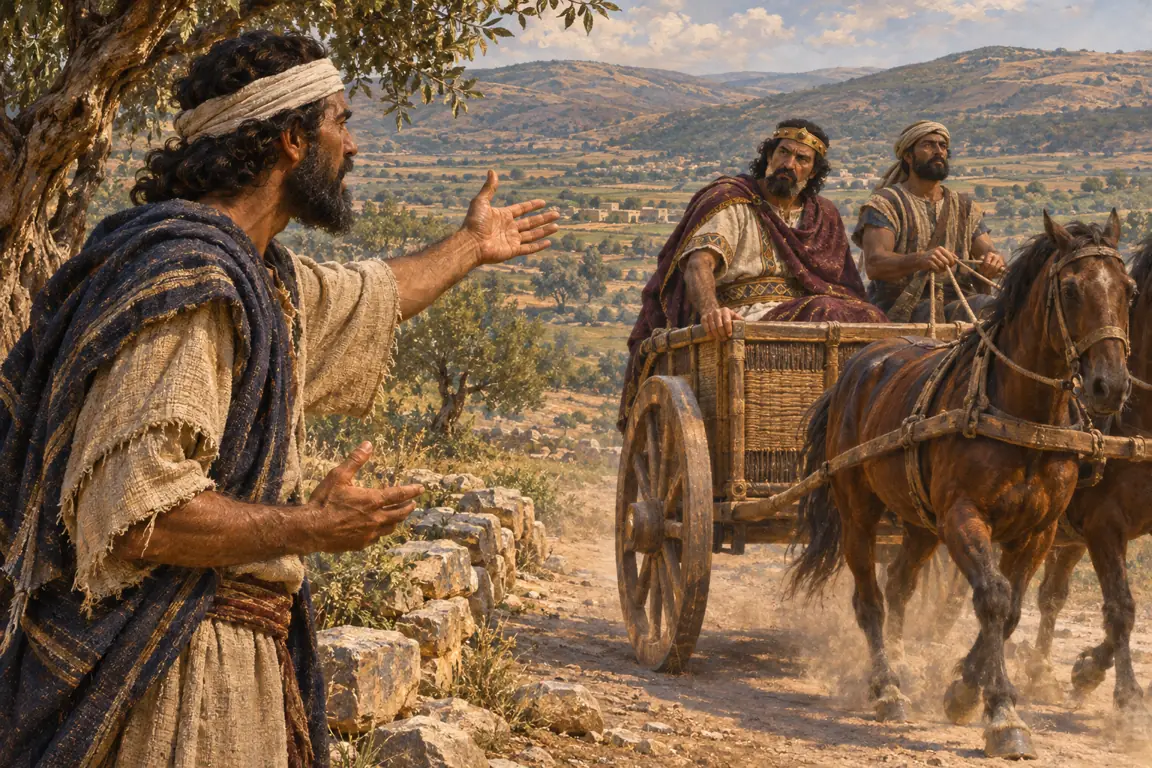
The enemy counts chariots; the prophet announces a gift. The valley cannot fence the living God out. Two kings climb into one chariot and make a bargain. Beside the road, a wounded messenger waits with another word.
Introduction — Receiving Help Does Not Finish the Lesson
A rescued person can become confident before becoming grateful. The immediate danger passes, the pressure lifts, and the successful outcome begins to feel like personal property. The gift remains visible while the giver’s claim fades from attention.
First Kings 20 gives Ahab two remarkable victories. An unnamed prophet promises help against a stronger enemy, and the outcome exposes the limits of Aramean power. A second encounter refutes the claim that Israel’s God belongs only to the hills.
Yet the chapter ends with judgment against Ahab. The king receives deliverance and then makes a treaty releasing Ben-hadad. A wounded prophet presents a roadside drama, leading Ahab to approve a verdict before recognizing the verdict’s application to the royal decision.
What happens when a king receives God’s help but treats the outcome as freedom from God’s authority? First Kings 20 portrays unexpected deliverance becoming a test of obedience, and royal confidence becoming exposed responsibility.
The chapter requires patient reading. The warfare is severe, the prophetic actions are disturbing, and the judgment concerns a particular ancient commission. The pastoral question nevertheless remains close: can gratitude receive the gift and remain willing to hear the giver’s correction?
Historical and Literary Context — Other Prophets Carry the Word
Chapter 19 widened Elijah’s view beyond solitary service. Chapter 20 now features unnamed prophets, a man of God, and a member of a prophetic company. Elijah does not appear. The literary movement reinforces the reality of God’s work extending beyond the best-known messenger.
Aram, often called Syria in English translations, has already entered the story through the alliance sought by Asa (15:16–22). The present account follows Ben-hadad’s pressure against Samaria, two campaigns, a treaty, and a prophetic judgment. Precise reconstruction of the Aramean royal succession remains debated; the narrative’s argument does not require settling every identification.
The repeated purpose of the victories is recognition of the LORD (20:13, 28). The wording recalls the exodus, where deliverance reveals God’s identity and authority (Exod 6:6–7; 14:4). Leithart emphasizes the surprising gift of prophetic good news to Ahab, creating another opportunity to recognize divine kindness (Leithart 2006, commentary on 1 Kgs 20:1–43).
The ending also recalls earlier biblical patterns. Ahab’s release of a king under divine judgment resembles Saul’s treatment of Agag; the dramatic story eliciting a royal verdict recalls Nathan’s confrontation with David (1 Sam 15; 2 Sam 12:1–7). Provan develops the connections with Saul and with the aftermath of Jericho (Provan 2012, commentary on 1 Kgs 20:1–43). Victory does not place a ruler beyond covenant examination.
Walking Through the Text
An Aggressor’s Demands Grow beyond the First Concession — 20:1–12
Ben-hadad approaches Samaria with a coalition of thirty-two kings, horses, and chariots. The demands claim Ahab’s wealth and royal household. Ahab initially accepts the terms.
The next message expands the intrusion: officials will search the palace and the houses of royal servants, taking valued possessions. Ahab consults the elders, and the elders and people counsel refusal. The negotiation has moved from submission toward an invasive seizure.
Threat and taunt follow. Ben-hadad boasts about the coalition’s overwhelming numbers. Ahab replies with a warning against celebrating victory before the fighting has ended. The king of Aram, drinking with the allied rulers, orders the attack.
The scene exposes the instability of security built around an aggressor’s satisfaction. An accepted demand can invite a larger demand. The narrative still gives no reason to make Ahab the spiritual hero: the threatened king will receive help through God’s initiative.
A Small Beginning Receives an Unexpected Victory — 20:13–22
A prophet approaches Ahab with the LORD’s promise to deliver the great enemy force. The stated purpose is knowledge of the LORD. The message comes before any narrated repentance by Ahab.
Young attendants associated with the provincial governors lead the first movement from Samaria, followed by the Israelite force. The account does not require identifying the attendants as elite troops or reconstructing a training history. The contrast between the modest beginning and the larger coalition carries the scene.
Ben-hadad remains drinking and orders the approaching men taken alive, regardless of the purpose of the approach. The Israelite attack instead produces a rout. Ben-hadad escapes, and Ahab’s forces overcome the horses and chariots.
The prophet then tells Ahab to strengthen preparations because Aram will return in the next campaigning season. Received help does not remove the responsibility of attentiveness. The victory brings relief and a further instruction.
A Valley Cannot Limit the LORD — 20:23–30
Aramean advisers explain the defeat through geography: Israel’s gods belong to the hills, so a battle on level ground should favor Aram. The proposal combines military reorganization with a mistaken theological map.
At Aphek, Israel’s smaller force appears like two little flocks of goats before an army filling the countryside. A man of God announces another victory. The reason directly confronts the claim limiting the LORD to the hills. God’s authority does not stop where the terrain changes.
After seven days facing the opposing force, Israel wins. The narrative describes catastrophic Aramean losses, followed by further destruction from a falling wall at Aphek. Ben-hadad takes refuge inside the city.
The immediate setting concerns warfare, but the theological claim reaches further: the Creator cannot be assigned a local jurisdiction by a rival army’s assumptions. Provan places the mistaken geographical reasoning beside the earlier demonstrations of God’s authority within Israel and beyond Israel’s border (Provan 2012, commentary on 1 Kgs 20:22–34).
The Defeated King Becomes a Treaty Partner — 20:31–34
Ben-hadad’s officials approach Ahab in signs of submission and appeal to the reputation of Israel’s kings for mercy. Ahab calls Ben-hadad a brother and brings the defeated ruler into the royal chariot.
The resulting agreement offers returned cities and commercial rights in Damascus. Ben-hadad receives release. Ahab gains an arrangement with apparent political and economic advantages.
Brueggemann notes the language of royal brotherhood, loyalty, and covenant within the diplomatic exchange (Brueggemann 2000, 249–50). The terms concern a relationship between rulers and cannot simply be reduced to private affection.
The final oracle will identify the release as a violation of God’s appointed judgment. The chapter does not narrate an earlier instruction to Ahab detailing the treatment of Ben-hadad. The gap should remain visible rather than be filled with an invented conversation. The narrative’s verdict nevertheless makes clear that the king has treated the outcome differently from God’s purpose.
A Prophetic Drama Begins with a Disturbing Command — 20:35–38
A member of a prophetic company asks a companion to strike the prophet, explicitly under the word of the LORD. The companion refuses. The prophet announces death by a lion, and the event follows. Another man then strikes and wounds the prophet.
The severity is difficult. The narrator identifies the first refusal as disobedience to a divine word within the specific mission. The lion recalls the judgment against the disobedient man of God in chapter 13. Messengers remain accountable to the word carried to kings (Provan 2012, additional note on 1 Kgs 20:36).
The wound prepares a public sign-act: the prophet can appear as a soldier returning from battle. With the face disguised, the messenger waits for Ahab beside the road. Brueggemann describes the confrontation as a form of street theater, a dramatic action exposing royal conduct through an unexpected encounter (Brueggemann 2000, 251).
The narrated divine commission cannot authorize a present religious leader to demand bodily harm. The passage interprets a particular prophetic action, rather than granting unrestricted power to a claimant of spiritual authority.
The King Approves a Verdict before Seeing the Mirror — 20:39–43
The disguised prophet tells a story about a soldier entrusted with guarding a captive. Failure would require the guard’s life or a crushing payment of silver. During other activity, the prisoner disappears.
Ahab confirms the stated responsibility and sentence. Then the prophet removes the disguise, and the king recognizes a member of the prophetic community. The roadside account has become a mirror.
The LORD’s verdict identifies Ben-hadad as a man appointed to destruction. Ahab’s release therefore brings a sentence involving the king’s life and people. The language belongs to the ancient judgment setting, not a general condemnation of mercy or peaceful negotiation.
Ahab returns to Samaria sullen and displeased. The chapter supplies no confession of wrongdoing. The gift of victory has not produced a willing acceptance of correction. The ruler capable of judging another person’s failed responsibility resists the word exposing the royal failure.
Theological Reflection
Kindness Invites Recognition and Repentance
The two victories arrive as gifts directed toward knowledge of the LORD. Ahab’s record makes the kindness surprising. Divine help cannot be interpreted as approval of every existing practice or later decision. A grateful response includes attention to God’s claim upon the rescued life. The chapter searches the temptation to remember relief while forgetting responsibility. Grace opens an opportunity for changed allegiance; success cannot substitute for the change.
God’s Authority Crosses the Boundaries People Draw
The hills-and-valleys claim tries to fit the LORD inside a manageable map. Chapter 17 already placed divine provision in Sidonian territory; chapter 20 confronts another limit imagined by human observers. God’s authority reaches beyond a sacred location, a preferred circumstance, or an institution’s territory. Faithful application involves integrity across the whole of life. Worship cannot remain on a religious hill while money, diplomacy, and decisions in the valley are treated as independent of God.
Prophetic Storytelling Exposes Selective Judgment
Ahab can recognize responsibility when the case appears to concern an ordinary soldier. The recognition becomes uncomfortable when the prophet turns the story toward the throne. The drama reveals a common moral weakness: clear standards for another person can become flexible standards for personal advantage. Scripture’s stories can function as mirrors, inviting a reader to receive correction before judging the next person. The faithful response is honest repentance rather than anger at the messenger.
Severe Judgment Requires Careful Christian Application
The lion, mass casualties, and sentence concerning Ben-hadad cannot be removed from the chapter. The ancient warfare setting also cannot be transferred directly into the church’s treatment of opponents. The narrative challenges royal autonomy and the misuse of deliverance. Christian discipleship receives the commands of Jesus concerning enemy-love and the means of witness. The present cost of obedience belongs in truthfulness, repentance, just stewardship, and resistance to evil without religious cruelty.
Canonical and Christological Horizon — The Risen King’s Wider Authority
The repeated purpose of recognizing the LORD echoes the exodus. The larger biblical story carries the knowledge of God toward the nations, reaching the risen Jesus’ claim of authority in heaven and on earth and the commission to make disciples (Matt 28:18–20). The God of hills and valleys cannot become the possession of one human power.
Romans 2:4 connects God’s kindness with repentance. The principle clarifies Ahab’s opportunity and the Christian response to grace. Jesus’ saving work opens reconciliation rather than permission to preserve an unexamined life (2 Cor 5:18–21).
The cross also governs the church’s manner of resisting evil. Jesus commands love for enemies, while Ephesians 6:10–18 describes the Christian struggle through truth, righteousness, faith, the gospel of peace, and prayer. The ancient battlefield does not supply a commission to destroy human opponents. Under the crucified and risen King, a renewed people bear witness through faithful allegiance and costly love.
Life Application
- Receive relief with a question about response. After an answered prayer or successful outcome, identify one responsibility toward God or neighbor requiring renewed attention. Take a concrete step of gratitude.
- Bring faith into a neglected valley. Choose an area involving money, workplace conduct, or a difficult agreement. Review the actual decision through Scripture rather than treating the issue as outside spiritual responsibility.
- Examine the benefit behind a convenient bargain. Before accepting favorable terms, name the gain, the obligations, and the people affected. Seek an honest review before personal advantage settles the decision.
- Apply the same standard near home. Revisit a criticism directed toward another person. Examine the corresponding pattern in personal conduct or leadership and make a specific correction.
- Use creativity to clarify truth. A Bible teacher can employ a carefully explained story or illustration to help learners recognize responsibility. Protect dignity and avoid manipulation, humiliation, or physical harm.
- Turn displeasure into a truthful response. After an unwelcome correction, pause before defending the existing position. Name the valid concern, apologize where needed, and agree on a practical repair.
Reflection Questions
- Which received mercy has still not led to a changed direction?
- What part of ordinary life is being treated as a valley outside God’s authority?
- Which attractive agreement needs closer examination of motive and cost?
- Where does a strict judgment of another person reveal an unexamined personal failure?
- What concrete response could replace resentment after a truthful correction?
Response Prayer
God of the hills and valleys, break the narrow maps drawn around divine authority. Bring worship into ordinary decisions, hidden agreements, and the uses of money and influence. Teach grateful hearts to receive deliverance as a call toward renewed allegiance.
Lord Jesus, faithful King, expose the convenient bargain and the selective standard. Give leaders humility to hear an unwelcome word, courage to acknowledge wrongdoing, and wisdom to repair the harm. Protect vulnerable people from religious manipulation and the misuse of spiritual authority.
Let Scripture become a truthful mirror. Where success has produced pride, restore gratitude. Where correction has produced anger, open the way to repentance. Through the cross and resurrection, form communities grounded in the gospel of peace. Give strength to resist evil through truth, justice, prayer, and costly love, until the whole of life bears clearer witness to God’s goodness. Amen.
Window into What Comes Next — From a Royal Treaty to a Neighbor’s Vineyard
Chapter 20 ends with Ahab displeased after a prophetic verdict. Chapter 21 will move from international conflict to a vineyard beside the palace. The king receiving a defeated ruler as a brother will face a neighbor’s refusal to surrender an inherited piece of land.
Watch the movement from military strength to everyday justice. The question of royal accountability will become painfully local. Elijah will return, and the LORD’s word will reach a transaction the palace expects to control. What response will emerge when royal desire meets the covenant protection of a neighbor’s inheritance?
Bibliography
- Bible. 1769. The Holy Bible: King James Version. 1 Kings 20. BibleGateway. https://www.biblegateway.com/passage/?search=1%20Kings%2020&version=KJV. Scripture wording in the study is paraphrased unless otherwise indicated.
- Brueggemann, Walter. 2000. 1 & 2 Kings. Smyth & Helwys Bible Commentary. Macon, GA: Smyth & Helwys. See “War, Diplomacy, and Prophetic Zeal,” especially 245–52.
- Leithart, Peter J. 2006. 1 & 2 Kings. Brazos Theological Commentary on the Bible. Grand Rapids: Brazos Press. See commentary on 1 Kings 20:1–43.
- Provan, Iain W. 2012. 1 & 2 Kings. Understanding the Bible Commentary Series. Grand Rapids: Baker Books. See “Ahab’s War against Aram (1 Kgs. 20:1–43),” including additional notes.
Be the first to leave a comment.