

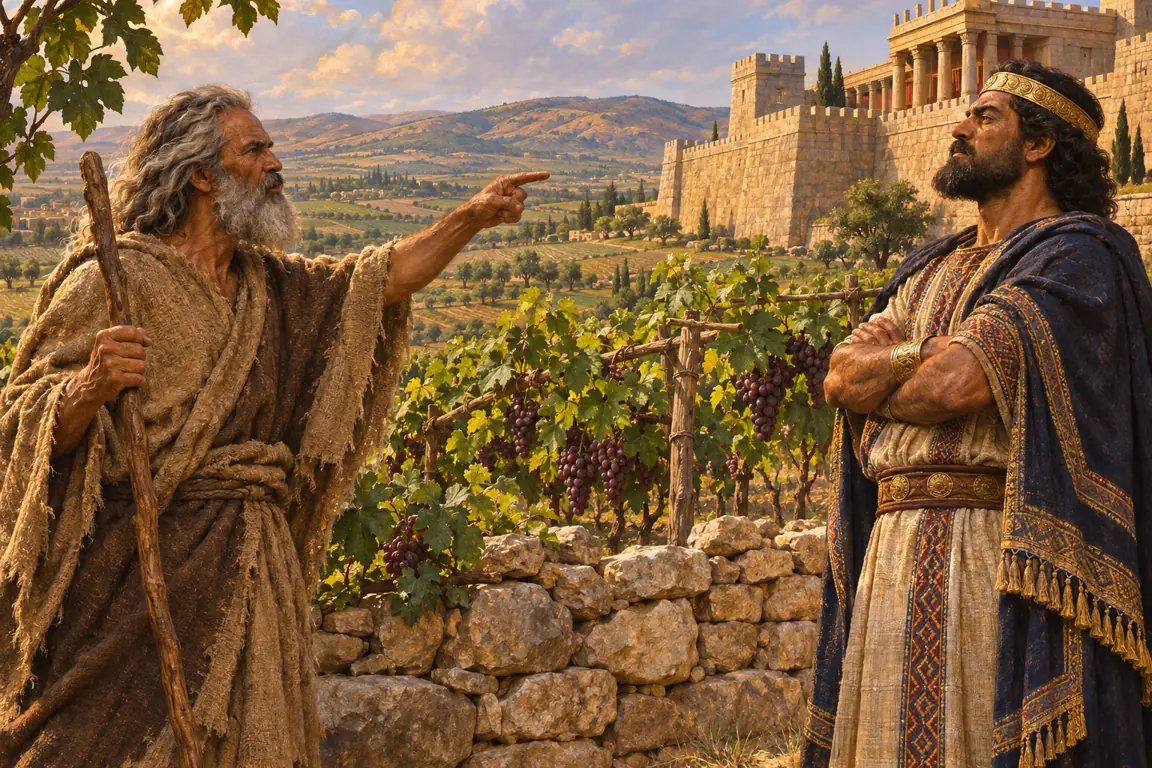
How can God recognize Ahab’s humility while Naboth’s loss remains unrepaired?
Study overview
Coveting, Corrupted Justice, and God’s Surprising Response to Humility
Key passage: 1 Kings 21:19 — God confronts Ahab over the joined crimes of killing Naboth and taking possession of Naboth’s inheritance. (Summary, not a direct quotation.)
A vineyard carries a family’s memory. A royal seal turns a lie into public business. The owner dies, and the king walks toward possession. In the stolen ground, the word of God is already waiting.
Introduction — Desire Becomes Dangerous When Refusal Feels Unacceptable
A field can mean more than the price offered across a table. The soil may hold a family’s labor, belonging, provision, and memory. A powerful buyer may see convenience while a household sees a trust received from earlier generations.
First Kings 21 begins with such a difference. Ahab wants Naboth’s vineyard beside the palace for a vegetable garden. The king offers another vineyard or payment. Naboth refuses because the property is ancestral inheritance held under the LORD’s claim.
The refusal exposes a royal appetite unable to accept a boundary. Ahab withdraws in resentment. Jezebel organizes a false prosecution, local leaders comply, and Naboth dies. The desired property appears available at last. Then God sends Elijah into the vineyard.
What happens when powerful desire recruits religious language and public institutions against a neighbor? First Kings 21 portrays coveting becoming organized violence, while revealing divine judgment against exploitation and divine attention to an offender’s humility.
The ending must remain as searching as the beginning. God recognizes Ahab’s humbling and postpones the disaster against the royal house. Yet Naboth remains dead, and the chapter records no restitution. Mercy must be heard without allowing the victim to disappear from the story.
Historical and Literary Context — Land Held beneath God’s Ownership
Chapter 20 ended with Ahab displeased after a prophetic verdict. Chapter 21 repeats the description of resentment, now following a neighbor’s refusal. The narrative moves from international negotiation to the treatment of a person living beside the palace. Covenant accountability reaches both settings.
Israel’s land tradition supplies the background. Leviticus 25:23 identifies the land as belonging to God and restricts permanent alienation. Family inheritance therefore carries a meaning deeper than an interchangeable asset. The legislation includes transactions and redemption arrangements; the issue cannot be simplified into a ban on every exchange of property.
Naboth’s refusal appeals to the LORD and ancestral inheritance. Provan reads the scene through the gift of the land and the safeguards intended to prevent the concentration of family holdings in powerful hands (Provan 2012, commentary on 1 Kgs 21:1–3). The king must remain under the covenant rather than above a neighbor’s faithful boundary.
The chapter also exposes the relationship between worship and ethics. Coveting leads to false testimony, killing, and seizure, recalling the commandments of Exodus 20. Leithart traces the movement from Ahab’s idolatry into oppression of a fellow Israelite (Leithart 2006, commentary on 1 Kgs 21:1–29). The prophets’ concern for true worship reaches the courtroom and the field. Faithfulness to God cannot be separated from the treatment of a neighbor.
Walking Through the Text
A Fair Price Cannot Cancel a Faithful Boundary — 21:1–3
Naboth owns a vineyard in Jezreel beside Ahab’s palace. Ahab proposes converting the vineyard into a vegetable garden and offers a better vineyard or payment. The opening offer need not be described as an openly fraudulent valuation. The deeper conflict concerns the nature of the inheritance.
Naboth refuses in the name of the LORD. The refusal does not invite a higher bid; the refusal expresses responsibility before God. A king’s preference cannot automatically outrank the obligations attached to a family’s place.
Brueggemann emphasizes the clash between inherited belonging and a royal view of land as a negotiable possession (Brueggemann 2000, 257–59). The scene asks the reader to hear the meaning of the neighbor’s boundary. A purchase can appear attractive to a buyer while still requiring the owner to surrender a trust money cannot replace.
Resentment Waits for a More Ruthless Answer — 21:4–7
Ahab returns home resentful, turns away, lies down, and refuses food. The king has faced a lawful refusal, yet the response makes frustrated desire the center of the household.
Jezebel asks about the distress. Ahab reports the offer and refusal, but the account given to Jezebel omits Naboth’s explicit appeal to the LORD and ancestral inheritance. A covenant boundary becomes, in the king’s retelling, an obstacle to obtaining a vineyard.
Jezebel answers with a challenge to Ahab’s exercise of royal power and a promise to secure the land. The queen’s initiative does not remove the king’s responsibility. The desire began with Ahab, and the desired outcome will be received by Ahab.
The chapter does not narrate Ahab planning the false charges. The prophetic judgment will nevertheless hold the king accountable for the killing and possession. Remaining distant from the machinery of wrongdoing does not make a beneficiary innocent.
A Fast and Two Witnesses Become Instruments of Murder — 21:8–14
Jezebel writes letters in Ahab’s name, uses the royal seal, and sends instructions to the elders and nobles living in Naboth’s city. A public fast is to be proclaimed, Naboth placed before the assembly, and two dishonest witnesses arranged to accuse Naboth of cursing God and the king.
The leaders carry out the plan. The false accusation is delivered publicly, and Naboth is taken outside the city and stoned to death. A report confirms the killing to Jezebel.
The legal and religious forms make the crime especially grievous. The requirement of witnesses was intended to protect truth, accompanied by serious warnings against false testimony (Deut 19:15–21). The fast gives the gathering the appearance of religious concern. Both forms are turned against an innocent neighbor.
The wrongdoing requires cooperation. Royal authority, local leadership, false witnesses, and public participation converge. The narrator refuses to let a corrupted process appear just because the correct officials and solemn language are present. A community’s guardians have become participants in the destruction of a member.
God’s Word Meets the King in the Stolen Vineyard — 21:15–19
Jezebel tells Ahab to take possession because Naboth is dead. Ahab goes toward the vineyard. The royal plan appears complete: the resisting owner has been removed, and the desired ground can be occupied.
The word of the LORD then comes to Elijah. God identifies the place and sends the prophet to confront Ahab. The vineyard remains associated with Naboth in the narrative, despite the king’s movement toward possession.
God’s accusation joins killing and acquisition. The owner’s death cannot be separated from the benefit sought by the palace. The announced judgment brings the king’s own blood and dishonor into the account. The ruler has no exemption from the value of a neighbor’s life.
Brueggemann notes the interruption of the apparently completed royal narrative by God’s counterclaim (Brueggemann 2000, 259–60). The seal has authorized the letters; the seal cannot close the case before God.
The King Calls the Truth an Enemy — 21:20–26
Ahab addresses Elijah as an enemy. The prophet identifies the deeper problem: the king has given allegiance to evil in the LORD’s sight. A truthful confrontation threatens the royal account of a successful acquisition.
The judgment extends to Ahab’s house, comparing the coming destruction with the houses of Jeroboam and Baasha. Jezebel also faces judgment. The language of dogs, birds, and dishonored bodies announces a devastating end to royal security.
The narrator then recalls Ahab’s exceptional wrongdoing, Jezebel’s incitement, and the following of idols. The religious verdict belongs beside the story of judicial murder. The social crime is part of the same disloyalty already visible in worship.
Jezebel’s active role remains clear, and Ahab’s responsibility remains clear. Neither the king’s passivity nor the queen’s influence cancels accountability. The chapter identifies actual decisions and participation rather than permitting a convenient transfer of blame to one person alone.
Humility Receives a Respite without Erasing the Crime — 21:27–29
Ahab hears the words, tears the garments, wears sackcloth, fasts, and moves humbly. The response differs from the resentment recorded earlier. The king now visibly lowers the royal posture before God.
God draws Elijah’s attention to Ahab’s humbling and announces a delay of the disaster upon the house until the next generation. The narrator explicitly identifies God’s recognition. The response should not be dismissed as a theatrical trick simply because the king’s earlier record is appalling.
The respite also has limits. The dynasty’s judgment is delayed rather than canceled, and the chapter does not narrate the return of the vineyard or repair to Naboth’s household. Ahab’s personal death remains part of the unfolding story in chapter 22.
Brueggemann places the unexpected mercy beside Jonah 3 and Jeremiah 18:7–10, where divine judgment responds to an emerging human turn (Brueggemann 2000, 262–63). God takes humility seriously. The reader must also keep the victim’s loss seriously in view.
Theological Reflection
Coveting Can Recruit a Whole System
The desire for a convenient garden becomes the occasion for letters, official compliance, false witnesses, and death. An inward appetite can acquire public machinery when power refuses limits. The commandments against coveting, lying, killing, and stealing illuminate the sequence (Exod 20:13–17). The chapter calls for examination before desire becomes a plan requiring the cooperation of a household or community. A faithful refusal deserves respect even when the refusal obstructs a powerful person’s preference.
Religious Form Cannot Make Falsehood Holy
The fast and accusation invoke God while violating God’s concern for truth and life. Worship becomes dangerous when sacred language protects a desired outcome from scrutiny. A solemn meeting, official letter, or respected title still requires truthful conduct. The issue is not the rejection of institutions; the issue is institutions betraying an entrusted purpose. Faithful leadership protects fair hearing, refuses manufactured testimony, and permits facts to challenge convenience.
God’s Judgment Remembers the Neighbor
Naboth cannot speak after death, yet the LORD’s word brings Naboth’s name and loss before the king. Royal advantage does not determine the value of a life. The prophetic tradition makes the same concern visible in warnings against adding field to field and seizing another household’s inheritance (Isa 5:8; Mic 2:1–2). The theological weight of the account rests partly in the refusal to let a small neighbor become invisible beside a large palace.
Mercy Requires a Larger Vision than the Offender’s Relief
God’s response to Ahab prevents a closed verdict declaring an offender beyond every possibility of humility. The chapter also leaves a painful absence: no restoration of Naboth appears. Christian application must hold mercy and the harmed neighbor together. Forgiveness cannot mean calling the crime harmless or demanding silence from affected people. A changed direction should seek truthful acknowledgment, appropriate repair, and an end to the practices enabling the harm. The gospel widens concern beyond the offender’s desire for relief.
Canonical and Christological Horizon — The Innocent Condemned and the King Restoring Life
Naboth’s case belongs within a biblical pattern of innocent people condemned through manipulated testimony. The trial of Jesus brings the pattern to a climax through false witnesses and a death driven by threatened power (Mark 14:55–65). The comparison does not reduce Naboth to a symbol; the gospel discloses God’s solidarity with victims of distorted judgment through the faithful Son.
Jesus’ ministry also joins mercy with a changed treatment of neighbors. Zacchaeus responds to the encounter with Jesus through generous provision and restitution (Luke 19:1–10). The passage gives Christian readers a concrete horizon for repentance after wrongful gain, beyond outward sorrow alone.
The cross exposes the destructive work of sin, while the resurrection announces God’s victory over the power of death. Christian hope therefore seeks justice in the present and looks toward God’s final judgment and renewal of life (Acts 17:31; Rev 21:4–5). The last word belongs beyond a king’s stolen possession: the faithful King will not preserve a world built on falsehood, death, and dispossession.
Life Application
- Respect a faithful refusal. When a person declines a request concerning property, money, time, or responsibility, listen to the stated reasons. Stop pressure designed to wear down a legitimate boundary.
- Examine benefit as well as direct participation. Review an advantage received through another person’s questionable conduct. Ask about the actual process and refuse to protect gain resting on harm.
- Protect truthful decision-making. In a family, workplace, or church committee, check an accusation before repeating or acting upon the accusation. Give an affected person a fair opportunity to be heard.
- Keep religious language open to examination. When a proposal is presented as God’s will, ask for the biblical grounds and the relevant facts. Refuse to treat a title or public prayer as a substitute for integrity.
- Give the harmed neighbor practical attention. Listen without minimizing the loss. Offer companionship, material help, or support for a fair process while preserving the person’s dignity.
- Let humility move toward repair. Name a wrong honestly, stop the harmful practice, and identify an appropriate act of restitution. Read Luke 19:1–10 with a trusted companion and make the response concrete.
Reflection Questions
- Which frustrated desire has begun making another person’s boundary feel unacceptable?
- What benefit requires an honest examination of the process behind the gain?
- Where could a respected institution or religious phrase be hiding an untruth?
- Which harmed neighbor has received less attention than the reputation of a powerful person?
- What specific repair could give practical expression to humility before God?
Response Prayer
God of truth and justice, remember the neighbor standing beside the palace. Expose the desire growing impatient with a faithful boundary. Break the cooperation between ambition, false testimony, and public power. Give leaders courage to protect a fair hearing and humility to accept an unwelcome refusal.
Lord Jesus, innocent Savior, draw close to people harmed by distorted judgment. Restore dignity, strengthen truthful witnesses, and provide patient companions for households carrying loss. Guard churches from using sacred language to defend a desired outcome.
Where wrongdoing has brought advantage, open the way to confession and repair. Where humility begins, let mercy bear the fruit of changed conduct. Through the cross and resurrection, sustain hope for justice beyond the limits of present institutions. Form communities faithful in worship and honest with neighbors, until the coming kingdom makes room for life without theft, fear, or mourning. Amen.
Window into What Comes Next — A Crown Seeks a Favorable Word
Chapter 21 closes with Ahab humbled and the disaster against the royal house delayed. Chapter 22 will bring another decision involving Aram, the disputed city of Ramoth-gilead, and prophetic counsel before war.
Watch the difference between receiving a moment of mercy and continuing to hear God’s word. A crowded platform of agreement will stand beside a lone challenging witness. The northern king will face the temptation to prefer a favorable message over a faithful message. What response will emerge when the next unwelcome truth reaches a throne already granted a respite?
Bibliography
- Bible. 1769. The Holy Bible: King James Version. 1 Kings 21. BibleGateway. https://www.biblegateway.com/passage/?search=1%20Kings%2021&version=KJV. Scripture wording in the study is paraphrased unless otherwise indicated.
- Brueggemann, Walter. 2000. 1 & 2 Kings. Smyth & Helwys Bible Commentary. Macon, GA: Smyth & Helwys. See “A Clash over Land,” especially 257–63.
- Leithart, Peter J. 2006. 1 & 2 Kings. Brazos Theological Commentary on the Bible. Grand Rapids: Brazos Press. See commentary on 1 Kings 21:1–29.
- Provan, Iain W. 2012. 1 & 2 Kings. Understanding the Bible Commentary Series. Grand Rapids: Baker Books. See “Naboth’s Vineyard (1 Kgs. 21:1–29),” including additional notes.


Be the first to leave a comment.