

Why does Micaiah expose the heavenly deception before Ahab enters battle?
Study overview
Micaiah’s witness, Ahab’s last battle, and the cost of refusing another opportunity to listen
Key passage: 1 Kings 22:14 — Micaiah commits to speaking only the message received from the LORD. Summary of the verse, not a direct quotation.
Mercy has opened a little space for breathing. The palace fills the space with promises of victory. A prisoner carries the unwelcome word. An arrow reaches beyond the king’s disguise.
Introduction — After the Sackcloth, Another Decision
An apology can soften a voice before changing a habit. Ahab’s story now reaches a searching moment: after humility, another decision; after mercy, another opportunity to listen.
First Kings 21 ended with a real divine acknowledgment of Ahab’s humiliation. The announced disaster against Ahab’s dynasty would fall during the reign of Ahab’s son rather than during Ahab’s lifetime. God saw the humility and granted a reprieve (1 Kings 21:27–29).
Yet a reprieve does not complete the work of repentance. Ramoth-gilead now stands before Ahab as a military objective. Friendly voices promise success. Micaiah brings a different word. The central question follows naturally from Naboth’s vineyard: Can a king receive the relief of mercy and still reject the correction needed for a faithful future?
First Kings 22 portrays an opportunity to keep listening becoming another refusal of truth, until royal control collapses before God’s word. The chapter closes Ahab’s reign and the first book of Kings, but the spiritual problem survives both endings. Ahab’s successor inherits a throne, a religious pattern, and an unfinished confrontation with the living God.
Historical and Literary Context — A War Council beneath a Higher Throne
Solomon’s rise and fracture in chapters 1–11 led into the divided kingdom’s disorder in chapters 12–16. From chapter 17 onward, prophetic confrontation gains prominence. The struggle over Baal, the Aramean wars, and Naboth’s murder expose a monarchy resisting covenant accountability.
Chapter 22 resumes the conflict with Aram after three years without war. Ahab wants Ramoth-gilead recovered. Jehoshaphat, king of Judah, visits the northern kingdom and agrees to cooperate. Only afterward does Jehoshaphat request an inquiry into the LORD’s word. The sequence matters: consultation can become a search for religious approval after a political decision has already gathered momentum (Brueggemann 2000, 267–70).
Earlier warnings remain active. The prophet in chapter 20 announced Ahab’s death following the release of Ben-hadad. Elijah announced judgment after Naboth’s murder. Chapter 21’s postponement concerns the disaster against Ahab’s house; chapter 22 does not present the postponement as cancellation of every earlier judgment against Ahab personally (1 Kings 20:42; 21:19, 29; Provan 2012, “Ahab Dispatched”).
The chapter places two royal settings beside a heavenly court. Ahab and Jehoshaphat sit enthroned at Samaria’s gate. Micaiah reports the LORD enthroned amid the heavenly host. The heavenly host means the heavenly assembly attending God’s throne. The vision uses royal-court imagery to locate earthly kings beneath divine authority (1 Kings 22:10, 19).
Kings measures public achievement by covenant faithfulness. Deuteronomy’s king must live under divine instruction; Deuteronomy’s tests of prophecy require both fidelity to God and truthful fulfillment (Deuteronomy 17:18–20; 13:1–5; 18:20–22).
Walking Through the Text
The Agreement Arrives before the Inquiry — 22:1–14
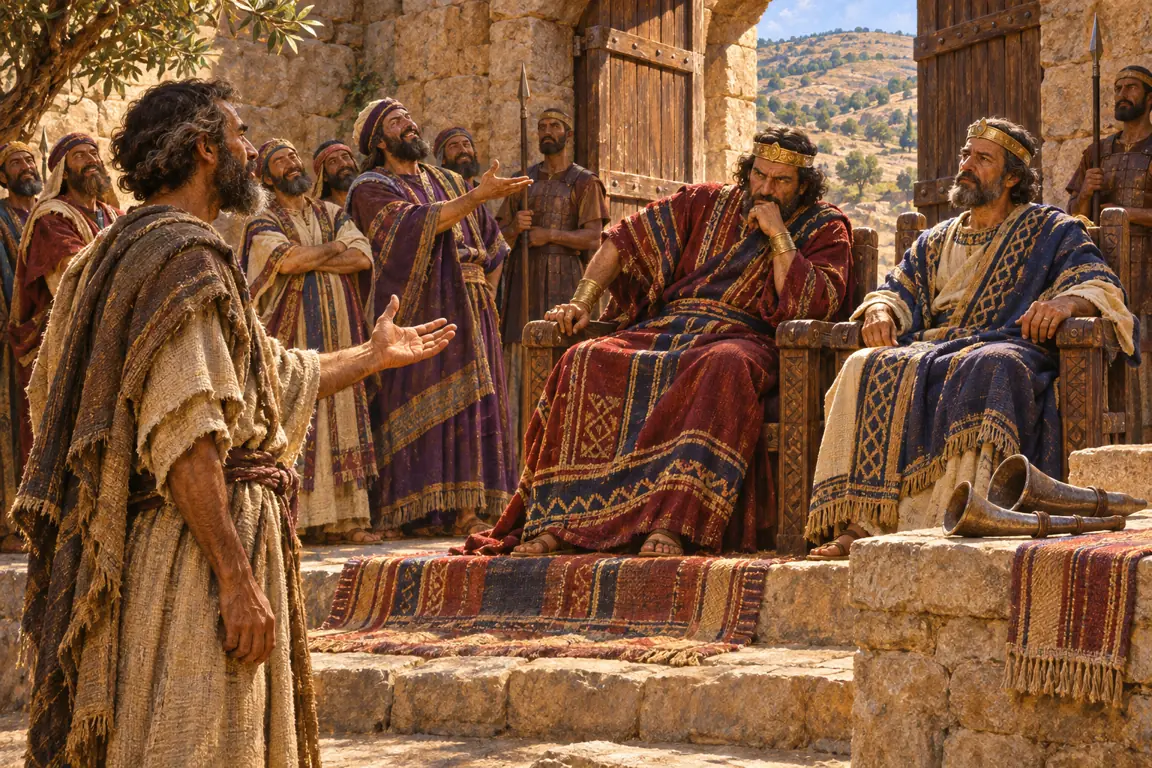
Jehoshaphat pledges solidarity with Ahab, including troops and horses, then asks for the LORD’s counsel. About four hundred prophets announce victory. Zedekiah son of Chenaanah adds a vivid demonstration: iron horns portray Aram being driven back. Religious language, impressive numbers, and prophetic performance reinforce the same military expectation.
Jehoshaphat nevertheless asks for another prophet of the LORD. Ahab names Micaiah son of Imlah but objects to Micaiah’s unfavorable messages. Ahab’s complaint reveals a dangerous standard: the messenger’s acceptability depends on the message’s pleasantness.
The royal messenger urges Micaiah to agree with the chorus. Micaiah instead binds the coming testimony to the LORD’s actual message. The pressure reaches beyond disagreement about military strategy. A whole public atmosphere is demanding conformity, and a prophet must decide whether access to the palace deserves greater loyalty than God’s word (22:13–14).
The Heavenly Court Interrupts the Royal Performance — 22:15–23
Micaiah initially repeats the favorable prediction. Ahab immediately demands truthful speech in the LORD’s name. The exchange is commonly understood as irony: Micaiah echoes the desired answer, and Ahab recognizes the ironic echo. The narrator leaves the tone unstated; Ahab’s abrupt demand for truth supports the interpretation (Provan 2012, “Ahab Dispatched”).
The next vision shows Israel scattered like sheep without a shepherd. The image announces royal loss while allowing the soldiers to return home in peace. Ahab hears personal hostility. Micaiah then opens a larger horizon: the LORD sits enthroned, the heavenly assembly attends, and a spirit offers to entice Ahab through false speech in the prophets’ mouths.
The passage is morally difficult. The LORD authorizes the spirit’s proposed deception and declares the mission successful. Describing the scene as mere detached permission weakens the text. Equally, naming the spirit Satan or Naboth’s ghost supplies an identity absent from the narrative. The vision portrays judicial deception under God’s authority, bringing Ahab toward the announced fall (22:19–23; Brueggemann 2000, 270–75).
Yet the judicial process is disclosed to Ahab before the battle. Through Micaiah, Ahab hears the warning and learns the character of the flattering chorus. The king cannot claim an absence of truthful testimony. The unsettling scene leaves a sober tension: God judges through deception, while God’s prophet openly exposes the deception to the king.
A Slap, a Prison, and an Unchanged Message — 22:24–28
Zedekiah strikes Micaiah and challenges Micaiah’s claim to the LORD’s Spirit. The public dispute becomes physical intimidation. Ahab then orders imprisonment and meager rations until the king’s safe return. Royal confidence turns a future homecoming into a threat against the prophet.
Micaiah stakes the prophetic claim on the outcome. Ahab’s safe return would invalidate the announced message. The appeal concerns accountable truth, rather than the glamour of solitary resistance. A minority voice deserves examination by God’s word; isolation alone does not establish inspiration (Deuteronomy 18:20–22; Leithart 2006, “1 Kings 22:1–40”).
A king can restrict a prophet’s food and movement without gaining control over the announced word. Micaiah’s eventual fate remains unreported.
The Disguise Cannot Govern the Arrow — 22:29–40
Ahab enters battle in disguise while Jehoshaphat wears royal robes. Aram’s chariot commanders have orders to concentrate on Israel’s king. Jehoshaphat’s visible royalty therefore attracts a lethal pursuit. Ahab’s strategy exposes the allied king to danger, although the narrator does not explicitly name a deliberate plan to sacrifice Jehoshaphat.
Jehoshaphat cries out, and the commanders turn away after recognizing the mistaken target. Kings does not explicitly identify the cry as prayer or describe divine intervention at the moment; the parallel account supplies an explicit statement of God’s help (2 Chronicles 18:31).
An archer then shoots without knowing the target’s identity. The arrow enters between sections of Ahab’s armor. Ahab remains supported in the chariot during the battle and dies toward evening. Israel’s dispersal brings the shepherdless-flock vision into painful focus. A hidden royal identity cannot overturn the disclosed divine word.
Ahab receives burial in Samaria. Dogs lick the king’s blood as the chariot is washed at Samaria’s pool, and the narrator identifies fulfillment of the LORD’s word. The fulfillment echoes 21:19, with a geographical difference: Elijah named Naboth’s death-place in Jezreel; the washing occurs in Samaria. Royal buildings and the ivory house enter the record, but the chapter’s decisive testimony concerns the word Ahab refused to heed (22:37–40).
A Faithful Direction with Unfinished Reform — 22:41–50
Jehoshaphat receives a substantially different evaluation: the king follows Asa’s good direction and does right in the LORD’s sight. Jehoshaphat also removes remaining male cult personnel. Nevertheless, sacrifice at the high places continues. A favorable assessment can coexist with unfinished communal reform.
The king’s trading fleet, built for a voyage toward Ophir’s gold, breaks apart at Ezion-geber before sailing. The failed enterprise recalls earlier royal wealth and maritime ambition. Kings leaves the wreck unexplained; the parallel account supplies a prophetic judgment concerning the alliance with Ahaziah (2 Chronicles 20:35–37).
Jehoshaphat subsequently refuses Ahaziah’s proposal for shared crews. The record holds faithfulness, dangerous alliance, unfinished reform, disappointment, and a later refusal together (Provan 2012, “Jehoshaphat and Ahaziah”).
A New Name above an Old Allegiance — 22:51–53
Ahaziah succeeds Ahab and reigns for two years. The narrator traces continuity with Ahab, Jezebel, and Jeroboam. Baal worship continues. Succession supplies a new ruler without supplying a new direction.
The book therefore closes with an unresolved spiritual inheritance. Ahab’s death confirms the prophetic warning, but a royal funeral does not automatically reform royal worship. The next stage will ask whether Ahaziah can recognize the God repeatedly ignored by the northern throne.
Theological Reflection
Mercy Opens Time for Continued Obedience
Chapter 21’s mercy remains meaningful. God acknowledged Ahab’s humility, and chapter 22 does not revoke the acknowledgment. The fresh crisis instead exposes the difference between receiving a reprieve and sustaining a responsive life. Repentance has a future tense: another meeting, another decision, another unwelcome truth.
Ahab’s story calls for grateful perseverance after an authentic beginning. Mercy grants space for obedience rather than guaranteed safety during renewed resistance.
Judicial Deception Does Not Authorize Human Dishonesty
The heavenly-court scene confronts the reader with divine agency in judgment. God’s commission to the spirit retains a disturbing force beyond easy explanation.
Within the narrative, however, deception serves the judgment of a resistant king, and Micaiah exposes the deceptive mechanism openly. The passage supplies no permission for pastors, governments, or families to manipulate audiences for supposedly sacred purposes. Covenant instruction still forbids false witness (Exodus 20:16). Covenant faithfulness demands truthfulness that protects one's neighbor while honoring God, even when God's sovereignty in judgment appears to transcend the limits of human understanding.
Listening Requires More than a Religious Consultation
Jehoshaphat requests the LORD’s word, but both kings still enter the battle. A religious inquiry can occur without governing the resulting conduct. The practical test arrives after the prayer meeting: can counsel alter the plan, delay an ambition, or cancel an attractive opportunity?
Numbers, symbols, confidence, and religious vocabulary cannot settle the question of truth. Conversely, disagreement and suffering cannot automatically certify a messenger. Prophetic discernment requires allegiance to the LORD and responsible attention to the actual message.
Royal Decisions Place Other Lives at Risk
Ahab’s disguise does not affect Ahab alone. Jehoshaphat faces chariot pursuit, soldiers enter battle, and Israel eventually scatters. Leadership’s search for security can move danger onto neighboring shoulders.
Kings makes such consequences part of theological evaluation. Worship and public responsibility belong together. A leader’s faithfulness includes the safety, dignity, and truthful treatment of the community entrusted to leadership.
Canonical and Christological Horizon — The Shepherd Gives a Life for the Flock
Micaiah’s scattered sheep belong within a wider biblical concern for faithful shepherding. Moses asks for a leader to prevent Israel becoming a shepherdless congregation (Numbers 27:15–17). Ezekiel condemns shepherds feeding on the flock and announces God’s own shepherding care (Ezekiel 34:1–16).
Jesus encounters a crowd resembling sheep without a shepherd and responds with compassion and teaching (Mark 6:34). John’s Gospel develops the shepherd theme further: Jesus willingly lays down a life for the sheep (John 10:11–18). The canonical contrast is searching. Ahab seeks protection through concealment during a campaign endangering the flock; Jesus accepts costly exposure for the flock’s rescue.
Micaiah’s imprisonment also anticipates a recurring biblical conflict between constrained messengers and God’s unconstrained word. Paul later testifies from confinement to the freedom of God’s word (2 Timothy 2:9). The recurring pattern locates hope beyond a ruler’s ability to silence a witness.
The Christian horizon finally rests in the reign of Jesus, named Faithful and True (Revelation 19:11). The answer to a throne demanding pleasant falsehood is a truthful King, a self-giving Shepherd, and a kingdom without deception.
Life Application
- Review the next decision after an apology. Identify one relationship or responsibility affected by an earlier confession. Arrange a concrete act of repair during the coming week: repayment, an honest report, or a difficult follow-up conversation.
- Seek counsel before commitments harden. Before announcing a ministry project, financial obligation, or family plan, invite biblical scrutiny. Leave enough time to change the decision without making public embarrassment the controlling concern.
- Protect space for unwelcome testimony. In a church or workplace meeting, allow a concerned participant to complete the concern without ridicule. Record the substantive objection and assign a fair review before proceeding.
- Test agreement and disagreement by Scripture. Examine a popular spiritual claim in context, including covenant faithfulness and the accuracy of the claim. Resist both crowd approval and automatic admiration for a lone dissenter.
- Name the people carrying a plan’s risks. Before a leadership decision, list the likely effects on staff, volunteers, spouses, children, and vulnerable neighbors. Accept an appropriate share of inconvenience instead of shifting the cost downward.
- Continue unfinished reform. Choose one tolerated practice contradicting an acknowledged conviction. Agree on a realistic change with affected participants, set a date, and request accountable follow-up rather than another encouraging speech.
Reflection Questions
- After an experience of mercy, what repeated decision now tests the depth of repentance?
- What desired outcome might be controlling the choice of advisers or the interpretation of biblical counsel?
- What evidence would justify changing a cherished plan, even after a public announcement?
- What practical protection exists for a truthful voice bringing discomfort to church, workplace, or family leadership?
- What costs are falling on vulnerable people while a leader preserves comfort, reputation, or security?
Response Prayer
Faithful God, the palace can grow loud while the conscience grows quiet. Give the church a love for truth stronger than the appetite for reassurance. After confession, cultivate patient obedience. After mercy, nurture a willing response to the next correction.
Guard pastors, parents, employers, and public leaders from turning prayer into decoration around a settled ambition. Grant courage to receive unwelcome counsel, cancel harmful plans, repair damaged trust, and protect a threatened witness. Let authority become shelter for vulnerable neighbors.
Lord Jesus, Good Shepherd, gather frightened hearts around the truth of the gospel. Form communities capable of honest speech without cruelty and humble listening without fear. During costly decisions, sustain faithfulness beyond applause. Let the memory of Ahab’s hidden face and exposed armor deepen reverence for God’s word. Through the grace of Christ, grow a truthful life, a teachable church, and a hope grounded in the coming kingdom. Amen.
Window into What Comes Next — A Fallen King and a Question from a Sickbed
First Kings closes with Ahaziah following Ahab’s religious direction. Second Kings 1 will move from the battlefield to a royal sickbed. After an injury, Ahaziah will send messengers to consult Baal-zebub of Ekron. Elijah will interrupt the journey with a question about the king’s refusal to seek Israel’s God.
The book boundary does not end the larger narrative. Ahab’s dynasty still faces God’s word, and political succession still fails to create covenant faithfulness. Watch the movement from a father seeking a pleasing prediction to a son seeking guidance beyond the LORD. The new crisis concerns illness rather than a disputed city, but the old struggle over trust remains. What response becomes possible when human strength fails and God’s word interrupts the search for another source of security?
Bibliography
- Biblical references supply the primary evidence. The key passage above is a labeled summary; the study’s retellings are paraphrases. Commentary citations use SBL author–date style. Section titles identify unpaginated digital editions.
- The Holy Bible. King James Version. 1 Kings 20–22; 2 Kings 1; and the biblical passages cited throughout the study.
- Brueggemann, Walter. 2000. 1 & 2 Kings. Smyth & Helwys Bible Commentary. Macon, GA: Smyth & Helwys. Especially 267–80.
- Leithart, Peter J. 2006. 1 & 2 Kings. Brazos Theological Commentary on the Bible. Grand Rapids: Brazos Press. Especially “1 Kings 22:1–40.”
- Provan, Iain W. 2012. 1 & 2 Kings. Understanding the Bible Commentary Series. Grand Rapids: Baker Books. Especially “Ahab Dispatched (1 Kgs. 22:1–40)” and “Jehoshaphat and Ahaziah (1 Kgs. 22:41–2 Kgs. 1:18).”
Be the first to leave a comment.