

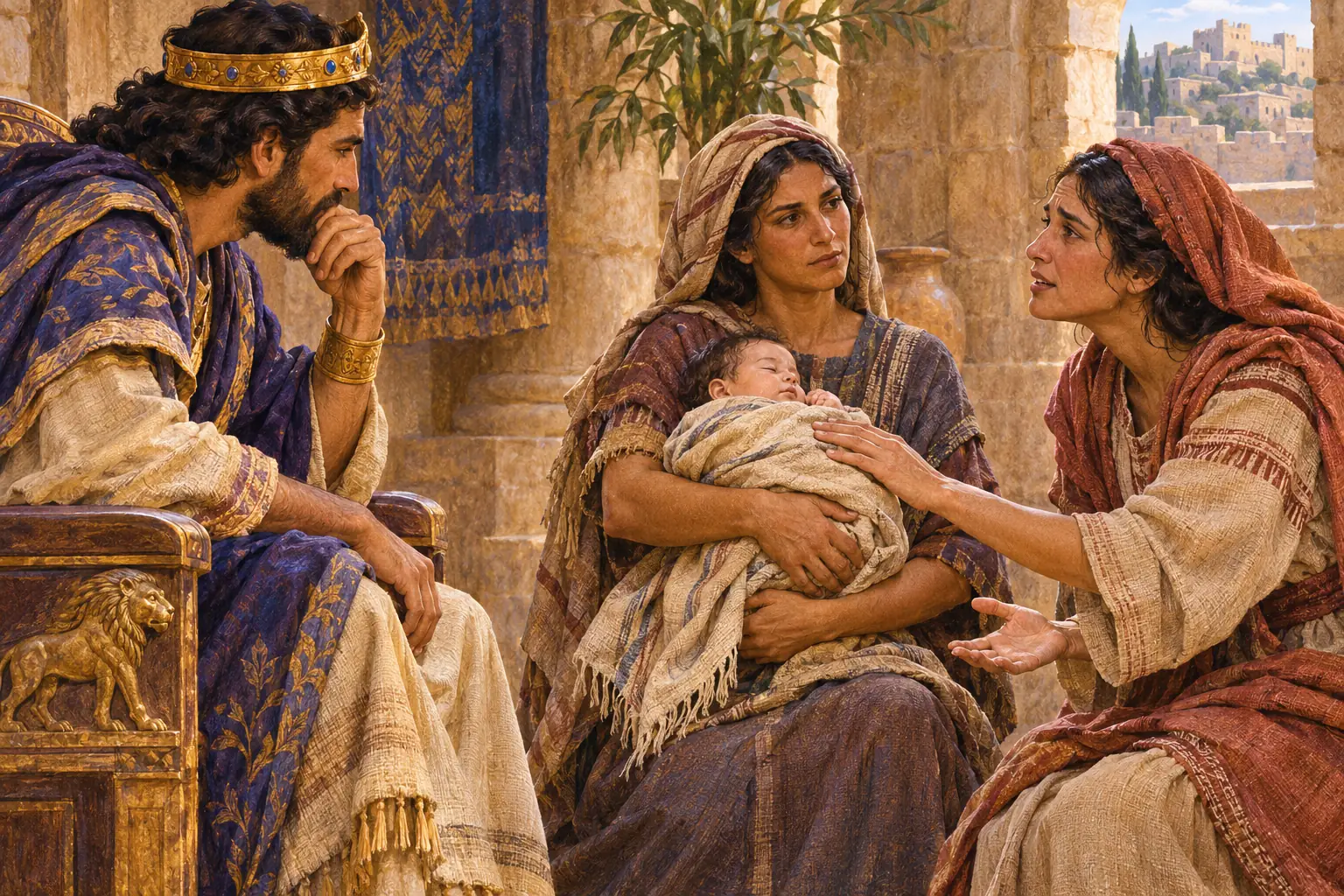
How does the compassionate mother’s response disclose truth beyond the competing claims heard earlier in the royal court?
Study overview
God’s Gift of Wisdom Becomes Justice for Vulnerable Lives
By Pr Enos Mwakalindile Reading: 1 Kings 3:1–28 Key verse: 1 Kings 3:9 — Solomon asks for a listening heart, able to govern God’s people and distinguish good from evil. (Summary, not a direct quotation.)
At Gibeon, a king admits the limits of royal strength. In Jerusalem, two mothers bring a household’s sorrow. Between a promised gift and a threatened child, wisdom must learn the sound of love.
Introduction — A Crown Cannot Supply a Listening Heart
A new position can provide a chair, a title, and a room full of expectant faces. A position cannot automatically provide understanding. A parent can speak firmly and still misunderstand a child. A pastor can answer quickly and still miss a wounded heart. A leader can win a dispute while failing the people entrusted to the leader’s care.
Solomon has secured the throne. Chapter 2 ended with an established kingdom; chapter 3 asks about the capacity to govern. Before God, the king acknowledges inadequacy. The celebrated request concerns a heart capable of listening and discerning, rather than another instrument for defeating rivals.
The answer becomes visible in an unexpected place. Two women identified as prostitutes bring a dispute about a living infant. The palace must attend to a household far removed from royal prestige. A divine gift reaches the ground through the protection of a child.
How can authority become a blessing for vulnerable lives? First Kings 3 reveals God-given wisdom becoming public justice through humble dependence, attentive hearing, and discernment of life-preserving love. Yet the chapter’s opening qualifications remain important: a wise decision and a gifted heart still require continuing faithfulness.
Historical and Literary Context — Wisdom within an Unfinished Story
The chapter belongs to Solomon’s rise in 1 Kings 1–11. David’s final instructions called for obedience to the law of Moses. Solomon’s subsequent consolidation involved executions and the removal of Abiathar. The new prayer therefore follows an already complicated exercise of royal power.
Verses 1–3 introduce an Egyptian marriage alliance, building projects, and worship at high places. Solomon’s love for the LORD receives explicit affirmation alongside a qualification concerning worship. Provan cautions against dividing Solomon’s life into a completely innocent beginning and an entirely corrupt ending; tensions appear early (Provan 2012, commentary on 1 Kgs 3:1–3).
The high places were local worship sites. Verse 2 connects continuing sacrifice at such sites with the absence of a completed temple. The parallel account places the tabernacle at Gibeon (2 Chr 1:3–6). Interpreters differ over the degree of criticism in Kings’ opening description. The passage clearly presents the LORD meeting Solomon at Gibeon; the later account will expose the danger of divided worship (1 Kgs 11:1–8). Neither the affirmation nor the warning should disappear.
The chapter moves from the king’s choices, through the dream and prayer, into a concrete judgment. Verse 28 supplies the interpretive conclusion: God’s wisdom equips Solomon to administer justice. The book’s wider story will test whether such wisdom continues to shape royal life (BibleProject n.d., 2–3).
Walking Through the Text
Genuine Love amid Unsettled Loyalties — 3:1–3
Solomon forms an alliance with Pharaoh through marriage to Pharaoh’s daughter. The narrative leaves Pharaoh unnamed. The important connection is Egypt: in Israel’s remembered story, Egypt represents both impressive royal power and the bondage ended by God’s deliverance.
The marriage displays international prestige, but the later story makes the question of allegiance unavoidable. First Kings 11 links Solomon’s marriages with a heart turned toward other gods. The problem develops around covenant loyalty and the practices shaping the king’s heart.
Verse 3 genuinely affirms Solomon’s love for the LORD, then adds the qualification concerning sacrifice and incense at high places. The portrait holds devotion and vulnerability together. Brueggemann reads the Egyptian connection as a significant pressure toward royal grandeur and political security (Brueggemann 2000, 43–46). The question is already present: can love for God govern the king’s pursuit of success?
A Great Offering Leads to a Humble Request — 3:4–9
Solomon goes to Gibeon and offers a thousand burnt offerings. The LORD appears in a dream and invites a request. The text locates the initiative in God’s generosity; the offerings do not establish a transaction capable of purchasing wisdom.
Solomon begins with God’s steadfast kindness to David and the gift of a successor. Gratitude then opens into confession of need. The description of being a little child expresses inadequacy for the task; the phrase does not establish a precise age. The vastness of the people makes royal confidence seem small.
Most significantly, Solomon repeatedly identifies Israel as God’s people. The kingdom belongs within God’s purpose. Authority becomes a trust rather than a personal possession.
The request in verse 9 concerns a listening heart. In biblical usage, the heart includes understanding, intention, and moral judgment. Listening therefore involves receptiveness to God and careful attention to human cases. Brueggemann emphasizes the request’s connection with obedience and the work of justice (Brueggemann 2000, 47–48). Solomon asks for the capacity to serve a people beyond Solomon’s unaided understanding.
God Gives Wisdom and Keeps Obedience in View — 3:10–15
The request pleases the Lord. God explicitly names the alternatives Solomon has declined: long life, riches, and the death of enemies. After chapter 2, the final alternative carries particular weight. The new petition directs attention toward justice for the people rather than the elimination of threats.
God grants a wise and discerning heart, with extraordinary riches and honor in addition. The promise of lengthened life receives an explicit condition: walking in God’s ways. A good beginning must become a faithful journey. Spiritual gifting does not remove the need for obedience.
The additional royal gifts should not become a general formula promising wealth after a sufficiently spiritual prayer. The passage concerns a particular king and vocation. The priority commended is the good of God’s people.
Solomon awakens and returns to Jerusalem. Before the ark of the covenant, the king offers sacrifices and provides a feast for royal servants. Prayer moves toward worship and shared celebration. The divine encounter begins to take visible form within communal life.
Two Unnamed Women Enter the Royal Hearing — 3:16–22
The next scene brings two women before the king. The narrator identifies the women as prostitutes but supplies no names. Social standing does not prevent access to a hearing. God’s gift to the king must prove useful beyond the circles of the powerful.
The first speaker describes two births, a death during the night, and an exchange of infants. The second speaker denies the claim. The alleged cause of death and the exchange initially belong to the first speaker’s testimony; the reader should distinguish testimony from a separate narrator’s report. No independent witness appears in the account (Provan 2012, commentary on 1 Kgs 3:16–22).
The dispute cannot be solved by counting speeches or rewarding confidence. A dead child and a living child stand behind the competing claims. Royal wisdom must hear the grief without allowing the living infant to disappear beneath the argument.
A Threatened Life Reveals a Mother’s Compassion — 3:23–27
Solomon first restates the opposing claims. The king has listened carefully enough to name the impasse. Then comes the shocking order for a sword and the proposed division of the living child.
The true mother pleads for the child’s survival, even at the cost of surrendering the child to the opposing claimant. The second response accepts the child’s death. Compassion breaks through the struggle for possession. The king orders the living child preserved and given to the pleading mother.
Verse 26 explicitly identifies the compassionate woman as the living child’s mother. The narrative does not explicitly map the final identification back to the order of the women’s earlier speeches. Provan helpfully cautions against presenting the initial complainant’s identity as a textual certainty (Provan 2012, commentary on 1 Kgs 3:23–28).
The narrative commends the discernment producing a truthful judgment and a surviving child. The threatened violence remains disturbing, especially after chapter 2. Brueggemann draws attention to the fear created by the method (Brueggemann 2000, 54–55). The scene supplies no general permission for leaders to manufacture terror or treat a single response as a universal test of parenthood. The chapter’s achievement is justice and preserved life; the sword never falls.
A Private Prayer Becomes Public Trust — 3:28
Israel hears about the judgment and responds with awe toward the king. The people recognize God’s wisdom at work for justice. The conclusion deliberately connects the courtroom with the dream.
The measure of the gift is practical: a difficult case receives judgment, a false claim fails, and a child remains alive. A prayer offered at night becomes a public responsibility fulfilled by day. Wisdom has reached beyond the king’s reputation to the life of a household.
Theological Reflection — Wisdom for the Good of a Neighbor
Grace invites an honest confession of limits
God’s invitation precedes Solomon’s request. The king can acknowledge need because divine generosity has opened the conversation. Humility is therefore more than modest language. Humility places real decisions beneath God’s instruction and admits the need to learn. A leader capable of asking for wisdom has begun to loosen the grip of pride.
Listening belongs at the heart of justice
The requested heart concerns the ability to distinguish good and evil in governing God’s people. Wisdom includes moral attention, rather than intelligence alone. A quick mind can defend a private interest; a listening heart seeks a truthful judgment serving a neighbor. The women’s access to the king makes the point concrete: low status cannot cancel the need for justice.
Love seeks life beyond possession
The true mother’s response places the infant’s survival above winning the immediate dispute. The scene exposes a difference between caring for a life and insisting on control. The application requires care: a threatened person should never be pressured to abandon rightful protection or accept abuse. The theological insight concerns the priority of another human life over the appetite for victory.
A gift needs continuing faithfulness
God’s promise in verse 14 retains the demand for obedience. Solomon’s later story prevents a gifted moment from becoming a guarantee of lifelong integrity. Insight, influence, and spiritual experience require a sustained life of listening. Wisdom must govern worship and ambition as well as a single remarkable judgment.
Canonical and Christological Horizon — Greater than Solomon
Psalm 72:1–4 gives royal wisdom a social horizon: the king’s justice should defend the poor, bring deliverance to the needy, and confront oppression. The two women and the infant bring the royal calling into a small room. Covenant faithfulness reaches kitchens, bedsides, and vulnerable households.
Isaiah 11:1–5 extends the Davidic hope toward a ruler endowed with God’s Spirit, wisdom, understanding, and righteous judgment. The promised ruler judges beyond appearances. The trajectory grows from the longing for a kingdom governed by faithful discernment.
Jesus explicitly announces a presence greater than Solomon (Matt 12:42). The connection goes beyond superior cleverness. In Jesus, God’s wisdom takes the form of a faithful life, restorative deeds, the cross, and resurrection. The King gives life in the work of rescue (Mark 10:45). The mother’s costly concern offers a thematic echo of love seeking another person’s good; the narrative does not make the mother a direct prediction of Christ.
James carries the formation into the church: ask God for wisdom, and recognize wisdom from above through mercy, peace, sincerity, and good fruit (Jas 1:5; 3:17–18). The church’s task is to embody the reign of Jesus through truthful, merciful life together. Such wisdom anticipates God’s new creation, where mourning and death give way to life (Rev 21:4).
Life Application — Practice a Listening Heart
- Begin a difficult duty with a specific prayer. Before a family conversation or ministry decision, name the actual responsibility and ask for discernment serving the affected people. Pause before announcing a preferred answer.
- Hear the account before preparing the reply. Give a child, spouse, colleague, or congregant uninterrupted time. Summarize the concern accurately and ask for correction before offering counsel.
- Distinguish a claim from an established fact. In a dispute, record the agreed details, the conflicting accounts, and the missing evidence. Refuse the convenience of treating the most confident speaker as automatically truthful.
- Make room for an overlooked voice. Review a church or workplace decision affecting people with little influence. Provide time and a respectful way for the affected people to speak.
- Choose a person’s good over a public victory. In a disagreement, withdraw a humiliating remark, accept mediation, or surrender unnecessary control. Keep protective boundaries while seeking a resolution preserving dignity and life.
- Examine a successful beginning. Identify a respected gift or responsibility currently coexisting with neglected obedience. Make a concrete change in worship, money, relationships, or use of authority before admiration hardens into entitlement.
Reflection Questions
- How do the opening qualifications shape a responsible reading of Solomon’s wisdom?
- Which contrast between Solomon’s request and the rejected alternatives most challenges a present ambition?
- Where has a quick answer recently prevented careful hearing of a vulnerable person?
- How does the true mother’s concern expose the difference between love and the desire to win?
- Which concrete act of listening and obedience would make a current responsibility more faithful to Jesus?
Response Prayer
Generous God, giver of wisdom and defender of vulnerable life, receive the confession of hurried hearts. Titles can hide fear, knowledge can feed pride, and a quick reply can close the door against a wounded neighbor.
Give parents patience to hear children. Give pastors tenderness to hear sorrow. Give leaders courage to examine evidence and humility to welcome correction. Keep the cries of overlooked households within the hearing of the church.
Let love for living people become stronger than the hunger to win. Restrain cruel words and reckless uses of power. Guard children, comfort grieving families, and guide difficult decisions toward truth and mercy.
Risen Jesus, wisdom of God, form hearts attentive to the reign of Christ. Let prayer become faithful action, gifts become service, and understanding become justice. Sustain daily obedience until God’s peace fills creation. Amen.
Window into What Comes Next — Can a Kingdom Listen at Scale?
A listening heart has helped resolve a household’s crisis. First Kings 4 will widen the scene to officials, districts, provisions, royal abundance, and the breadth of Solomon’s wisdom. A king’s discernment must shape an entire system of government.
The next chapter will describe impressive order and flourishing, while the costs of sustaining the royal household begin to enter view. The infant’s life remains a useful question beneath the growing machinery of the state: will the organization of the kingdom serve ordinary households? Can wisdom remain attentive when success becomes large?
Bibliography
- BibleProject. n.d. “The Books of Kings.” Old Testament Overviews. Supplied PDF, “Books of 1 and 2 Kings: Guide with Key Information and Resources,” 2–3.
- Brueggemann, Walter. 2000. 1 & 2 Kings. Smyth & Helwys Bible Commentary. Macon, GA: Smyth & Helwys. Especially 43–55.
- The Holy Bible: King James Version. 1769 edition. “1 Kings 3.” Bible Gateway. Scripture summaries and interpretive paraphrases are distinguished from direct quotation throughout the study.
- Provan, Iain W. 2012. 1 & 2 Kings. Understanding the Bible Commentary Series. Grand Rapids: Baker Books. Originally published 1995. Sections “More on Solomon and Wisdom (1 Kgs. 3:1–15)” and “A Wise Ruling (1 Kgs. 3:16–28).” Section references used because the supplied electronic edition has no stable printed pagination.


Be the first to leave a comment.