

How do the two comparisons with seashore sand connect the size of Israel with the breadth of Solomon’s understanding?
Study overview
God-Given Wisdom, Shared Abundance, and the Responsibilities of a Growing Kingdom
By Pr Enos Mwakalindile Reading: 1 Kings 4:1–34 Key verse: 1 Kings 4:25 — Judah and Israel enjoy security, pictured through people dwelling beneath vines and fig trees from Dan to Beersheba. (Summary, not a direct quotation.)
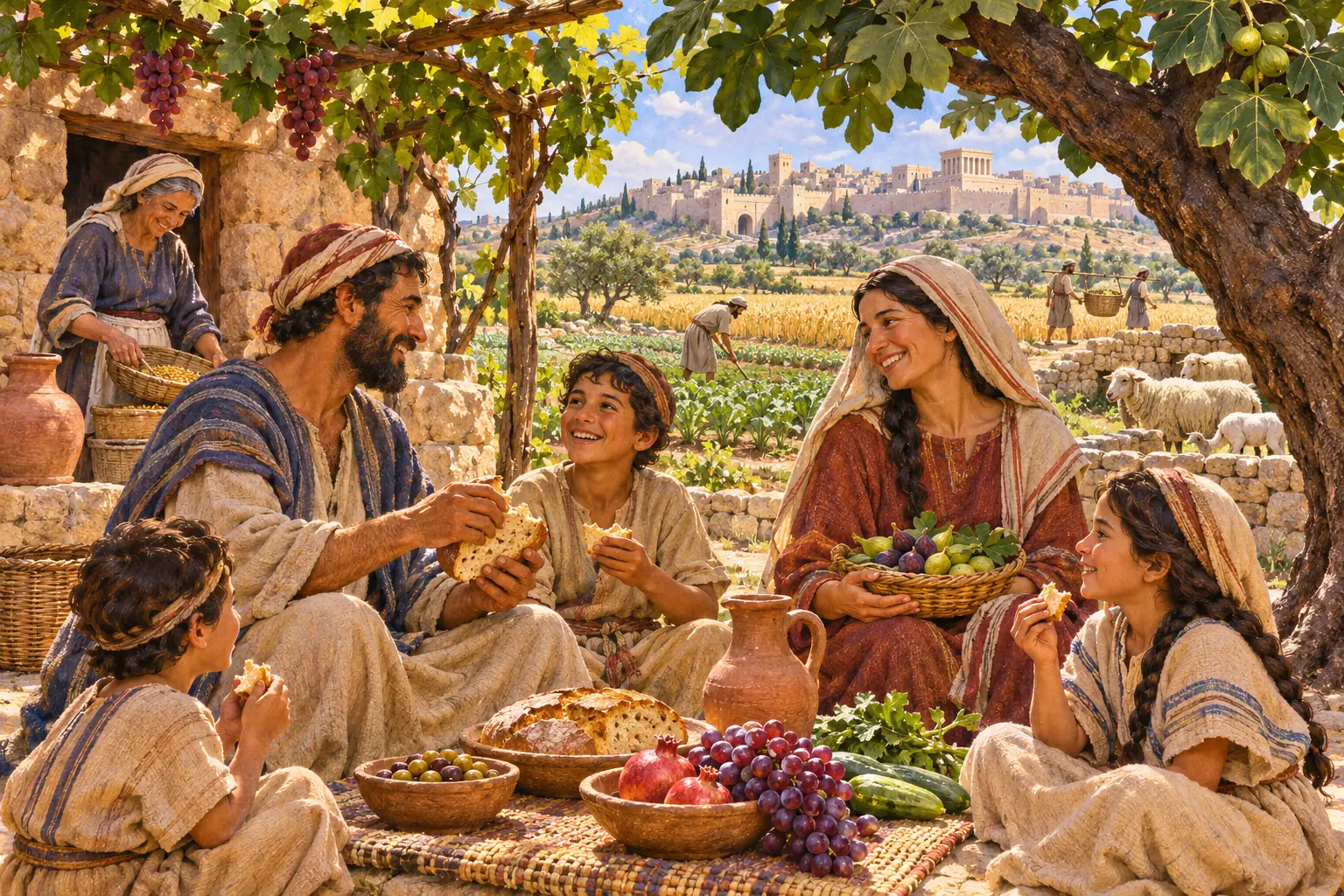
A household rests beneath a fruitful vine. A palace receives another day’s provisions. Beyond the tables, horses wait for barley. Across the kingdom, wisdom faces the question of enough.
Introduction — Can Success Keep a Neighbor in View?
A growing institution can look healthy from the front gate. Buildings rise, visitors arrive, records improve, and the leader’s reputation travels. The more difficult measure may be found in a kitchen, a field, or an exhausted worker’s evening. Does growth make ordinary life more secure? Can success remain attentive to the people sustaining the achievement?
First Kings 4 widens the view after Solomon’s judgment between the two women. Wisdom must now shape a nation. Officials carry responsibilities, districts supply provisions, Judah and Israel celebrate, and surrounding kingdoms acknowledge Solomon’s power. The narrator also describes extraordinary understanding reaching from political life to plants, animals, proverbs, and songs.
The chapter genuinely celebrates a divine gift bearing public fruit. Yet the inventories contain questions for a reader remembering Torah: compulsory labor appears among royal offices, the palace requires enormous supplies, and the king maintains many horses. Later chapters will make the costs harder to overlook.
Can God’s gift of wisdom produce flourishing without allowing royal appetite to consume the blessing? First Kings 4 portrays ordered abundance and broad understanding as gifts requiring continued covenant faithfulness, measured through the security of ordinary households as well as the achievements of the throne.
Historical and Literary Context — From a Wise Judgment to a National System
Solomon asked for understanding to govern a numerous people (3:8–9). Chapter 4 answers the concern on a larger scale. The population is compared with the sand beside the sea in verse 20; Solomon’s breadth of understanding receives a matching comparison in verse 29. God’s gift corresponds to the size of the responsibility.
The chapter combines lists and summaries rather than unfolding as a single day’s events. Senior officials appear first, followed by district officers, national prosperity, international dominion, royal provisions, and the extent of Solomon’s wisdom. The cumulative picture is a kingdom organized to function beyond the king’s individual presence.
The earlier covenant charge remains essential (2:1–4). Deuteronomy 17:14–20 places royal life beneath God’s instruction and warns against multiplying horses, wives, and wealth. Samuel’s warning concerning a king’s appetite for people, produce, and labor also belongs in the background (1 Sam 8:11–18).
The supplied commentaries emphasize different dimensions. Provan gives substantial weight to the explicit happiness and security of the people; Brueggemann probes the demands supporting royal abundance (Provan 2012, commentary on 1 Kgs 4:1–34; Brueggemann 2000, 57–72). The narrative supports gratitude for the prosperity described and scrutiny of the developing system. The larger Solomon story will bring admiration and warning into increasingly sharp tension (BibleProject n.d., 2–3).
Walking Through the Text
Wisdom Takes the Form of Shared Responsibility — 4:1–6
Solomon reigns over all Israel. The list of senior officials includes priests, scribes, a recorder, a military commander, a supervisor of district officers, a royal adviser, and an official responsible for the household. Government requires differentiated responsibilities. The listening heart must become reliable administration.
Some names connect the administration with earlier royal relationships. The offices show continuity as well as growth. Exact functions are not equally clear in every case, so the list should not be converted into a precise modern cabinet.
One appointment deserves particular attention: Adoniram oversees the labor levy. Later chapters describe compulsory labor more fully (5:13–18; 9:15–22). The brief notice already creates tension with Israel’s memory of deliverance from Egyptian forced labor. Efficient organization can serve the common good while also making increasing demands easier to impose (Brueggemann 2000, 58–59).
Twelve Districts Bring the Country to the Royal Table — 4:7–19
Twelve officers provide food for the king and royal household, with a month assigned to each officer. The arrangement distributes supply through an annual rotation. Places, regions, and several tribal names locate the system across the land.
The districts do not simply reproduce twelve traditional tribal territories. The list describes a royal administrative arrangement, with geographical complexities still debated by interpreters. Two officers are also identified through marriage to Solomon’s daughters. Family connection and public responsibility overlap.
The narrator provides no accounts from the farmers supplying the provisions. The absence leaves questions about the experience of contributors open; the reader should avoid inventing either universal resentment or a completely costless system. The explicit point is dependable provision through organized responsibility (Provan 2012, commentary on 1 Kgs 4:7–19). The moral question concerns the fairness and limits of such demands.
Many People Enjoy Abundance under a Great King — 4:20–21
Judah and Israel are numerous, eating, drinking, and rejoicing. The comparison with seashore sand recalls God’s promise concerning Abraham’s descendants (Gen 22:17). The summary presents a people enjoying the goodness of a settled life.
Solomon’s dominion extends from the Euphrates toward Philistine territory and Egypt’s border. The description evokes the geographical horizon of the ancestral promise (Gen 15:18). Subject kingdoms bring tribute and serve Solomon. The text describes an extensive sphere of rule, rather than a detailed modern boundary survey.
The two verses belong together: prosperity within Israel exists alongside tribute from surrounding kingdoms. Brueggemann stresses the unequal positions implied by the arrangement (Brueggemann 2000, 61–62). Kings reports Israel’s joy explicitly; the passage does not supply an equivalent description of life among the tributary populations. The wider biblical purpose of blessing the nations remains a searching horizon for royal greatness (Gen 12:3).
The Palace Feast Stands beside the Household Vine — 4:22–25
The daily royal provisions are immense: thirty cors of fine flour, sixty cors of meal, cattle, sheep, game, and birds. The quantities communicate the scale of feeding a large royal establishment. The provisions extend beyond the king’s individual plate, as verse 27 will clarify.
The narrative then describes peace around the kingdom and safety throughout Judah and Israel. Vine and fig tree bring the vision close to the ground. A household can cultivate, rest, and enjoy produce without immediate fear. The image conveys secure ordinary life rather than a requirement for every faithful person to possess a particular crop.
The juxtaposition invites reflection. The palace receives elaborate abundance; the countryside’s happiness is pictured through shelter, fruit, and safety. Provan emphasizes the genuine well-being reported; Brueggemann asks about the distance between royal consumption and rural sufficiency. The chapter permits celebration without making luxury the measure of household flourishing (Provan 2012, commentary on 1 Kgs 4:21–28; Brueggemann 2000, 65–66).
Horses Place a Question beneath the Peace — 4:26–28
Solomon maintains a large establishment of chariot horses and horsemen. The district officers supply the royal table without shortage and provide barley and straw for the animals. The same organization sustains hospitality, administration, and military capacity.
The horses cannot be assessed by expense alone. Deuteronomy 17:16 explicitly warns the king against multiplying horses. Provan highlights the warning embedded within the otherwise glorious picture (Provan 2012, commentary on 1 Kgs 4:21–28).
The text describes security, but the covenant asks about the foundations of trust. A kingdom can enjoy peace while beginning to accumulate the habits of future trouble. Dependable supply and impressive defense still require submission to God’s instruction. The subsequent story will reveal the danger of treating expansion as a sufficient justification for expansion.
A Broad Heart Learns the World and Welcomes the Nations — 4:29–34
God gives Solomon wisdom, understanding, and breadth of heart. The language concerns expansive comprehension. The repeated image of seashore sand connects a numerous people with a generously equipped ruler.
Solomon’s wisdom surpasses renowned learning in the East and Egypt, as well as named sages. The narrator credits Solomon with three thousand proverbs and one thousand and five songs. Trees, animals, birds, creeping creatures, and fish enter the scope of royal knowledge. The account presents intellectual and creative abundance alongside administrative ability.
The movement from Lebanon’s cedar to wall-growing hyssop places the large and the small within wisdom’s attention. Creation deserves thoughtful observation. The chapter does not identify every surviving proverb or song with the numbers listed, nor does the passage make Solomon the author of every later wisdom text.
People come from surrounding kingdoms to hear the king. God’s gift becomes internationally visible. Yet the final test will remain covenantal: a mind capable of describing creation must also govern desire and protect human neighbors.
Theological Reflection — The Gift Must Serve the Household
God’s generosity reaches ordinary life
The chapter’s blessings include food, gladness, security, learning, and creativity. Biblical flourishing has bodily and communal dimensions. Gratitude belongs at the family table as well as in the sanctuary. The vine and fig tree remind leaders to evaluate achievement through the daily lives of people beyond the center of power.
Administration carries moral weight
Lists of officers and supplies may seem less spiritual than Solomon’s dream. Yet a schedule determines a worker’s burden, and a distribution system shapes a household’s access to necessities. Wisdom must inhabit practical arrangements. A well-organized system can distribute responsibility fairly; an unexamined system can organize exploitation efficiently.
Success remains beneath the covenant
The happiness described should be received as a real feature of the narrative. The horses and labor office should also be heard as warning signs within the larger story. God’s gifts never place a ruler beyond correction. A blessing becomes endangered when appetite grows faster than obedience or when prestige prevents scrutiny of the costs.
A broad heart cultivates humble attention
God-given wisdom reaches beyond the management of rivals and resources. Songs, proverbs, plants, and animals belong within a rich human vocation. Learning can nurture gratitude and careful stewardship. The cedar matters, and the small growth in a wall matters. Such attention should enlarge concern for neighbors rather than become another instrument of royal self-display.
Canonical and Christological Horizon — Peace Greater than Royal Splendor
The vine and fig tree reappear in Micah 4:1–4, alongside the nations learning God’s ways and weapons becoming agricultural tools. The prophetic vision carries household security toward a wider peace under God’s instruction. First Kings 4 offers a significant glimpse; the later fracture of Solomon’s kingdom shows the incompleteness of the achievement.
Jesus explicitly announces a presence greater than Solomon (Matt 12:42). Jesus also places Solomon’s splendor beside the beauty of lilies and directs anxious attention toward the Father’s care and God’s kingdom (Matt 6:28–33). Royal display cannot supply the final measure of life’s worth or security.
In the feeding of the multitude, Jesus directs care toward hungry people and involves the disciples in serving the gathered crowd (Mark 6:34–44). The scene is a canonical comparison rather than a direct fulfillment of Solomon’s food inventory. The King’s abundance reaches the people. The cross deepens the pattern: royal greatness gives life in service (Mark 10:45).
The church bears witness through shared resources, generosity, and attention to need (Acts 2:44–47). The horizon extends to the river and tree of life, with healing for the nations and the removal of the curse (Rev 22:1–5). God’s final kingdom joins worship, creation, and flourishing without making vulnerable households the fuel of greatness.
Life Application — Measure Growth from the Household
- Review a system through a worker’s day. Examine a ministry rota, school timetable, or family arrangement. Ask about rest, clarity, and repeated overload; change an unfair assignment even at the cost of convenience.
- Make the cost of an achievement visible. Before approving a project, record the required money, labor, and time away from families. Include the people expected to carry the burden in planning the work.
- Protect an ordinary household’s sufficiency. Review a church or organizational budget for practical support to people facing food insecurity or heavy caregiving responsibilities. Move a specific resource toward an identified need.
- Accept a covenant limit. Identify an expansion driven mainly by prestige or anxiety. Reduce the commitment or delay the purchase when obedience, family care, or fair treatment requires restraint.
- Cultivate a broad heart. Set aside time for Scripture, thoughtful reading, music, or close observation of the created world. Let learning generate a concrete act of care for a neighbor or a shared environment.
- Share success beyond the center. After a successful program, recognize quiet contributors and assess the experience of people with little influence. Let the next improvement arise from the margins as well as the leadership table.
Reflection Questions
- How do the two comparisons with seashore sand connect Solomon’s task and God’s gift?
- Which details invite gratitude for prosperity, and which details require covenantal scrutiny?
- Where does a present institution measure success by a full leadership table while overlooking a burdened household?
- Which growing appetite currently competes with a clear duty of obedience?
- How could Jesus’ pattern of abundant service reshape a specific use of money, labor, or influence during the coming week?
Response Prayer
Generous God, giver of fruitful seasons and wisdom for shared life, receive thanksgiving for food, shelter, learning, and peace. Keep gratitude alive in ordinary kitchens and strengthen hope in households facing uncertainty.
Forgive ambition measured only by buildings, numbers, and applause. Reveal the burdens hidden beneath successful reports. Give leaders courage to hear tired workers, protect family life, and bring growing appetites beneath God’s instruction.
Grant a broad heart attentive to the cedar and the small plant in the wall. Let knowledge become care, creativity become service, and organization become a means of justice.
Risen Jesus, King of generous life, guide every table toward faithful hospitality. Protect the hungry from neglect and the powerful from pride. Form communities capable of rejoicing together, until the healing of the nations fills God’s renewed creation. Amen.
Window into What Comes Next — Timber, Labor, and a House for God
First Kings 5 will turn toward the temple. Peace and international relationships will make possible an agreement with Hiram of Tyre, the supply of timber, and preparations for construction. The king’s wisdom will take the form of a great building enterprise.
The labor office briefly named in chapter 4 will become more visible. Cedar will move from the scope of Solomon’s learning into the work of builders and carriers. A holy purpose will still require faithful means. Can a house built for God honor the lives of the people carrying the timber?
Bibliography
- BibleProject. n.d. “The Books of Kings.” Old Testament Overviews. Supplied PDF, “Books of 1 and 2 Kings: Guide with Key Information and Resources,” 2–3.
- Brueggemann, Walter. 2000. 1 & 2 Kings. Smyth & Helwys Bible Commentary. Macon, GA: Smyth & Helwys. Especially 57–72.
- The Holy Bible: King James Version. 1769 edition. “1 Kings 4.” Bible Gateway. Scripture summaries and interpretive paraphrases are distinguished from direct quotation throughout the study.
- Provan, Iain W. 2012. 1 & 2 Kings. Understanding the Bible Commentary Series. Grand Rapids: Baker Books. Originally published 1995. Sections “Solomon’s Rule over Israel (1 Kgs. 4:1–20)” and “Solomon and the Nations (1 Kgs. 4:21–34).” Section references used because the supplied electronic edition has no stable printed pagination.
Be the first to leave a comment.