

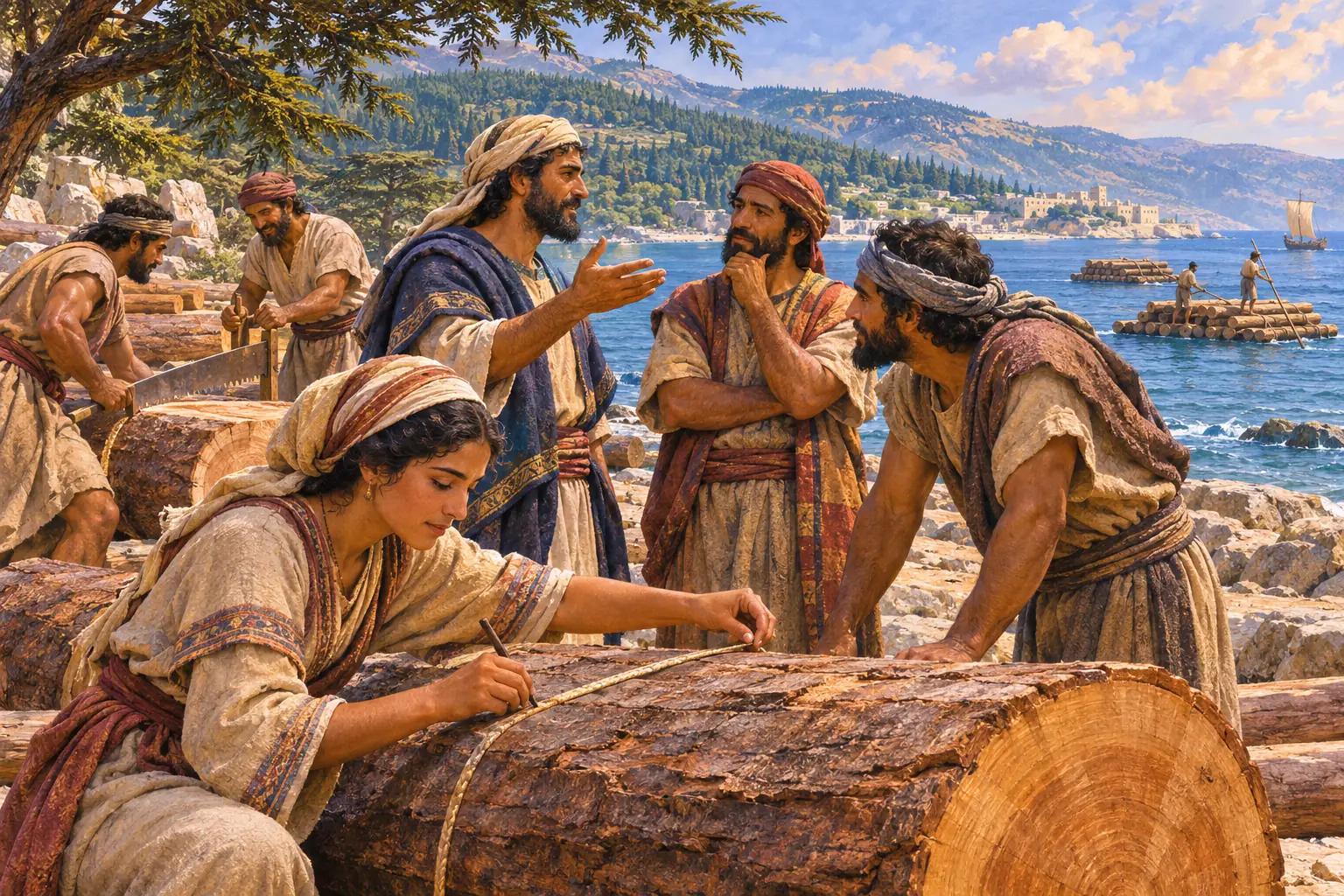
How does the movement from God-given national rest to the labor levy sharpen the ethical question beneath temple preparation?
Study overview
God’s Promise, Shared Skill, and the Human Cost of Preparing the Temple
By Pr Enos Mwakalindile Reading: 1 Kings 5:1–18 Key verse: 1 Kings 5:12 — The LORD gives Solomon the promised wisdom, and Solomon and Hiram establish peace through a treaty. (Summary, not a direct quotation.)
Cedar waits upon the mountain. Stone waits beneath the ground. A king speaks of a house for God’s name. The hands preparing the house also belong within the care of God.
Introduction — The People beneath a Holy Project
A building begins long before the first wall rises. A conversation opens a door. A supplier promises materials. A budget assigns costs. A worker leaves home before sunrise. The finished structure may carry a leader’s name, while the names of carriers and cutters disappear beneath the foundation.
First Kings 5 stays with the preparations. No gold-covered room appears yet. The chapter concerns messages, timber, food, transport, agreements, labor, and stone. The vision of a temple enters the practical world of planning and human effort.
The purpose is substantial. Solomon intends to build for the name of the LORD, in continuity with God’s promise to David. God has given rest and wisdom; Hiram responds with joy and cooperation. The narrative also records a large labor levy and an enormous workforce. A sacred aim requires human hands, and the treatment of human hands becomes a theological question.
Can a house built to honor God also honor the lives involved in building? First Kings 5 presents temple preparation as a response to divine promise and an achievement of wise cooperation, while requiring readers to weigh royal ambition and labor demands against the covenant character of God. Foundations involve more than stone. Faithfulness must support the work.
Historical and Literary Context — A Promise Becomes a Building Project
Chapters 5–8 describe temple preparation, construction, furnishings, and dedication. The building will become a central setting for prayer and Israel’s understanding of God’s presence. The supplied temple study places the sanctuary within the wider biblical movement of God dwelling among humanity (BibleProject n.d., 1–3).
The immediate background includes Solomon’s gift of wisdom and the organized prosperity of chapter 4. Adoniram, briefly named as supervisor of the labor levy in 4:6, now becomes visible within the preparations. International relationships and domestic administration converge upon the temple.
Behind Solomon stands David. Hiram previously supplied materials and craftsmen for David’s palace (2 Sam 5:11). David later considered building a house for the LORD, but God’s promise placed the work with David’s successor (2 Sam 7:1–16). The promise concerning David’s royal house precedes the son’s building of God’s house. Grace supplies the starting point.
Deuteronomy 12:10–11 connects rest from enemies with worship at the place bearing God’s name. Solomon’s description of rest belongs within the covenant horizon. The speech describes an opportunity at the present stage of the reign; subsequent opposition in chapter 11 will prevent rest from becoming a permanent achievement independent of obedience.
Commentators differ over the political balance of the agreement and the composition of the workforces. Careful reading should preserve the chapter’s explicit praise of wisdom and peace alongside honest scrutiny of royal demands (Provan 2012, commentary on 1 Kgs 5:1–18; Brueggemann 2000, 73–81).
Walking Through the Text
An Old Friendship Opens a New Conversation — 5:1
Hiram, king of Tyre, sends servants after hearing of Solomon’s accession. The narrator explains the initiative through Hiram’s longstanding affection for David. A relationship formed in an earlier reign provides an opening for the next generation.
The scene begins with communication rather than a shipment of timber. Political transition requires relationships to be renewed in practice. Neither inherited friendship nor a significant calling eliminates the need for respectful conversation. Solomon receives an opportunity through a history of connection extending beyond Solomon’s own achievement.
God’s Gift of Rest Opens a Responsibility — 5:2–5
Solomon explains David’s inability to build in the context of surrounding warfare. In contrast, Solomon describes rest given by the LORD. The speech credits God for the opportunity and recalls the promise concerning David’s son and the temple.
Rest becomes an occasion for purposeful service. The ending of immediate military pressure permits planning, cooperation, and worship. Peace carries responsibilities beyond the enjoyment of a secure throne.
The intended building is for God’s name. The expression locates worship within God’s gracious self-disclosure and authority. Later, Solomon will acknowledge the impossibility of containing God even within the heavens (8:27). A temple can be a true place of encounter without becoming a royal possession capable of controlling God (Brueggemann 2000, 75–76).
Wise Leadership Acknowledges Another Community’s Skill — 5:6–9
Solomon requests cedar from Lebanon and acknowledges the Sidonians’ exceptional timber-working expertise. The request proposes cooperation and payment. Wisdom includes recognizing a real limitation and seeking qualified assistance.
Hiram rejoices and blesses the LORD for giving David a wise son. The praise is explicit; the passage supplies no complete account of Hiram’s religious allegiance. The chapter’s immediate emphasis is the welcoming response and the practical agreement.
Hiram describes a workable supply route: timber comes down to the sea, travels in rafts, and is delivered at an agreed destination. Hiram requests food for the royal household. The exchange needs materials, transport, and sustained provision. A worthy purpose does not remove the need for clear arrangements.
The participation of Phoenician workers also challenges the fantasy of a completely self-sufficient sacred enterprise. God’s work can involve gifts and expertise beyond familiar circles. Such cooperation still requires discernment about the terms and effects of the arrangement.
Giving Becomes a Pattern of Peace — 5:10–12
Hiram provides timber; Solomon provides wheat and oil year by year. The commitment extends beyond an initial announcement. A large project depends upon continued reliability.
Verse 12 explicitly credits the LORD with giving Solomon wisdom and reports peace and a treaty between the kings. Provan draws attention to the repeated giving: Hiram gives, Solomon gives, and the LORD gives wisdom (Provan 2012, additional note on 1 Kgs 5:10–12). The relationship is narrated within a gift received from God.
The passage does not require readers to prove perfect equality between the two monarchs. The visible achievement is a negotiated exchange enabling cooperation. Later dealings with Hiram will raise further questions (9:10–14). Present peace deserves gratitude without ending the responsibility to examine future conduct.
The Project Reaches into Workers’ Homes — 5:13–14
Solomon raises a levy of thirty thousand men from all Israel and sends ten thousand monthly to Lebanon under Adoniram. The usual reading describes one month in Lebanon followed by two months at home. Rotation limits continuous absence, but the workforce is still summoned by royal authority.
The wording should be allowed to retain moral weight. The passage does not describe the whole undertaking as spontaneous volunteer service. At the same time, the text does not narrate every worker’s conditions or identify every labor category with equal precision. The relationship with the distinctions in 9:20–22 remains debated; Provan and Brueggemann differ concerning the groups involved (Provan 2012, additional note on 1 Kgs 5:13; Brueggemann 2000, 77–79).
The later complaint about Solomon’s heavy yoke will make labor a national crisis (12:4). The foundation of a holy building already reaches into family time, agricultural work, and bodily strength. The project’s sacred purpose cannot settle every ethical question about the means.
Great Stones Depend upon Uncelebrated Hands — 5:15–18
The narrator counts seventy thousand burden carriers, eighty thousand stonecutters in the hills, and three thousand three hundred supervisors. The scale communicates an extraordinary undertaking. Behind the totals stand bodies capable of fatigue and households dependent upon labor.
Large, costly, dressed stones are prepared for the foundation. Solomon’s builders, Hiram’s builders, and workers from Gebal participate in preparing timber and stone. The construction requires both strength and trained skill.
The chapter ends with materials ready rather than a sanctuary completed. Preparation has value before a crowd can admire a finished result. Yet the large foundation stones also ask a searching question: will the faithfulness of the enterprise be as carefully examined as the quality of the stone?
Theological Reflection — A Holy Purpose Requires Faithful Means
God’s promise precedes human achievement
Solomon builds within an opportunity made possible by God’s promise, rest, and wisdom. Gratitude should therefore restrain the temptation to treat the temple as proof of royal greatness. Human planning matters, but the project begins within divine generosity. The proper response is responsible service rather than entitlement.
Peace should create room for shared service
Rest permits constructive work, and wisdom enables cooperation across communities. The treaty shows practical intelligence bearing relational fruit. Neither international contact nor specialist skill is automatically unfaithful. The covenantal question concerns the loyalties, responsibilities, and human effects shaped by the partnership.
Excellence includes concern for workers
Skilled cutting, dependable delivery, and sound foundations honor a serious task. The same concern for quality must extend to the people carrying the work. Israel’s memory of Egyptian labor and the Sabbath command’s provision for household rest give covenant life a different horizon from endless production (Exod 1:11–14; Deut 5:12–15). The national rest described in chapter 5 is political peace; the wider covenant also asks about rest within everyday labor.
Religious ambition remains open to judgment
Brueggemann probes the danger of a great religious enterprise drawing people into royal demands (Brueggemann 2000, 77–81). The warning becomes explicit elsewhere in prophetic Scripture: Jeremiah condemns royal building through unpaid labor and asks whether cedar can substitute for justice (Jer 22:13–16). Jeremiah’s immediate subject is a later palace; the principle supplies a legitimate ethical question for religious projects as well. A sacred name on the building cannot replace faithfulness in the work.
Canonical and Christological Horizon — From Prepared Stones to Living People
First Kings 5 belongs to the biblical hope of God dwelling among the people. The temple’s material preparations matter within Israel’s historical story. The Christian horizon then follows the developments explicitly made in the New Testament.
John identifies Jesus’ body as the temple in the saying concerning destruction and rising after three days (John 2:19–22). God’s presence reaches humanity through the life, death, and resurrection of Jesus. The connection concerns the sanctuary’s unfolding significance; an individual cedar raft or foundation stone need not become a separate prediction of the cross.
Ephesians describes Jews and Gentiles joined in Christ as a holy temple, with Jesus as the cornerstone and the Spirit making the community God’s dwelling (Eph 2:19–22). First Peter similarly describes believers as living stones gathered around the living Stone (1 Pet 2:4–5). Hiram’s participation provides an earlier picture of cooperation beyond Israel, while the inclusion described in Ephesians rests specifically upon Christ’s reconciling work.
The direction is deeply practical. A congregation cannot honor the dwelling of God while treating people as expendable building materials. The King’s pattern is service and the giving of life (Mark 10:45). Finally, the new Jerusalem needs no temple building, because God and the Lamb are the temple (Rev 21:22). The biblical journey reaches God’s unveiled presence within renewed creation (BibleProject n.d., 3).
Life Application — Build Faithfulness into the Foundations
- Name the purpose before announcing the project. Write a clear account of the actual ministry need and the people expected to benefit. Revise a plan driven primarily by prestige or rivalry.
- Honor expertise beyond familiar circles. Seek a qualified craftsperson, planner, or adviser. Agree on responsibilities, materials, payment, and communication before work begins.
- Count the human cost alongside the financial cost. Include travel, fatigue, family absence, and time away from ordinary work in project planning. Adjust the schedule when the burden becomes unreasonable.
- Protect willing participation and rest. Give church volunteers a real opportunity to decline or reduce responsibilities. Organize Sabbath rest and adequate recovery without using spiritual pressure to conceal overload.
- Treat reliability as worship. Keep payment commitments, communicate changes promptly, and acknowledge quiet workers. A faithful agreement can honor God before a visible structure is completed.
- Inspect the community as carefully as the building. Before celebrating progress, hear the workers and affected households. Repair a damaged relationship or an unfair arrangement even when the repair delays an opening ceremony.
Reflection Questions
- How does Solomon connect the temple project with God’s promise and gift of rest?
- Which features of the agreement display wisdom through practical cooperation?
- Where could a worthy ministry purpose be hiding an unfair burden on workers or families?
- Which neglected commitment would strengthen the moral foundation of a present project?
- How would the New Testament picture of God’s dwelling among living people change a current priority concerning buildings, budgets, or service?
Response Prayer
Faithful God, giver of rest and keeper of promises, receive thanksgiving for opportunities to serve. Let remembered grace stand beneath every plan and prevent achievement from becoming a monument to pride.
Give leaders humility to seek skilled help and patience to make clear agreements. Give workers strength, protection, adequate rest, and the dignity of being heard. Remember the households beyond the building site and the quiet hands beneath successful reports.
Forgive spiritual language used to press exhausted people into silence. Bring hidden burdens into the light. Teach congregations to value truthful relationships as deeply as sound foundations.
Risen Jesus, cornerstone of God’s living household, build a community shaped by service, justice, and generous love. Let every faithful task point toward the day of God’s unveiled presence, when healing fills creation. Amen.
Window into What Comes Next — The House Begins to Rise
Timber and stone are prepared. First Kings 6 will lead into the temple’s measurements, chambers, carvings, and inner sanctuary. The cedar discussed by kings and carried by workers will become part of a place devoted to worship.
Within the construction account, God’s word will interrupt the architectural detail. The question will concern obedience and God’s dwelling among Israel (6:11–13). A magnificent structure must remain beneath the covenant. Can the builders of a holy house also become a people ready to walk in God’s ways?
Bibliography
- BibleProject. n.d. Temple: Script References. Supplied PDF, 1–3. Especially the movement from Israel’s temple to Jesus, the church, and new creation.
- Brueggemann, Walter. 2000. 1 & 2 Kings. Smyth & Helwys Bible Commentary. Macon, GA: Smyth & Helwys. Especially 73–81.
- The Holy Bible: King James Version. 1769 edition. “1 Kings 5.” Bible Gateway. Scripture summaries and interpretive paraphrases are distinguished from direct quotation throughout the study.
- Provan, Iain W. 2012. 1 & 2 Kings. Understanding the Bible Commentary Series. Grand Rapids: Baker Books. Originally published 1995. Section “Preparations for Building the Temple (1 Kgs. 5:1–18),” including additional notes. Section references used because the supplied electronic edition has no stable printed pagination.
Be the first to leave a comment.