

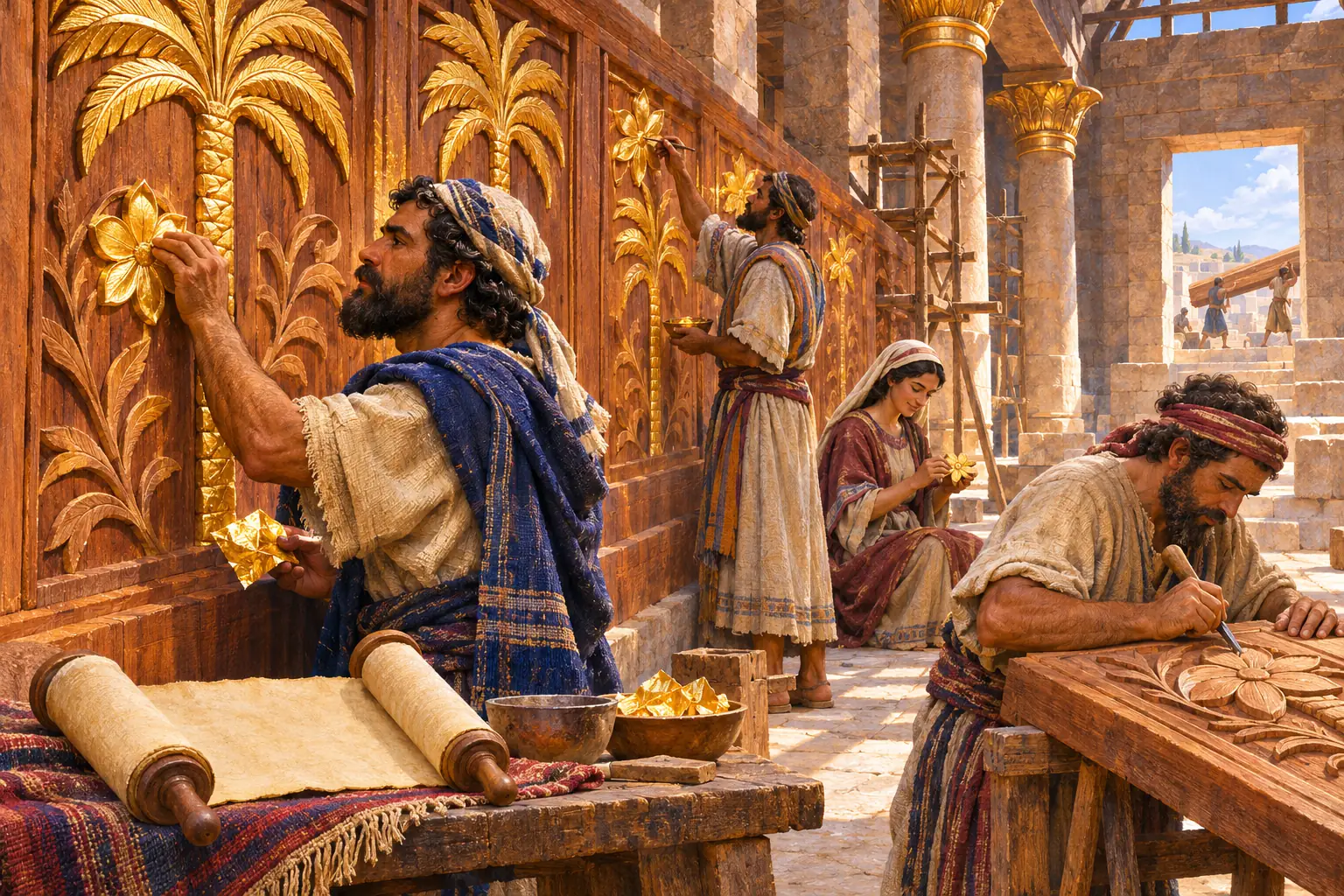
Why does the covenant speech interrupt construction before the interior description begins?
Study overview
The Temple’s Beauty and God’s Call to Covenant Faithfulness
By Pr Enos Mwakalindile Reading: 1 Kings 6:1–38 Key passage: 1 Kings 6:11–13 — God places the temple project within covenant obedience and promises to dwell among Israel without abandoning God’s people. (Summary, not a direct quotation.)
Stone is fitted without the sound of iron. Cedar carries flowers into the house. Golden wings stretch across the inner room. In the middle of the building, God speaks about walking.
Introduction — A Beautiful House Still Needs a Faithful People
A carefully prepared room can express love. Freshly swept floors, a repaired doorway, and a place made ready for a guest can turn hospitality into something visible. Beauty matters because human beings communicate through space, care, and attention.
Yet a room can also conceal a broken relationship. A polished table cannot repair a dishonest promise. An impressive church building cannot supply humility, justice, or love by architectural force. The outward work may be finished while the deeper response remains unfinished.
First Kings 6 describes the temple in patient detail: dimensions, chambers, timber, gold, cherubim, flowers, doors, and a courtyard. The narrative invites reverence and wonder. But the most decisive passage interrupts construction with God’s word. Before the tour moves into the decorated interior, Solomon hears the call to obey.
Can a holy building become the setting for a faithful life? First Kings 6 presents the temple as a beautiful, ordered dwelling prepared for God’s presence, while placing every claim of sacred achievement beneath covenant obedience. The carved garden points toward life with God. The king must also learn to walk in God’s ways.
Historical and Literary Context — From Exodus toward a Dwelling Place
The preparations of chapter 5 now become construction. Verse 1 dates the beginning to Solomon’s fourth regnal year, in Ziv, the second month, and counts the event within the 480th year after the exodus. Chronological reconstructions remain debated, but the narrative’s historical-theological starting point is explicit: the temple belongs to the story of a people delivered from Egypt.
The closing verses date completion to Solomon’s eleventh year, in Bul, the eighth month, and summarize the building period as seven years. The dates frame a carefully organized account. The repeated language of finishing also recalls the completion of the tabernacle and, more broadly, creation (Exod 40:33; Gen 2:1). The seven-year summary can carry theological resonance without requiring every measurement to become a secret code (Brueggemann 2000, 83–84, 91–92).
The temple continues earlier patterns of sanctuary, covenant, and divine dwelling. Leviticus 26:3–12 connects faithful life with God’s dwelling among Israel. First Kings 6:11–13 renews the connection within Solomon’s building enterprise.
The architectural details are not equally clear to modern readers. A responsible study should distinguish explicit measurements from disputed reconstructions. The dominant movement is easier to follow: exterior construction, God’s word, interior preparation, and completion. Provan emphasizes the covenant passage’s role in defining the meaning of the whole building (Provan 2012, commentary on 1 Kgs 6:1–13). The temple must remain a place of relationship under God’s authority.
Walking Through the Text
Careful Work Creates a Place of Reverence — 6:1–10
The main building measures sixty cubits long, twenty cubits wide, and thirty cubits high. An entrance porch, windows, and surrounding side chambers complete the initial description. The three levels of side rooms widen upward, supported through the arrangement of the exterior walls. The account emphasizes intentional craftsmanship rather than improvised grandeur.
Verse 7 supplies a memorable detail: the stones have been prepared before arrival, so hammer, axe, and iron tool are not heard within the house during construction. The quiet at the site depends upon work already done elsewhere. Chapter 5’s cutters and carriers remain behind the apparent stillness.
The detail suggests reverent preparation. Provan connects the avoidance of iron at the site with earlier instructions concerning altars (Exod 20:25; Deut 27:5–6), while the application to the whole temple is a narrative extension rather than the repetition of an identical command (Provan 2012, commentary on 1 Kgs 6:1–13).
Cedar beams and roofing complete the exterior picture. The silence concerns a particular construction practice; the verse supplies no universal prohibition against tools, music, or audible worship. The practical lesson begins with preparation worthy of a serious task.
God’s Word Interrupts the Building — 6:11–13
The narrative pauses. The word of the LORD comes to Solomon concerning the house under construction. God directs the king toward statutes, judgments, and commandments, linking faithful conduct with the promise spoken to David.
The promised dwelling concerns life among the children of Israel. The focus moves beyond a beautiful room to a covenant people. God’s refusal to abandon Israel is spoken within the call to walk faithfully. Solomon cannot substitute construction for obedience.
The literary position matters. Statements about building and finishing stand around the divine speech. Architecture receives meaning from the word spoken within the account. Brueggemann highlights the interruption as a challenge to treating the temple as an automatic guarantee of divine favor (Brueggemann 2000, 88–89).
The passage concerns a relationship grounded in God’s prior promise. Obedience is the fitting covenant response. Gold cannot purchase God’s presence, and royal achievement cannot place the king beyond correction.
The Inner House Is Prepared for the Covenant — 6:14–22
The construction account resumes, now moving inside. Cedar covers the walls, timber covers the floor, and carved gourds and open flowers enrich the surface. The stones supporting the house disappear beneath the interior lining.
The rear twenty cubits form the Most Holy Place; the main hall before the inner sanctuary extends forty cubits. The inner sanctuary is described as twenty cubits in length, breadth, and height—a cube prepared for the ark of the LORD’s covenant.
The distinction matters: the room is being prepared for the ark, but chapter 6 does not yet narrate the ark’s installation. The transfer will occur in chapter 8. Preparation and occupation belong to different stages of the story.
Gold repeatedly appears in the description. The costly covering communicates honor and splendor, but the ark’s designation keeps covenant at the center. The most precious room is not the king’s throne room. The house points toward the authority of the LORD over the royal project.
Golden Wings Mark a Holy Presence — 6:23–28
Two cherubim carved from olive wood stand within the inner sanctuary. The matching figures stand ten cubits high, with wings extending across the room. The outer wings reach the walls; the inner wings meet in the center. Gold covers the figures.
Cherubim are winged heavenly creatures associated with sacred guardianship and God’s throne. Genesis places cherubim at Eden’s guarded entrance; Israel’s worship speaks of the LORD enthroned above the cherubim (Gen 3:24; Ps 99:1). The sanctuary’s figures communicate holiness and royal presence (Brueggemann 2000, 91).
The carved attendants should not be confused with a carved image of the LORD. The account directs attention toward the covenant ark and the holy King’s presence. The wings mark the seriousness of approach without reducing God to an object available for royal possession.
A Carved Garden Surrounds the Thresholds — 6:29–35
Cherubim, palm trees, and open flowers appear on walls and doors. Gold follows the carved work. The repetition draws the entrances and inner rooms into a coherent world of living imagery.
The combination of plant life, cherubim, and precious material invites comparison with Eden and the wider sanctuary story. The supplied temple study traces the temple’s garden imagery within the biblical hope of God and humanity dwelling together (BibleProject n.d., 1–2). The relationship is a supported theological reading; the chapter does not explicitly label the building Eden.
The carvings need not be turned into separate predictions or assigned private spiritual meanings. Together, the images portray sacred space through creation’s beauty and vitality. Provan also cautions against assuming plant imagery automatically proves devotion to Canaanite fertility gods; the narrative directs worship toward the LORD (Provan 2012, additional note on 1 Kgs 6:18).
The doors carry the same garden language into the places of approach. Beauty teaches through repeated attention. The way toward the inner sanctuary is marked by life, holiness, and the distinction between ordinary space and a place set apart for God.
The Building Is Finished; the Calling Continues — 6:36–38
The description returns to the inner courtyard, built with dressed stone and cedar beams. The dates close the account: foundations in the fourth year, completion in the eleventh year, and a seven-year building summary.
The work has coherence, endurance, and a finished form. The narrator permits readers to recognize a substantial achievement. Years of preparation and labor have produced a place ready for the next stages of worship.
Yet the central speech remains active after the final stone. Finishing a house cannot finish the responsibility to obey. A completed building becomes a setting for a continuing vocation. The next chapters will keep asking whether the king and people can live faithfully within the beauty.
Theological Reflection — The Word Must Govern the Garden
Beauty can serve reverence
The temple’s detailed craftsmanship gives created materials a role in worship. Wood, stone, proportion, and carved flowers can direct attention toward God’s holiness and generosity. The aesthetic dimension deserves gratitude. The covenant speech also requires beauty to remain answerable to God’s ways. A sanctuary’s loveliness and a community’s faithfulness belong within the same moral vision.
Presence is promised to a people
God’s declaration concerns dwelling among Israel. The building serves a covenant relationship extending into the people’s common life. The wording recalls Leviticus 26:11–12, where dwelling and walking among the people belong together. The sacred center should therefore shape conduct outside the sanctuary as well as reverence within the sanctuary.
Privilege cannot cancel obedience
The temple could tempt a king to treat divine favor as permanently secured. The interruption of verses 11–13 resists the temptation. Jeremiah later condemns the use of temple language as protection for injustice and covenant violation (Jer 7:3–11). The prophetic criticism develops the question already present in Kings: worship must remain responsive to the God being worshiped.
Garden imagery nourishes hope for restored life
Flowers and palms bring the beauty of creation into sacred space. Cherubim also recall the gravity of lost access to Eden. The imagery holds longing and holiness together. God’s presence concerns the restoration of life within God’s good order. The temple offers a concentrated sign of the hope; the biblical story continues beyond the building toward renewed creation.
Canonical and Christological Horizon — The Dwelling Opens toward New Creation
John describes the Word becoming flesh and dwelling among humanity, then identifies Jesus’ body as the temple in the saying about destruction and resurrection (John 1:14; 2:19–22). The movement centers access to God upon the life, death, and resurrection of Jesus. The historical temple remains part of the story leading toward the faithful King and true dwelling of God.
The New Testament extends sanctuary language to a people joined in Christ and inhabited by the Spirit (Eph 2:19–22; 1 Pet 2:4–5). The result is a communal vocation. The church honors God’s dwelling through truthful speech, reconciliation, holiness, and practical love. The architectural description does not authorize assigning an allegorical meaning to every timber or measurement.
Revelation’s new Jerusalem offers a further striking connection. The city’s equal length, breadth, and height recall the cubic inner sanctuary; the city has no temple building because God and the Lamb are the temple (Rev 21:16, 22). Sanctuary imagery expands into the vision of God dwelling openly with humanity (21:3).
The river and tree of life carry the garden horizon toward healing and the removal of the curse (Rev 22:1–5). The carved flowers of Solomon’s house participate in a story eventually reaching living creation restored. The goal is God’s presence filling renewed life, beyond the sanctuary’s golden walls (BibleProject n.d., 3).
Life Application — Prepare a Faithful Life within the Beautiful Space
- Let Scripture interrupt a successful plan. Before approving a major church or family decision, read a relevant biblical passage and name a required act of obedience. Change the plan when the requirement challenges convenience.
- Join visible care with hidden integrity. Repair a worship space, prepare a room, or organize an event carefully. Give equal attention to honest accounting, truthful communication, and fair treatment of helpers.
- Protect preparation time. Arrive ready for a teaching responsibility or shared task. Complete necessary work beforehand so other people are not left carrying avoidable disorder.
- Examine the life beyond worship. Choose a neglected relationship, unpaid obligation, or harmful pattern requiring attention. Make an apology, arrange repayment, or seek accountable help during the coming week.
- Make beauty serve shared reverence. Invite artistic skill while considering accessibility and the needs of people with limited resources. Choose a specific improvement helping the whole congregation attend to worship.
- Treat the congregation as God’s living household. Visit an isolated member, listen to a wounded colleague, or help reconcile a dispute. Invest time in people alongside care for buildings.
Reflection Questions
- How does the speech in verses 11–13 change the meaning of the surrounding architectural description?
- Which details help the reader recognize the temple as a place of covenant and holy presence?
- Where could visible religious achievement be concealing a neglected duty of obedience?
- How can beauty, preparation, and craftsmanship serve worship without becoming substitutes for faithfulness?
- Which act of reconciliation or practical love would make a congregation’s identity as God’s dwelling more visible?
Response Prayer
Holy God, giver of life and keeper of the covenant, receive thanksgiving for beauty, skilled hands, and places prepared for worship. Let carved flowers and living gardens awaken gratitude for the goodness of creation.
Speak into the middle of busy plans. Interrupt pride disguised as achievement. Bring neglected duties, injured relationships, and hidden dishonesty beneath the light of God’s word.
Give leaders humility, workers dignity, and congregations patient love. Let careful preparation make room for reverence, and let reverence travel beyond the sanctuary into daily conduct. Keep the care of buildings joined to the care of people.
Risen Jesus, true dwelling of God among humanity, build a faithful household through the Spirit. Let worship become obedience and beauty become hospitality. Sustain hope for the renewed creation, where God’s presence fills life and the curse is gone. Amen.
Window into What Comes Next — God’s House beside the King’s House
The temple building is complete, but the larger construction account continues. First Kings 7 will describe Solomon’s royal buildings before returning to the temple furnishings, including pillars, basins, and bronze work.
The narrative will place a seven-year temple project beside a thirteen-year royal building enterprise. Duration alone cannot settle every question about priority, but the juxtaposition deserves attention within Solomon’s developing story. The next chapter will ask the reader to consider worship, craftsmanship, justice, and royal display together. Can a king honoring God’s house keep personal greatness beneath God’s rule?
Bibliography
- BibleProject. n.d. Temple: Script References. Supplied PDF, 1–3. Especially garden imagery, Jesus as temple, the church, and new creation.
- Brueggemann, Walter. 2000. 1 & 2 Kings. Smyth & Helwys Bible Commentary. Macon, GA: Smyth & Helwys. Especially 83–92.
- The Holy Bible: King James Version. 1769 edition. “1 Kings 6.” Bible Gateway. Scripture summaries and interpretive paraphrases are distinguished from direct quotation throughout the study.
- Provan, Iain W. 2012. 1 & 2 Kings. Understanding the Bible Commentary Series. Grand Rapids: Baker Books. Originally published 1995. Section “Solomon Builds the Temple (1 Kgs. 6:1–38),” including additional notes. Section references used because the supplied electronic edition has no stable printed pagination.
Be the first to leave a comment.