

How does the royal complex’s placement inside the temple narrative affect the meaning of craftsmanship?
Study overview
Royal Buildings, Skilled Hands, and the Preparation of Worship
By Pr Enos Mwakalindile Reading: 1 Kings 7:1–51 Key verse: 1 Kings 7:14 — Hiram the craftsman possesses wisdom, understanding, and knowledge for bronze work and undertakes Solomon’s commission. (Summary, not a direct quotation.)
Cedar rises around a royal throne. Bronze flows into the shape of service. Water waits in a great basin; lamps wait before the inner room. Beyond the finished vessels, the covenant still searches the heart.
Introduction — A Beautiful Instrument Still Needs a Faithful Purpose
A skilled craftsperson can turn ordinary material into a useful gift. A carpenter brings a doorway into alignment. A welder strengthens a weak joint. A potter shapes a vessel capable of holding water. Good work joins understanding, patience, and the discipline of doing a task well.
First Kings 7 gives such work sustained attention. Bronze pillars, basins, stands, utensils, and golden furnishings fill the chapter. The narrative also pauses over Solomon’s royal complex. A house prepared for God stands beside buildings serving the king.
The juxtaposition creates a searching question. Beauty can honor God, organize worship, and express grateful care. Beauty can also magnify a ruler’s importance. The same expensive materials can serve reverence and ambition within a complicated human enterprise.
How can impressive work remain faithful service? First Kings 7 celebrates wisdom expressed through craftsmanship while placing royal splendor and sacred furnishings beneath the continuing demands of covenant obedience. The bronze needs a skilled hand; authority needs a faithful heart. The real question reaches beyond the ability to finish a building toward the purposes served by the finished work.
Historical and Literary Context — Two Houses within a Single Story
The temple’s main structure was completed in chapter 6. Readers might expect an uninterrupted move toward furnishings and dedication. Instead, 7:1–12 describes the royal complex before 7:13–51 returns to temple equipment. The arrangement makes the relationship between palace and sanctuary unavoidable.
The thirteen years assigned to Solomon’s royal building enterprise stand beside the seven-year temple summary in 6:38. The royal project includes several buildings; comparison with a single private bedroom would distort the account. Duration alone cannot establish every motive or the exact overlap of construction. Nevertheless, the literary placement invites scrutiny of priorities. Provan emphasizes the contrast between the king’s house and the LORD’s house (Provan 2012, commentary on 1 Kgs 7:1–12).
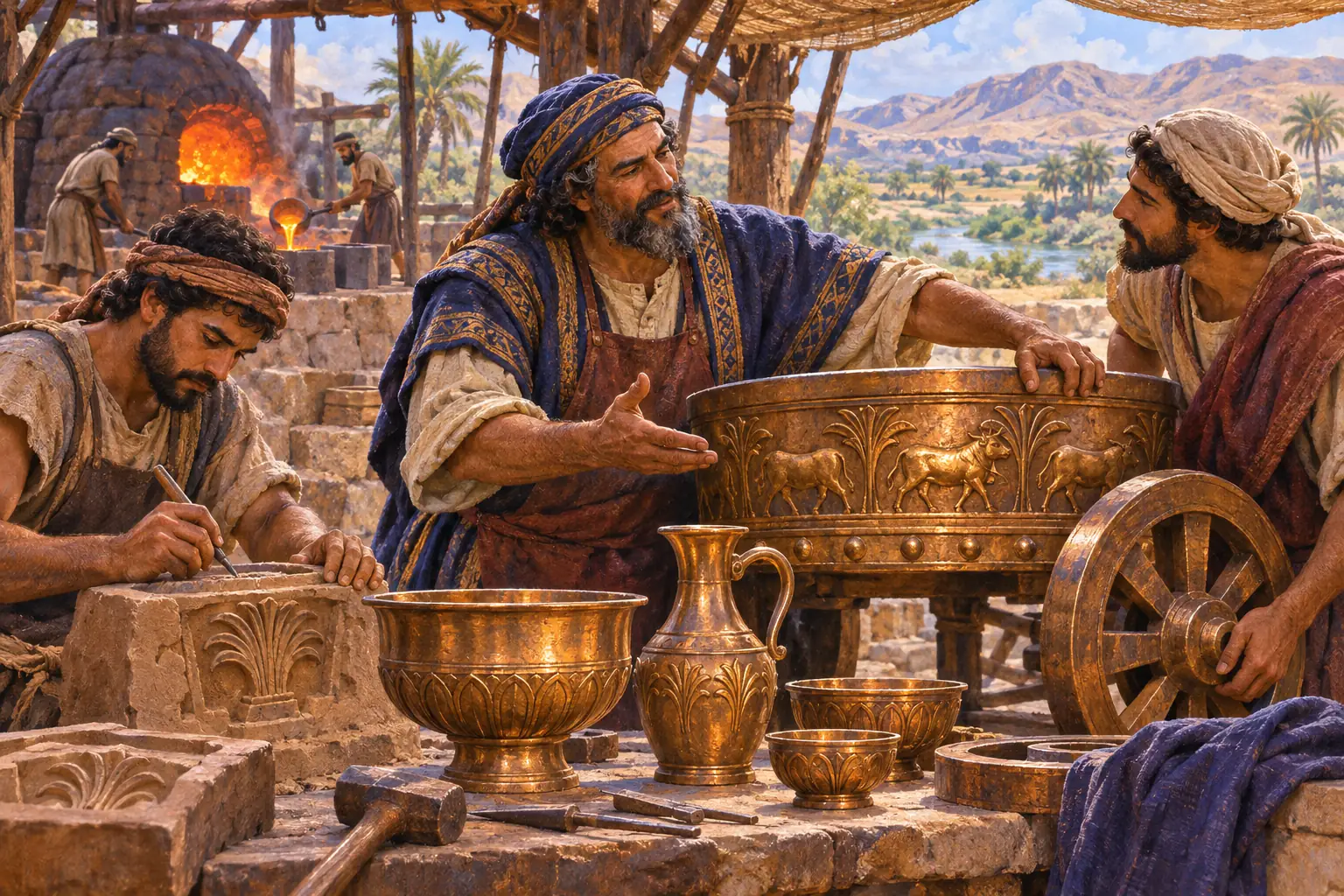
The account of furnishings introduces Hiram the craftsman from Tyre. The craftsman is distinct from Hiram the king in chapter 5. The description of wisdom, understanding, and knowledge recalls Bezalel’s preparation for tabernacle work (Exod 31:1–5). Sanctuary construction continues an earlier biblical pattern of skilled service.
The controlling word remains 6:11–13: God’s promise of dwelling among Israel belongs within covenant faithfulness. Brueggemann values the care given to worship while warning about the temptation to use sacred beauty for royal self-display (Brueggemann 2000, 103–104). The chapter can inspire gratitude for craftsmanship and examination of power at the same time.
Walking Through the Text
A Hall of Judgment within a Landscape of Splendor — 7:1–12
Solomon completes the royal complex over thirteen years. The House of the Forest of Lebanon measures one hundred cubits long, fifty wide, and thirty high. The abundant cedar columns explain the forest-like name. Later references associate the building with royal treasures and shields (10:17, 21).
The list includes a hall of pillars, a throne hall for judgment, Solomon’s residence, and a residence for Pharaoh’s daughter. Dressed stone, substantial foundations, cedar, and a great courtyard communicate wealth and organized achievement.
The judgment hall introduces a public obligation within the impressive setting. Royal authority should protect people through truthful decisions. Psalm 72:1–4 gives the obligation concrete direction: defend the poor and confront oppression. Brueggemann reads the hall against the biblical responsibilities of kingship (Brueggemann 2000, 93–95).
The narrative records the setting for justice, but architecture cannot demonstrate the quality of every judgment. A splendid courtroom requires a righteous judge. The residence for Pharaoh’s daughter also recalls the Egyptian alliance already introduced in 3:1, keeping royal policy within the reader’s field of attention.
Wisdom Arrives with a Craftsperson’s Hands — 7:13–14
Solomon summons Hiram from Tyre. The narrator identifies Hiram as the son of a widow from Naphtali and a father from Tyre skilled in bronze work. The family account places Israelite and Tyrian connections within the story of temple craftsmanship.
The decisive emphasis is competence. Hiram has wisdom, understanding, and knowledge for the work. The vocabulary recalls Bezalel without making Hiram a king or prophet. Wisdom belongs at the workbench as well as the judgment seat (Provan 2012, commentary on 1 Kgs 7:13–14).
The passage honors disciplined ability. Planning, shaping, casting, and finishing become forms of substantial service. A community prepared for worship needs more than public speakers. The named craftsperson helps prevent royal credit from swallowing the contribution of trained hands.
Two Pillars Announce Strength and Establishment — 7:15–22
Hiram casts two great bronze pillars with elaborate capitals. Networks, chains, pomegranates, and lily-shaped work join strength with carefully formed beauty. The pillars stand at the temple entrance and receive the names Jachin and Boaz.
Jachin is commonly associated with establishment; Boaz is traditionally connected with strength, although the precise interpretation remains debated. The names plausibly express confidence in divine sustaining power. Provan and Brueggemann both discuss the connection with the establishment of the royal house (Provan 2012, commentary on 1 Kgs 7:15–22; Brueggemann 2000, 98–99).
The covenant word must govern such confidence. A strong pillar cannot guarantee a faithful dynasty. The architectural proclamation should lead toward dependence on God and responsibility before God. The entrance stands within the promise to David, rather than above the conditions of obedience.
The Great Sea Holds Water within an Ordered Sanctuary — 7:23–26
The bronze Sea is a large circular basin supported by twelve bronze oxen, arranged in groups facing the four directions. A decorated rim and substantial capacity make the basin a striking feature of the sanctuary setting.
Kings describes the object more fully than the function. The parallel account explains the Sea’s use for priestly washing (2 Chr 4:6). The connection with the tabernacle’s washing basin provides further context for preparation to minister before God (Exod 30:18–21).
The name Sea also invites a possible symbolic reading. Biblical poetry celebrates the LORD’s power over threatening waters (Ps 93:3–4). Interpreters therefore see the contained water as a sign of creation ordered beneath divine rule. The symbolism is a plausible theological inference, rather than an explanation explicitly supplied in 1 Kings 7 (Brueggemann 2000, 99–100).
Practical use and symbolic depth can belong together. Water for service stands within a sanctuary expressing confidence in God’s holy, life-ordering presence.
Detailed Skill Makes the Worshiping Life Possible — 7:27–47
Ten bronze stands carry ten basins, with five placed on each side of the house. Wheels, supports, frames, and decorated panels receive close attention. Lions, oxen, cherubim, and palms continue the sanctuary’s language of strength, sacred attendance, and living creation.
The parallel in Chronicles distinguishes the smaller basins’ use for washing sacrificial materials from the Sea’s use for priests (2 Chr 4:6). The elaborate objects support concrete work. The ornamental and the useful belong within the same act of preparation.
The closing inventory gathers pillars, capitals, networks, pomegranates, stands, basins, the Sea, oxen, and utensils. Casting takes place in the Jordan plain, between Succoth and Zarethan. The enormous quantity of bronze leaves the total weight undetermined.
The scale conveys an extraordinary achievement. The detail also preserves work easily overlooked in a quick account of royal greatness. Worship requires preparation, maintenance, and ordinary tools alongside prominent objects. The many vessels should remain subject to the covenant’s question about faithful use, rather than becoming the final measure of spiritual success.
Finished Vessels Await the Next Gift — 7:48–51
The final section credits Solomon with the golden furnishings: an altar, the table for the bread of the Presence, ten lampstands, and associated utensils and fittings. Royal credit names responsibility for the commission; the statement does not require Solomon personally to forge every object.
Altar, table, and lamps continue patterns already present in the tabernacle (Exod 25:23–40; 30:1–10). The house is being prepared for a regular life of worship, rather than a single moment of admiration.
Solomon brings David’s dedicated silver, gold, and vessels into the treasuries. The work reaches completion within a history extending beyond Solomon’s reign. The gifts of an earlier generation find a place in the new sanctuary.
The ark has not yet been brought in, and the chapter does not narrate the glory filling the house. Finished equipment is preparation for the encounter described in chapter 8. Human craftsmanship can make ready; God’s presence remains God’s gift.
Theological Reflection — Skill, Cleansing, and Accountable Splendor
God’s service includes the work of trained hands
Hiram’s competence receives the language of wisdom. The chapter widens the reader’s understanding of meaningful service: metalwork, design, and practical understanding matter. Congregations should honor craftsmanship and quiet reliability alongside teaching and leadership. Training and patient improvement can become faithful stewardship of ability.
Royal beauty must remain answerable to justice
The hall of judgment sits within costly buildings. The juxtaposition asks whether public resources and royal authority serve the vulnerable. Beauty can support the dignity of worship and public life. The danger arises when admiration replaces examination and expensive surroundings become a substitute for truthful, just conduct.
Preparation for holiness touches ordinary practice
The basins and utensils show a worshiping life requiring concrete preparation. Cleanliness, order, and attention have a place. Yet the covenant demands extend beyond the management of ritual equipment. The God being worshiped also requires faithfulness in human relationships. Sacred objects cannot carry the moral responsibility of the people using the objects.
Completion should produce gratitude and readiness
The repeated finishing gathers years of work into a substantial achievement. David’s dedicated gifts remind the present king about inherited generosity. Gratitude should therefore lead toward readiness for God’s purposes. An opening ceremony cannot make a community’s obedience complete or place a leader beyond correction.
Canonical and Christological Horizon — From Prepared Vessels to a Cleansed People
The strongest early connection is the tabernacle. Hiram’s wisdom and the furnishings continue the biblical account of a dwelling prepared for God among the people. The temple enlarges the material setting while retaining the need for covenant faithfulness (BibleProject n.d., 1–3).
The New Testament identifies Jesus’ body as the temple through the saying about destruction and resurrection (John 2:19–22). The connection concerns God’s dwelling and access through Jesus. Individual wheels, pomegranates, and measurements need no private code to make the chapter Christian Scripture.
Hebrews carries the larger sanctuary pattern toward Christ’s priestly work. Ritual washings belong within the earlier order, while Christ’s self-offering cleanses the conscience for service to the living God (Heb 9:9–14). Access to God therefore opens into faithful living (10:19–24). The comparison does not require identifying every basin in 1 Kings 7 as a separate prediction.
The church becomes a dwelling built together in Christ through the Spirit (Eph 2:19–22). The responsibility reaches from worship into relationships, work, and care for neighbors. Revelation finally portrays a city requiring no temple building because God and the Lamb are the temple (Rev 21:22). The gold of Solomon’s sanctuary participates in a story directed toward God’s unveiled presence among a renewed people and creation.
Life Application — Let the Work Serve the Calling
- Honor a practical gift. Thank a craftsperson, cleaner, technician, or maintenance worker by naming a specific contribution. Provide suitable equipment or training rather than relying upon appreciation alone.
- Review priorities through actual commitments. Compare time, money, and attention given to personal prestige with resources supporting worship, justice, and care. Change a specific allocation when the imbalance becomes clear.
- Connect authority with a fair hearing. In a family, ministry, or workplace dispute, provide a respectful opportunity for the less influential person to speak. Judge the issue through evidence and consistent standards.
- Prepare ordinary tools faithfully. Check equipment, accessibility, cleanliness, and communication before a gathering. Share maintenance responsibilities so a few dependable workers do not carry an invisible burden.
- Join outward care with inward truthfulness. Address a dishonest report, unpaid obligation, or unresolved injury. Let confession and repair accompany the attention given to visible worship arrangements.
- Finish with gratitude and open hands. At the completion of a project, acknowledge earlier donors, current workers, and affected households. Invite honest feedback and leave room for God’s purposes beyond the leadership’s preferred outcome.
Reflection Questions
- How does the placement of the royal complex within the temple account shape the chapter’s questions about priority?
- Which assumptions about important ministry are challenged by Hiram’s description in verse 14?
- How can confidence in God’s strength become distorted into confidence in an institution’s permanence?
- Where do visible standards of excellence need to be matched by justice or personal honesty?
- Which practical act would help a present gift, resource, or position serve the character and purposes of Jesus?
Response Prayer
Holy God, giver of wisdom for minds and hands, receive thanksgiving for patient workers and the gifts supporting shared worship. Keep unnoticed service within the gratitude of the church.
Bring personal ambition beneath the covenant. Let authority make room for truth, and let the beauty of public spaces be matched by justice for vulnerable people. Forgive expensive appearances used to conceal a neglected duty.
Cleanse conscience through the grace of Jesus. Repair habits of dishonesty, pride, and careless treatment of neighbors. Give congregations strength to prepare faithfully and humility to remain teachable after success.
Risen Lord, true dwelling of God among humanity, make every useful skill an instrument of service. Let completed work lead to gratitude and readiness. Sustain hope for the day of unveiled presence, when God’s peace fills renewed creation. Amen.
Window into What Comes Next — The Prepared House Meets the Presence
The bronze and gold are ready. David’s dedicated gifts have entered the treasuries, and the work of the house is complete. First Kings 8 will bring the ark, the gathering of Israel, the cloud of divine glory, and Solomon’s great prayer.
The story will move from the achievements of builders to the freedom and generosity of God. Even the heavens cannot contain the LORD, as Solomon will confess. The prepared house becomes the setting for a larger question: how can a people receive holy presence through prayer, repentance, and faithful life?
Bibliography
- BibleProject. n.d. Temple: Script References. Supplied PDF, 1–3. Especially the sanctuary theme through Jesus, the church, and new creation.
- Brueggemann, Walter. 2000. 1 & 2 Kings. Smyth & Helwys Bible Commentary. Macon, GA: Smyth & Helwys. Especially 93–104.
- The Holy Bible: King James Version. 1769 edition. “1 Kings 7.” Bible Gateway. Scripture summaries and interpretive paraphrases are distinguished from direct quotation throughout the study.
- Provan, Iain W. 2012. 1 & 2 Kings. Understanding the Bible Commentary Series. Grand Rapids: Baker Books. Originally published 1995. Sections “Solomon Builds His Palace (1 Kgs. 7:1–12)” and “The Temple’s Furnishings (1 Kgs. 7:13–51).” Section references used because the supplied electronic edition has no stable printed pagination.
Be the first to leave a comment.