

Why does the temple dedication already contain a sustained prayer for exile?
Study overview
God’s Holy Presence and the Prayer Reaching toward Forgiveness, Justice, and the Nations
By Pr Enos Mwakalindile Reading: 1 Kings 8:1–66 Key verse: 1 Kings 8:30 — Solomon asks God to hear the prayers of king and people from heaven and to forgive. (Summary, not a direct quotation.)
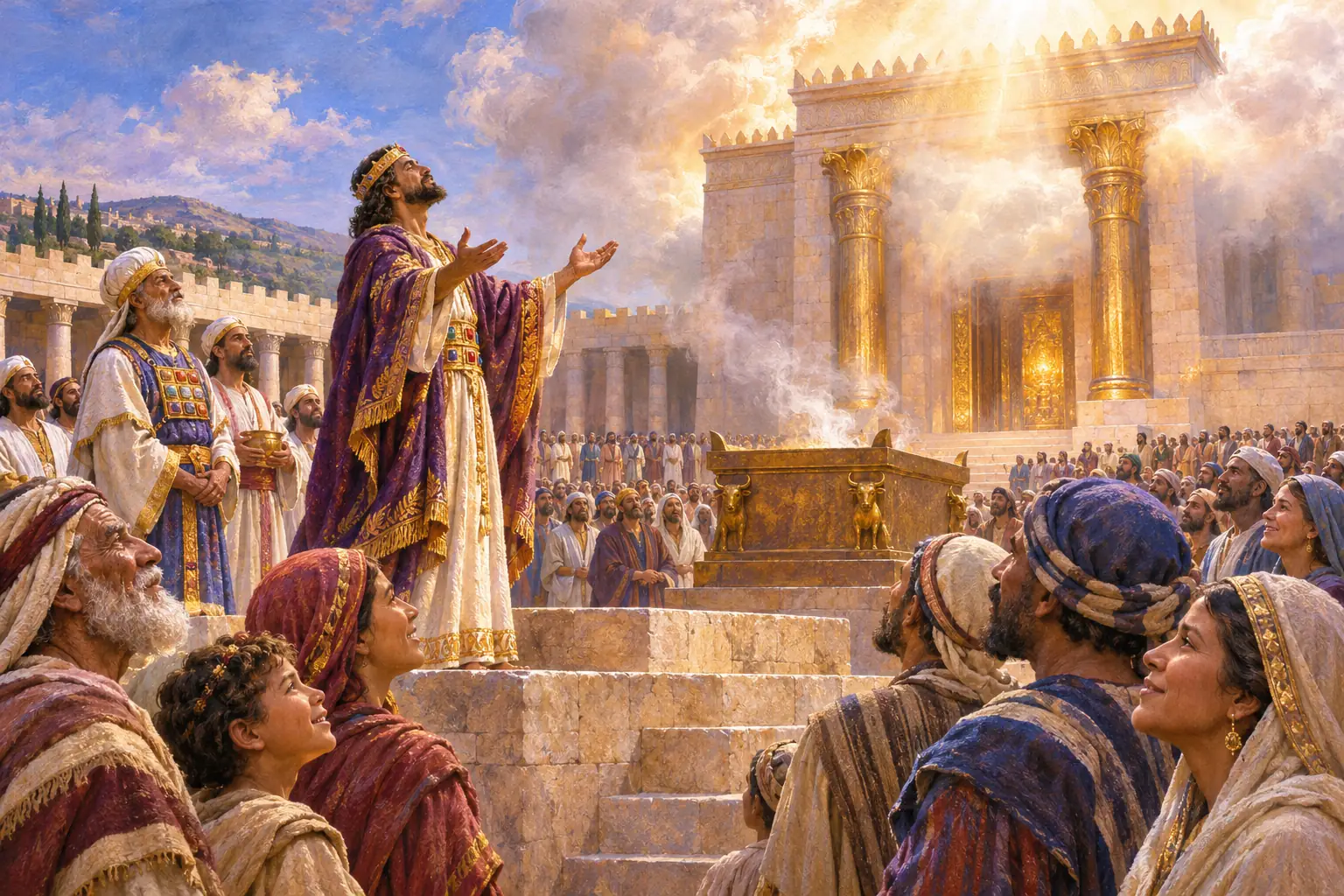
The house receives a cloud of glory. The king opens empty hands toward heaven. A foreigner approaches; an exile remembers home. Beyond the golden walls, mercy can still hear a human cry.
Introduction — The Need to Know Prayer Can Still Be Heard
A familiar place of worship can carry years of memory: a prayer beside a parent, a hymn after a funeral, a promise made before a congregation. Such places matter. Yet illness, imprisonment, migration, or personal failure can separate a person from the setting once associated with God’s nearness. The searching question becomes painfully simple: can prayer still reach God from here?
First Kings 8 begins with the dedication of an extraordinary sanctuary. The ark enters, the cloud fills the house, and the priests cannot continue ministry before the weight of divine glory. The moment is genuinely magnificent.
Yet Solomon’s prayer refuses to leave God enclosed within the magnificent moment. Even the highest heavens cannot contain the LORD. The prayer moves toward disputed justice, drought, sickness, a foreigner’s request, and eventual exile. The celebration already makes room for the failures and sorrows ahead.
Where can a wounded or guilty people find a hearing? First Kings 8 reveals God’s presence as a holy gift beyond human control, inviting prayer grounded in covenant mercy and expressed through repentance, justice, and a welcome reaching the nations. The building becomes a focal point of prayer. The mercy of God reaches beyond the building.
Historical and Literary Context — Dedication beneath the Covenant
Chapters 5–7 prepared the temple and furnishings. Chapter 8 explains the sanctuary’s significance through procession, glory, blessing, prayer, sacrifice, and celebration. The ark and tent connect the new building with the God of the exodus; the tablets within the ark keep the covenant at the center.
The gathering takes place in Ethanim, the seventh month, during the festival associated with the Feast of Booths (8:2; Lev 23:33–43). A celebration recalling life in temporary shelters accompanies the movement toward a permanent sanctuary. The continuity of God’s faithfulness matters more than the impressiveness of a new address.
Solomon recalls the promise to David, but the prayer also draws deeply upon Moses. Defeat, drought, famine, and exile belong within the covenant warnings of Deuteronomy 28. Repentance and renewed hope recall Deuteronomy 30:1–10. Provan identifies the prayer as a major interpretive guide for the whole book, including hope beyond the eventual loss of land and temple (Provan 2012, commentary on 1 Kgs 8:22–53).
For readers encountering Kings through the tragedy of exile, the prayer offers a vocabulary for returning to God after collapse. The book’s historical judgment never becomes permission for despair. Brueggemann emphasizes the pastoral force of a prayer reaching from failed security toward forgiveness (Brueggemann 2000, 110–114). The dedication opens a future larger than royal success.
Walking Through the Text
The Covenant Enters, and Glory Interrupts the Service — 8:1–13
Solomon gathers Israel’s elders and tribal leaders. Priests carry the ark from the City of David into the inner sanctuary beneath the cherubim. The tent and sacred vessels accompany the movement, while king and people offer sacrifices.
Verse 9 specifies the ark’s contents: the two stone tablets placed by Moses at Horeb. The sacred center carries the witness to covenant. A splendid temple cannot release Israel from the word already given by God.
The cloud fills the house after the priests withdraw. The glory prevents the priests from standing to minister, recalling the cloud filling the completed tabernacle (Exod 40:34–35). Human preparations meet an action belonging to God. The moment affirms real divine presence without turning the ceremony into a means of control.
Solomon speaks of God dwelling in thick darkness and celebrates the prepared house. The imagery conveys holy mystery. The later confession in verse 27 will require the language of dwelling to remain larger than physical confinement (Provan 2012, commentary on 1 Kgs 8:3–13).
Thanksgiving Remembers a Promise before a Building — 8:14–26
Solomon turns and blesses the standing assembly. The speech interprets the temple through God’s promise to David: David desired to build, but the work belonged to David’s son. Solomon now occupies the throne and has provided a place for the ark.
The emphasis falls upon divine faithfulness. God’s speaking and accomplishing belong together. The royal achievement is narrated as the fulfillment of a word received before the work began.
Solomon then stands before the altar, spreads hands toward heaven, and praises the incomparable God of covenant love. The prayer asks for the continuing fulfillment of the Davidic promise and acknowledges the obligation of faithful conduct. Promise and obedience remain together. The king can lead the congregation in prayer but must also stand beneath God’s instruction.
The House Points toward a God beyond Containment — 8:27–30
Verse 27 changes the scale: earth, heaven, and the highest heavens cannot contain God. The temple’s beauty cannot make the building adequate to enclose the Creator.
The next request remains astonishingly confident. Solomon asks for God’s attentive regard toward the house bearing God’s name. The king and people may pray toward the sanctuary, and God may hear from heaven and forgive. Nearness and freedom remain together: God genuinely receives prayer while exceeding the limits of sacred architecture.
The confession of God’s greatness also guides the language of heavenly dwelling. The purpose is reverence and trust rather than a physical map of God’s location. The temple serves as a focus for petition without becoming a container of divine power (Provan 2012, commentary on 1 Kgs 8:27–30).
The repeated concern of the prayer now becomes clear: a people need a hearing, a truthful judgment, and mercy.
Prayer Opens toward Justice, Affliction, and the Foreigner — 8:31–45
Six petitions lead toward the longer appeal concerning exile. The first concerns a disputed wrong and an oath before the altar (31–32). Solomon asks God to condemn the guilty and vindicate the righteous. The sanctuary must serve justice rather than conceal harm.
The second concerns defeat following Israel’s sin (33–34). Turning, confessing God’s name, and pleading lead into a request for forgiveness and restoration. The third concerns drought (35–36). The prayer asks for rain and instruction in the good way of life. Forgiveness should renew conduct as well as circumstances.
The fourth concerns famine, disease, crop failure, siege, and personal anguish (37–40). God knows the human heart. The prayer makes room for an individual’s distress within the gathered people’s life.
The fifth concerns a foreigner arriving because of God’s great name (41–43). Solomon asks God to hear the visitor’s prayer so the peoples of the earth may know and revere the LORD. Israel’s election opens toward witness and blessing beyond Israel.
The sixth concerns an army sent into battle (44–45). The wording places the mission under God’s sending. The petition cannot simply be transferred into an automatic divine endorsement of every national campaign.
The petitions belong to Israel’s covenant story. The passages concerning affliction do not authorize blaming a particular patient’s illness upon a hidden personal sin. The wider biblical witness, including John 9:1–3, requires greater care. Prayer should bring sufferers before God with compassion and truthful discernment.
Even Exile Does Not Close the Way of Return — 8:46–53
The seventh petition anticipates captivity. Solomon acknowledges the universality of human sin and imagines a people carried into an enemy’s land. The temple’s dedication already contains a prayer for life after national failure.
The turning point is repentance within exile. The captives remember, confess wrongdoing, and return wholeheartedly to God. Prayer reaches toward land, city, and house from the place of displacement. God can hear without the praying people standing within the temple courts.
Solomon asks for forgiveness, upheld justice, and compassion from captors. The appeal rests upon belonging: Israel remains God’s inheritance, the people brought out of Egypt’s iron furnace. Grace precedes the present crisis and sustains the possibility of a future (Provan 2012, commentary on 1 Kgs 8:46–53).
The petition will matter when the book reaches exile. Loss and judgment are real; the capacity to turn toward God has not been abolished.
Grace Turns the Congregation toward Faithful Life — 8:54–66
Solomon rises from kneeling with hands extended and blesses the congregation. The blessing praises God’s fulfilled promises and asks for continuing presence. Verse 58 also asks God to incline hearts toward obedience. The needed response includes grace at work within human desire.
The purpose reaches outward again: the peoples of the earth should know the LORD (60). Wholehearted devotion should shape the people’s continuing conduct (61). The celebration must travel into ordinary life.
Sacrifices and a great festival mark the dedication. The narrative describes a vast assembly and an extraordinary scale of offerings. The final note centers gladness in God’s goodness toward David and Israel. The people return home with joy. Worship has gathered a nation; the coming chapters will test the nation’s faithfulness after the festival.
Theological Reflection — Holy Presence and Open Mercy
God’s nearness cannot be possessed
The cloud affirms God’s presence; verse 27 resists confinement. The tension protects worship from both emptiness and manipulation. God can meet a community through a meaningful place and practice without becoming the property of a leader, institution, or nation. Reverence receives a gift; humility remembers the freedom of the Giver.
Forgiveness belongs with truth and turning
The prayer seeks a truthful verdict in the first petition and mercy after confessed failure in later petitions. Grace does not require pretending wrongdoing never occurred. Returning to God involves honest recognition and a changed direction. Forgiveness opens a future in faithful relationship rather than providing a religious shelter for repeated harm.
Election carries a horizon of welcome
The foreigner’s petition and the final blessing place the nations within Israel’s prayer. A distinctive covenant calling should make God known. The community honoring God’s name must therefore examine the barriers facing a newcomer seeking a hearing, prayer, and belonging.
Failure need not become the final word
The exile petition holds judgment and hope together. The same God remembered in deliverance from Egypt can hear displaced people after disaster. For ministry among people facing confinement, estrangement, or shame, the passage offers a strong foundation for prayer and repentance without promising the immediate removal of every consequence.
Canonical and Christological Horizon — Prayer Opens through the Faithful King
The exodus cloud and covenant frame the temple dedication; the exilic petitions anticipate a return shaped by mercy. Daniel’s prayer toward Jerusalem provides a later example of faithfulness in displacement (Dan 6:10). The temple points beyond national security toward the living God’s attentiveness.
Isaiah’s vision of a house of prayer for all peoples develops the horizon already present in Solomon’s intercession for the foreigner (Isa 56:6–8). Jesus invokes the prophetic vision during the temple confrontation (Mark 11:17). Worship must remain answerable to God’s purpose for people approaching from beyond familiar boundaries.
John identifies Jesus’ body as the temple through death and resurrection, while Jesus’ conversation with the Samaritan woman directs worship toward the Father in spirit and truth beyond a contest between sacred locations (John 2:19–22; 4:21–24). The faithful King brings access to God through a life and saving work beyond Solomon’s capacity.
Hebrews therefore invites confident approach through Jesus’ priestly ministry (Heb 4:14–16). Confidence includes mercy and timely help, rather than control over God. The biblical horizon finally reaches God dwelling with humanity, where tears and death are removed (Rev 21:3–4). The glory filling one house points into a story of creation renewed in God’s presence (BibleProject n.d., 3).
Life Application — Carry Prayer beyond the Sanctuary Door
- Pray from the actual place of life. A hospital bedside, prison cell, rented room, or distant town can become the setting for honest prayer. Name the present need and remember God’s attentive freedom.
- Join confession to repair. Identify a specific wrong, confess the action without excuse, and arrange a concrete step of restitution or changed conduct. Preserve appropriate accountability during the process.
- Bring a disputed case into truthful light. Hear the affected people, examine evidence, and pray for justice. Avoid using religious loyalty to protect a favored offender or silence a harmed person.
- Welcome a prayerful newcomer. Help a visitor across a language, cultural, or social barrier. Offer a respectful hearing and include the newcomer’s actual concern in congregational prayer.
- Intercede with compassionate care. Support a grieving or ill person through presence, prayer, and practical help. Resist careless explanations of suffering and make room for lament.
- Ask for an obedient heart after worship. Turn a meaningful service into a specific commitment: reconciliation, fair treatment, faithful giving, or sustained support for a struggling household. Review the commitment after the celebration.
Reflection Questions
- How do the cloud of glory and Solomon’s confession in verse 27 shape a fuller understanding of God’s presence?
- Which petition most closely addresses a present need for justice, mercy, or restoration?
- How does the prayer for the foreigner challenge a congregation’s welcome?
- Where must confession become a concrete change rather than repeated religious language?
- How could hope for a hearing beyond the temple strengthen ministry among displaced, confined, or ashamed people?
Response Prayer
God of covenant mercy, holy beyond the highest heavens and attentive to a human cry, receive thanksgiving for faithful promises. Let worship awaken reverence without feeding pride in a building, a name, or a position.
Hear the wronged seeking justice, the guilty seeking a changed life, the sick longing for comfort, and the foreigner seeking welcome. Teach the church to offer truth with compassion and hospitality with courage.
Remember people far from home, people behind locked doors, and people burdened by shame. Open a path of confession, forgiveness, and faithful action. Incline hearts toward God’s ways and sustain hope through consequences still requiring endurance.
Risen Jesus, faithful King and merciful High Priest, carry human need into the presence of God. Let gratitude become obedience and prayer become loving service, until divine glory fills renewed creation. Amen.
Window into What Comes Next — The Answer Includes a Warning
The people have returned home glad, and Solomon has prayed for attentive mercy. First Kings 9 will record God’s response. The house receives divine acknowledgment, while king and people face a renewed summons to faithfulness.
The warning will be sobering: even the magnificent temple can become a ruin if Israel abandons the covenant for other gods. The next chapter also returns to royal projects and relationships. A prayer has named the path of life. Can the ruler continue to walk the path after the glory of dedication?
Bibliography
- BibleProject. n.d. Temple: Script References. Supplied PDF, 1–3. Especially divine presence, Jesus as temple, and new creation.
- Brueggemann, Walter. 2000. 1 & 2 Kings. Smyth & Helwys Bible Commentary. Macon, GA: Smyth & Helwys. Especially 105–120.
- The Holy Bible: King James Version. 1769 edition. “1 Kings 8.” Bible Gateway. Scripture summaries and interpretive paraphrases are distinguished from direct quotation throughout the study.
- Provan, Iain W. 2012. 1 & 2 Kings. Understanding the Bible Commentary Series. Grand Rapids: Baker Books. Originally published 1995. Sections “The Ark Brought to the Temple (1 Kgs. 8:1–21),” “Solomon’s Prayer (1 Kgs. 8:22–53),” and “The Temple Narrative Ended (1 Kgs. 8:54–9:9).” Section references used because the supplied electronic edition has no stable printed pagination.
Be the first to leave a comment.