

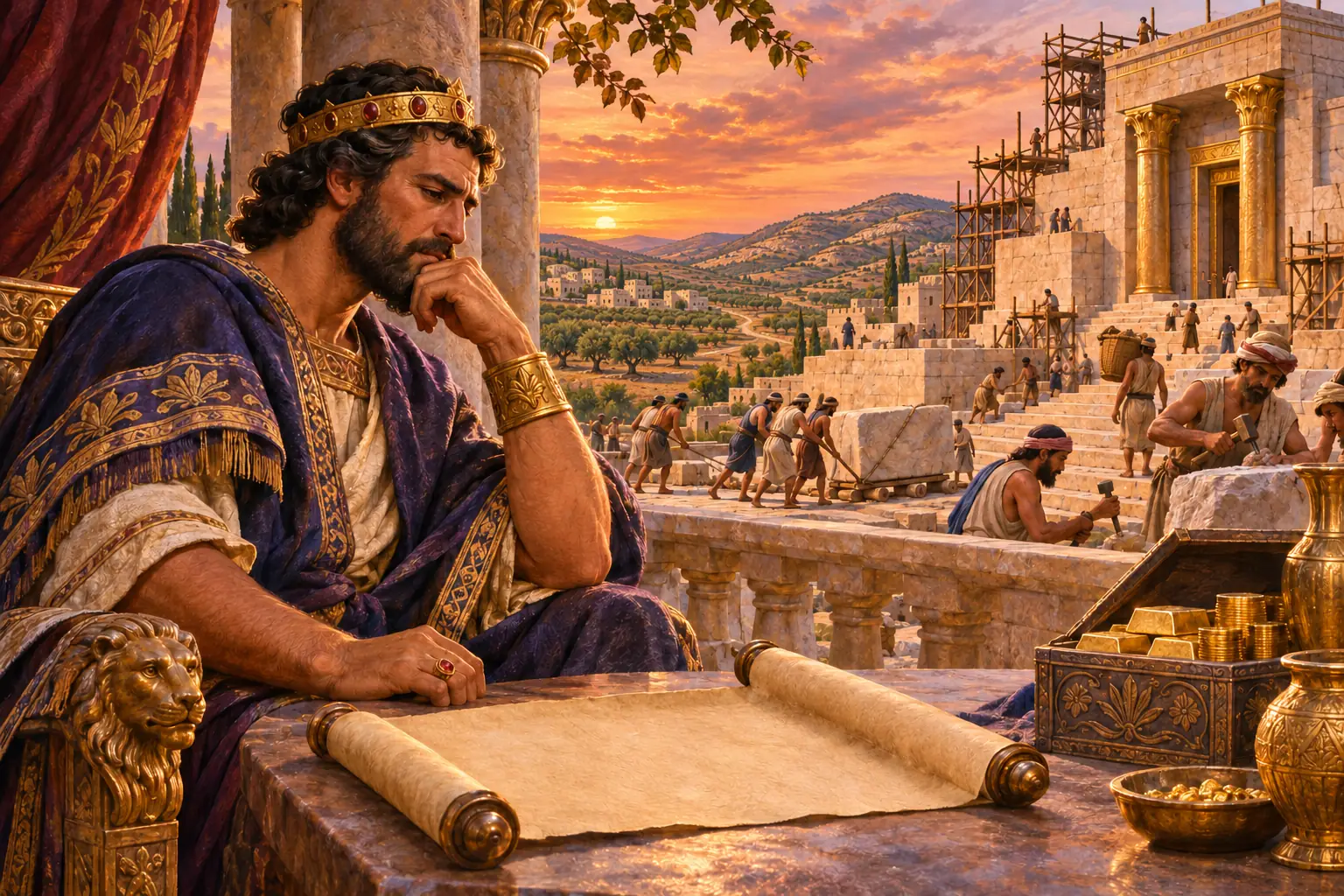
How does Hiram’s dissatisfaction change the reading of Solomon’s successful building program?
Study overview
God’s Answer, Solomon’s Achievements, and the Covenant beneath Success
By Pr Enos Mwakalindile Reading: 1 Kings 9:1–28 Key passage: 1 Kings 9:3–5 — God acknowledges Solomon’s prayer and the consecrated temple while calling the king to integrity, uprightness, and obedience. (Summary, not a direct quotation.)
The house is finished; the question remains. God answers prayer and speaks about a faithful walk. Cities change hands, workers carry stone, and ships return with gold. Beneath the growing achievement, the covenant keeps watch.
Introduction — The Danger of Success beyond Correction
Success can make a warning sound unnecessary. A completed project, a rising income, or an admired ministry can persuade a leader to stop asking difficult questions. The visible result becomes an argument for the method. Criticism begins to sound like ingratitude.
First Kings 9 stands at such a moment. The temple and royal complex are finished. Solomon has prayed a great prayer, gathered the people, and celebrated God’s goodness. The next divine appearance could easily be imagined as an uncomplicated approval of everything the king has become.
God’s response includes genuine affirmation. The prayer has been heard, and the house has been consecrated for God’s name. Yet the response also contains a severe warning. Dynasty, land, and temple remain answerable to covenant faithfulness. The chapter then describes trade, construction, labor, worship, and imported gold beneath the warning’s shadow.
Can achievement remain open to God’s correction? First Kings 9 reveals divine favor calling successful people toward integrity, while exposing the danger of allowing religious privilege and material growth to conceal compromised loyalties and costly human arrangements. The warning is part of the answer to prayer. Faithfulness requires listening after the celebration.
Historical and Literary Context — After the Dedication, before the Fracture
Chapter 8 asked God to hear from heaven, forgive, sustain the dynasty, and attend to the house bearing God’s name. First Kings 9:1–9 responds to the prayer and recalls the earlier appearance at Gibeon in chapter 3. The first appearance emphasized wisdom and the beginning of a royal calling. The second places accumulated achievement beneath renewed accountability.
The divine speech draws upon Deuteronomy. The warning of removal from the land recalls covenant curses, while the future question concerning national disaster resembles Deuteronomy 29:24–28. Kings will eventually narrate the ruin already brought into view (2 Kgs 24–25). Provan reads the passage as a decisive warning over Solomon’s apparent golden age (Provan 2012, commentary on 1 Kgs 9:1–9).
Verses 10–28 revisit earlier themes: dealings with Hiram, the labor levy, royal officials, Pharaoh’s daughter, sacrifice, and international wealth. The chapter is a thematic collection of royal affairs rather than a diary locating every transaction in an exact sequence. The twenty-year notice connects the account with the two great building enterprises (9:10).
Brueggemann stresses the effect of placing covenant warning beside impressive royal activity (Brueggemann 2000, 121–130). The achievements remain visible, but the reader now possesses a moral measure larger than success. The developing story will ask whether the king’s gifts continue to serve the purposes of God.
Walking Through the Text
God Hears the Prayer and Calls for Integrity — 9:1–5
After the building work, the LORD appears to Solomon again, recalling Gibeon. God declares the prayer heard and the house consecrated. The language of God’s name, eyes, and heart expresses sustained attention and genuine commitment.
The speech immediately turns toward Solomon’s walk. Integrity of heart, uprightness, and obedience belong with the promise of an established throne. Divine acknowledgment of the building cannot become permission to ignore God’s commands.
David supplies a covenant benchmark. The wider biblical account includes David’s grave failures and confession, so the comparison should not be reduced to a claim of faultless performance (2 Sam 11–12). The emphasis concerns a life oriented toward God’s authority. Solomon must bring conduct under the word already received.
The affection expressed in verse 3 remains substantial. The warning does not make the answer unreal; the answer does not remove the need for faithfulness. Grace and responsibility meet within the same divine speech.
The Consecrated House Can Still Become a Ruin — 9:6–9
The address widens from Solomon to the king’s descendants and people. Turning from God’s commandments toward the worship of other gods threatens the nation’s future. The LORD can remove Israel from the land and reject the very house consecrated for God’s name.
Passing observers will ask about the devastation. The answer will identify abandonment of the LORD, the God of the exodus. The ruin will witness to covenant betrayal rather than a lack of divine power. The warning is sharpened by remembered rescue: the people have turned from the Deliverer.
The passage denies automatic religious immunity. A sanctuary’s honored past cannot protect a community determined to abandon God’s ways. The repeated concern with other gods also gives the warning a definite focus; the speech should not become a demand for anxious speculation about every ordinary setback.
Brueggemann notes the clarity of the covenant alternatives and the horizon of exile (Brueggemann 2000, 121–123). The land is a gift, and the gift carries a vocation. Sacred history must remain a reason for faithfulness rather than an excuse for presumption.
A Successful Deal Leaves a Partner Dissatisfied — 9:10–14
Hiram has supplied timber and gold. Solomon gives Hiram twenty towns in Galilee. Hiram inspects the towns and expresses displeasure, naming the region Cabul. The precise meaning of the name remains disputed; the dissatisfaction is explicit.
The account also records one hundred and twenty talents of gold sent by Hiram. The financial arrangements are not fully explained. A reader should avoid inventing a complete contract or a detailed account of the towns’ defects.
The change from chapter 5’s celebrated cooperation is significant. Royal desire has been satisfied, yet the partner’s protest enters the story. The residents of the transferred towns receive no recorded voice in the transaction. Brueggemann draws attention to the power implied in treating communities as elements of a royal exchange (Brueggemann 2000, 123–124).
The episode asks whether competence in obtaining an advantage has remained wisdom in the covenant sense. A profitable result can coexist with a damaged relationship.
Impressive Buildings Carry Histories of Power and Labor — 9:15–23
The labor levy supports the temple, the royal house, the Millo, Jerusalem’s wall, and work at Hazor, Megiddo, and Gezer. Store cities, chariot cities, and settlements for horsemen extend the scale. The exact form of the Millo remains uncertain, but the list clearly describes substantial royal infrastructure.
Gezer receives a disturbing explanatory note. Pharaoh captured and burned the city, killed the Canaanite inhabitants, and gave the city to Pharaoh’s daughter, Solomon’s wife. The narrator attributes the military action to Pharaoh. The royal gift nevertheless carries a history of human loss into Solomon’s building program.
The account distinguishes surviving non-Israelite populations placed under continuing bondservice from Israelites serving in military, administrative, and supervisory roles. Five hundred and fifty chief officials oversee the work. The relationship with the levy described in 5:13–18 is debated, including distinctions between labor categories. The later complaint about Solomon’s heavy yoke prevents the statement about Israelites from being read as proof of a burden-free population (12:4).
The hierarchy is part of the ancient system described. Careful theological application must attend to the dignity of workers beyond favored ethnic or social circles. An impressive structure does not make the people sustaining the structure morally invisible (Provan 2012, commentary on 1 Kgs 9:15–25).
Royal Worship Continues beside Royal Ambition — 9:24–25
Pharaoh’s daughter moves from the City of David into the house Solomon built for the royal wife. The Millo appears again. Domestic arrangements, diplomacy, and construction remain intertwined.
The narrator then records Solomon’s offerings three times a year at the temple altar. The rhythm recalls Israel’s annual festival obligations (Exod 23:14–17). Worship continues as part of the king’s public responsibilities.
The text reports real religious activity without independently describing every inner motive. The opening divine speech supplies the test: sacrificial observance must belong with covenant obedience. The reader need neither dismiss worship as empty performance nor allow worship to silence questions about the rest of royal life.
Skilled Sailors Bring Home More Gold — 9:26–28
Solomon establishes a fleet at Ezion-geber near Eloth, on the Red Sea in Edom. Hiram supplies sailors experienced at sea to work with Solomon’s servants. International cooperation and specialized skill produce another striking result.
The ships return from Ophir with four hundred and twenty talents of gold for Solomon. Ophir’s exact location remains uncertain; the narrative’s emphasis rests on the valuable cargo reaching the king.
The ending leaves a strong contrast. The chapter began with God’s call to integrity and finishes with an enlarged royal treasury. Wealth is not automatically condemned, but Deuteronomy warns the king against excessive accumulation (Deut 17:17). The spiritual question concerns the loyalties and uses forming around the gold. Can the king still hear the covenant beneath the noise of success?
Theological Reflection — The Covenant Measures the Achievement
God’s attentiveness invites a faithful response
The prayer has been heard. The temple has been set apart. God’s answer begins in committed attention, not indifference. The call to obedience therefore belongs within grace already given. A community receiving divine generosity should become more teachable and responsible, especially after visible success.
Idolatry redirects the whole life
The warning concerns serving other gods. The later royal report invites attention to the practical directions of loyalty: ambition, status, military security, and wealth. Solomon’s explicit apostasy will be narrated in chapter 11. The signs require examination before divided loyalty becomes an openly abandoned covenant.
Competence must remain joined to neighborly faithfulness
Solomon organizes construction, oversees labor, negotiates territory, and develops maritime trade. The capacities are substantial. The ethical question concerns the people affected by the use of royal ability. Hiram’s dissatisfaction and the unequal labor structure resist an evaluation based only on buildings and gold. Covenant wisdom asks about fairness, dignity, and the cost carried by less powerful people.
A warning can preserve the possibility of repentance
The account’s future ruin is sobering, but the warning is spoken before the narrated apostasy and collapse. God addresses a king still capable of hearing. Chapter 8’s prayer for forgiveness after failure remains part of the context. Moral seriousness and hope for return must therefore remain together; judgment does not turn repentance into an empty gesture.
Canonical and Christological Horizon — A Faithful King beyond Presumption
The warning against trusting a sacred building develops through the prophets. Jeremiah exposes worship used as shelter for covenant-breaking; Jesus later announces the vulnerability of the admired temple buildings to judgment (Jer 7:3–14; Mark 13:1–2). Religious splendor cannot make faithfulness unnecessary.
John locates the temple’s deeper fulfillment in Jesus’ body through death and resurrection (John 2:19–22). The Davidic hope reaches Jesus, the faithful King carrying the story beyond Solomon’s divided loyalties. The cross reveals royal greatness expressed through costly love (Mark 10:45).
Jesus also joins abiding love with obedience, calling disciples to remain within a life shaped by the commands and love of Christ (John 15:9–12). The Christian response grows from communion and grace. The covenant’s moral seriousness becomes a summons to faithful discipleship rather than confidence in an institution’s immunity.
Paul describes the gathered church as God’s holy temple and treats harm to the community with gravity (1 Cor 3:16–17). Care for God’s dwelling therefore includes the lives and relationships of people. The biblical story finally reaches God and the Lamb dwelling with humanity in renewed creation (Rev 21:3, 22). The goal of the sanctuary is a holy, reconciled life in God’s presence (BibleProject n.d., 3).
Life Application — Listen after the Celebration
- Review a recent success before expanding. Ask a trusted colleague to examine the methods, relationships, and burdens behind the result. Name one needed correction and make the correction before beginning another major project.
- Honor the disappointed partner. Revisit an agreement after a colleague or supplier raises a concern. Hear the complaint without appealing to status, then address any misleading expectation or unfair term.
- Include the people affected by a transfer or plan. Before moving a responsibility, changing a workplace arrangement, or committing shared property, explain the proposal to the affected people and seek meaningful participation.
- Examine treatment across social boundaries. Compare the conditions given to influential members, temporary workers, migrants, and overlooked helpers. Correct an unfair difference rather than protecting only the favored group.
- Join worship with integrity. Identify a gap between public religious practice and conduct in money, family, or leadership. Confess the gap and take a concrete step of repair.
- Set a limit on accumulation. Delay a purchase or expansion mainly serving prestige or anxiety. Direct a specific resource toward a genuine need and leave space for rest, generosity, and faithful service.
Reflection Questions
- How do divine affirmation and covenant warning belong together in verses 1–9?
- Which details complicate a simple celebration of Solomon’s success?
- Where might competence be concealing a disappointed partner or an unfair burden?
- Which present loyalty needs examination before admiration, wealth, or security becomes a competing devotion?
- How would the servant kingship of Jesus reshape one current decision about resources, people, or growth?
Response Prayer
Faithful God, attentive to prayer and steadfast in holy love, receive thanksgiving for gifts already given. Keep successful hearts open to the word of correction. Let gratitude deepen responsibility rather than silence difficult questions.
Expose the loyalties growing beneath ambition. Bring damaged agreements, hidden burdens, and neglected people into the light. Give leaders courage to hear a disappointed voice and humility to repair an unfair arrangement.
Join worship with truthful conduct. Protect workers beyond familiar circles and teach communities to value dignity above profitable appearances. Set wise limits around appetite and restore the joy of generous service.
Risen Jesus, faithful King, lead the church through confession into renewed obedience. Let the cross reshape greatness and the Spirit sustain a listening heart. Keep hope alive until God’s peace fills renewed creation. Amen.
Window into What Comes Next — Admiration Reaches the Royal Court
First Kings 10 will bring the queen of Sheba, searching questions, abundant gifts, and worldwide admiration. Solomon’s wisdom and wealth will appear at an extraordinary height. The warning of chapter 9 must remain in the reader’s hearing throughout the royal display.
The next chapter will also multiply references to gold, horses, and international trade. The question grows sharper: does the ability to astonish visitors demonstrate faithful rule over ordinary life? Can a king answer difficult questions while losing the habit of asking the most necessary question about obedience?
Bibliography
- BibleProject. n.d. Temple: Script References. Supplied PDF, 1–3. Especially the temple’s significance through Jesus, the church, and new creation.
- Brueggemann, Walter. 2000. 1 & 2 Kings. Smyth & Helwys Bible Commentary. Macon, GA: Smyth & Helwys. Especially 121–130.
- The Holy Bible: King James Version. 1769 edition. “1 Kings 9.” Bible Gateway. Scripture summaries and interpretive paraphrases are distinguished from direct quotation throughout the study.
- Provan, Iain W. 2012. 1 & 2 Kings. Understanding the Bible Commentary Series. Grand Rapids: Baker Books. Originally published 1995. Sections “The Temple Narrative Ended (1 Kgs. 8:54–9:9)” and “Glory under a Cloud (1 Kgs. 9:10–10:29),” especially commentary on 9:1–28. Section references used because the supplied electronic edition has no stable printed pagination.
Be the first to leave a comment.