

Why does the chapter end with Egyptian horse commerce after affirming God-given wisdom?
Study overview
The Queen of Sheba, Solomon’s Splendor, and Wisdom Answerable to God
By Pr Enos Mwakalindile Reading: 1 Kings 10:1–29 Key verse: 1 Kings 10:9 — The queen blesses the LORD and identifies justice and righteousness as the purpose of Solomon’s kingship, rooted in God’s love for Israel. (Summary, not a direct quotation.)
A distant queen arrives with searching questions. A splendid court supplies astonishing answers. Gold gathers around the throne; horses gather beyond the walls. Beneath the admiration, justice asks about the people.
Introduction — The Difference between Admiration and Faithfulness
A respected leader can become very good at receiving visitors. The presentation is polished, the room is ready, and difficult questions receive confident answers. An impressed guest leaves with a generous report. Yet a successful visit cannot tell the whole story of the institution’s daily life.
First Kings 10 describes Solomon at the height of international recognition. The queen of Sheba tests the king, sees the court, and discovers a reality greater than the reports. The narrator also names God as the giver of Solomon’s wisdom. The achievement is substantial and deserves careful attention.
But chapter 9’s covenant warning remains in the reader’s hearing. An impressive throne still stands beneath God’s instruction. The queen’s own words introduce the most searching criterion: God’s love for Israel has given the king a responsibility to practice justice and righteousness.
Can a ruler possess impressive wisdom while neglecting wisdom’s purpose? First Kings 10 celebrates a divine gift attracting the nations while exposing the danger of royal wealth and admiration becoming detached from obedience and the well-being of the people. The chapter invites wonder. The covenant requires examination beyond the wonder.
Historical and Literary Context — The Golden Summit before the Turning Heart
The account follows God’s second appearance to Solomon, with affirmation of answered prayer and warning against abandonment of the covenant (9:1–9). Chapter 9 then described dissatisfied dealings with Hiram, extensive building, labor hierarchies, sacrifice, and imported gold. Chapter 10 enlarges the international display before chapter 11 names Solomon’s divided worship openly.
The chapter has two major movements: the queen’s visit in verses 1–13 and a wider inventory of royal wealth and power in verses 14–29. The earlier promise of wisdom, riches, and honor provides an important background (3:10–13). The narrator does not retract God’s gift. The question concerns Solomon’s use of the gift.
Deuteronomy 17:14–20 supplies the decisive standard. The king must avoid excessive silver and gold, the multiplication of horses, and a return to Egypt to obtain horses. The final verses of chapter 10 bring the royal restrictions into close view. Tim Mackie’s supplied article traces the cumulative effect of such details across Solomon’s story: admiration becomes morally complicated as the narrative is read against Torah (Mackie 2017, 5–7).
Provan also contrasts the earlier attention to ordinary households’ prosperity with the concentration upon courtly luxury here (Provan 2012, commentary on 1 Kgs 9:26–10:29). The queen’s declaration about justice in verse 9 becomes a crucial interpretive light within the spectacle.
Walking Through the Text
A Queen Makes the Journey from Report to Inquiry — 10:1–5
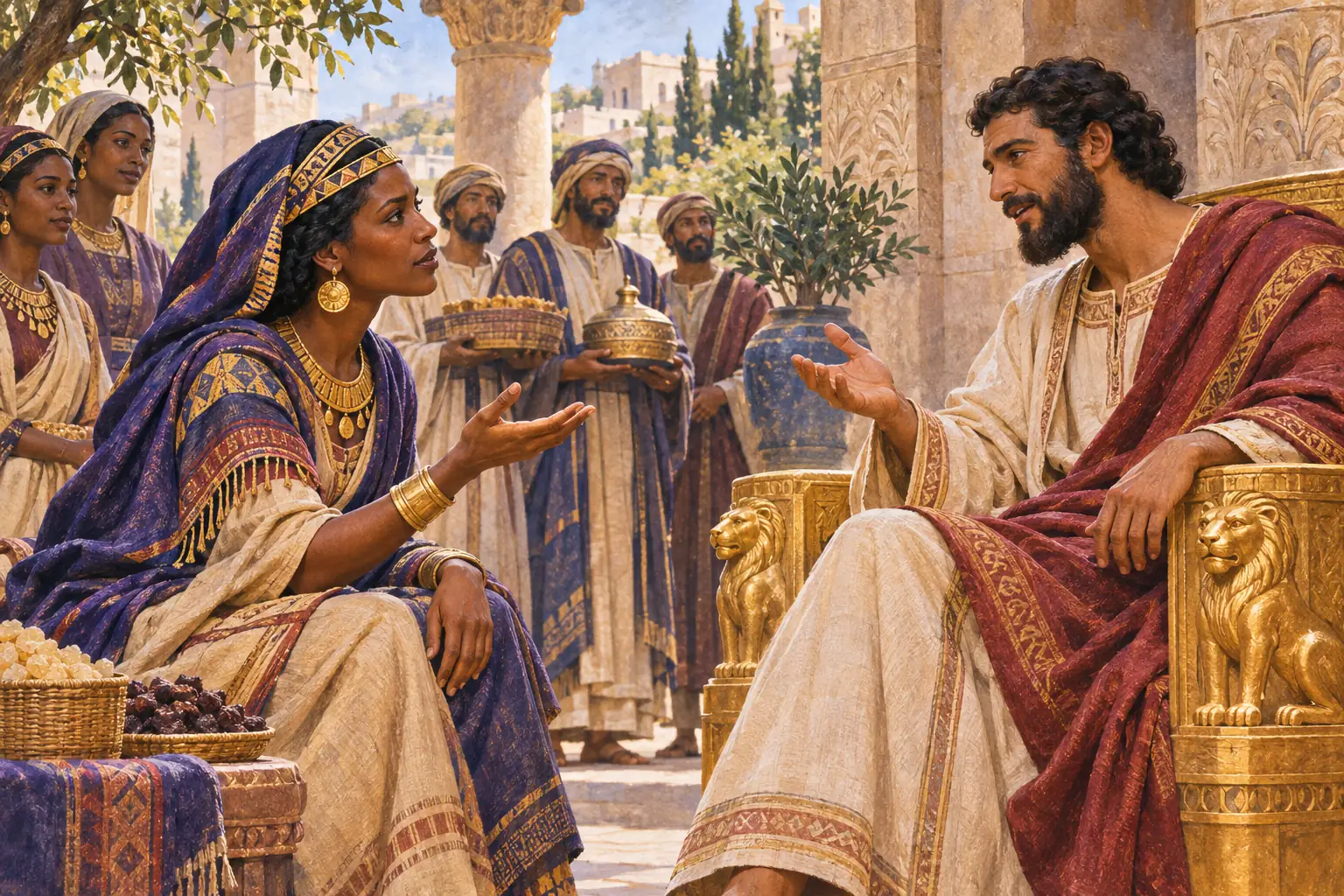
The queen of Sheba hears Solomon’s fame in connection with the name of the LORD and arrives with hard questions. Camels carry spices, gold, and precious stones, but the visit also involves an active search for understanding. The queen brings the concerns of the heart into conversation with the king.
Solomon answers the questions. The narrator presents genuine intellectual capacity, rather than mere performance. The queen then observes the royal house, provisions, officials, attendants, clothing, cupbearers, and arrangements associated with the temple. Wisdom appears within a carefully ordered and lavish public world.
The result is overwhelming amazement. The language portrays the queen as breathless before the combined achievement. Yet the queen has done more than repeat a rumor: hearing has become travel, conversation, and observation. The willingness to investigate becomes important in Jesus’ later use of the story.
The Visitor’s Praise Names the King’s True Calling — 10:6–9
The queen acknowledges the truth of the original report and declares the reality even greater. The attendants regularly hearing Solomon’s wisdom are described as fortunate. The words genuinely celebrate the gift visible in the court.
Verse 9 then turns praise toward the LORD. God’s delight and love for Israel explain the king’s position, and justice and righteousness name the purpose. The throne exists within a vocation reaching beyond Solomon’s personal satisfaction.
The queen’s language should remain distinct from a complete account of conversion; the text records praise without narrating the whole history of the queen’s religious allegiance. The theological force of the speech is nevertheless clear. Royal favor carries a responsibility for people.
Brueggemann notices the tension between the fortunate court circle in verse 8 and the wider responsibility voiced in verse 9 (Brueggemann 2000, 133–134). The king’s good order must reach the population beyond the palace. The queen has named a standard capable of examining the very splendor being praised.
Gifts Circulate through an International Royal World — 10:10–13
The queen gives one hundred and twenty talents of gold, exceptional quantities of spices, and precious stones. The narrator interrupts the visit with a related report: Hiram’s fleet brings gold, valuable timber, and precious stones from Ophir. The timber serves the temple, royal buildings, and musical instruments.
The brief interruption widens the picture. The queen’s gifts belong within a larger stream of exotic materials reaching Solomon. Wealth supports worship and the royal establishment together, recalling the interwoven buildings described in chapters 6–7.
Solomon grants the queen’s requests and additional royal generosity; the queen returns home with the royal company. The text does not itemize the return gifts or disclose a complete commercial agreement. Diplomatic and economic interests form a plausible setting, but the narrative explicitly emphasizes wisdom, amazement, praise, and exchange.
The scene ends with abundance. The question of faithful use will remain open as the account continues beyond the visiting delegation.
Gold Moves from Treasury to the Display of Greatness — 10:14–22
The narrator reports six hundred and sixty-six talents of gold arriving in a year, apart from further revenues. The number belongs to the account of royal income. The following details show the gold taking visible form.
Solomon makes two hundred large shields and three hundred smaller shields of beaten gold and places the shields in the House of the Forest of Lebanon. An ivory throne overlaid with gold rises above six steps, attended by carved lions. Golden drinking vessels fill the royal setting, while silver receives little regard by comparison.
The trading fleet adds precious metals, ivory, and imported animals on a three-year cycle. The report conveys a court reaching widely across the known world and possessing unusual resources.
The material should be heard alongside Deuteronomy’s restraint concerning royal accumulation. Provan asks readers to examine the uses of wealth now concentrated upon Solomon’s surroundings (Provan 2012, commentary on 1 Kgs 10:14–29). The earlier image of secure households beneath vines and fig trees has receded from the foreground. The visible abundance demonstrates capacity; the covenant asks about purpose, restraint, and human benefit.
The Gift of Wisdom Attracts More Annual Gifts — 10:23–25
Solomon surpasses other kings in wealth and wisdom. Verse 24 explicitly returns the source of wisdom to God: the understanding within Solomon’s heart is a divine gift. The worldwide desire to hear the king therefore bears witness to God’s generosity.
The next verse lists annual gifts: silver, gold, clothing, weapons, spices, horses, and mules. The text places intellectual admiration within a recurring flow of valuable goods. Some gifts can also function within relations of tribute, as similar language elsewhere in Kings shows.
The theological question concerns the growing orbit around the gifted ruler. Has wisdom remained an ability to serve people in God’s name, or is wisdom becoming another way of increasing the ruler’s importance? The narrator’s acknowledgment of the gift makes misuse a question of stewardship rather than a denial of genuine ability.
The Road of Horses Leads Back toward Egypt — 10:26–29
Solomon gathers fourteen hundred chariots and twelve thousand horsemen, distributing the military establishment between chariot cities and Jerusalem. Silver becomes abundant as stone in the city, and cedar as common as the sycamores of the lowlands.
The final verses describe imports of horses and chariots, with Egypt explicitly named. Royal merchants also arrange exports to Hittite and Aramean kings. The kingdom has become an active participant in the commerce of military power.
The echo of Deuteronomy 17:16–17 is difficult to miss. Royal accumulation, horses, and Egypt have come together within a passage apparently celebrating unparalleled achievement. The text does not need to repeat the prohibition for a Torah-aware reader to recognize the problem (Mackie 2017, 5–6).
The chapter ends before the open account of apostasy. The moral direction is already troubling: the wise king knows many answers, while the king’s policies increasingly contradict the instruction meant to govern kingship.
Theological Reflection — Wisdom Must Remain a Servant of Justice
Seeking wisdom requires movement beyond reputation
The queen hears, travels, asks, observes, and revises an earlier estimate. The narrative honors a serious encounter with wisdom. A teachable person can investigate without dismissing a report or surrendering judgment to fame. In discipleship, admiration becomes fruitful when hearing produces attentive response.
God’s love for a people defines the leader’s vocation
Verse 9 roots kingship in God’s love for Israel and directs kingship toward justice. The order matters: the leader receives responsibility for the good of the people. Prestige cannot replace care for vulnerable lives. Brueggemann regards the queen’s declaration as the moral question continuing beneath the royal celebration (Brueggemann 2000, 134, 139–140).
Genuine gifts can coexist with growing disobedience
Verse 24 affirms God-given wisdom; the closing inventory confronts the king with Torah. The tension prevents both uncritical admiration and a complete dismissal of Solomon’s gifts. A preacher, teacher, or leader may possess real understanding while needing serious correction in conduct. Ability requires continuing submission to God.
Abundance needs a disciplined purpose
The chapter reports increasing gold, luxury, and military capacity. God’s earlier promise of riches does not erase the king’s duty to receive wealth within covenant limits. Gratitude should deepen generosity and restraint. Accumulation becomes spiritually dangerous when the expanding store of resources captures the attention once given to faithful service.
Canonical and Christological Horizon — The Queen Points toward a Greater King
Jesus directly invokes the queen’s journey. The queen of the South came to hear Solomon’s wisdom, while the generation addressed by Jesus faces a presence greater than Solomon (Matt 12:42; Luke 11:31). The comparison calls hearers to respond. Access to greater revelation requires more than casual admiration.
Psalm 72 joins international homage and gifts with a king’s defense of the needy and rescue of the oppressed (72:10–14). The sequence illuminates the calling expressed by the queen. The nations’ honor belongs within a hope of righteous government, not a royal appetite without limits.
The nations bringing gold and incense also reappear in Isaiah’s vision of renewed Zion, and Matthew portrays visitors bringing gifts to the child Jesus (Isa 60:6; Matt 2:1–12). The patterns converge upon God’s promised kingship, without turning every detail of Solomon’s luxury into a separate prediction.
Jesus gives the royal calling a decisive form through service and the giving of life (Mark 10:45). God’s wisdom reaches the cross, where human standards of power encounter the saving purpose of God (1 Cor 1:23–25). The faithful King fulfills the vocation Solomon increasingly compromises. The nations ultimately bring honor into a renewed creation illuminated by God’s glory, where unclean and destructive life has no place (Rev 21:23–27).
Life Application — Put the Gift Back into Service
- Ask a necessary question beneath praise. After receiving appreciation for a ministry or achievement, identify the people meant to benefit. Check whether the actual work has improved the lives of the intended people.
- Seek wisdom through attentive engagement. Bring a real question to Scripture, prepare carefully for study, and listen to a knowledgeable teacher. Let the answer produce a specific change in conduct.
- Examine the circle enjoying success. Review a church, family enterprise, or workplace from the viewpoint of people beyond the leadership group. Ask about fair treatment, access, and burdens absent from a visitor’s tour.
- Place a limit beside a growing resource. Set a practical boundary for spending on status or unnecessary accumulation. Assign a clear share of time or resources to a neighbor’s concrete need.
- Invite correction in an area of strength. Ask a trusted colleague whether an admired gift has begun to protect a neglected duty. Hear the response without using successful results as a defense.
- Choose service over a costly display. Redirect a planned expense or public gesture toward training, relief, family care, or another verified need. Accept the loss of attention when quiet service better expresses the character of Jesus.
Reflection Questions
- How does the queen’s statement in verse 9 provide a standard for reading the rest of the chapter?
- Which details affirm God’s gift, and which details recall the limits set in Deuteronomy 17?
- Where could public admiration be narrowing attention to a comfortable circle?
- Which genuine ability currently needs to be brought under a neglected command of God?
- How could the servant kingship of Jesus reshape one concrete decision about wealth, recognition, or responsibility?
Response Prayer
God of generous wisdom and righteous love, receive thanksgiving for understanding, opportunity, and resources. Keep gratitude alive when praise grows loud. Give a teachable heart willing to ask the necessary question beneath success.
Protect leaders from confusing admiration with faithfulness. Bring the lives beyond the palace into view: tired workers, overlooked neighbors, and families carrying unseen burdens. Let authority become protection and knowledge become care.
Expose the appetites growing around real gifts. Set wise limits around display and accumulation. Restore joy in generous service and courage to accept correction without defending a cherished reputation.
Risen Jesus, greater than Solomon, draw the church beyond admiration into obedience. Let the cross define greatness and the Spirit shape a faithful use of every gift. Sustain hope for the day when the nations walk in God’s healing light. Amen.
Window into What Comes Next — The Splendor Cannot Guard the Heart
The gold has multiplied, the horses have gathered, and international admiration has reached an extraordinary height. First Kings 11 will reveal the condition of Solomon’s heart through marriages and worship. The remaining royal prohibition concerning the multiplication of wives will enter the story with devastating force.
The next chapter will connect divided affection with divided allegiance and a kingdom facing fracture. The warning has been present beneath the splendor. Can a gifted king recognize the danger before the heart’s compromises become the nation’s wounds?
Bibliography
- Brueggemann, Walter. 2000. 1 & 2 Kings. Smyth & Helwys Bible Commentary. Macon, GA: Smyth & Helwys. Especially 131–140.
- The Holy Bible: King James Version. 1769 edition. “1 Kings 10.” Bible Gateway. Scripture summaries and interpretive paraphrases are distinguished from direct quotation throughout the study.
- Mackie, Tim. 2017. “Solomon: Love Him or Hate Him? A Tale of Wisdom, Wealth, and Lots of Women.” BibleProject, April 2. Supplied PDF, especially 5–7.
- Provan, Iain W. 2012. 1 & 2 Kings. Understanding the Bible Commentary Series. Grand Rapids: Baker Books. Originally published 1995. Section “Glory under a Cloud (1 Kgs. 9:10–10:29),” especially commentary on 10:1–29. Section references used because the supplied electronic edition has no stable printed pagination.
Be the first to leave a comment.