

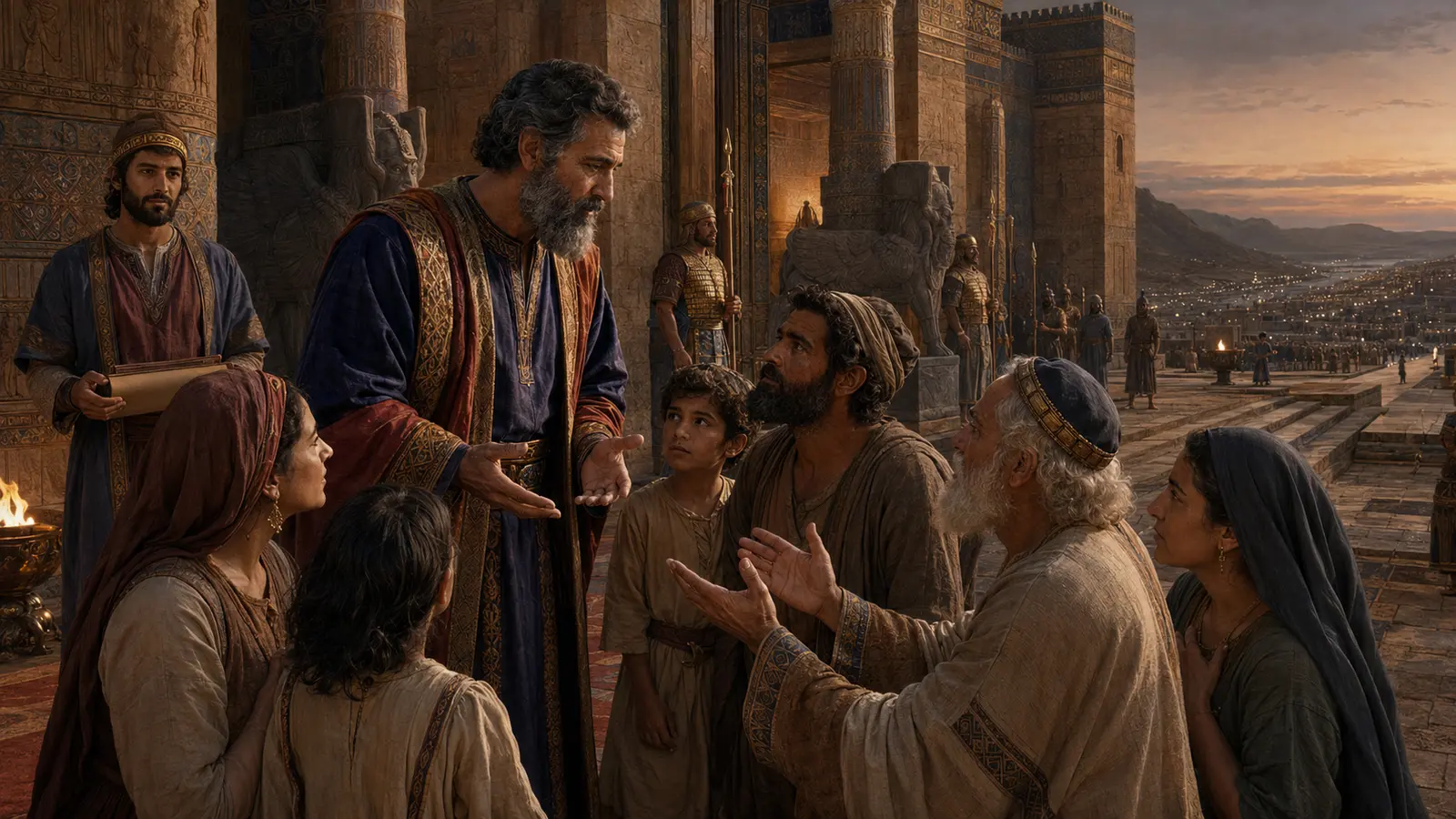
The feast has been established, the enemy has fallen, and the people have learned to remember mercy with joy. Yet the final scene is still inside Persia. Mordecai is great, the Jews are protected, but the throne above him still belongs to Ahasuerus.
01
Introduction
and people have learned to remember mercy with joy.
But the final event is still within Persia.
Mordecai is great, the Jews are protected,
but the throne above it still belongs to Ahasuerus.
02
1.0 Introduction: When Deliverance Is Real but the Story Is Not Yet Finished
There are other happy endings, but still not the final ending.
Esther 10 contains only three verses, but those short verses carry the weight of the unfulfilled hope of the entire book. Haman is dead. The death sentence has been answered. The Jews have survived the day that was planned for their destruction. Purim is established as an annual holiday—a holiday of remembrance, rejoicing, gift-giving, and concern for the poor. Mordecai, the one who was sitting at the king's gate unnoticed, now stands second only to King Ahasuerus. People who were threatened to be erased from history have not been erased. They have found rest, honor, and protection in exile. But the book does not end with Jerusalem.
There is no return to the promised land. No temple was rebuilt. No king of the line of David sat in Zion. No cloud of glory filled the house of the Lord. There is no final overthrow of the empire. The last political word in this narrative still belongs to Ahasuerus, the king of Persia. Mordecai is great, but still second. The Jews are thriving, but under foreign rule. Redemption has come, but exile is not fully over.
This text is about true redemption that turns into a holy passion, because God can protect his people within the empire, while still teaching them to trust in the kingdom that is beyond the empire.
That is why the ending of Esther is both comforting and incomplete. It comforts us by showing that God’s people can live, serve, and even become a blessing far from home—even within institutions of mixed values, and even when God’s name is not openly mentioned in public records. But it also unsettles us, refusing to let deliverance under empire masquerade as salvation in its fullness. Mordecai’s rise is good news, but it is not yet the kingdom of God in its fullness.
The whole book has taught us to read ordinary events with the eyes of the covenant. King sleepless. A forgotten memory. Delayed reward. A party that arrived on time. The wicked is caught in his own trap. The book of Esther does not mention God in its Hebrew text, but its narrative invites us to look for God's hidden hand dealing with human decisions, events that seem like luck, sudden revolutions, and the courage of faith. [1] The God who appears silently in the Book of Esther is not a distant God. Its activity is similar to the power of the seed under the soil, the leaven that works silently in the dough, or the light of dawn that rises secretly behind a dark mountain.
So Esther 10 is a quiet ending, but not a low ending. It leaves us with a picture of a Jewish leader using his influence for the welfare of his people. It leaves us the honor of the faithfulness of the people scattered abroad. It leaves us grateful to God who works in secret. And it leaves us longing for a true King—a King whose majesty will not depend on the consent of the state, and whose kingdom will turn mourning into joy without leaving the death machine running.
The narrative ends in Persia.
But hope continues to walk towards a new creation.
03
2.0 Historical and Literary Context: A Brief Epilogue after Purim
Esther 10 serves as a brief conclusion to the book. After the great tension of chapters 7–9—the fall of Haman, the command to face the death penalty, the salvation of the Jews, and the institution of Purim—the narrative closes with a brief royal announcement. It sounds almost like a piece from the annals of empire: King Ahasuerus taxed the land and islands of the sea; the deeds of his strength and power, as well as the greatness of Mordecai, were written in the royal chronicles of Media and Persia; Mordecai the Jew was second after Ahasuerus, a leader among the Jews, accepted by many of his brothers, and who sought the welfare of his people.
This writing style is important. The book of Esther often borrows the tone of royal records, imperial decrees, lists, banquets, and administrative reports. But it does so with holy irony. The empire thinks its memories tell the true history of the world, but this book quietly shows that the ink of the empire is not the last ink. The royal memory may write about power and taxes, but the book of the Bible teaches us to see the providence of God, the revolution of circumstances, and the survival of the covenant under the official language of the state. [2]
This ending also completes one of the great literary revolutions in Esther. In chapter 1, Ahasuerus shows his greatness with wealth, feasts, officials, and the breadth of his empire. In chapter 10, his greatness is mentioned again, but now it is placed parallel to the greatness of Mordecai the Jew. The pride of Persia at the beginning is answered by the honor of the Jew at the end. The one who belonged to a small threatened group has now entered the annals of the empire. He whose faithfulness was forgotten in the history books, is now remembered in them.
However, this end is not just an easy victory. Ahasuerus is still king. Mordecai was raised within the Persian system, not outside of it. Jews are protected in exile, not returned to the land. Esther celebrates liberation without pretending that every tension has been resolved. The book gives us pleasure, but not illusion; it gives us rest, but not final pleasure; it gives us a feast, but not yet the marriage feast of the Lamb.
This is where the important difference between Esther and Ezra–Nehemiah appears. Ezra-Nehemiah asks: what happens when some of God's people return to the land and build their lives around the temple, the Torah, the wall, and the community? Esther asks: what happens when some Jews remain scattered among the nations while trusting in the hand of God hidden in foreign palaces? The answer is not to give up. God can protect them there too. But the answer is not to relax as if things are done. Exile remains exile, even when God's providence brings honor into it. [3]
That is why the last note about Mordecai is so important: he seeks the welfare of his people and speaks peace to all his descendants. His greatness is not defined only by a title, royal clothing, or proximity to the king. It is defined by service. Unlike Haman, whose elevation became a weapon of pride and death, Mordecai's elevation becomes a platform for good in society.
The book does not end with a feast, but with a leader seeking shalom—the perfect peace of God.
04
3.1 When Ahasuerus Still Taxes the World (Esther 10:1)
This chapter begins like this: "King Ahasuerus imposed a tax on the land and on the islands of the sea."
At a glance, this seems like a strange ending. After all the tension of liberation, why mention taxes? Why take us back to the breadth of Persian rule?
Because Esther wants us to remember where we are yet. The Jews have recovered, but the empire continues. Ahasuerus still reigns. His administrative powers extend over land and sea. Rent is still flowing toward the heart of the empire. The empire machine is not gone.
This is unadulterated reality. Esther does not say that because the Jews have been saved, Persia has become the kingdom of God. Ahasuerus has not yet turned into a righteous king. The same empire whose bureaucracy almost executed it, now continues to collect wealth from its territories. The throne that gave Haman power still stands, even though Haman has fallen.
Here Esther gently touches on Israel's long-standing doubts about a human kingdom that ignores justice. Samuel warned that kings can "take away" sons, daughters, fields, servants, and livestock (1 Sam 8:10-18). Deuteronomy warned that the king of Israel should not multiply horses, wives, silver, or gold, because royal power must be restricted under God's Torah (Deuteronomy 17:14-20). Esther 10:1 shows us a foreign empire doing what most worldly empires do: expanding borders, levying taxes, accumulating wealth, writing records of their deeds, and consolidating power.
How can we ignore the importance of this truth for the disciples of Jesus who live today in systems that have lost their moral direction? Listen: God's deliverance in one crisis does not mean that every system around you has been delivered! If your prayer is answered at work, that does not automatically make the workplace righteous! If victory is found in society, it does not mean that the whole system has become holy! And even if a bad leader is removed from power, it does not mean that every style of harm is over!
God's people should learn to be thankful without deceiving themselves.
We can thank God for mercy, and still clearly mention the collapse of the empire. We can celebrate redemption, and still hunger for justice. We can serve in public places without baptizing the system as if it is the kingdom of God.
Esther 10:1 is an eye opener.
Redemption is real.
The empire is still there.
05
3.2 When the Empire’s Records Remember Mordecai (Esther 10:2)
Then the narrator mentions the deeds of power and might of Ahasuerus, as well as the full account of the greatness of Mordecai, "to which the king had raised him," written in the royal chronicles of Media and Persia.
This line completes an important thread in the narrative. In Esther 2, Mordecai saved the king's life, and the act was recorded in the book of royal records, but he was not rewarded (Esther 2:21-23). In Esther 6, the insomniac king was read the record and discovered that nothing had been done for Mordecai (Esther 6:1-3). That forgotten loyalty became the turning point of the whole story. Now, in Esther 10, Mordecai's greatness is not hidden in abandoned memories. It is now publicly preserved in the empire’s records.
A forgotten person becomes an unforgettable person.
But the saying also has irony in it. Mordecai's reign is recorded in Persian records, not in Israel's royal records. His honor is real, but it passes through the hands of the empire. He has been a great figure within the Persian narrative. His life testifies to God's protection for the scattered Jews, but it also reminds us that people are still outside the full hope of the covenant—the restored kingdom and the promised land.
Theologically, this is a gift and a tension at the same time. It is a gift because God can give his people permission even in foreign places. Joseph rose from Egypt and stored grain for life (Gen 41:37-57). Daniel served Babylon and testified with wisdom and courage (Dan 2:46-49; 6:1-28). Nehemiah stood before the king of Persia and used his position to rebuild the walls of Jerusalem (Neh 2:1-8). Mordecai became second in Persia. God can place his servants in unexpected rooms for the welfare of many.
But it is also a tension because being promoted by the state is not the same as the kingdom of God. Being written in the records of Persia is a meaningful thing, but it is not the same as the nations flowing to Zion under the rule of the Lord (Isa 2:2-4). Mordecai's greatness is real, but not yet final. It is a light at night, not the morning sun.
Followers of Christ must maintain a high level of focus in their faith journey. It is true that God entrusts his people with education, positions, influence, social networks, and various opportunities as instruments to transmit his grace. However, these opportunities can turn into a luxury prison when we mix them with the main goal of our calling. Promotion is only a practical means; Our calling and the Kingdom of God carry great and eternal weight.
The book teaches us to be thankful for partial redemption, while our hope remains anchored in God's final redemption.
06
3.3 When Mordecai the Jew Becomes Second to the King (Esther 10:3a)
Mordecai is described as "Mordecai the Jew," second only to King Ahasuerus, the greatest among the Jews, and accepted by many of his brethren.
The name "Jew" is important. In the end, Mordecai's identity is not revealed. In chapter 3, it was his Jewish identity that caused Haman's anger. In chapter 4, Esther's hidden Jewish identity becomes a question of her calling. By chapter 8, Mordecai was publicly clothed in royal robes. Now, in chapter 10, he is clearly identified as Mordecai the Jew.
The identity that was at stake is now respected.
This does not mean that the danger of Jewish difference has disappeared forever. The book knows better than that. Purim exists because memory must resist oblivion. But at this time, Jewish identity has moved from a threatened weakness into a public honor. People who were marked for death now stand as witnesses that the God of the covenant preserves his seed even when his name is not written on the page.
Mordecai is elevated to the head of all power, surpassed only by the king's throne! This thing immediately reminds us of the story of Joseph in Egypt when he was told, 'For the sake of the throne I will be greater than you' (Gen 41:40). It reminds the reader of Daniel, whose wisdom gave him authority over all Babylon (Dan 2:48)! In these narratives, God shows that exile is not the end of the journey; it is where his hidden hand is at work through your courage, public service, and loyalty!
But again, the word "second" is important. Mordecai is highly exalted, but not according to the king. He can influence the throne, but it does not change. His majesty protects, but has limits. This is a sojourn success, not a final return.
That is why Mordecai should be respected, but not turned into the pinnacle of our hope. The book of Esther does not show him as a flawless Messiah; he is only a witness of the transition, and not the fulfillment of the promise. His exaltation points far beyond himself—toward the kind of rule that Israel's Scriptures had long anticipated: a true King who justly judges the poor, defends the needy, crushes the oppressor, and brings the peace of shalom like rain falling on cut leaves (Ps. 72:1–7).
The rise of Mordecai reminds us that God can call his people to serve faithfully in imperfect positions. We may find ourselves second, not first; close to power, but not all power; we can protect, but not change everything. Esther calls this matter meaningful. But it is not called the last.
07
3.4 When Greatness Becomes Service to the People (Esther 10:3b)
The last verse says that Mordecai sought the welfare of his people and looked after the welfare of all his descendants.
Here the book defines true greatness. It is not a title alone. Not a dress. Not a signet ring. It is not a public honor. Mordecai's greatness is measured by the good he seeks for others.
This is the biggest moral difference between Mordecai and Haman. While Haman used his power to demand worship and destroy all those who refused to bow down to him, Mordecai uses his power to promote the prosperity and good of the entire community. Haman's greatness was based on selfishness and violence, but Mordecai's greatness is built on protection and social cohesion. Haman made policy out of his wounded pride, while Mordecai made policy out of a great covenant obligation.
The word "prosperity" brings us to the biblical world of shalom: peace, wholeness, prosperity, security, justice, and a life that is right before God. Mordecai does not help the Jews out of just one crisis. He seeks their continued good. He says peace not only for his generation, but for "all his descendants", for the generations that will inherit that memory.
This last phrase goes back and also moves forward. It goes back to God's promise to Abraham that his offspring would be a blessing to the nations (Gen 12:1-3; 22:17-18). It goes back to Jeremiah's call to those in exile to seek the prosperity of the city where they were sent (Jer 29:7). You move forward to Jesus, the Son of Abraham and the Son of David, who carries the call of Israel and brings blessings to the nations through the cross and resurrection (Mt 1:1; Gal 3:16).
This is pastoral leadership in a political form. True leadership asks: Are people safer? Are the weak protected? Is society thriving? Are future generations blessed? Do our words increase peace, or spread fear? Are we using the space given to us to protect life, or are we using people to protect our space?
The climax of Mordecai's life is a great lesson for church leadership today! The greatness of the shepherd is not measured by the way people say his name loudly on the stage, but it is measured by the way the sheep feel the love and care of God through his service! Pastor, church elder, leader, parent, teacher, and mission worker—we all have to kneel down and ask: Who gets God's shalom because I have been given a chance to influence?!
But even at this peak of success, the desire for something better still remains alive. Mordecai preaches peace, but the world has not yet found true peace; he seeks the welfare of his people, but the foreign empire still continues to levy taxes. He is great among the Jews, but Ahasuerus still sits on the throne.
The book ends with a sought shalom, not a completed shalom.
08
4.1 God Can Preserve His People in Exile
The last chapter of Esther declares that exile will not be abandoned. The Jews are far from Jerusalem, but they are not outside of God's care. God's name does not appear in the Hebrew text, but his providence has protected his people from destruction.
There are times when believers live far from the familiar symbols of spiritual security. The temple seems far away. Language of faith is not welcome in public rooms. The systems around us are mixed with destruction. The calendar is ruled by people who don't pray. But God can work there too.
The God hidden in Esther is not far from his scattered people. He is a covenant-keeping Lord even when his people do not see the full picture of his work.
Does the fact that God works behind the scenes mean we should just sit back and do nothing? No way! God's care in the Book of Esther does not extinguish human courage; instead, you wake it up with a bang. That is why Mordecai must raise his voice, Esther must risk her life, the Jews must gather, royal letters must be written, and feasts must be kept for remembrance. In this narrative, God's hidden plans and human responsibility are not enemies; they work together like two hands weaving one garment of salvation.
For Jesus' disciples, this means that faith does not always mean seeing everything clearly. Sometimes faith is acting wisely in the fog. Sometimes it's doing the next thing of obedience when God's name doesn't appear in the headlines. Sometimes it is believing that the Lord of the covenant is still there when the news seems like politics, paperwork, sleeplessness, and danger.
The God who seems to be hiding is still the God who watches.
09
4.2 Success under Empire Is a Gift, but It Is Not the Kingdom
Mordecai's rise deserves to be celebrated. His influence protects the Jews. His leadership seeks their welfare. But Esther refuses to allow us to confuse this with final redemption. Persia remains Persia. Ahasuerus remains king. Transfer is not fully removed.
As disciples of Christ we should be grateful when God opens doors in government, education, business, media, health, law, community development, or church administration. Influence can be a gift. Chance can be a mercy. A seat next to power can be a shield for the weak.
But there is no institution, office, position, denomination, or public platform that is the kingdom of God.
Here Esther teaches leaders to live in a state of "ready, but not yet." Redemption has already come, but restoration is not yet complete. God has already acted, but the world is not yet healed. Christ has already risen, but creation still suffers (Romans 8:18-25). The kingdom has already been established in Jesus, but it is still waiting to be fully revealed when the kingdoms of the world will become the kingdom of our Lord and of his Christ (Rev 11:15).
Therefore, Christians can serve faithfully within the systems of this age without worshiping those systems. We can participate without surrendering our royal mindset. We can seek the prosperity of the city without confusing that city with the New Jerusalem.
We serve where we are, but our hope rests in a greater King.
10
4.3 True Greatness Seeks the Welfare of Others
Haman's greatness demanded recognition. Mordecai's majesty sought prosperity. Esther ends by comparing the two visions of power.
The world often defines greatness by appearance, control, wealth, proximity to the throne, popular applause, and public honor. Scripture defines greatness as service, righteousness, protection, humility, and peace. Later Jesus will teach this matter with surprising clarity: "Whoever wants to be your chief must be your servant" (Mk 10:43). The Son of Man did not come to be served, but to serve and to give his life as a ransom for many (Mk 10:45).
Mordecai is not perfect, and Esther does not present him as a perfect moral example. The book itself is full of moral dilemmas, hidden compromises, and survival decisions made in dangerous places. [4] However, the last note about Mordecai is good: he used his position to seek the good of his people.
That is greatness worthy of emulation.
This fact should be the basis of evaluation in the leadership of the Church. Spiritual leadership cannot be a tool to achieve personal desires dressed in a religious cloak, nor is it an administrative strategy to gain fame through the backs of believers. It is not the building of individual kingdoms where leaders expect applause from the heartbroken. On the contrary, true leadership is a sacrificial service aimed at developing the well-being of God's group, especially in times of threat, dispersion, fatigue, and fear.
A leader who reflects the heart of Mordecai does not ask, 'How do these people want me to be great?' Instead, he asks himself, 'How can my influence help these people to recover and thrive?
11
4.4 Esther Ends with Longing for the True King
The final tension of the book points beyond the book itself. The Jews are alive, but still in exile. Mordecai is second, but not king. Purim remembers redemption, but the world still needs a deeper redemption.
This passion finds its answer in Jesus the Messiah, the faithful Israelite and the true King. Unlike Ahasuerus, he is not morally empty. Unlike Haman, he does not cling to honor by force. Unlike every empire, his kingdom comes with self-sacrificing love, justice, mercy, and resurrection life.
In Jesus, the whole calling of Israel is fulfilled. He becomes a true man, a true Jew, a true Son of David, and a perfect representative of God's people. He does not come to fight the forces of death by writing a defensive order while he is safe in the palace; but he descends and enters the midst of the storm itself by carrying death in his own body. At the cross, the violence of the state, the envy of men, religious fears, and the accusations of the enemy gather against him. But in the resurrection, a major turning point in history begins: The condemned is confirmed as Righteous, the crucified is enthroned, and death begins to lose its authority and future.
In Jesus, God's hand that was working in secret now becomes visible deliverance! In it, the command of death is answered - not only for a few Jews in Persia, but for all creation! In it, our mourning is not just turned into a once-a-year feast; no! One day they will be absorbed into the new creation, where death will be no more, and every tear will be wiped away!
Esther ends beneath the shadow of the empire, but the Bible's narrative does not end there.
It continues toward the throne of God and of the Lamb.
12
5.0 Life Application: Faithful Greatness in Imperfect Places
Thank God for partial redemption. Do not underestimate the real mercy because it is not yet the final restoration. Celebrate what God has done. Purim teaches God's people to remember salvation with joy, generosity, and caring for the poor (Es 9:20-22).
Thank God for partial deliverance. Do not underestimate the real mercy because it is not yet the final restoration. Celebrate what God has done. Purim teaches God's people to remember salvation with joy, generosity, and caring for the poor (Es 9:20-22).
Be honest about pending transfers. A good result in one area does not mean everything is cured. Gratitude and passion can coexist. A mature faith can sing and still be sick.
Be honest about pending transfers. A good result in one area does not mean everything is cured. Gratitude and passion can coexist. A mature faith can sing and still be sick.
Use influence for prosperity. Mordecai's greatness is measured by the good he seeks for his people. Ask yourself: who becomes safer, stronger, freer, and more hopeful because of my influence?
Use influence for prosperity. Mordecai's greatness is measured by the good he seeks for his people. Ask yourself: who becomes safer, stronger, freer, and more hopeful because of my influence?
Do not confuse promotion with purpose. Position is not the goal; service is the goal. A ring, title, pulpit, office, certificate, or platform must be instruments of love.
Don't confuse promotion with purpose. Position is not the goal; service is the goal. A ring, title, pulpit, office, certificate, or platform must be instruments of love.
Serve reliably within imperfect systems. God may call you to work in a place of mixed values. Find wisdom, courage, integrity, and discernment there. Joseph served in Egypt. Daniel served Babylon. Mordecai served in Persia. But none bowed to the empire as a savior.
Serve faithfully within imperfect systems. God may call you to work in a place of mixed values. Find wisdom, courage, integrity, and discernment there. Joseph served in Egypt. Daniel served Babylon. Mordecai served in Persia. But none bowed to the empire as a savior.
Live public faith without public pride. Mordecai's Jewish identity appears at the end, but his greatness is shown by his pursuit of prosperity and peace. Your identity in Christ should be clear, humble, courageous, and life-giving.
Live public faith without public boasting. Mordecai's Jewish identity appears at the end, but his greatness is shown by his pursuit of prosperity and peace. Your identity in Christ should be clear, humble, courageous, and life-giving.
Lead for future generations. Mordecai said peace to all his descendants. Christian leadership must think beyond today's applause. What church, what family, what community, and what testimony do we leave for those who will come after us?
Lead for future generations. Mordecai said peace to all his descendants. Christian leadership must think beyond today's applause. What church, what family, what community, and what testimony do we leave for those who will come after us?
Let the mission be shalom. The mission is not just to win debates. It is to announce and show the rule of God in Christ - good news for the poor, freedom for the prisoners, sight for the blind, justice for the oppressed, and welcome into the family of God (Lk 4:18-19).
Let the mission be shalom. The mission is not just to win debates. It is to announce and show the rule of God in Christ - good news for the poor, freedom for the prisoners, sight for the blind, justice for the oppressed, and welcome into the family of God (Lk 4:18-19).
Put all your trust in the King of kings. Institutions and governments can be used by God to do great things, but remember—they can never be your savior! The true and final king is Jesus Christ, and his kingdom cannot be shaken or destroyed by any earthly empire! (Heb. 12:28).
Put all your trust in the King of kings. Institutions and governments can be used by God to do great things, but remember—they can never be your savior! The true and final king is Jesus Christ, and his kingdom cannot be shaken or destroyed by any earthly empire! (Heb. 12:28).
13
6.0 Reflection Questions
Where has God brought real deliverance in your life, even though the great story of life is not yet complete?
Where has God brought real deliverance in your life, even though the great story of life is not yet complete?
What influence, position, gift, relationship, or position do you have that you can use more purposefully for the welfare of others?
What influence, position, gift, relationship, or position do you have that you can use more purposefully for the welfare of others?
Are you tempted to confuse success within a certain system with the perfection of God's kingdom?
Are you tempted to confuse success within a certain system with the perfection of God's kingdom?
How can you live with gratitude without losing the sacred passion for deeper restoration?
How can you live in gratitude without losing the sacred passion for deeper restoration?
To you, what would "saying peace" to the next generation mean?
To you, what would "saying peace" to the next generation mean?
Where do you need the courage to serve faithfully in an imperfect place without being captured by its values?
Where do you need the courage to serve faithfully in an imperfect place without being captured by its values?
How can your church or your ministry be a Mordecai-like presence—one that seeks prosperity, that protects the weak, and that points more than money to Christ?
How can your church or ministry be a Mordecai-like presence—one that seeks prosperity, protects the weak, and points more than money to Christ?
14
7.0 Response Prayer
O God who hid in exile and redemption, You protected your people when your name was not spoken. You saved them in Shushan, you turned mourning into a feast, and you raised a forgotten servant to seek their welfare.
Teach us to receive partial redemption with gratitude. Teach us also to continue to desire the perfection of your kingdom. Do not allow us to confuse Persia with paradise, or promotion and final redemption.
Give us Mordecai's burden for the welfare of the people. Make our influence protective, our leadership humble, our words full of peace, and our service faithful in imperfect areas.
When we live under systems that we cannot fully change, make us wise and courageous. When we are given a chance, make us defenders of the weak. When we are respected, protect us with Hamanina's pride and create in us the heart of Christ's service.
Teach your church to live as a sign of the coming kingdom. Make our discipleship strong, our leadership pure, our mission be generous, and our hope shine like the morning.
Lead us past the palaces of the empire towards a kingdom that cannot be shaken. Close our eyes to Jesus, the true King, who not only sits above us in glory, but comes among us with mercy, overturns death with resurrection, and one day he will make all things new.
Amen.
15
8.0 The Final Window: From Purim to the Kingdom of God
Esther ends with Mordecai as a prince in Persia, seeking the welfare of his people and speaking peace to his descendants. It's a good ending. But it is also an unfinished end.
The Jews survive, but the exile remains. The enemy falls, but the empire continues. Mordecai rises, but Ahasuerus still rules. Purim remembers redemption, but the world is still waiting for the day when every decree of death will be abolished.
That is why Esther is part of the larger narrative of the Bible. It teaches us to trust in the God who is hidden in the middle of history, while longing for the day when his kingdom will be fully revealed. It teaches us that God can work through ordinary courage, a moment of wisdom, public intercession, administrative skills, and surprising revolutions. It teaches us that joy can remember tears, and that memory can be resistance to despair.
But it also pushes us forward.
16
9.0 Bibliography
[1] BibleProject. "The Book of Esther." Old Testament Overview Guide.
[1] BibleProject. "The Book of Esther." Old Testament Overview Guide.
[2] Levenson, Jon D. Esther: A Commentary. Old Testament Library. Louisville: Westminster John Knox, 1997.
[2] Levenson, Jon D. Esther: A Commentary. Old Testament Library. Louisville: Westminster John Knox, 1997.
[3] Clines, David J. A. Ezra, Nehemiah, Esther. New Century Bible Commentary. Grand Rapids: Eerdmans, 1984.
[3] Clines, David J. A. Ezra, Nehemiah, Esther. New Century Bible Commentary. Grand Rapids: Eerdmans, 1984.
[4] Fox, Michael V. Character and Ideology in the Book of Esther. 2nd ed. Grand Rapids: Eerdmans, 2001.
[4] Fox, Michael V. Character and Ideology in the Book of Esther. 2nd ed. Grand Rapids: Eerdmans, 2001.
[5] Berlin, Adele. Esther. JPS Bible Commentary. Philadelphia: Jewish Publication Society, 2001.
[5] Berlin, Adele. Esther. JPS Bible Commentary. Philadelphia: Jewish Publication Society, 2001.
[6] Moore, Carey A. Esther. Anchor Bible 7B. Garden City, NY: Doubleday, 1971.
[6] Moore, Carey A. Esther. Anchor Bible 7B. Garden City, NY: Doubleday, 1971.
[7] Wright, N. T. The New Testament and the People of God. Minneapolis: Fortress, 1992.
[7] Wright, N. T. The New Testament and the People of God. Minneapolis: Fortress, 1992.
[8] Wright, N. T. Surprised by Hope: Rethinking Heaven, the Resurrection, and the Mission of the Church. New York: HarperOne, 2008.
[8] Wright, N. T. Surprised by Hope: Rethinking Heaven, the Resurrection, and the Mission of the Church. New York: HarperOne, 2008.
Listen To Song About:
Be the first to leave a comment.