

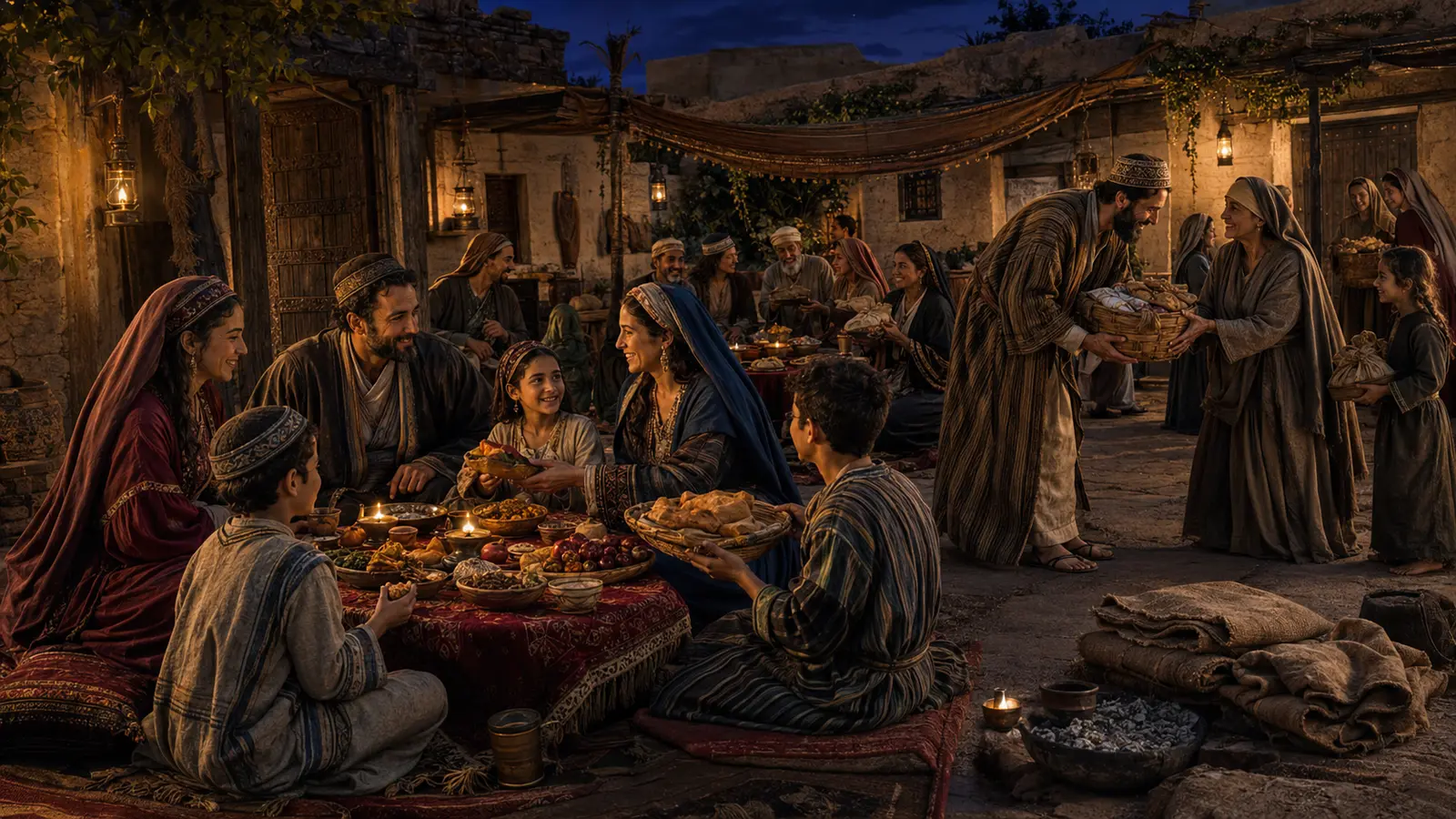
The day marked for death finally came. The decree still had teeth, and the enemies still had names. But the shadow turned, the hunted stood, and through joyful tears the people who had worn sackcloth began to teach their children how to feast with memory.
01
Introduction
The decree of destruction still had teeth, and the enemies still had names.
But the shadow turned, the hunted stood,
and the people wearing sackcloth
they began to teach their children how to celebrate with memories.
02
1.0 Introduction: When a Day of Fear Becomes a Day of Feasting
There are days that we dread before they arrive. We count them with a heavy heart. They stand on the calendar like mountains of darkness: the day of judgment, the day of struggle, the day when what has been threatened must finally be faced.
For the Jews throughout the Persian Empire, the thirteenth day of the month of Adar was such a day. Haman had chosen it by puri, that is, by lot. His decree had called it the day of doom. Even after Haman fell, the first decree could not simply be revoked. A second decree had been issued, giving the Jews the right to assemble and defend themselves in order to save their lives. But the day itself was yet to be reached and faced.
Esther 9 is the chapter in which the day to be faced arrives.
It is also one of the most difficult chapters in this book. It's full of self-defense, fear, death, public embarrassment, and triumph. Jews beat their enemies. Haman's sons are killed and hanged in public. Esther asks for another day in Shushan. The death toll is high. The language of this chapter is serious, cautionary, and disturbing.
We should not rush through this chapter as if it were just a simple ceremony. Scripture does not call us to enjoy violence. Nor does it invite us to baptize revenge. Esther 9 must be read within its dangerous imperial world: a world in which the decree of genocide had been legalized, in which the Jews were a scattered minority, and in which enemies were waiting for the appointed day to destroy them. This chapter says again and again that the Jews gathered "to defend themselves" (Esther 9:2, 16). It also emphasizes three times that they did not touch the spoil (Esther 9:10, 15, 16). Their survival is not seen as greed for wealth. It is deliverance from complete destruction. [1]
This text is about when a threatened life turns into a remembered deliverance, because God's people must learn not only how to escape evil, but also how to remember mercy in truth, with restraint, with joy, and with generosity.
God is still not mentioned by name. But the secret hand of his care is seen in the change of destiny: "things turned upside down" (Esther 9:1). The day appointed for the extermination of the Jews becomes the day of the salvation of the Jews. Fear changes direction. Mourning turns to joy. The vote cast for death gives name to the festival of life.
In this way, Esther 9 stands close to the heart of the great narrative of the Bible. Pharaoh throws the children of Israel into the Nile River, but God delivers the nation through the sea (Ex. 1-15). Joseph's brothers intend evil against him, but God turns it into a way of life (Gen. 50:20). Haman casts the lot, but the lot does not rule history. In the cross of Jesus, Rome's vessel of shame becomes the throne of God's saving love (Col. 2:14–15). The reversal of destiny in Esther is not yet the full kingdom of God, but it is a sign on the way: death is not given the last word.
Esther 9 teaches us that joy is not forgetting. True joy remembers danger, honors grief, tells stories honestly, and opens the table for others. Purim is a holy memory with bread in his hands.
03
2.0 Historical and Literary Context: The Day Appointed by the Lot
Esther 9 brings the narrative to the date set by Haman's lot: the thirteenth day of the twelfth month, Adar. This date was first mentioned in Esther 3, when Haman cast lots to determine when the Jews would be destroyed (Esther 3:7). The order was sent throughout the empire. Later, in Esther 8, Mordecai issued a second command that allowed the Jews to gather and defend themselves (Esther 8:11–12).
So this chapter holds together two words from the kingdom: Haman's word of death and Mordecai's word of salvation. A conflict of this nature is no ordinary war. It is a conflict between the death penalty and the legal opportunity to defend oneself.
In terms of narrative structure, Esther 9 is the visible fulfillment of the reversal of destiny toward which the entire book has been moving. In the past, the Jews were weak, scattered, and threatened. Haman was powerful, close to the king, and seemed unstoppable. Now the house of Haman has fallen, the greatness of Mordecai has spread, and the officials of the empire are supporting the Jews because the fear of Mordecai has fallen on them (Esther 9:3–4).
The whole book has been moving towards "turning things around." Haman's promotion in Esther 3 is answered by Mordecai's promotion in Esther 8. Haman's command is answered by Mordecai's command. Haman's feast smelling of death is answered by the Jews' feast of redemption. Esther and Mordecai, who first helped the king to escape in chapter 2, now help to save the Jews in chapter 9. [2]
This chapter also introduces Purim. It is a very important thing. Esther not only tells how the Jews were saved; explains why the Jews remember. Purim becomes a practice of collective remembrance: feasting, joy, sharing portions of food, and giving gifts to the poor (Esther 9:22).
That last detail is not a decoration. In Israel's Scriptures, festivals were not meant to be private islands of joy. The stranger, the orphan, the widow, the Levite, and the poor are to be included in the joy of Israel (Deut. 16:11, 14; Neh. 8:10). Purim stands in the same moral world. If God has turned mourning into joy, then a weak person should taste that joy.
Therefore, this chapter must be addressed with the eyes of the whole Bible and with a pastoral heart. It is not permission for personal revenge. It is the story of a small threatened group surviving a genocidal order in the world of a violent empire. Refusing to take loot is important, because it distinguishes self-defense from materialism. It also touches on the old conflict between Israel and Amalek. Saul's failure involved leaving alive what God had judged and taking the spoils (1 Sam. 15:9, 19). In Esther, Saul's descendants do not repeat Saul's mistake. They stand for life, but they refuse to turn redemption into lust. [3]
Theologically, Esther 9 asks: How do God's people remember deliverance after great wounds?
The answer is not to deny what happened.
The answer is not to moan endlessly.J
Ibu is a sacred memory: the truth should be told, joy should be shared, the poor should be included,
and future generations should be taught that death did not have the last word.
04
3.1 When the Tables Are Turned (Esther 9:1–5)
The chapter begins with the arrival of the appointed day. The enemies of the Jews hoped to conquer and dominate them. But "things turned the other way around": the Jews defeated those who hated them (Esther 9:1).
These words are the heartbeat of the book of Esther. The Hebrew idea of a change of fate runs throughout the book, but here it is clearly stated. What is planned against the Jews returns to the planners. A day of fear becomes a day of redemption. The hunted can now stand.
The Jews are gathering in their cities in all the provinces. This gathering is important. Haman's command was aimed at the scattered Jews, but Mordecai's command enables them to gather. Loneliness gives way to solidarity. People who are weak individually become a protected community together.
Here is wisdom for discipleship. Evil often separates us before it destroys us. Fear whispers, "Stand alone." But the covenant life says, "Gather." The church is not just a crowd that meets for worship. They are people who learn to stand together when the day of fear comes (Heb. 10:24-25).
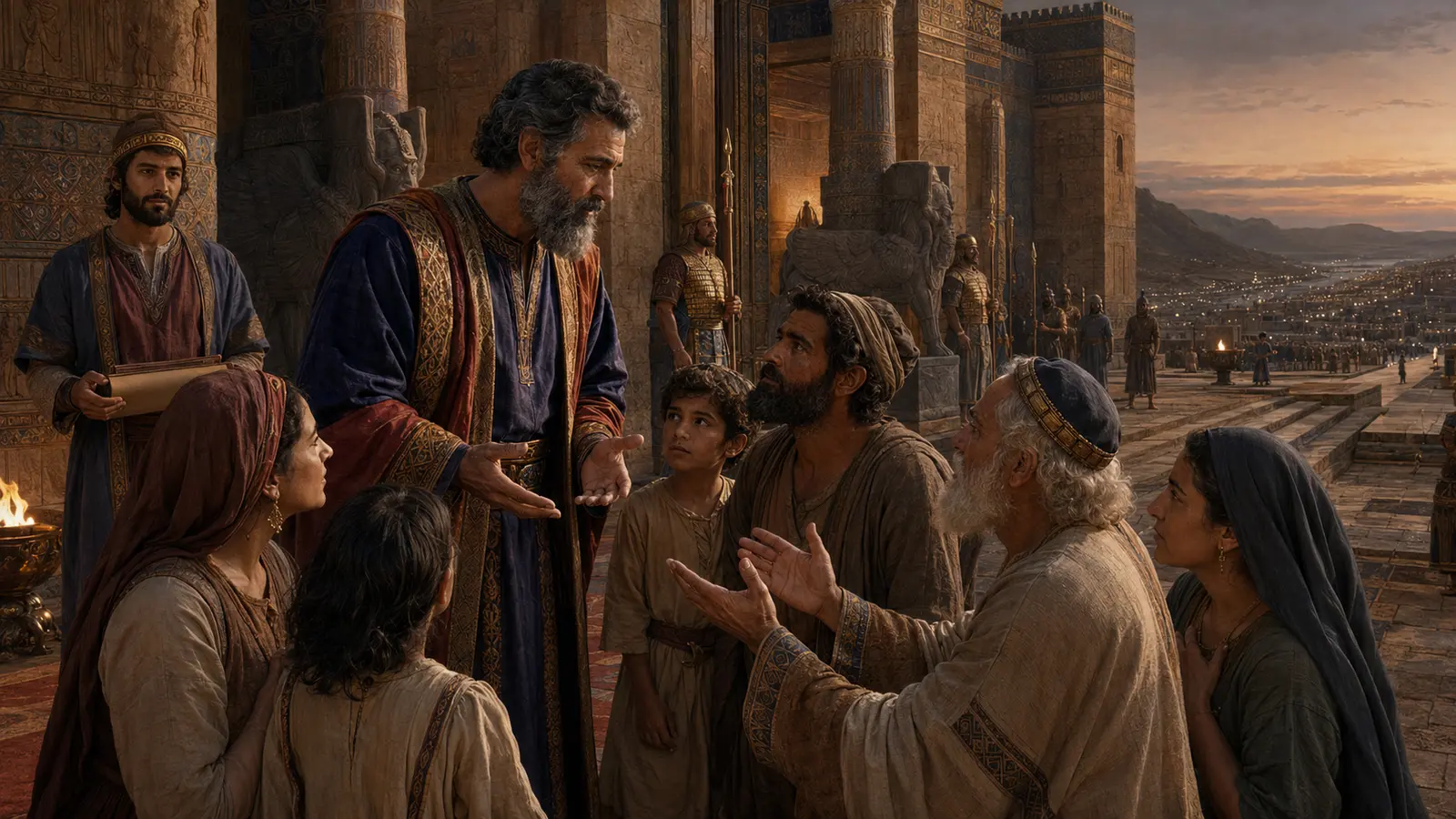
The scripture says that no one could stand before them, because their fear had fallen on all people. Officials, governors, captains, and servants of the king help the Jews because the fear of Mordecai has fallen on them (Esther 9:2-3). Mordecai has become a prince in the king's house, and his reputation is spread throughout the provinces.
This is a complete reversal of chapter 3. Haman's greatness endangered the Jews. Mordecai's majesty now protects them. Haman's influence spread death. Mordecai's influence brings security.
However, the language of the text remains heavy. Jews beat those who hate them. The narrative does not want us to enjoy violence. It wants us to realize that survival in this world of royal decrees required confronting those who were determined to destroy the Jews.
The main theological claim is not that violence is a good thing. The main claim is that the people marked for extermination were not left under the death warrant.
05
3.2 When the House of Haman Is Cut Off (Esther 9:6–10)
In Shushan, the capital, the Jews kill five hundred people. They also kill Haman's ten sons: Parshandatha, Dalphon, Aspatha, Poratha, Adalia, Aridatha, Parmashta, Arisai, Aridai, and Vaizatha (Esther 9:6–10).
The mention of the names of Haman's sons slows down the narrative. These are not unknown people. They are related to the house of Haman, the clan of the enemy of the Jews. Their death marks the fall of Haman's legacy. The one who tried to wipe out the Jewish people sees his own house cut off.
But why this murder? The death of Haman's sons is embedded in a complex ancient world: clan conflicts, royal revenge, and community survival. However, within Esther's logic, it also means that Haman's genocidal project will not continue through her house.
The foundation of Amalek gives this event more depth. Haman is called an Agagite (Esther 3:1), which connects him in the narrative with Agag, the king of the Amalekites, whom Saul left alive for disobedience (1 Sam. 15:8–9). Mordecai, from the clan of Kish (Esther 2:5), stands in the shadow of Saul's story that did not end well. The events of Esther 9 should not be seen as just personal revenge; is the culmination of historical hostility against the people of Israel[4]
Then the text adds an important emphasis: "but they did not lay their hands on the spoil" (Esther 9:10). This emphasis appears three times in this chapter. It is morally important. Although the second decree allowed the taking of booty (Esther 8:11), the Jews refuse. Their passion is survival, not enrichment.
This restraint is important. It distinguishes self-defense from greed, liberation from exploitation. It reminds us looking back to Saul and forward to the church. When God saves his people, they should not be a mirror of their oppressors. The people who were redeemed from Egypt should not build Egypt again in their hearts.
Threatened people stand up, but they do not turn redemption into theft.
06
3.3 When Esther Asks for Judgment to Be Completed in Susa (Esther 9:11–15)
The number of those killed in Shushan is reported to the king. The king tells Esther what happened and asks what request she still has. Esther asks that the Jews in Susa be allowed to act again the next day under the same decree, and that the bodies of Haman’s ten sons be publicly displayed (Esther 9:12–13).
This is where it is difficult. Esther's request may seem cruel, even heartbreaking. Why another day? Why should the bodies of Haman's sons be seen in public?
Within the world of the narrative, Shushan is the center of Haman's influence and is the capital city where the order was born. It is possible that the crisis was not over there. The hanging of Haman's sons is a public sign that the house of the enemy has fallen and that his plan is no longer effective. In the ancient world, showing bodies in public was a warning, a shame, and a way to close the political circle regarding the issue.
As if the details weren't enough, Esther is not a sanitized and painted narrative. It is a story of survival in an empire, where even redemption comes dressed in the harsh clothes of its era. This chapter does not invite personal revenge. It tells the story of the defeat of the threat of genocide.
For Christian readers, this must be read through the crucified Messiah. Jesus does not call his disciples to advance the kingdom of God with the sword (Mt. 26:52; John 18:36). Paul tells the church not to take revenge, but to overcome evil with good (Rom. 12:19-21). Esther 9 shows the survival of God's people under the old covenant, in a violent empire, before the victory of the cross. The church should receive his testimony without abusing it.
The Jews in Shushan gather again on the fourteenth day and kill three hundred people, but like the beginning, they did not touch the spoils (Esther 9:15). This emphasis is repeated because it is so important: even in the midst of struggle, the text shows how they restrained themselves against the lust of material things.
People fight to survive, not to get rich.
07
3.4 When the Provinces Rest from Their Enemies (Esther 9:16–19)
Other Jews who were in the king's provinces are also gathering to defend themselves. They get pleasure from their enemies and kill seventy-five thousand people who hated them, but they do not touch the spoils (Esther 9:16).
This number is huge and heartbreaking. It shows the magnitude of the threat and the magnitude of the reversal. Throughout the empire, many were willing to engage in violence against the Jews. The danger was not imaginary. The second decree did not create enemies; it exposed them.
Then comes the break. Jews in the provinces rest on the fourteenth day and make it a day of feasting and joy. The Jews in Shushan fight on the thirteenth and fourteenth, then rest on the fifteenth. This difference explains why Purim
it is celebrated on different days in cities without walls and in cities with walls like Shushan (Esther 9:17-19).
His movement is important: to defend himself, to find relief, to rest, to party, and to have fun. This chapter does not end at the sword. It's heading to rest. The goal is not an endless conflict. The goal is life after the threat.
This "rest" is also part of the great hope of the Bible. God brings Israel out of Egypt so they can worship him and live (Ex. 5:1; 15:13). God brings his people to the land to give them rest from the enemies (Jos. 21:44). The Sabbath itself is a sign that creation was not meant to be a battlefield forever (Gen. 2:1-3; Deut. 5:12-15). Esther 9 gives the exiles a small Sabbath in the kingdom: a table laid after the terror.
Levenson notes that Purim does not celebrate the war itself, but rather the relief that came after the war. The feast is connected with rest, not anger. [5]
People who should have died are now sitting at the table.
08
3.5 When Deliverance Becomes a Shared Memory (Esther 9:20–28)
Mordecai writes these things and sends letters to all the Jews, near and far, in all the provinces of Ahasuerus. He instructs them to celebrate the fourteenth and fifteenth day of the month of Adar every year, because those are the days when the Jews got relief from their enemies, and that month was turned from sadness to joy, and from mourning to a festival (Esther 9:20-22).
Purim theology at its best! Memory becomes action. Redemption is not left to personal gratitude. It is written, assigned, repeated, worn, and calendared.
Amazing celebration: feasting and rejoicing, exchanging gifts of food, and giving gifts to the poor (Esther 9:22). Joy becomes social and generous. The poor should not be left out of the celebration. Liberation that forgets the poor has not understood mercy.
Purim teaches us that the sacred memory is a social thing. We remember not only with words, but by sharing meals, giving gifts, and serving others. We are remembered for being one happy community that works together.
The name Purim comes from puri, the lot that Haman cast (Esther 9:24–26). Because it's stuck! The same thing associated with death becomes the name of the holiday. Haman's instrument of destiny becomes Israel's reminder of God's care.
A vote was cast, but the vote did not prevail.
The decree was written, but the decree did not have the last word.
The day of mourning became a festival.
Here Esther speaks to every generation that is tempted to believe that history is ruled by fortune, wealth, or cruelty. The testimony of the Bible says something more profound: "Lots are cast in the folds of clothes; But all his judgments are the Lord's" (Prov. 16:33). Esther does not mention God by name, but the narrative invites us to seek the secret wisdom of Him who turns human plans into unexpected redemption. [6]
09
3.6 When Esther Confirms the Feast (Esther 9:29–32)
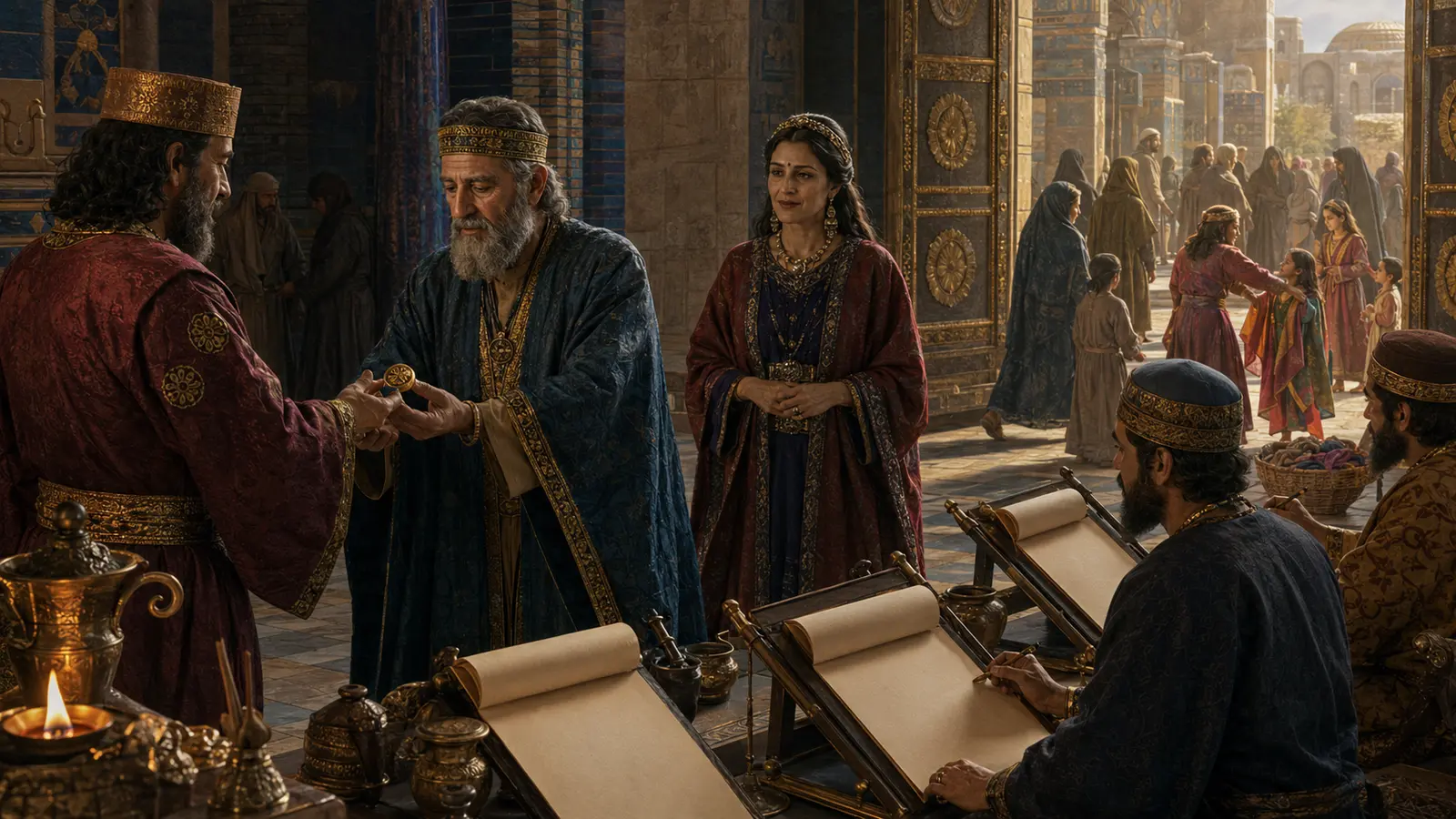
Queen Esther, daughter of Abihail, and Mordecai the Jew write with full authority to confirm this second letter about Purim. Letters are sent to all Jews in 127 provinces with words of peace and truth, confirming the days of Purim at its appointed times (Esther 9:29–31).
Esther, once hiding her identity, now writes openly with authority to all Jews. Mordecai, who once sat unnoticed at the gate, is now helping to establish a collective memory for generations. Their news has become the people's calendar.
The statement "peace and truth" is very good (Esther 9:30). Purim is not just a celebration of survival; is built on truth. The risk must be honestly remembered. Grief should not be dismissed. Redemption should not be exaggerated to the point of self-aggrandizing cruelty.
Peace without truth is denying the truth. Truth without peace is a wound that never heals. Purim holds them all together.
Pastoral care. Communities cannot recover by pretending as if nothing happened. But they also cannot thrive by remembering pain without hope. Sacred memory speaks truth in the face of mercy.
The chapter closes by saying that Esther's decree confirmed these Purim customs, and it was written in a book (Esther 9:32).
What began as a latent conflict becomes a written record. What began with Haman's letters of death ends with Esther's letters of peace and truth.
10
4.1 Reversal Is More Than Escape; It Is a Change of Meaning
Esther 9 does not just say that the Jews escaped death. It says the day itself was changed. The date chosen for destruction becomes the date remembered for redemption. The lot cast by Haman becomes the name of Purim.
God is the leader of change. God doesn't just save people from danger; he can change the meaning of the same place, day, or entity associated with suffering. Joseph can look back at the betrayal and say, "You intended evil for me, but God intended it to be good" (Gen. 50:20). Israel can look at the sea, which was once a place of fear, and sing beside it (Ex. 15:1-2). Prophets can announce that God gives "a crown instead of ashes" and turn mourning into joy (Isa. 61:3; Jer. 31:13).
The cross has brought the greatest change in human destiny to be witnessed. Roman rule crucified people to humiliate rebels and strike fear into the hearts of the weak; but God used the cross to reveal the precious love of the true King. What the empire planned to be the height of shame, God turned it into a way of reconciliation.
The reversal of fate in Esther is only partial. The change of destiny in Christ is universal and complete. But the pattern is the same: death does not get the last word.
11
4.2 God’s Hidden Providence Does Not Remove Human Courage
God is never mentioned by name in the Book of Esther, but his absence does not mean that he does not exist. This narrative is full of 'haphazard events': Esther becomes queen, Mordecai hears a secret plot, the king sleeps at night, royal records are read, Haman enters the palace at the wrong time, and the tree he carved becomes an instrument of his own judgment (Esther 2:21-23; 6:1-11; 7:9-10). This book invites readers to recognize God's hand guiding events, without making it seem too obvious. [7]
But God's hidden hand does not make man's courage unnecessary. Esther must risk her life. Mordecai must write. The Jews must gather. Redemption comes through the real submission of human beings to real historical danger.
Important for discipleship. Trusting God does not mean sitting idle. It means acting honestly when the whole story still seems to be unraveling. The student does not need to see the hidden hand to take the next step of trust.
12
4.3 Survival Must Be Remembered Truthfully and with Restraint
The violence of this chapter should not be ignored. Esther 9 forces us to face the cost of survival in a world where evil was justified. However, the repeated statement that the Jews did not take the booty shows moral restraint (Esther 9:10, 15, 16).
Memory can be revenge. A wound can be a furnace in which pain is created. But Purim points in another direction: true gratitude created by self-restraint.
People remember danger without getting drunk on victory. They celebrate liberation without sanctifying greed. They name evil without being children of evil.
Here is an important word for injured communities. God's people should never turn testimony into a weapon of pride. We remember not to perpetuate hatred, but to keep mercy in mind.
13
4.4 Joy Must Include the Vulnerable
Purim includes gifts to the poor (Esther 9:22). These details shine like lights in this chapter. When liberation turns into a feast, the poor must find a place at the table.
See theology in action. If the Jews were once a powerless people under the command of death, then their joy must remain with compassion for those who still live under pressure. Mercy received must be mercy dispensed.
All scriptures confirm that fact. Israel celebrates with the weak because Israel was once weak (Deut. 16:11-12). Nehemiah tells the people, "Go, eat what is fat, and drink what is sweet, and send a portion to him for whom nothing was prepared" (Neh. 8:10). The first church breaks bread and shares wealth so that no one is left alone (Acts 2:42-47; 4:32-35).
If God has turned our mourning into joy, then a hungry person should taste that joy.
14
4.5 Sacred Memory Forms Courage for Tomorrow
Mordecai and Esther write so that future generations will remember. Because Purim is not just a memory of longing for old things, but a form of education. Children who hear this story learn that God is able to protect his people even when worldly empires threaten, when enemies plot, when death orders are sent, and even when his name seems to be hidden.
In the same way, the Church also lives by sacred memory. We break the bread and drink the cup to remember the death and resurrection of Jesus (Lk. 22:19-20; 1 Cor. 11:23-26). We tell these stories of victory so that the fire of courage does not go out and die with this generation!
Memory becomes resistance against despair.
A church without memory is a weak church! It is a church that easily forgets the victory in the desert, the power of the cross, the openness of the empty tomb, and the blood of the saints who stood before us. But hear this: A church made of holy memories will not be shaken! It looks to the future full of courage, because it knows that our God has a history of turning graves into gardens!
15
4.6 Leadership Must Turn Deliverance into Shared Life
Mordecai does not regard redemption as his personal achievement. Esther does not hold power as her personal glory. They write, plan, prove, and teach society how to remember.
This is an example of leadership that reflects the heart of God. The best leaders not only face the challenges of the times, but build the well-being of their people. They are not just looking to survive the conflict; they build solid foundations of gratitude, justice, and social generosity.
The modern leadership of the Church should learn this important lesson from Esther 9. When God allows the assembly to pass safely through a period of turmoil, the leaders must lead the process of preserving that memory with integrity. The memory should not be based on gossip, pride, or editing the truth; but stand on the foundations of peace and firm truth
The job of a pastor is to help people turn wounds into wisdom and mercy into mission.
16
4.7 Mission Is Witness from the Table of Deliverance
Purim is not evangelism in the modern sense, but it is a public witness. Nations see that people marked for death are protected. The decree of possession does not have the last word. The feast proclaims that there is another force at work beneath the surface of history.
For the church, the mission flows from the transformation of destiny above all in Jesus. We do not go into the world as people who have never suffered. We go as the people whose Lord was crucified and resurrected. We testify not by hiding our scars, but by showing what mercy has done with them.
The mission is not to transport religious pride. It is an overflow of remembered redemption.
We have received bread; therefore we become bread for the world. We are welcomed; therefore we welcome. We are saved; therefore we say hope to those who still live under decrees of fear.
17
5.1 For the Learner
Face difficult texts with sincere honesty. Don't run away from its violence or its moral challenges. Remember that our faith grows only when we read the Scriptures with humility, courage, and a willingness to meditate deeply.
Face difficult texts with sincere honesty. Don't run away from its violence or its moral challenges. Remember that our faith grows only when we read the Scriptures with humility, courage, and a willingness to meditate deeply.
Trust God who works in secret without being negligent. God may not be mentioned by name at some point, but human obedience still has names: courage, prayer, wisdom, and faithfulness.
Trust God who works in secret without being careless. God may not be mentioned by name at some point, but human obedience still has names: courage, prayer, wisdom, and faithfulness.
Refrain from revenge even when protecting life. Refusing to take spoils reminds us that survival should not turn into lust, bitterness, or pride.
Refrain from revenge even when you protect life. Refusing to take spoils reminds us that survival should not turn into lust, bitterness, or pride.
Turn painful dates into a testimony of prayer. Some memories come as dark clouds. Bring them before God and ask him to turn mourning into joy with wisdom and humility.
Turn painful dates into a testimony of prayer. Some memories come as dark clouds. Bring them before God and ask him to turn mourning into joy with wisdom and humility.
Celebrate without denying the truth. Joy is not pretending that sadness never happened. Joy is remembering that sadness did not win.
Celebrate without denying the truth. Joy is not pretending that sadness never happened. Joy is remembering that sadness did not win.
18
5.2 For Church Leadership
Lead the community from crisis to sacred memory. After God put the church in danger, leaders must help people to remember in peace and truth.
Lead the community from crisis to sacred memory. After God put the church in danger, leaders must help people to remember in peace and truth.
Lay the foundations of a continuous testimony: write this news, tell it, sing it, and seal it with thanksgiving. The goal is for the next generation to know for sure what God has done.
Lay the foundations of a lasting testimony: write it down, tell it, sing it, and seal it with thanksgiving. The goal is for the next generation to know for sure what God has done.
Maintain self-discipline even in the midst of great victories. Don't let your redemption turn into pride; because the Church saved by grace must remember to remain humble at all times.
Maintain self-discipline even in the midst of great victories. Don't let your redemption turn into pride; because the Church saved by grace must remember to remain humble at all times.
Make the party generous. Purim includes gifts for the poor. Church celebrations, testimonies, and thanksgiving services should open arms to the weak.
Make the party generous. Purim includes gifts for the poor. Church celebrations, testimonies, and thanksgiving services should open arms to the weak.
Build people, not just software. Mordecai and Esther don't just solve the problem; they create a calendar. Leadership must build practices that carry faith beyond short-term emotion.
Build people, not just software. Mordecai and Esther don't just solve the problem; they create a calendar. Leadership must build practices that carry faith beyond short-term emotion.
19
5.3 For Mission
Witness from the mercy that is remembered. The world does not need a church drunk on boastful victories. You need people who can say, "We were under death, but mercy found us."
Witness from the remembered mercy. The world does not need a church drunk on boastful victories. You need people who can say, "We were under death, but mercy found us."
Stand with threatened communities. Esther 9 calls us to take seriously the fears of those marked by violence, hatred, or exclusion.
Stand with threatened communities. Esther 9 calls us to take seriously the fears of those marked by violence, hatred, or exclusion.
Let the poor taste the gospel. Mission is not just lip service; it is the generosity of hands.
Let the poor taste the gospel. Mission is not just lip service; it is the generosity of hands.
Proclaim the change of destiny than the greatest in Christ. Purim points to deliverance from death; the resurrection announces the final defeat of death (1 Cor. 15:54–57).
Proclaim the change of destiny than the greatest in Christ. Purim points to deliverance from death; the resurrection announces the final defeat of death (1 Cor. 15:54–57).
Live hope in exile. Esther reminds us that God can work even where his name is not welcome in the palace. Mission often happens in hidden places, with faithful presence, wise words, and courageous love.
Live hope in exile. Esther reminds us that God can work even where his name is not welcome in the palace. Mission often happens in hidden places, with faithful presence, wise words, and courageous love.
20
6.0 Reflection Questions
What "date" or painful memory in your life still needs healing and a new interpretation from God?
What "date" or painful memory in your life still needs healing and a new interpretation from God?
How can you faithfully remember redemption without getting caught up in pain?
How can you faithfully remember redemption without getting caught up in pain?
Where does your joy need to turn into generosity for the poor or the weak?
Where does your joy need to turn into generosity to the poor or the weak?
What stories of God's faithfulness should your family, your church, or your community intentionally preserve?
What stories of God's faithfulness should your family, your church, or your community intentionally preserve?
How does the resurrection of Jesus help you to believe that death and sorrow do not have the last word?
How does the resurrection of Jesus help you believe that death and sorrow do not have the last word?
In your area of leadership, what crisis needs to be turned into a testimony of "peace and truth"?
In your area of leadership, what crisis needs to be turned into a testimony of "peace and truth"?
How can your church celebrations be more missional, more generous, and more welcoming?
How can your church celebrations be more missional, more generous, and more welcoming?
21
7.0 Closing Prayer
O God who is hidden, God who changes destiny,
You see the dreaded day before it arrives.
You know the commands that hurt us, the dates that make our hearts tremble,
and the memories we carry like ashes in the soul.
Teach us to truly remember.
Protect us with joy above that forgets tears,
and with a painful memory that refuses to heal.
Make us people who can say, "Mourning was true, but mercy was stronger."
Where we should protect life, give us restraint.
Where we celebrate redemption, give us hospitality.
Let the poor taste our joy.
The lonely are welcome to the party.
Let our testimony be bread in the hand of another.
Teach our leaders to write peace and truth
above the memory of your people.
Teach your church to gather the scattered,
to strengthen those who fear, and open the table wide.
Turn our Purim times into sacred memories.
Change what was meant to be a testimony of your faithfulness.
And keep our eyes fixed on Jesus,
whose cross became victory,
his grave became a door,
and his resurrection promises
that one day every mourning will be clothed with joy.
Amen.
22
8.0 A Window into What Comes Next
Through the celebration of Purim, Esther 9 publicly commemorates the great turning point in which the Jews transcended destruction and entered into feasting, gifts, and rest.
However, the conclusion of Esther 10 leaves a passionate hope. Although Mordecai is promoted to the rank of a prince under the Persian Empire and seeks the welfare of his people, the Jews remain safe but still in exile, which proves that the kingdom of God has not come in its entirety.
23
9.0 Bibliography
[1] Levenson, Jon D. Esther: A Commentary. Old Testament Library. Louisville: Westminster John Knox, 1997.
[2] BibleProject. "The Book of Esther." Old Testament Overview Guide. Portland: BibleProject, 2026.
[3] Berlin, Adele. Esther. JPS Bible Commentary. Philadelphia: Jewish Publication Society, 2001.
[4] Moore, Carey A. Esther. Anchor Bible 7B. Garden City, NY: Doubleday, 1971.
[5] Fox, Michael V. Character and Ideology in the Book of Esther. 2nd ed. Grand Rapids: Eerdmans, 2001.
[6] Clines, David J. A. The Esther Scroll: The Story of the Story. Journal for the Study of the Old Testament Supplement Series 30. Sheffield: JSOT Press, 1984.
[7] Wright, N. T. The New Testament and the People of God. Minneapolis: Fortress, 1992.
Listen To Song About:
Be the first to leave a comment.