

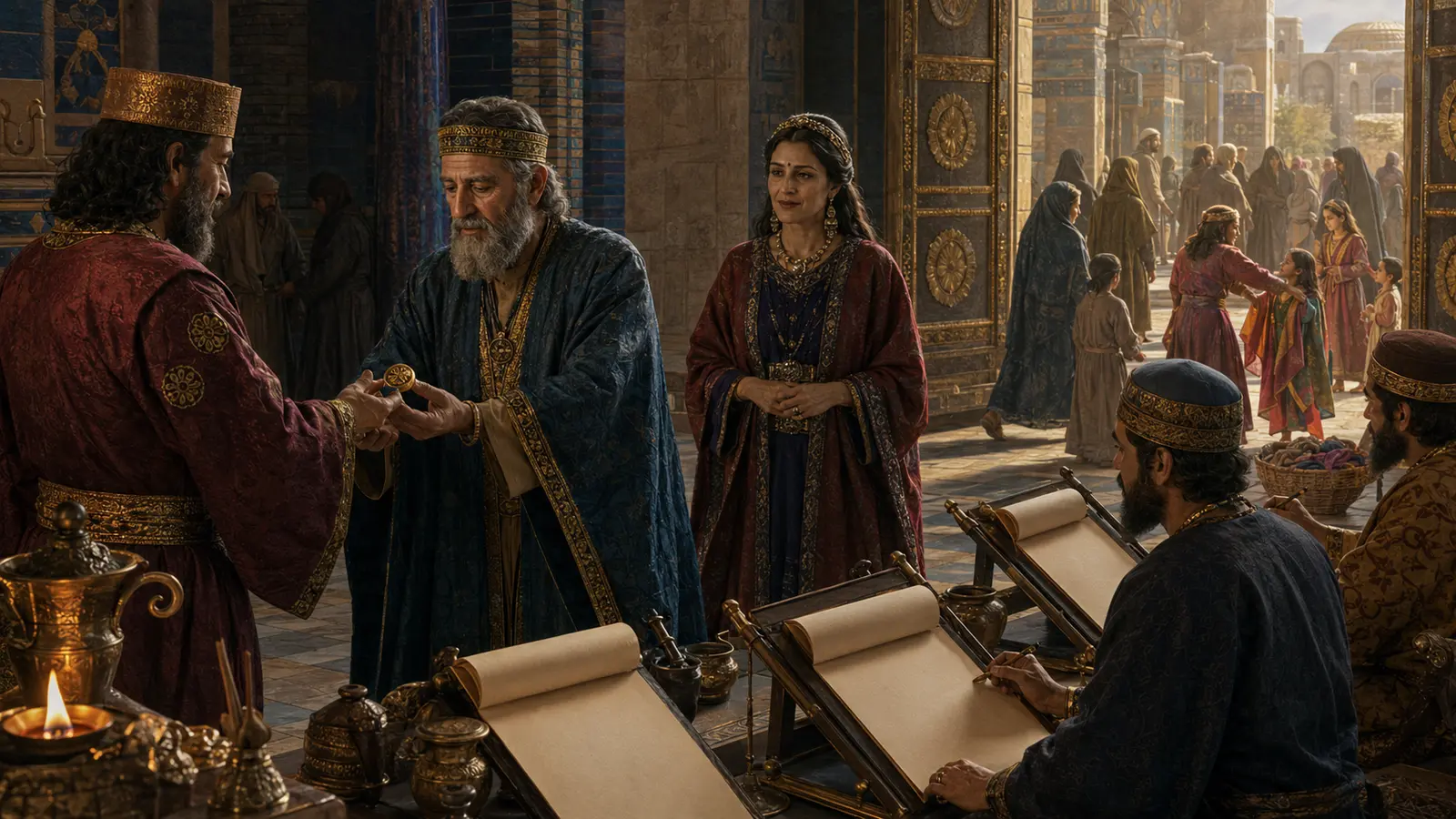
Esther 7 gave us one of the biggest changes in this book: Haman, the enemy of the Jews, was hanged on the same tree he had prepared for Mordecai. The party turned into a court. The hidden queen mentioned the hidden threat. The proud man fell into his own trap.
01
1.0 Intro: When the Evil One Falls but the Wound Remains
Sometimes justice begins with the revelation of evil, but it does not end there.
Esther 7 gave us one of the biggest changes in this book: Haman, the enemy of the Jews, was hanged on the same tree he had prepared for Mordecai. The party turned into a court. The hidden queen mentioned the hidden threat. The proud man fell into his own trap.
But Esther 8 teaches us a modest, serious, and necessary truth: the fall of one wicked person does not automatically erase the harm he has unleashed. Haman is dead, but Haman's order lives on. His body is gone, but his words still walk in the realm. Letters sealed with the king's ring cannot be easily erased. The death machine continues to operate even after the death master is convicted.
This text shows how judgment turns into permanent intercession; Redemption is not limited to exposing evil, but aims to destroy the systems of that evil. [1]
Esther must pray again. He must fall again at the feet of the king. He must reveal himself again emotionally and courageously. Mordecai must receive authority and use it not for show, but for protection. The new decree must be written, sealed, translated, and sent throughout the empire. Mourning must begin to turn into joy, but not because the danger has disappeared. Happiness comes when the day of struggle is still ahead.
This chapter of Esther is very useful for us in life. It rejects easy and superficial victories. It teaches us that public justice requires order and policy, not just emotion. It teaches us that power must change hands, but that power must also change purpose. It teaches us that society cannot live by symbolic victory alone; it needs real protection, tangible hope, and words of life strong enough to answer the words of death.
God is not yet mentioned by name. But his hidden leadership shines through events one after the other: Haman's house is given to Esther, the king's ring is given to Mordecai, the threatened people are given the right to defend themselves, and the city that was full of turmoil begins to rejoice. Esther invites us to seek God not only in thunder and fire, but also in the right season, courage, wisdom, sleeplessness, laws, letters, and public testimony. [2]
The death warrant still roars in the distance.
But now another command is starting to ride.
02
2.0 Historical and Narrative Context: From Haman's Command to Mordecai's Substitute Command
Esther 8 closely parallels Esther 3. In chapter 3, Haman is exalted, receives the king's ring, issues a decree against the Jews, then sits down to drink with the king while the city of Shushan is in turmoil. In chapter 8, Mordecai is lifted up, receives the king's ring, issues a decree for the Jews, then leaves the palace in royal robes as Shushan rejoices with joy.
This is the architecture of narrative evolution. The story doesn't just move forward in a straight line; it loops back to the previous event to reverse it. What Haman intended for death is answered with the word of life. What is stamped with a ring of possession is stamped with the same ring in the hands of another person. The narrative doesn't just punish evil; it turns the tables on evil. The Hebrew wisdom contained in Esther is later revealed in these words: "things turned out the other way around" (Esther 9:1). [3]
This chapter also continues the book's reflection on Persian law and bureaucracy. The empire is large, multilingual, and has a complex administrative system. The decrees are written in the script and language of each state. Envoys ride royal horses. The king's ring seals authority. The law runs faster than conscience, and once released, it is not easy to get it back.
The problem is legal. The king says that the decree written in his name and sealed with his ring cannot be revoked (Esther 8:8). Haman's decree cannot be revoked; must be answered. Death cannot be erased by pretending it was not written. There must be an injunction that gives threatened individuals the ability to stand against damages.
Theologically, this chapter shows hope under constant threat. The Jews rejoice after the substitutionary commandment, but the day of danger has not yet come. Their happiness is real, but not self-deceiving. It is a joy with a sword that is still needed. It is a celebration when caution is still necessary. It is the first light before full morning.
Biblically, Esther 8 is heard along with other cases where the word of death is answered with the word of life. Pharaoh's order against the children of the Hebrews is answered by God by saving Moses (Ex 1:15-2:10). The curse that Balak wishes Israel through Balaam is turned into a blessing (Numbers 22-24). The sentence of exile is answered with promises of restoration (Isa 40:1-11; 52:7-10). In the New Testament, the death sentence caused by sin is answered with the good news of resurrection and new creation (Rom 8:1-4; 1 Cor 15:20-28; Col 2:13-15).
Ester 8 does not completely resolve the transfer. The Jews are still in Persia. Ahasuerus is still on the throne. The world has not yet been made new. But this chapter testifies to this truth: God can bring an alternative word into history. He can work through honest courage within polluted systems, without blessing those systems themselves. [4]
Haman's letters rode on horses carrying death.
Mordecai's letters ride on horses carrying hope.
03
3.1 When Haman's House Changed Ownership (Esther 8:1–2)
On that day, King Ahasuerus gives Queen Esther the house of Haman, the enemy of the Jews. Mordecai is brought before the king, because Esther has informed the king who he is to her. The king takes off the signet ring he took from Haman and gives it to Mordecai. Esther then places Mordecai over Haman's house.
This evolution is rapid and visible. Haman's wealth, status, and power are transferred to the very people he had tried to destroy. His house becomes Esther's property. His ring becomes Mordecai's authority. His place in the kingdom is taken by the person who hated him.
The words "enemy of the Jews" carry weight. Haman is not just Esther's personal enemy. He is known for his enmity against the people of the covenant. His downfall is not an individual revenge; it is a public condemnation of the policy of genocide.
This tragedy is reminiscent of the long Biblical conflict concerning Amalek. Haman is called an Agagite (Esther 3:1), which connects him narratively with Agag, the king of the Amalekites whom Saul failed to fully judge (1 Sam 15). Mordecai, on the other hand, is associated with Saul's Benjamin line (Esther 2:5). So Esther reopens an old wound in Israel's memory. What Saul did not finish now returns dressed in Persian clothing. The conflict is no longer on the battlefield in Canaan, but within the royal palace. [5]
Now Esther reveals her relationship with Mordecai. A family relationship that was hidden is made public. At first, Esther hid her people and her relatives (Esther 2:10, 20). Now all is mentioned. His hidden identity becomes a public testimony, and that truth changes the way power is achieved.
But we have to see that the transfer of power is not the end of the story. Haman's ring in Mordecai's hand opens up possibilities, but possibilities must be turned into action. Authority is not a trophy to display on the wall. It is a tool to protect life.
Knowledge for students and leaders. The question is not just, "Whose hand is the ring now?" The most important question is, "Now what will the ring do for him?" Haman used the authority he was given to nurture his wounded soul. Mordecai must use the authority given to him to protect the threatened life. In the kingdom of God, authority is justified only when it turns into a shadow of security.
04
3.2 When Esther Prays Again (Esther 8:3–6)
Esther says again before the king. She falls at his feet, weeping, and pleads with him to remove Haman's evil plan and plot against the Jews.
This is Esther's second intercession. After chapter 7 exposes Haman, chapter 8 focuses on the deliverance of his people. The queen does not stop there just because the enemy has fallen; he continues to fight because his people are still in danger.
The king hands Esther the golden rod again. Esther gets up and stands in front of him. This repetition reminds us of chapter 5, but now Esther's request is faster and more direct. He asks for letters to be written to cancel the letters composed by Haman.
I listened to his words: "For how will I be able to bear to see the evil that will befall my people? How will I be able to bear to see the destruction of my relatives?" (Esther 8:6).
This is the language of love that refuses to separate. Esther cannot live as if the security of the palace is enough. He cannot enjoy his personal salvation while his people are still condemned. His heart is connected to their fate.
Esther stands with other intercessors in the Bible. And Abraham pleads for Sodom (Gen 18:22-33). Moses stands between the wrath of God and the destruction of Israel (Ex 32:11-14, 30-32). Samuel says it will be a sin for him to stop praying for the people (1 Sam 12:23). Nehemiah weeps, fasts, prays, and then asks the king for permission to rebuild Jerusalem (Neh 1:4-2:8). Esther's tears are not new in this community. His intercession is not a way to avoid public responsibility; rather, it is the main entrance into it.
However, Esther's intercession is also unique. God is not mentioned. There is no written prayer in the Hebrew text. The throne before which Esther falls is not the throne of heaven, but the throne of Persia. But the truth remains clear: covenant love ventures into danger for others. Esther becomes a living question for every student: What is the wound in the body of God's people that I have learned to carry as mine?
One of the hallmarks of mature intercession is this: it is not satisfied with personal relief. They seek the salvation of the community. Esther could have lived on after Haman's fall with more status and wealth, but she rejects a personal victory that leaves her people exposed to danger.
05
3.3 When the King Fails to Cancel the Decree (Esther 8:7–8)
The king reminds Esther and Mordecai that he has given Haman's house to Esther, and that Haman has been hanged because he raised his hand against the Jews. Then he allows them to write what they want about the Jews, in the name of the king, and seal it with the king's ring.
But he also mentions a problem: a decree written in the king's name and sealed with the king's ring cannot be undone.
Once again the weakness of the empire is seen again. The king's authority is strong enough to impose the death sentence, but they seem not to be wise enough to easily abolish it. The law of possession has ensnared its maker. The king can kill Haman, but he cannot easily cancel Haman's order.
This is more than a legal drama. Once the harm has occurred, it is not removed by the forgiveness or punishment of just one person. There must be responses to comments, changes to systems, and concrete steps to correct the damage.
Ahasuerus is a picture of immoral authority. He gave Haman the ring very quickly in chapter 3, and now he gives permission to Mordecai in chapter 8. In both cases, he entrusts matters of life and death to others. The irony is stark: a king who rules 127 states cannot control the consequences of his own signatures. [6]
For church leaders. When leadership has allowed harm—by silence, negligence, favoritism, abuse of power, racial disdain, financial fraud, or careless teaching—it is not enough to say, "Haman is removed." The command may still be riding in the middle of the assembly. People may still be afraid. Policies may still be weak. Victims may still not be heard. Faith may still be broken. An alternate command must be typed.
The king gives permission, but Esther and Mordecai must now write. They must turn the position given to them into protection. You must answer death with the approved word of life.
06
3.4 When Hope Is Written in Every Language (Esther 8:9-14)
The king's scribes are called the third month, the month of Sivani. They write according to all that Mordecai commands about the Jews, for governors, governors, and heads of states from India to Cush, 127 states, each state with its writing and every nation with its language, and also for the Jews with their writing and their language.
Didn't we grow like this in Esther 3? Yes, but now the machine of possession is used for another purpose. The same administrative system that carried Haman's death warrant now carries Mordecai's replacement warrant.
This is one of the great reforms of this chapter: scribes, languages, rings, messengers, royal horses—all the means of royal communication are re-used for the survival of the Jews.
This decree allows the Jews of every city to assemble and defend themselves—by exterminating, killing, and destroying any armed enemies who would attack them, along with their families, and seize their property. Although this language is difficult, it must be read in its context; The book of Esther does not preach personal revenge as a virtue. This order was aimed at protecting the community that was already doomed to destruction, giving those who were threatened a legal right to stand up against those who wanted to carry out Haman's atrocities. [7]
Although we understand the context of the time, the language of violence must make us sad. In Esther's harsh world, royal laws left only one option for survival: self-defense. The Bible does not want us to enjoy this cruelty; it wants us to witness the gravity of evil and the harsh conditions that the weak have to go through in order to survive.
For Christian readers, this story must be read through the crucified and risen Messiah. Jesus does not give his disciples permission to develop the kingdom by the sword (Mt 26:52; John 18:36). But he calls his people to resist evil, to defend the weak, to reveal the works of darkness, and to stand firm against spiritual forces (Eph 5:11; 6:10-18). The alternative order of the church is not revenge. It is the public announcement and visible actions of the gospel: forgiveness without denying the truth, justice without hatred, protection without cruelty, courage without dominating others.
The explanation that the commandment is written "to every province in its own writing and to every nation in its own language" has missional force. Hope must be understood. A word of life that people cannot understand may be true, but it is not yet pastoral. The God who divided the languages at Babylon also gathers the nations through a clear testimony on the day of Pentecost (Gen 11:1-9; Acts 2:1-11). Mordecai's command precedes this principle: the good news must travel in the language of those who need to hear it.
The messengers are hurrying out on the royal horses. The keyword is moving fast. Now hope also has urgency.
07
3.5 When Mordecai Comes Out of Royal Glory (Esther 8:15)
Mordecai comes out before the king wearing a royal robe of blue and white, a large golden crown, and a robe of fine linen and purple.
This event overturns previous images in the book. In chapter 4, Mordecai stood outside the gate wearing sackcloth and ashes. In chapter 6, he was briefly dressed in royal robes and mounted on the king's horse. Now he comes forth clothed with royal glory, not only temporarily, but as a truly exalted man.
The journey from sacks to royal dresses is a small summary of the entire book. Sorrow begins to be clothed with honor. Shame begins to turn into dignity. Mourning begins to loosen its grip.
These colors and clothing have meaning. Blue, white, fine linen, purple, and gold denote royal status. They can also remind of the priestly images in the Torah, where the garments of glory and beauty show service before God (Exodus 28:2-8). Mordecai is not a priest in the temple, but in the palace of Persia he becomes like a public servant for the life of his people. Her clothes are not just decorations; it is a calling that has a body. [8]
However, the exaltation of Mordecai is not like the exaltation of Haman. Haman used his power to promote himself and threaten others. Mordecai's authority is tied to the welfare of his people. His royal attire reflects a new regime of protection.
Here we see a theological image of redeemed power. Although power is dangerous, when guided by wisdom and service it becomes a fortress of safety. The rise of Mordecai does not bring personal praise, but it shows the positive results when power is held by someone who defends life.
Here, this chapter presents an image that transcends its limits: it reminds us of Joseph who was raised from prison to the palace to preserve life (Gen 41:39-57; 50:20), and Daniel who ruled Babylon with firm loyalty to God (Dan 1; 6). Its peak is Jesus, the true King, who is not exalted by the desire for power, but by the humility of the cross (Phil 2:5-11). His crown comes through suffering. His authority is quite unlike Haman's political vanity; it is the reign of the Lamb, where the supreme power becomes self-sacrificing love (Rev 5:6-10).
08
3.6 When Shushan Rejoices and Many Draw Near (Esther 8:16–17)
The city of Shushan shouts with joy. The Jews find light, joy, joy, and honor. In every province and every city, wherever the king's command and decree arrives, there is joy and gladness among the Jews, feasts and great days. Many among the people of the country call themselves Jews, because the fear of the Jews has fallen upon them.
Here we see the complete reversal of the end of the third chapter. At that time, the king and Haman sat down to drink wine while the city of Shushan was in turmoil and mourning; now, Mordecai comes out and the town explodes with joy. The atmosphere changes completely—frustration gives way to joy, and an identity that was threatened turns into an identity that is respected.
The sequence of words "light, joy, joy, and honor" is like the sun rising after a long night. It answers the previous sequence of "mourning, fasting, weeping, and wailing" (Esther 4:3). The order has not yet been tested in battle, but hope has entered the marketplace, the streets, and the public. Jews can breathe again. They can gather. They can prepare. They can celebrate the first sign that death will not have the last word. [9]
Biblically, light is not just a feeling. It is the language of creation. God's first word about the darkness of the depths is, "Let there be light" (Gen 1:3). The restoration of Israel is described as light coming to the people sitting in darkness (Isa 9:2; 60:1-3). The psalmist says, "Light dawns on the righteous, and happiness dawns on the upright" (Ps 97:11). Esther 8 does not mention God, but speaks in the grammar of dawn.
The statement that many people call themselves Jews is controversial. Some may actually identify with Jews. Others may be taking their side out of fear. In any case, the social position of the Jews has changed to a great extent. Those who were marked for extermination are now recognized as persons under protection.
These events shed light on mission: when God saves his people, the nations testify. Abraham was blessed so that all the families of the earth would be blessed (Gen 12:1-3), and Israel was called to be a light to the nations (Isa 49:6). In the book of Acts, the nations are drawn to the Messiah of Israel without having to be Jews by nature, being made one renewed family in Christ (Acts 10-11; Eph 2:11-22).
This chapter of Esther has not yet reached that fulfillment, but it marks the beginning of the way: when God's people come out of fear and enter into faithful testimony, outsiders begin to ask where life is found.
This joy does not mean that the story is over, but it indicates that the direction has changed.
Death letters have been answered.
Mourning now begins to put on festive clothes.
09
4.1 Redemption Requires More than the Fall of the Wicked
Haman's death was necessary, but not sufficient. Esther 8 teaches us that justice must deal with people and systems. The evildoer may fall, but harmful policies continue to operate. Evil may be exposed in public, but the weak still need protection.
This is important pastorally. Families, churches, institutions, and communities often want to end in one big event: the culprit is named, the scandal is revealed, the leader is removed. But Esther reminds us that the command must still be answered. Healing requires systems of safety, truth, accountability, and restoration.
In discipleship, this means that repentance must turn into reformation. Zacchaeus does not receive Jesus only with joy; he also returns what he took (Lk 19:1-10). Paul doesn't just preach reconciliation; he wants the church to be a new humanity in which the old walls have been torn down (Eph 2:11-22). Biblical redemption moves from the altar to the street, from confession to redemption, from tears to new customs.
10
4.2 Powers Must Be Released for Protection
The signet ring originally fueled Haman's hatred. It now powers Mordecai's alternate command. The same symbol of power changes hands and changes purpose.
Power is not automatically sacred. Force is legitimate when it is used to sustain. Mordecai's exaltation is meaningful because he uses power to preserve life. In the Bible's narrative, righteous leadership is measured not by the shine of clothing, but by this question: are the weak protected and people prosper? (Deuteronomy 17:14-20; Psalm 72:1-4; Proverbs 31:8-9).
Mordecai's new authority finds full meaning in the presence of Jesus, whose kingdom is not an authoritarian monarchy, but pastoral love. He is the Son of Man who receives all authority from the Ancient of Days (Dan 7:13–14), but interprets his greatness through service (Mk 10:42–45). He wears no crown to crush the bruised reed; he wears the crown by carrying the cross
Therefore, the leadership of the church should ask themselves: Are our rings of authority protecting people or protecting our image? Do our titles breed fear or provide a shadow of security? Are our meetings passing life-altering commands, or are they regurgitating the same old patterns in spiritual terms?
11
4.3 Hope Must Be Clearly Written and Promptly Sent
Mordecai's alternate commandment is practical. It is written, translated, sealed, and sent. Hope is not an abstract feeling. It turns into communication, policy, preparation, and protection.
God's people must learn this. Prayer is necessary, but prayer does not take the place of wise action. Compassion is necessary, but compassion must translate into plans, letters, meetings, budgets, policies, training, pastoral care, and tangible support.
Esther 8 turns intercession into the rule of life—an action that is not only physical, but has deep spiritual weight. The God who fed Israel with manna in the desert, also gave instructions on how to collect it (Exodus 16). Likewise, the Spirit that descended on the day of Pentecost created a community that shared resources and coordinated services for widows (Acts 2:42-47; 6:1-7). Here, grace ceases to be a mere concept and becomes a tangible reality.
12
4.4 The Fun Can Begin Before the War Is Over
The Jews rejoice before the thirteenth day of Adar arrives. Their enemies are still there. The danger has not fully passed. But the alternative command gives them real reason to rejoice.
Christian hope has this form: we rejoice because the last word of life has been spoken in Christ, even when the world is still sick (Rom 8:18-25). We celebrate the resurrection while continuing to resist evil; we live between the decree and the final victory, between the promise and the fulfillment, and between the first dawn and the full noon.
This is not an evasion of reality, but a firm hope taught to stand. The resurrection of Jesus is God's substitute command against sin, death, and the powers of darkness. However, the church is still waiting—praying, suffering, witnessing, and working—until the day when death itself will be eradicated and mourning will be completely removed (1 Cor 15:20-28; Rev 21:1-5).
Happiness is not the absence of struggle.
Joy is the realization that death has been defeated.
13
4.5 God's Hidden Leadership Does Not Eliminate Man's Responsibility
God is not mentioned in Esther, but human responsibility is everywhere: Esther prays, Mordecai writes, messengers chase horses, and society gathers. God's silence does not create laziness, but it inspires courage.
Herein lies Esther's greatest gift for discipleship. Believers often wait for God to perform miracles that will forgive them the need to obey. But Esther reveals another wisdom: that sometimes, the hidden hand of God puts you in a position, opens doors, moves something on your table, and asks you, "What will you do with the authority you have?"
God's providence is not a river for spiritual sleep. It is a trumpet to wake us up and act honestly.
14
5.0 Life Applications: Writing Life-Alternatives
Don't stop at exposing evil. As harm is revealed, ask what concrete steps are needed to protect people and repair the damage. The truth must not only be told, it must become a defense.
Use power as a shadow of security, not a platform for showing off. Mordecai receives the ring and writes for life. Whatever influence we have—at home, in the altar, in the office, in the classroom, on the committee, or on the platform—must serve the weak.
Turn compassion into action. Esther cries, but Mordecai writes. Mercy and mourning will not suffice; they must be turned into plans, systems, and robust defenses.
Present hope clearly. Command-substitution traveled to every language. Heartbroken people need clear messages, not formless consolations. True mission requires interpretation that reaches hearts, not general announcements.
Protect without being cruel. Jews are given the right to defend themselves. Do not embellish the crisis as if it is a good thing, but also do not ignore the need to protect life. Christian opposition must be firm, true, and modeled after the cross.
Build on previous wins. Bringing down Haman is only half the battle; the real job is to save people. Church leaders must ask themselves: What commandments of the enemy are still governed by the law, even after the apparent conflict is over?
End the Community that Stands Together. The new commandment gave the Jews the right to assemble and protect their lives. To be a disciple of Christ is not to face the pressure of the world alone; it is to be part of a covenant family that carries shared burdens.
Let joy explode when hope is grasped. Even before every danger is gone, celebrate the sign that God is turning the wind. The little rays of the dawn should wake up the songs.
Remember that God can reuse what was carrying death. Rings, scribes, messengers, and royal horses formerly served Haman's command; now they serve redemption. God can redeem vessels, places, systems, platforms, and even painful histories for life.
Type your command-line. In the family: Establish words of forgiveness and new healthy boundaries. In the church: Establish policies that protect children, the vulnerable, and the injured. In mission: Preach the gospel in a language that can convey hope to people. In personal discipleship: Replace lies with truth, fear with obedience, silence with prayer, and shame with a strong identity in Christ.
15
6.0 Reflection Questions
Recognizing Patterns: Where have you ever witnessed "Haman" fall, but his decree of destruction remained in power?
Using Authority: What ring of authority, position, or influence has God entrusted to you for the purposes of protecting the weak?
Life Writing: What practical “commandment” should you write today—in your family, church, office, or community?
Translating Hope: How can you convey a message of hope in a language that is touching and easily understood by brokenhearted people?
Joy in the Midst of the Storm: In what area of your life is God inviting you to rejoice in the small dawn, even before the battle is fully over?
Real Leadership: If you go beyond the boundaries of the victory of only external changes and enter into the protection of concrete, how will your daily responsibilities change?
Redeeming History: What are the old vessels, poor systems, or painful histories that God is calling you to release and reuse to bring life?
16
7.0 Response Prayer
O God who hides himself in the evolution of history,
You see orders still riding through the empire.
You know the words of death that still travel
even after the enemy has fallen.
You hear Esther's tears,
and you receive the cry of those who cannot endure
to see their people destroyed.
Give us the courage to continue the work of justice.
Do not let us be satisfied with symbolic victories
while vulnerable people are still exposed to danger.
Place the ring of duty in the hands of honest people.
Teach us to write the words of life
the place where the words of death were sent.
Make our compassion practical.
Make our power to protect.
Make our hope clear enough to be carried
to every state and every language.
Teach your church to lead like Mordecai,
to pray like Esther, to speak like the prophets,
to serve as the Messiah, and to live as people of the resurrection
while the night is still learning how to be in the morning.
As the mourning begins to subside,
teach us to be happy without forgetting the dangers.
When the light rises,
teach us to walk like children of the dawn.
While the war is not yet over,
hold our joy in your covenant faithfulness.
Through Jesus Christ,
The true King whose power gives life,
whose resurrection answers death's command,
and whose kingdom turns fear into joy.
Amen.
17
8.0 What's Next Window
Esther 8 ends with light, joy, gladness, and honor. Mordecai has a ring. A replacement command has been sent. Shushan is happy. Throughout the empire, the Jews begin to feast even before the day of danger arrives.
But that day has yet to come.
In Esther 9, the thirteenth day of Adar will arrive, and a transformation will be seen within the crisis. The Jews will survive the day that was planned for their destruction. The narrative will move from command to self-defense, from self-defense to rest, from rest to memory. Purim will be established so that future generations will not forget how mourning turned into joy.
An alternative command is written.
Now the survival will turn into a memory.
18
9.0 Bibliography
[1] Jon D. Levenson, Esther: A Commentary, Old Testament Library (Louisville: Westminster John Knox, 1997), 106–17.
[2] BibleProject, “The Book of Esther,” Old Testament Overviews (Portland, OR: BibleProject, 2026).
[3] Michael V. Fox, Character and Ideology in the Book of Esther, 2nd ed. (Grand Rapids: Eerdmans, 2001), 157–63.
[4] N. T. Wright, The New Testament and the People of God (Minneapolis: Fortress, 1992), 268–79.
[5] Adele Berlin, Esther, JPS Bible Commentary (Philadelphia: Jewish Publication Society, 2001), 35–43.
[6] Carey A. Moore, Esther, Anchor Bible 7B (Garden City, NY: Doubleday, 1971), 79–83.
[7] David J. A. Clines, Ezra, Nehemiah, Esther, New Century Bible Commentary (Grand Rapids: Eerdmans, 1984), 314–19.
[8] Levenson, Esther , 115–17.
[9] Fox, Character and Ideology, 101–5.
Be the first to leave a comment.