

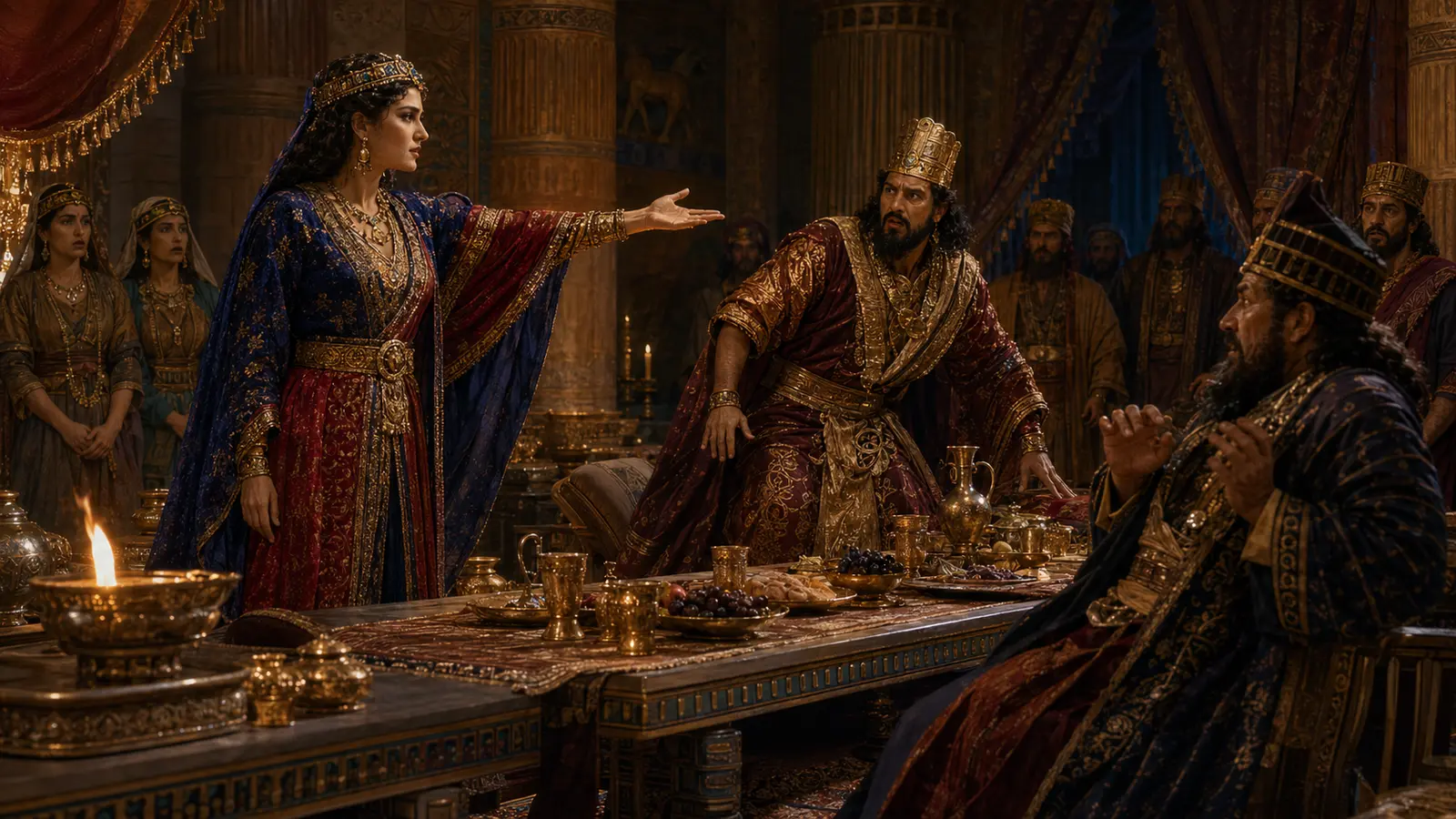
The table was prepared with wine, but it was actually waiting under the cup. The queen who had hidden her name now called her people from the darkness and put them in the light. The enemy who built the aibua tree realized that evil often prepares its own judgment.
01
Introduction
The table was prepared with wine, but it was actually waiting under the cup. The queen who had hidden her name now called her people from the darkness and put them in the light. The enemy who built the aibua tree realized that evil often prepares its own judgment.
02
1.0 Introduction: When the Truth Must Be Told
Sometimes wisdom waits. There are times when courage takes its toll. Then there are times when the truth can no longer go around the corner; it must be clearly stated.
Esther 7 is that time.
In two chapters, Esther has walked with holy caution. He has fasted in secret, entered the inner courtyard at the risk of his life, received the king's scepter, invited the king and Haman to a feast, delayed his request, and waited for a night when the invisible hand of fate turned the wheels of history. The king could not sleep. Mordecai's forgotten faithfulness was remembered. Haman had to publicly honor the very man who wanted to destroy him. By Esther's second feast, Haman had already begun to fall.
Now the hidden truth brings its face to the table.
Esther reveals what she had been hiding: she is Jewish. His life is tied to the lives of his people. The order to kill the Jews is not only a political matter; it is a death sentence against the queen herself. Haman's plot is not a distant frontier threat; it is a treasonous murder in the palace.
This text refers to the hidden identity of public intercession, because justice begins when it names both: the threatened and the one who threatened.
This chapter has drama, it has literary irony, and it has real intensity. The king asks who would dare to threaten the queen. Esther mentions Haman. The king rises in anger. Haman falls before Esther, begging for her life. The king misunderstands the incident—or perhaps uses the opportunity to mock him on purpose—and Haman's face is covered. Then Harbona, one of the eunuchs, directs the king's eyes to the tree that Haman had carved for Mordecai, the man who saved the king. Haman is hanged on the gallows he had prepared for his enemy.
For Haman, the winds of change have completed his work. But for the Jews, things are still. The great enemy has fallen, but the decree of destruction still stands. Removing an evil person does not automatically mean that the system he created by his evil is broken. The dragon's head can be cut off, but its body continues to crawl on the streets. The work of justice must go far beyond exposing evil; it must move to slide protection, restoration, and new creation.
However, Esther 7 illuminates the revolution in a bright light. The party becomes the court. The queen becomes a witness. The hidden enemy is exposed. The tree of shame becomes an instrument of judgment. And behind all that, God is not named, but his presence cannot be denied in the strange order of time, courage, memory, and fall. The book of Esther is one of the great testimonies of the Scriptures that God can work with great power even when his name is not mentioned in words. The silence of God's name is not the absence of God's hand. [1]
A trap is woven. The proud has fallen. The table has become the throne of truth.
03
2.0 Historical and Literary Context: The Summit Banquet
Esther 7 is the second of two feasts that Esther prepared for the king and Haman. These two feasts revolve around the central event of chapter 6, where Mordecai is honored in public and Haman is shamed in the air. This writing makes sense. Esther's first feast raises Haman's pride; a sleepless night reveals a hidden memory; Esther's second party reveals a hidden plot. What seemed like silence becomes an unstoppable loud voice, and the darkness now ushers in the dawn of a new season of glory.
The theme of the party is very important. In the book of Esther, festivals and feasts show the rise and fall of power. Ahasuerus' banquet in chapter 1 showed the pride of the empire and exposed the folly of the empire. Esther's coronation feast in chapter 2 placed her in the palace. Haman's banquet with the king in chapter 3 celebrated the decree of death as the city of Shushan went into turmoil. Esther's feasts in chapters 5 and 7 become instruments to turn things around. In the design of this book, the party is not a backstage decoration; they are theological platforms where power reveals its hunger, and destiny turns its tables. [2]
This chapter also reverses Haman's ascension in chapter 3. In chapter 3, Haman is elevated, persuades the king, receives the royal ring, gives orders, then sits down to drink with the king while the city mourns. In chapter 7, Haman is brought to Esther's table, is revealed as an enemy, falls in fear, and is hanged on his own gallows. A man who used his proximity to power to threaten the Jews is now losing his life because a Jewish queen is using her proximity to power to speak the truth.
The memory of the Bible behind what is happening is from ancient times. Haman is called an Agagite, which connects him with Agag and Amalek, the old enemy who attacked Israel in the desert (Ex. 17:8-16; Deut. 25:17-19; 1 Sam. 15:1-35). So Esther 7 is not just a palace drama; it is another event in the long struggle between the seed of promise and the forces that want to cancel it. Amalek attacked the weak behind Israel's caravan; Haman now wants to attack God's people scattered throughout the empire. The costume has changed, but the old enmity is still recognizable.
But Esther does not face evil for fear of greed. He confronts them with incarnate intercession.
His identity is no longer a private fact; you become the basis of his defense. He speaks as a person whose life is tied to the lives of those condemned to die. In this, Esther stands in the place of Moses, who prayed for Israel after the golden calf (Ex. 32:30-32); Daniel, who confessed the sins of his people as if they were his own (Dan. 9:4-19); and Nehemiah, who wept, fasted, prayed, and acted for Jerusalem (Neh. 1:4-11).
This is one of the great theological movements in Esther: salvation comes through identification with the vulnerable. Esther stands with her people. He does not isolate himself from their danger. He brings their death sentence before the king by saying, in a broad sense, "A command against them is a command against me. Their death is my death. Their enemy is my enemy."
For Christian readers, this precious solidarity of Esther points them forward to Jesus, the true and final Intercessor, who does not save in a safe distance. He takes on a body, joins the family of threatened humans, enters the place of death, and rises again so that mercy has the last word (Jn. 1:14; Heb. 2:14-18; 7:25). Esther risks death to defend her people; Christ enters into death to redeem even his enemies.
The hidden queen has now become a public advocate.
04
3.1 When the King Asks Again (Esther 7:1–2)
The king and Haman come to feast with Queen Esther. Again, on the second day, while they were drinking wine, the king asked: "What will you want, Queen Esther? It will be granted. And what is your request? Even half of my kingdom will be granted."
This is the third time the king has made such a promise. The reader has waited with Esther through fasting, danger, delay, and feasting. Now the question comes back: What does he want?
The phrase "even half the kingdom" sounds like a big promise, but Esther's need is more urgent than royal hospitality. He does not ask for territory, wealth, title, or revenge. He begs for life. The king speaks in the language of many. Esther responds from the brink of death.
This distinction is important. Empire likes to put on a show while ignoring injuries. It can show gold, wine, gardens, thrones, decrees, and crowns, but fail to protect the innocent. The palace may offer half the kingdom, but Esther is asking for something more fundamental and more sacred: that the lives of her people be allowed to continue.
Now the banquet table is spilled with all the hidden truths. Haman may think he is still an honored guest. The king may think this is another royal event. But Esther knows that the party has become a place where silence must come to an end.
05
3.2 When Esther Prays for Life (Esther 7:3–4)
Esther answers with humility and courage: "If I have found favor in your eyes, O king, and if it pleases the king, let my life be given to me as my need, and my people as my request."
Esther reveals herself with a serious and persuasive power. He begins with his own life, then mentions his people. A strategic and heroic request—a request that reminds the king that the queen's life is at stake.
Then he describes the danger in the language of Haman's command: "We have been sold, I and my people, to be destroyed, killed, and destroyed." These words echo the royal decree of Esther 3:13. Esther brings the language of death into the banquet hall, and makes the king hear what he has allowed.
This is prophetic wisdom within royal etiquette. Esther doesn't shout, but she doesn't make a sound either.
He speaks in the grammar of the palace, but the burden of his words is covenantal: the people created by promise have been sold for slaughter. This language reminds us of Joseph, who was sold by his brothers, but later realized that God had acted through the evil of humans to preserve life (Gen. 37:28; 45:5; 50:20). Esther's people are "sold," but God who saved Israel through Joseph now saves Israel through Esther.
He adds that if they had only been sold as slaves, he would have remained silent, because the distress would not have weighed heavily on the king. This statement has high rhetorical power. Esther does not discount slavery as if it were not a bad thing; he shows the magnitude of the genocide. He says: this is not ordinary slavery. This is destruction.
The words "me and my people" are the heart of his intercession. Esther no longer hides behind the palace. He stands in solidarity with the condemned. His identity becomes his request. He speaks as someone who deals with vulnerable people.
06
3.3 When the King Wants a Name (Esther 7:5)
The king asks, "Who is that, and where is he, who dared to do that?"
The irony here is heavy. The king himself approved the decree. He gave Haman a ring. He allowed the people to be handed over to destruction. But now he speaks as if he is shocked that such a thing could happen in his kingdom.
This is an ironic part of the book of Esther against authority. Ahasuerus has power without understanding. He signs without seeing. He delegates power without distinction. Now, when the consequences of his carelessness affect his queen, he is furious. The king has power, but he has no wisdom; he has a throne, but he has no moral clarity; he has authority, but he has no responsibility. Esther reveals not only Haman's hatred, but also the danger of leadership that allows others to use their power as a weapon.
The king's question opens the door for the enemy to be named.
Naming injustice by name is important. Harms often hide behind vague language: policy, process, safety, tradition, efficiency, order. Esther clears the fog. People are threatened. The queen is in danger. Someone has done this.
It's really ready to be specific.
07
3.4 When Esther mentions Haman (Esther 7:6)
Esther says, "The persecutor and enemy is this evil Haman!"
These words land like thunder. Haman trembles before the king and queen.
Up to this point, Haman has been leading the narrative. In chapter 3, he described the Jews as a scattered, different, and disobedient people. He portrayed them as a political threat. He persuaded the king to see them as people who did not deserve to live. But now Esther names him correctly: a persecutor, an enemy, an evil person.
The defense has turned into an accusation. The accuser is charged. The one who named the Jews as a danger is revealed to be the real danger. Haman's hidden cruelty is brought to light.
The echo of the Scriptures is great. In Genesis, the serpent hides death in the midst of persuasive words (Gen. 3:1–5). Pharaoh hides oppression under the policy of national interest (Ex. 1:8-14). Jezebel hides the murder by using legal procedure (1 Kgs. 21:8-14). Haman hides genocide under administrative language. Evil often wears official clothes. Esther takes off the dress and mentions the heart inside it.
His words are short, but they carry the weight of many chapters of preparation. He doesn't argue for long. He does not reduce the charge. He does not hide behind empty politeness. When the time is right, courage speaks out.
There are times when honest words must be delivered carefully, and there are times when they must be blunt. Esther has waited wisely. Now he mentions evil without hesitation.
08
3.5 When the King Gets Angry and Haman Falls (Esther 7:7–8)
The king angrily gets up from drinking wine and goes into the palace garden. Haman continues to ask Queen Esther to spare his life, because he sees that the king has already intended evil for him.
The picture is changing rapidly. Haman, who had sought the death of Esther's people, now asks Esther for his life. The man who wanted Mordecai to fall now falls before the Jewish queen. The language of falling reminds us of the warning of his wife and his counselors in chapter 6: if Mordecai is one of the Jews, Haman will fall completely before him (Esther 6:13). The fall begins with Mordecai, but it reaches Esther's couch. The enemy falls before the people he planned to wipe out. [3]
The king returns from the garden at the same time Haman has fallen on the couch where Esther was. The king says, "Does he even want to force the queen in front of me, in my house?"
This scene is full of dark irony. Haman falls to beg for mercy, but the king interprets—or chooses to interpret—the act as an attack. The man who slandered the Jews now faces a charge that kills him before the king. His own despair becomes the final piece of his downfall.
As soon as the words leave the king's mouth, Haman's face is covered as a symbol of judgment and preparation for execution. The proud face that longed for public honor is now covered with shame.
Haman has gone from an honored party guest to a convicted criminal in no time.
09
3.6 When the Tree Testifies to Its Builder (Esther 7:9–10)
Harbona, one of the eunuchs who served the king, says: "Again, the tree that Haman prepared for Mordecai, whose word saved the king, is standing in Haman's house, fifty cubits high."
This is a perfectly planned time. Harbona reminds the king not only about the tree, but also about Mordecai's loyalty. The king has remembered Mordecai in chapter 6. Now the tree is revealed as an attempt to kill the man who saved the king.
The king orders, "Hang him on him."
So they hang Haman on the gallows he had prepared for Mordecai. Then the king's anger cools down.
The seventh chapter witnesses major changes in the future. Haman's cruelty backfires on him. His hidden intentions are brought out of the darkness and exposed, and the tree he carved with his own hands reveals his guilt in no secret.
In the words of wisdom and poetry of the Bible: "He has dug a hole, he has dug deep, and he has fallen into the hole he made" (Ps. 7:15); "He who digs a pit will fall into it" (Prov. 26:27). The book of Esther embodies that wisdom through the telling of this story. Evil is not defeated by external force; falls and is crushed under the weight of its own corruption.
Haman's "tree" also has more meaning. In Deuteronomy, a person hanged on a tree is publicly seen as under a curse (Deut. 21:22–23). In Esther, the wicked man is hanged on the gallows he built for the righteous. In the gospel, the example is changed in an unexpected way: the righteous Messiah is hanged on a tree prepared by the wickedness of men, not for his guilt, but to bear the curse and break the power of death (Gal. 3:13; 1 Pet. 2:24). Haman's tree represents justice against evil; the cross of Jesus shows mercy to the wicked.
But this chapter ends with a warning. The king's anger has subsided, but the Jews are still not safe. Haman is dead, but Haman's order lives on. The evil one has fallen, but the law of death still travels in the empire.
Justice has begun. Redemption must be earned.
10
4.1 Intercession Needs to Identify with People
Esther saves her people by identifying with them. He does not say, "Those people are in danger." He says, "I and my people." He brings the suffering of the Jews into the center of power by making their fate compatible with his own.
This is the heart of biblical intercession. Moses identifies himself with Israel: "But now, if you will forgive their sin - and if not, blot me out, I beg you, from your book" (Ex. 32:32). Nehemiah confesses, "We have wronged you," even though he himself stands among the faithful remnant (Neh. 1:6-7). Daniel prays, "We have sinned, we have done evil," even though he is one of the righteous in exile (Dan. 9:5). Intercession is not mercy at a distance. It is solidarity in the covenant.
At the end of the story of the Bible, Jesus identifies himself with the human beings so completely that he enters our body, our suffering, our trials, and our death (Heb. 2:14-18). He is not a lawyer who provides defense from a distance. He stands where we stand, carries what we cannot carry, and brings our counsel before God. True intercession is a costly solidarity.
11
4.2 Truth Must Finally Name Evil
Esther's timing is wise, but her final speech is direct. "This wicked man." There is a time for patience, but patience should not be an excuse to avoid forever. Wisdom prepares time; courage speaks truth.
Silence is the stronghold of suffering; they secretly hide behind patterns and humble words to avoid conflict. Esther 7 teaches us that true redemption begins by calling suffering by its name and confronting the source of the danger.
But it must really be said with humility and discernment, not with greedy accusations. Esther does not speak in sudden anger. He says after closing, waiting, realizing, and choosing time. The disciple of Jesus learns from him that the truth must be the salt that is seasoned and the edge that cleanses. The leader learns that maintaining peace without truth is not peace; it is a decorated silence. The missionary learns that the Gospel does not hesitate to mention sin by its name, since its main intention is to heal and protect life.
Jesus fulfills the example. He is gentle with the bruised reed, but he mentions the hypocrisy when religious forces devour the weak (Mt. 12:20; 23:1-36). The Kingdom of God does not heal by pretending wounds do not exist. It heals by bringing true light.
12
4.3 Evil Often Creates Its Own Judgment
Haman dies on the tree that Mordecai carved for him. This is justice in its measure. His cruelty comes back to haunt him. His hidden purpose is revealed. The tree he prepared reveals his guilt.
Scripture shows again and again that evil destroys itself. Pharaoh orders the Hebrew boys to be thrown into the Nile River, but through that water God raises up Moses and breaks the power of Egypt (Ex. 1-14). Goliath depends on the sword and size, but David cuts him with his own sword (1 Sam. 17:51). Those who accused Daniel are swallowed by the same pit they used as a weapon against him (Dan. 6:24). On the cross, the rulers of these times think they are embarrassing Jesus, but God turns the cross into a place where the powers of darkness are disarmed (Col. 2:15).
Esther 7 invites us to believe that evil, no matter how powerful, has no permanent foundation. In it you carry the seeds of his downfall. Pride builds tall structures, but the heavens laugh at the towers that are raised against God (Gen. 11:1-9; Ps. 2:1-4). Haman's tree was fifty cubits high, but height is no immunity from judgment.
13
4.4 Judgment Is Not the Same as Full Redemption
Haman falls, but the Jews are not yet redeemed. This distinction is very important. Sometimes removing an evil leader does not immediately remove the consequences of his actions. Patterns, commands, behaviors, traumas, and fears may remain after the person who initiated them is gone.
The work of justice must go beyond exposing evil. Esther will have to pray again in chapter 8. Mordecai will have to write an order to answer the first order. People will still need protection.
The Kingdom of God is not just the fall of Haman; is the writing of a new commandment. It is not just a death sentence; it is a life long work of resurrection.
14
4.5 Hidden Fates Do Not Seek Human Courage
God is not mentioned in Esther 7, but this chapter testifies to his providence. Esther teaches us to look for God's fingerprints even when His name is not written on the page. This book invites us to trust God who works through sleepless nights, studied memories, dangerous words, and even the folly of kings. [4]
But destiny does not make Esther stay silent. He fasts. He plans. He invites. He is waiting. He says. The hidden fortunes and courage of man are not enemies; are partners in the mystery of God's kingdom. God works behind the scenes, and Esther takes the stage.
15
5.0 Life Application: Telling the Truth at the Table
For discipleship: Stand where love wants you to introduce yourself to people. Esther's courage begins with the words, "I and my people." Ask yourself: where does God call you to stop watching the pain from the safe seat, and move closer to the vulnerable? Jesus' disciples do not love in theory; they carry names, faces, tears, and burdens before God.
For discipleship: Let wisdom prepare courage, but do not let caution become fear. Esther waited, but finally spoke. There is a silence that is a distinction; and there is silence which is the foolishness of self-preservation. Ask the Spirit to show you the difference. When the time is right, speak with humility, openness, and love.
For church leadership: Do not confuse position with responsibility. Ahasuerus had the throne, the ring, the law, and the empire, but he failed to see what his authority allowed. Leaders should not blame others, then the claimants are not guilty. Pastors are responsible not only for what they do directly, but also for what their authority allows.
To the leadership of the church: Name the tyranny with honesty and protect the weak quickly. Vague language can protect injustice from perpetuating itself. Esther mentions who is at risk, what has been done, and who is responsible. Churches need this true courage, especially when the weak are in danger.
To the church leadership: Continue the work after the evil is revealed. Haman dies, but the oppressive decree still stands. One confession, one session, one absolution, or one pardon may not be enough. Ask: what structures, policies, pastoral care, accountability, and healing should follow?
For the mission: Confront the commandments that bring death to the witness of the kingdom. The mission is not just to preach that souls go to heaven; is to testify that Jesus is Lord over every power that signs death as law. Wherever fear, hatred, racism, corruption, or violence threaten people created in God's image, the church must be a table where the truth is spoken and life is protected.
For the mission: Trust the hidden destiny while practicing the visible loyalty. God doesn't always write his name in the sky, but he still works in history. So plant seeds, raise disciples, build communities of mercy, and speak the truth at the table where silence has sat for too long.
To all believers: Remember that evil transcends borders. Haman's tree became his judgment. Do not assume that structures of oppression are as permanent as they seem. The God who raised Jesus from the dead knows how to turn vessels of shame into symbols of victory.
16
6.0 Reflection Questions
1. Who are "my people" in this season—those whose sufferings God calls me not to ignore?
2. Where have I been late to tell the truth, and is that delay wisdom or fear?
3. What harmful reality needs to be clearly stated in my family, my church, my work, or my community?
4. Where do I need to continue seeking justice even after an obvious wrongdoing is revealed?
5. How does Esther's identification with her people help me understand Jesus' intercession?
6. What "order" may still be active even after "Haman" falls?
7. How can my church carry out a mission as a proclamation of the gospel as well as heroic protection for the weak?
17
7.0 Response Request
The hidden God, the God of justice and mercy,
You see what is being whispered at the table
and what is written in the secret commandments.
You know the enemy behind the painted words,
the danger behind official language,
and the fear that lies beneath the silence of the weak.
Give us Esther's courage to speak when the time comes.
Teach us to say, "I and my people," not as a slogan,
but like a costly love.
Make us intercessors who do not stand apart from pain,
but those who carry those in danger to the authorities.
Reveal every Haman hiding behind honor.
Uncover every tree built with pride.
Let evil fall into the hole you dug,
and raise it truly to the table where fear has long waited.
But keep us faithful after the evil is revealed.
If one enemy falls,
show us the orders that still need to be canceled,
wounds that still need to be cared for,
and people who still need to be protected.
Lead us in the way of Jesus,
Our true intercessor,
who connected himself with our threatened lives,
entered into our death,
and rose again to make mercy stronger than the grave.
Amen.
18
8.0 Next window
Esther 7 ends with Haman dead and the king's anger calmed. The tree has become a symbol of the reversed state. The enemy is named and condemned.
But the story is not over yet.
In Esther 8, Esther will pray again, because Haman's order still stands. Mordecai will receive Haman's place and the king's ring. A retaliatory decree will be written, giving the Jews the right to defend themselves. Mourning will begin to turn to joy, and fear will begin to change sides.
19
9.0 Bibliography
1. BibleProject. The Book of Esther. Old Testament Overview Guide. Portland, OR: BibleProject, 2026.
2. Levenson, Jon D. Esther: A Commentary. Old Testament Library. Louisville: Westminster John Knox, 1997.
3. Berlin, Adele. Esther. JPS Bible Commentary. Philadelphia: Jewish Publication Society, 2001.
4. Fox, Michael V. Character and Ideology in the Book of Esther. 2nd ed. Grand Rapids: Eerdmans, 2001.
5. Clines, David J. A. Ezra, Nehemiah, Esther. New Century Bible Commentary. Grand Rapids: Eerdmans, 1984.
6. Moore, Carey A. Esther. Anchor Bible 7B. Garden City, NY: Doubleday, 1971.
7. Wright, N. T. The New Testament and the People of God. Minneapolis: Fortress, 1992.
8. Wright, N. T. Jesus and the Victory of God. Minneapolis: Fortress, 1996.
9. Wright, N. T. The Day the Revolution Began: Reconsidering the Meaning of Jesus' Crucifixion. New York: HarperOne, 2016.
Be the first to leave a comment.