

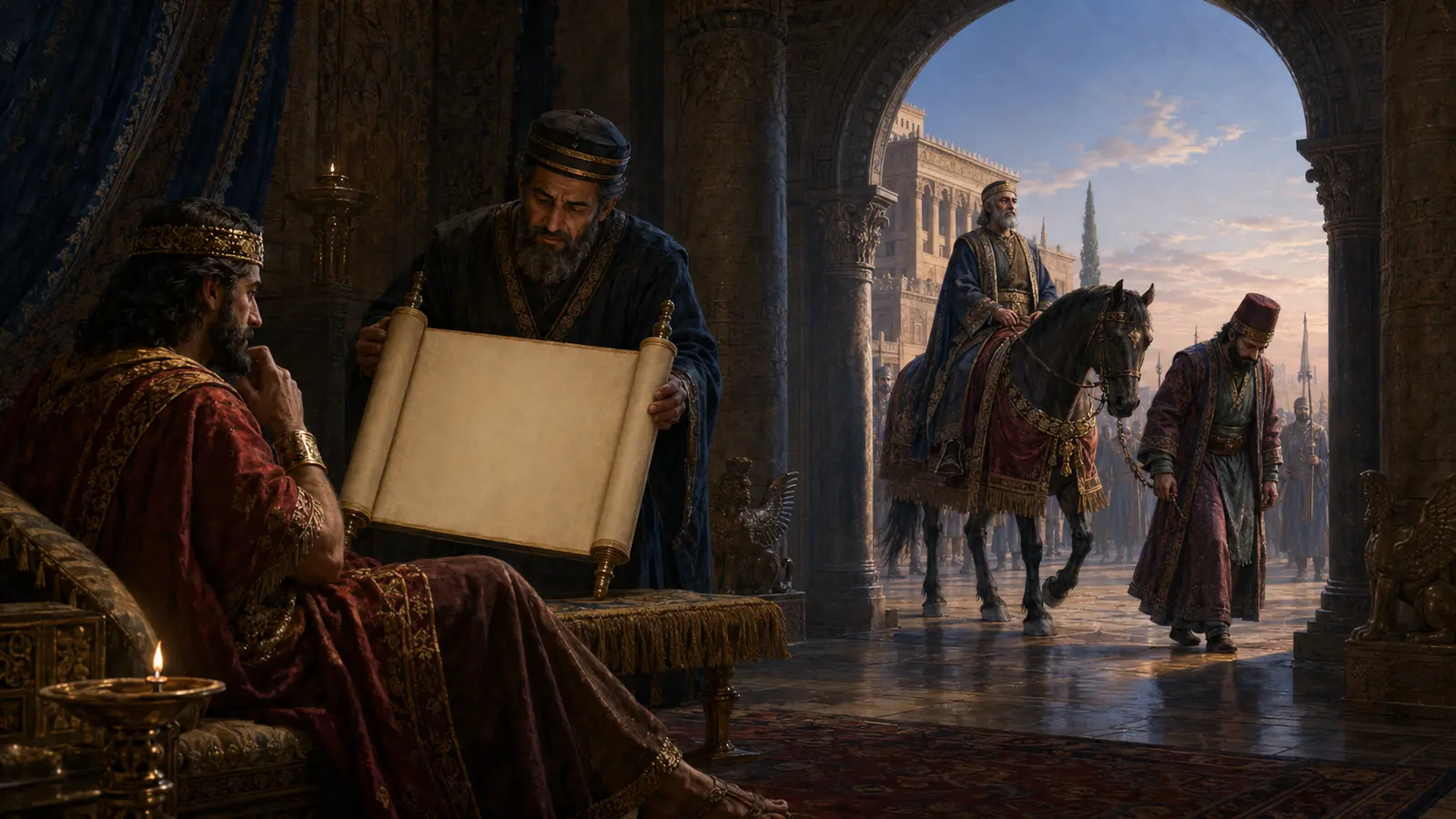
The gallows stood ready in the darkness. Haman arrived early with murderous poison in his mouth. But the king could not sleep, the memories began to speak, and the night itself became the servant of a hidden mercy.
01
Introduction
>The gallows stood ready in the darkness. Haman arrived early with murderous poison in his mouth. But the king could not sleep, the memories began to speak, and the night itself became the servant of a hidden mercy.
02
1.0 Introduction: The Night You Won't Sleep
There are nights that seem empty, but in it God is quietly moving things. While people are sleeping, planning is going on. When enemies plan harm, mercy prepares its season. When the righteous seem to be forgotten, some memory waits for its hour to be called.
Esther 6 is the hinge of the whole Bible of this book. Until now, the narrative has been slowly turning towards danger. Haman is exalted. Mordecai has refused to bow down. The death warrant against the Jews has been issued. Esther has risked her life and invited the king and Haman to two feasts. Haman has returned home hurt by Mordecai's steadfastness, then he has carved a tall gallows to hang him.
Everything seems ready for Mordecai's death. But that night, the king could not sleep.
The sentence is quiet, almost too casual. But in the book of Esther, ordinary things carry extraordinary weight. No angel appears. No prophet speaks. There is no sea breaking. There is no fire coming down from heaven. The king is just sleep deprived.
Then he orders the records of the kingdom to be read before him. Readers "happen" to encounter news of Mordecai's faithfulness. The king "happens" to discover that Mordecai was never rewarded. Haman "happens" to arrive at the same time, having come to ask for Mordecai's death.
And before Haman opens his mouth to talk about death, the king asks him how to honor a person whom the king is interested in.
This chapter reveals how forgotten faithfulness can be turned into a door that opens to open victory—because God, who works in secret, has the power to awaken memory in the very hour when evil assures itself of victory. [1]
The book of Esther teaches us to read history with trained eyes. God is not mentioned by name, but he is not far away. His name is hidden, but his fingerprints are everywhere. God's blessings do not always come with thunder. Sometimes it comes with lack of sleep, paperwork, tight deadlines, misunderstandings, and sudden changes that can bring pride to the ground. [2]
Haman thinks the morning belongs to his anger. But before dawn, fate has already turned the tide.
The sharpener is ready.
But the horse is also ready.
03
2.0 Historical and Literary Context: Where Narrative Turns
Esther 6 stands in the middle of a major turning point in the book. The first half of the narrative ends: Vashti is removed, Esther is taken to the palace, Haman is elevated, Mordecai is threatened, the Jews are judged, and the gallows is carved. After chapter 6, the pace begins to mix: Haman is exposed, Mordecai is exalted, the second commandment is given, the Jews are saved, and mourning becomes a feast.
Therefore, this chapter does not tell us a side event. It is the center, the hinge, and the wheel that turns the course of the narrative. However, the whole book is a story of transformation: the proud are brought down, the neglected are lifted up, the trap catches the one who made it, the hidden is seen, and the forgotten is remembered. [3]
Esther's two feasts with the king and Haman surround this fateful night. In chapter 5, Esther invites them to the first banquet and delays her request. In chapter 7, at the second feast, he exposes Haman. Between the two tables comes this fateful night, where Mordecai's forgotten loyalty is remembered, and Haman's pride begins to crumble.
This chapter also collects pre-woven threads. In Esther 2, Mordecai revealed a plot against the king. The incident was recorded, but Mordecai was not rewarded. That forgotten memory now comes back at exactly the right time, when Haman wants him dead. In Esther 3, Haman was exalted and Mordecai refused to bow down to him. Now Haman will have to honor Mordecai in public. In Esther 5, Haman built a gallows. Now, before he can use it, he will have to walk Mordecai around town.
The evolution is like that of Joseph in Egypt, whose ministry was forgotten in prison until the turbulent night of Pharaoh brought him back to memory (Gen. 40:23; 41:1-14). It is like Daniel in exile, where the courts of foreign kingdoms become a platform where God brings down proud powers and confirms faithful witnesses (Dan. 2:1-23; 6:18-23). It is like the Exodus, where Israel's deliverance comes in the night that is awake before the Lord (Ex. 12:42). Above all, evolution points forward to the news that the rejected stone becomes the cornerstone, the crucified Messiah is resurrected, and the shameful cross becomes the throne of God's saving wisdom (Ps. 118:22-23; Acts 2:23-24; 1 Cor. 1:18-25; Phil. 2:5-11).
Esther 6 is also full of literary irony. When Haman hears the king's question, his heart urges him to believe immediately that the question cannot be about anyone else but him. His thoughts reveal his hunger: royal robes, a king's horse, a crown, a procession, and a public announcement. He invents the honor he desires for himself, then he is ordered to give that honor to someone who hates him.
This chapter is funny, but not just for fun. His humor serves justice. It teaches us that arrogant authority may seem terrifying, but in the presence of God's wisdom it is also absurd. Haman's pride blinds him, and his blindness becomes the means of his humiliation.
God is not mentioned.
But every verse in this chapter hums with humility: here are God's fingerprints.
04
3.1 When the King Sleepless (Esther 6:1)
"That night the king did not sleep."
This is the same night that Haman's tree is already standing. It is the night before Esther's second feast. It is the night before Haman plans to pray for Mordecai's death. Timing here is everything.
In another biblical account, we would expect a dream from God, a prophetic word, or an angel to appear. But Esther gives us insomnia. The most powerful man in the empire is restless, and his restlessness becomes the door to redemption.
The king orders the book of records of great things to be read before him. Maybe he expects those memories to bring him to sleep. But the instrument of dollar records becomes the instrument of God's providence.
Esther has taught us to look at the little things: the chance that happened in the palace, the approval in the eyes of the officials, the plot heard by chance, the reward delayed, the feast postponed, the sleepless night. The hidden God often works through things so ordinary that the proud cannot recognize them. [4]
The king could not sleep.
But fate is fully awake.
And behind the sleepless king is God who "will neither slumber nor sleep" (Ps. 121:4). The eyes of the empire grow heavy, but the Watcher of Israel stays awake.
05
3.2 When the Forgotten Memory Speaks (Esther 6:2–3)
The records of the kingdom are read, and information is found on how Mordecai exposed Bigthana and Teresh, two of the king's eunuchs who plotted against Ahasuerus. The king asks, "What honor or rank has Mordecai been given for this?"
The answer is surprising: "Nothing was done to him."
This is where the pain of not being recognized in his time is seen. Mordecai saved the king's life, but the empire forgot him. His loyalty was recorded, but not rewarded. His service disappeared from the archives of the kingdom.
But what humans forget, God's providence can bring it back. The delay hurt, but that delay also put the reward in place, at the very moment Mordecai needed to be saved. If Mordecai had been honored earlier, that memory might not have saved him now. A forgotten act becomes powerful because it remained unfinished.
This does not make being ignored a good thing. It doesn't make the wait any easier. It doesn't mean every painful delay is a sweet secret. But it teaches us that hidden loyalty is not wasted. Other obedience is planted like a seed in the dark. You look like you are buried, but in God's time you dream.
Joseph knew this way. He interpreted the butler's dream and asked to be remembered, but the butler forgot him until Pharaoh's dream opened the prison door (Gen. 40:14, 23; 41:9-14). Later Joseph was able to look back and say, "God intended it to be good" (Gen. 50:20). Esther 6 stands within the same river of biblical hope: what seems forgotten can still be in God's hands.
This is where the king's question turns the tide. While evil seeks to dehumanize Mordecai and clothe him with shame, authority seeks to clothe him with delayed honor.
As Haman waits outside, the gallows begins to tremble under the weight of the silent sentence.
06
3.3 When Haman Is Early With Death in His Heart (Esther 6:4–5)
At the same time, the king asks, "Who is in the courtyard?" Haman had just entered the outer courtyard of the king's house to tell him about hanging Mordecai on the gallows he had prepared for him.
The timing here is so strange that it seems like a holy joke. Esther wants us to feel her irony. Haman arrives early, eager to turn his inner rage into public slaughter. But he arrives just after the king remembers Mordecai's loyalty.
The servants announce that Haman is standing in the courtyard. The king says, "Let him come in."
Haman enters carrying death, but the king does not know this. The king carries a question of honor, but Haman does not know that. Two agendas enter the same room: Haman's agenda of murder and God's providential agenda of turning things around.
Evil is not as out of control as you think. Haman has arranged a tree, he has chosen the morning, he has encouraged himself, and he has entered the courtyard. But he is already late in front of the destiny that started before he arrived.
The wicked may arrive early.
But God is never late.
07
3.4 When Pride Answers Its Own Lust (Esther 6:6–9)
The king asks Haman, "What should be done to the man whom the king is pleased to honor?"
Immediately Haman thinks, "Who would the king like to honor more than me?" This is the inner voice of pride. Haman cannot imagine a world where honor does not apply to him. His pride has swelled to such an extent that he does not understand the seriousness of the question being asked.
Therefore, he devises an elegant protocol aimed at stealing the king's glory. Let the royal robes be brought, which the king is wearing. Let the horse be brought, on which the king rides, and the royal crown be on his head. One of the king's nobles dressed the man and walked him through the city square, announcing, "That is what will be done to the man whom the king is pleased to honor."
Haman's answer reveals the fullness of his heart. He doesn't just want wealth or position. He wants to be recognized in public. He wants to look like a king. He wants the whole town to hear his greatness proclaimed. He wants respect to be shown, seen, and voiced.
This is the age-old test of human pride: grabbing glory instead of receiving it as a gift. In Eden, man stretched out his hand to seek the status of being like God (Gen. 3:5-6). Babylon, humans built up to make a name for themselves (Gen. 11:4). In Haman, the same opium is dressed in Persian clothing.
The wisdom of the Bible is clear: "Pride goes before destruction" (Prov. 16:18), and "before honor comes humility" (Prov. 18:12). Later Jesus will teach the same logic of the kingdom: "He who exalts himself will be humbled, and he who humbles himself will be exalted" (Mt. 23:12). This is the blindness of Haman: he cannot understand this wisdom until his fall is made a lesson for generations.
This irony cuts to the bone.
Haman writes a plan to glorify Mordecai.
The mind of his pride becomes the trap of his humiliation.
08
3.5 When the Proud One Leads the Horse (Esther 6:10–11)
Then the king utters the words that turn Haman's world: "Hima! Take the clothes and the horse as you said, and do the same to Mordecai the Jew, who is sitting at the king's gate. Don't leave out a word in everything you said."
Mordecai the Jew.
The identity that Haman hates is now spoken by the king in a context of honor. The person Haman wants to hang must be dressed in royal robes. A person who did not prostrate must be marched through the city. The person Haman wanted to shame must be publicly lifted up.
And Haman must lead the horse.
This is the beauty of the whimsy in the book of Esther. Haman's own thoughts turn out to be his punishment. Now he has to lead a ceremony to honor the same person who tortured his soul by denying him honor. He must be the herald of the exaltation of Mordecai. His mouth is now bound to proclaim the glory of the same man whose name he sought to blot out from under the sun.
This moment reminds us again of Joseph. Joseph is clothed in royal robes, is given public honor, and is raised in a foreign kingdom to preserve life (Gen. 41:42-45; 45:5-7). Mordecai's honor is not yet his final elevation, but it is the first sign that the narrative has turned. He who is marked for death is clothed with honor. The one who planned death becomes the servant of change. [5]
But Mordecai does not hold power for greed. He does not brag. He doesn't say a word. He receives the honor that came at a wonderful time of fate.
Reform has begun, but it is not complete. The death warrant still exists. Jews are still in danger. Esther has not yet made her request. But the direction of the narrative has changed.
The first light of redemption has entered the darkness.
09
3.6 When Haman Returns Covered in Mourning (Esther 6:12–14)
After the procession, Mordecai returns to the king's gate. This is an amazing part. Respect does not make him have a desire to advertise himself. He returns to his position. He remains steadfast.
But Haman runs home in mourning, with his head covered. The man who wanted Mordecai to be humiliated in public now himself bears the shame. Earlier, Mordecai wore sackcloth in public mourning (Est. 4:1). Now Haman wears the marks of humiliation. Changes are beginning to be seen even in clothing and posture.
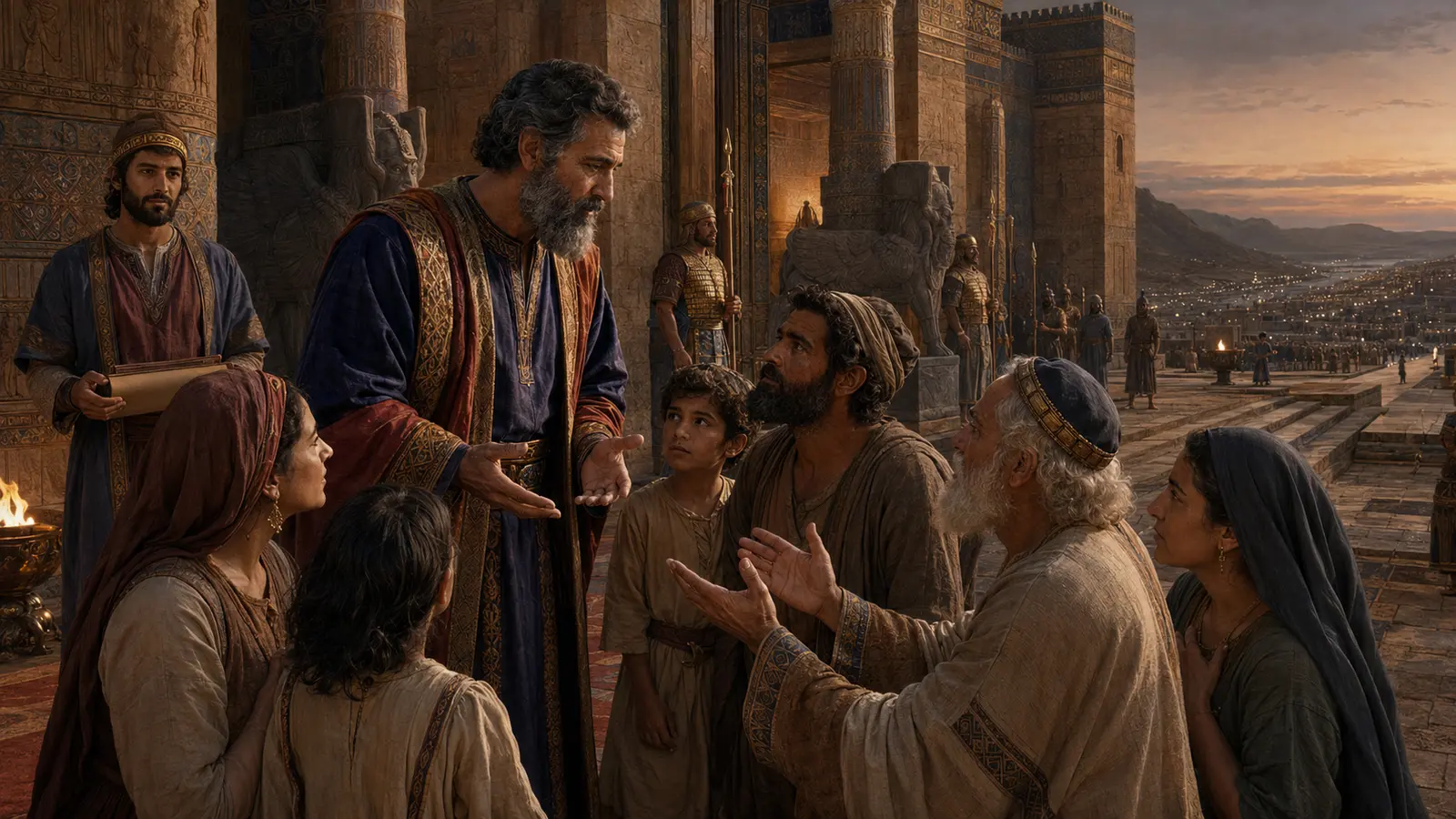
Haman tells Zeresh and his friends everything that happened. Their advice suddenly changes. Those who encouraged him to build the tree now interpret his humiliation as the beginning of his downfall. They say, "If Mordecai, before whom you have begun to fall, is of Jewish descent, you will not be able to defeat him, but you will surely fall before him."
This is one of the most theologically serious statements in this chapter. It does not come from the prophet, nor from Esther, nor from Mordecai, but from the house of Haman himself. They realize that there is something bigger than this event going on. Haman's fall before Mordecai is no ordinary shame; it is a sign of unstoppable collapse. [6]
The word "fall" sounds in this chapter like a bell. Haman has begun to fall, and will surely fall. A person who demanded that others bow down to him will be brought down.
Before they can finish speaking, the king's eunuchs arrive and rush Haman to Esther's second feast. He doesn't have time to rest enough, he doesn't have time to rethink, he doesn't have time to change his path. He is taken from humiliation straight to exposure.
The sleepless night has done its job.
Now the table is set.
10
4.1 Hidden Fortunes Work Through Common Means
Esther 6 is one of the great images of the Scriptures about unshowy gifts. The king is sleepless. The book is being read. Memory is available. A question is asked. Haman arrives at the wrong time. Mordecai is honored.
None of these events seem miraculous on their own. But together, they become a miracle of timing. Esther teaches us to believe that God's silence is not empty; His hidden powers work through the most ordinary events, without losing even an iota of his divinity. [7]
This lesson is important for faith. Often we seek God only in big things. Esther teaches us to see destiny in quiet settings: a memory that is awakened in time, a conversation that happens before harm, a delay that turns into redemption, a closed door that protects us, a door that unexpectedly opens.
God can turn the wind.
He can also make the king sleepless.
11
4.2 Forgotten Trust Is Not Lost For Free
Mordecai's faithfulness in chapter two is not immediately rewarded. But the sixth chapter shows that what is forgotten by the empire, is safely protected in the hidden activity of God.
Many believers live with hidden obedience: prayers that no one heard, sacrifices that no one thanked, service that no one recognized, and righteousness that no one paid. Esther 6 does not make a superficial promise that every act of faithfulness will immediately receive public honor. But it stands as a solid testimony that faithfulness is never lost in a vacuum before God.
Paul gives the church the same pastoral word emphasizing that your labor is not in vain in the Lord (1 Cor 15:58). The writer of Hebrews reminds us that God is not so unjust that he forgets your work and the love you have shown for his name (Hebrews 6:10). Even Jesus himself confirms that the Father sees what is done in secret (Mt 6:4, 6, 18).
The Kingdom of God keeps records completely different from human systems. In heaven there is no library covered with dust.
12
4.3 Pride is blind before it falls
Haman's downfall begins when he completely fails to think that honor can belong to someone else. Pride narrows a person's world until his soul becomes the only axis around which every thought revolves.
This blindness makes him easy to fall into the trap of irony. He skillfully designs Mordecai's honor because he thinks he is building his own glory; he leads the horse on the road because his mind has refused to accept that there is someone else who deserves to be rewarded.
The testimony of the Bible repeatedly warns that pride falls under its own weight. Pharaoh hardens his heart and ends up losing his firstborn (Exodus 7-12). Nebuchadnezzar brags about the greatness of Babylon and is reduced to the level of an animal (Dan 4:28-33). Herod also receives praise as if he were a god, then he suddenly falls under judgment (Acts 12:21-23).
The book of Esther adds a deeper truth: pride often actively participates in self-abasement. The words, plans, and desires of the proud become real tools that expose and bring them down.
13
4.4 Reversal is the Form of Biblical Hope
Esther 6 is not the final deliverance, but it is where the direction of things changes completely. This chapter introduces the setting that will be fully revealed later: Haman falls, Mordecai rises; mourning becomes joy; and the command of death is answered by the command of life.
This kind of turning of things is witnessed throughout the Scriptures. God chooses the young instead of the old, the barren becomes a mother, a slave becomes a ruler, a young shepherd becomes a king, exiles become witnesses, and the stone rejected by the masons becomes the cornerstone (Gen 21:1-7; 25:23; 41:41-45; 1 Sam 16:11-13; Ps 118:22-23).
In Mary's song, God brings down the powerful from their thrones and lifts up the humble (Lk 1:52). In Jesus, this arrangement reaches its peak. The cross was seen as a triumph of power, accusation, and death. But the resurrection revealed that the vessel of shame was the altar of God's victory. The rejected was lifted up. The condemned became the Lord. The crucified king became a faithful Savior.
At the heart of this struggle, Esther 6 carries the echo of the gospel: the night may be dark, and the gallows may be standing, but God has the power to change the direction of history before dawn.
14
4.5 Fortune does not destroy the courage of man
Esther 6 is about endowment, but not an endowment that justifies sitting idle. The night when the king could not sleep does not erase the courage of Esther, the testimony of Mordecai, nor the fasting of the whole community. God's hidden work does not make man's obedience unnecessary; rather, it makes that obedience more meaningful.
Mordecai had acted faithfully in chapter two, and Esther stood boldly in chapters four and five. The Jews had also gone into mourning and fasting in the fourth chapter. That sleepless night does not take the place of these acts of faithfulness, but gathers them and integrates them into God's great plan.
This truth carries great weight for discipleship, church leadership, and our mission. Believing in fate is not folding your hands when evil is busy carving gallows; it is to act righteously under the firm certainty that God is already moving things further than what is visible to the eyes of the flesh.
15
5.0 Use of Life: Loyalty in the Night of Waiting
1. Oblivion should not be interpreted as lost. Mordecai's faithfulness went unrewarded in the dark for many years, until God's proper season came. When you find your recognition delayed, continue to stand your ground with unwavering loyalty. A quick reward is not always a proof of deep mercy; often, God delays honor to place it where it will serve a greater purpose than you think.
2. Beware of Self-Circulating Self. Haman's greatest disease was the blindness of not being able to see anyone but himself as the only person worthy of glory. It is always good to ask yourself: where has pride narrowed your horizons and made your world so small that you see things only about you?
3. Allow Honor to Humble You. After being clothed in royal robes and paraded through the streets with great public fanfare, Mordecai did not change—he quietly returned to the king's gate to continue his duties. The certainty of being recognized by God does not require pride; True approval should leave you on your knees in humility.
4. See God in Ordinary Things. Don't think that God's presence only comes with thunder or earth-shaking miracles. The insomnia of a king, the papers of old records, the sudden conversation in the morning, and the precision of a few seconds—all these are pure instruments of grace that God uses to move history.
5. Don't be afraid when evil appears to complete its preparations. Haman had a tall tree already outside, and he had a solid schedule for that morning in his head. But before he could act, God already had a sleepless king and a faithful memory awakened in time. When the enemy thinks that the morning belongs to his anger, God has already changed the direction of things since the night.
6. Live Faithfully in an Exile Environment. Mordecai served with great integrity in the foreign palace of Shushan, without surrendering even an iota of his religious identity. In the same way, the disciples of Jesus today are called to witness with wisdom and steadfastness in their workplaces, in institutions, on the streets, among neighbors, and in all public life.
7. Realize That The Divine Revolution Begins Quietly. Before the great deliverance is publicly witnessed, God's work begins in the dark—awakening dust-covered memories, revealing hidden pride, and changing the destiny of things before the dawn comes.
16
6.1 For Discipleship: Be Faithful When No One Is Looking
Esther 6 calls Jesus' disciples to hidden faithfulness. Mordecai did the right thing in chapter 2 not knowing if he would ever be honored. That is the soil of true discipleship: obedience without applause.
The disciple follows Jesus not because every action is immediately visible, but because the Father sees the secret. The church must teach believers to serve without needing to be seen all the time, to pray without acting, to live righteously without reward, and to remain strong when recognition is delayed.
The way of Jesus is not the caravan of Haman to show off. It is the way of the cross, the way of humble trust.
17
6.2 For Church Leadership: Remember the Forgotten Servants
The king's defeat was a memorable defeat. Mordecai saved his life, but the dollar forgot him. Esther 6 warns leaders in a calm voice: institutions can maintain a record of service without honoring ministers.
Church leaders must build sacred memories. Who has been used quietly? Who has carried the burden without merit? Who has protected the community, taught the children, visited the sick, asked for secrets, cleaned the room, carried the wounded, or remained faithful at the gate?
Leadership has the appearance of the kingdom of God more when you refuse to let faithful people get lost in dusty folders.
Good shepherds remember.
And when they remember, they help the community to be a home of gratitude.
18
6.3 On Mission: God Works in the Mixture of Public Life
Esther is a book of people in exile. God's people are not in Jerusalem. They are in Shushan, in a morally ambiguous state. However, God is not far from that place. He works in the palace, through memory, time, courage, and public testimony.
Mission today often occurs in such places: offices, schools, politics, the media, hospitals, prisons, markets, streets, and within the family. The church should not think that God works only in mission buildings. Esther teaches us to recognize God's hidden hand in public life and join his work with wisdom, courage, and humility.
Mission is not just preaching from the pulpit. Sometimes it is an honest presence at the gate. Sometimes it's a bold speech at the table. Sometimes it is refusing to bow down before the idols of authority. Sometimes it is to keep hope until the night is dawn.
19
6.4 For Communities Under Pressure: Hope Without Ignorance
Ester 6 does not deny the magnitude of the danger that exists. The gallows is real, the decree of destruction is real, and Haman's hatred is an undeniable fact. Biblical hope is not to pretend that the night is harmless or powerless; but it is a firm certainty that that night does not carry the last word of our destiny.
Societies under pressure and severe trials need this kind of hope—hope that is not superficial, that does not deny the truth of things, and that does not come from fear clothed in religious language. Instead, it is the courage of inner calm that believes that God is able to work with great skill, even in times when his presence is not clearly visible on the surface of events.
The church must be a community of people who can look at the gallows standing, and still stand firm and boldly declare: God has not finished his work.
20
7.0 Reflection Questions
1. What act of faithfulness in your life seems forgotten, unpaid, or hidden?
2. Where do you need to trust God's timing instead of demanding immediate recognition?
3. How do Haman's self-centered thoughts warn you about pride in your heart?
4. Have you ever seen God use an ordinary thing to change the direction of a certain situation?
5. What would it look like for you to faithfully return to your "gate" after receiving the honor?
6. Who in your church or community needs to be remembered, thanked, and strengthened?
7. Where may God have already begun to change things that you cannot yet fully see?
21
8.0 Request for Response
O God who hides in the sleepless night,
You remember what kingdoms forget.
You see a faithful deed buried in memory,
silent obedience left unrewarded,
the servant who is still sitting at the gate.
When the gallows is ready,
protect our hearts from despair.
When evil is first with death in its mouth,
let us remind you that your mercy has already preceded us before morning.
Save us from the pride of Haman,
and the blindness that thinks every honor is ours,
and hunger to be seen, praised, lifted up, and announced.
Teach us the humility of Mordecai,
to receive honor without usurping it,
and return faithfully to the work before us.
Awaken the memory where it is truly buried.
Open the archives that need to be told.
Turn the plans of the proud into a means of their own exposure.
Let the horse of change pass through town until the tired remember that you are still working.
Make us disciples of hidden faithfulness,
leaders who remember the forgotten servants,
and a church whose mission moves boldly in the field of public life.
In the name of Jesus,
who was rejected but you lifted him up,
who was crucified but you resurrected him,
Our true King and faithful Savior.
Amen.
22
9.0 Next Window
Esther 6 ends with Haman being rushed to the queen's banquet. He has no time to recover from being humiliated. The man who built the tree for Mordecai has just walked Mordecai through town in honor. His own house has warned him that he has begun to fall.
Now the table is set for the reveal.
In Esther 7, the feast will turn into a court. Finally Esther will reveal her people and name the enemy. The king will be angry. Haman will beg for mercy. The tree he built for Mordecai will be the place of his own judgment.
A sleepless night has changed the narrative.
Now the hidden truth will come to light.
23
10.0 Bibliography
[1] Levenson, Jon D. Esther: A Commentary. Old Testament Library. Louisville: Westminster John Knox, 1997.
[2] BibleProject. "The Book of Esther." Old Testament Overview Guide.
[3] Fox, Michael V. Character and Ideology in the Book of Esther. 2nd ed. Grand Rapids: Eerdmans, 2001.
[4] Berlin, Adele. Esther. JPS Bible Commentary. Philadelphia: Jewish Publication Society, 2001.
[5] Clines, David J. A. Ezra, Nehemiah, Esther. New Century Bible Commentary. Grand Rapids: Eerdmans, 1984.
[6] Moore, Carey A. Esther. Anchor Bible 7B. Garden City, NY: Doubleday, 1971.
[7] Wright, N. T. The New Testament and the People of God. Minneapolis: Fortress, 1992.
Be the first to leave a comment.