

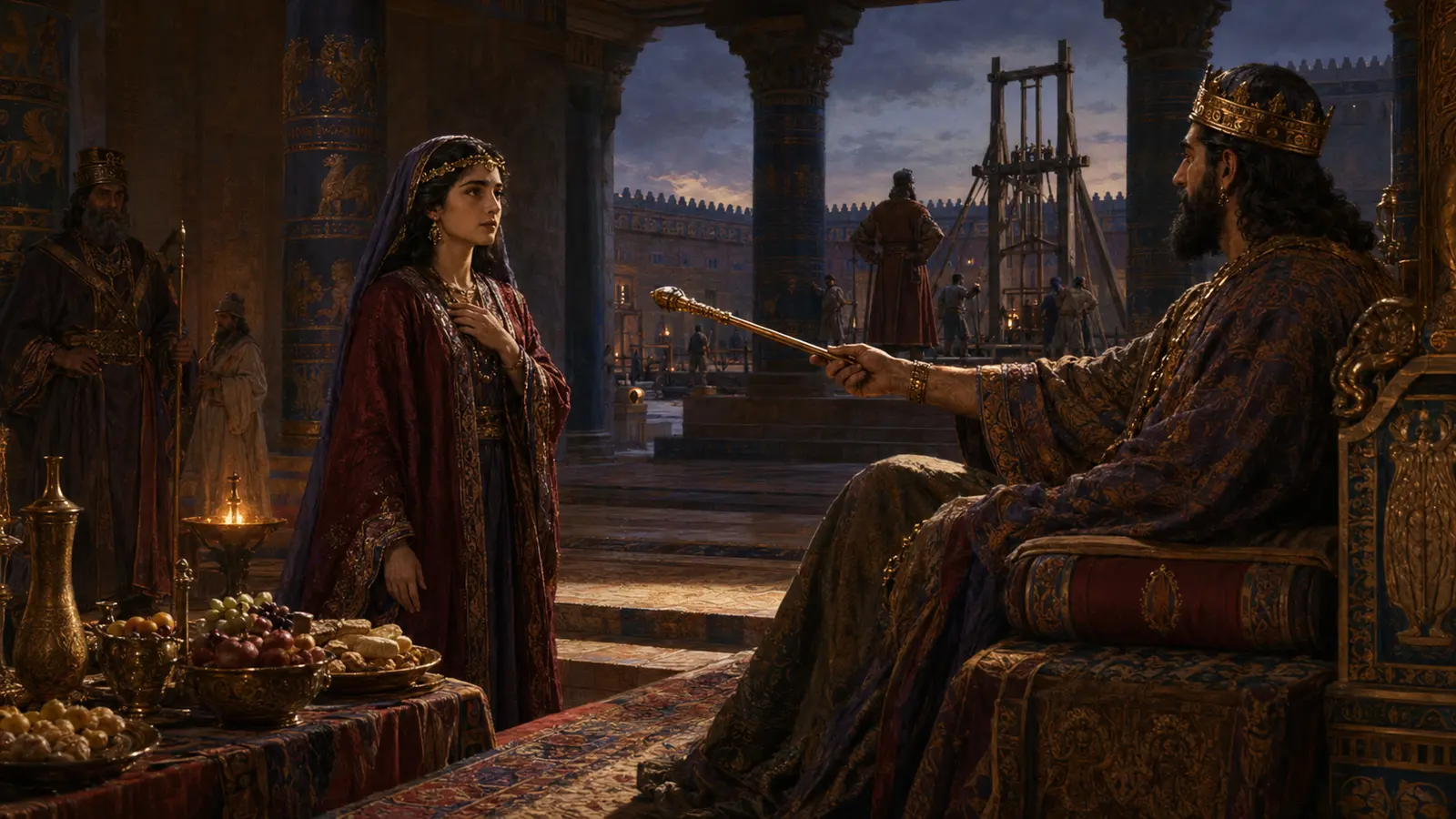
Esther crossed the threshold, her soul in her hand. At the same time, the royal scepter straightened and turned death into mercy. A banquet was prepared, the secret was covered with a smile; and while courage waits for wisdom, pride returns home full of blindness, forming its own judgment. The noose rose in the darkness, but the hand of God had already arranged the fate.
01
Introduction
Esther crossed the threshold, her soul in her hand. At the same time, the royal scepter straightened and turned death into mercy. A banquet was prepared, the secret was covered with a smile; and while courage waits for wisdom, pride returns home full of blindness, forming its own judgment. The noose rose in the darkness, but the hand of God had already arranged the fate.
02
1.0 Introduction: Courage When You Have to Walk Slow
Sometimes courage takes swift action. Sometimes courage waits. There are times when faith must venture directly into the fiery furnace; and there are times when it should walk quietly, waiting for the right season—the season when the truth will fall into the heart like a seed dropped on well-prepared soil.
Esther chapter 5 teaches us the sacred art of wise patience. In chapter 4, Esther responded to the call of death and recovery: "If I perish, let me perish" (Esther 4:16). He asked the Jews of Shushan to fast for three days. This queen who hid her identity, now began to prepare as an intercessor for her nation. Then, in chapter 5, determination turns into action. He dresses himself in royal robes, enters the inner courtyard, and stands where by law he is not allowed to be—unless mercy beckons.
But when the king points out the golden rod to her, Esther doesn't mention Haman right away. He doesn't realize the full extent of the danger he faces in the first second he gets the chance. Instead, he invites the king and Haman to a feast. And even when they are at the party, when the king asks her again what she needs, Esther gives them another invitation to the second party.
To today's reader, this patience may seem like a paradox. Why wait when the death sentence has already been given? Why should you stay calm while your people are perishing? Why prepare another table of food instead of confronting the existing evil head on?
It is because true courage does not require shouting, and strong loyalty is not in a hurry to open all the buttons at once. There are times when wisdom realizes that the truth should be spoken at the right time, in the right room, in front of the right witnesses—and only where pride has been left with a long enough rope to hang itself. Esther's courage was not rash; it was royal, priestly, and strategically woven courage. He mortgaged his life, but he did not play with his opportunity..
This act of courage turns into a wise strategy, because the courage of faith does not always have to be hasty, but must be guided by discernment.
At the same time, Haman stands as the epitome of pathetic folly in this chapter. He has been invited to eat at the same table with the king and queen. He comes out drunk with joy and full of pride. But only one person at the gate—Mordecai, who still refuses to bow to him—spoils all his happiness. Haman has wealth, children, rank, closeness to the king, and honor; but he admits that all that is meaningless to him as long as he sees Mordecai alive.
This chapter closes with a carved tree being erected for Mordecai. But the reader who understands the principles of Esther's world knows this allegory: a trap laid in secret ends up trapping the trapper himself. As the tree of judgment grows higher, the seed of redemption also prepares to split the earth.
So far, God has not been mentioned by name. But the hand of His providence is clearly seen at work in the midst of time, patience, feasting, lack of sleep, wounded pride, and a foolish plan that will soon become the noose of its founder. Esther's silence is not weakness. God's silence is not neglect. The invisible king is turning the tables upside down in the castles of rule. [1]
03
2.0 Historical and Literary Context: Between Fasting and Feasting
Esther chapter 5 should be read as a journey of spiritual rupture—a journey from the mourning and fasting of chapter 4, to the feasting strategies of chapters 5–7. The Jews of Shushan have fasted for three days; Esther has fasted with her maids. Now, sanctified in mourning, he treads the royal courtyard.
This movement from fasting to feasting is one of the major literary structures within the book of Esther. While the people of God are tormented with sorrow and sackcloth clothing, the palace gathers around the wine barrels. But here's the secret: Esther hijacks the empire's favorite showpiece—the banquet—and turns it into a platform for redemption.
Esther's two feasts (chapters 5 and 7) sit strategically as a parenthesis around the big twist of chapter 6—where the king's sleepless night forces Haman to raise Mordecai instead of strangling him. The first feast does not end the problem, but it sets the stage for the overthrow of evil. In the Bible, this whole book moves on the tables of food: from the feast of Ahasuerus's pride, the feast of hatred of Haman, to the Redemption Feast of Purim. The royal table becomes a mirror that illuminates power, danger, and the revolution of fate. [3]
The Mystery of Patience: The story is not delayed just to increase the reader's interest; it is being delayed in order to organize a strategic revolution against human pride
Esther's invitation plunges Haman into his own thoughts. His pride drives him to build a tall gallows. The tree opens the night when the king is sleepless. That night of the king's blinking leads to Mordecai's elevation, and that elevation humiliates Haman. This humiliation sets the stage for his revelation at the second feast.
Through this structure, the author reveals a great mystery that illuminates the weakness of the empire's power. Ahasuerus is generous with words—"even half of my kingdom"—but he lacks the moral eyes to see the destruction he has authorized with his own ink. Haman is given special honor at the queen's table, but inside he is completely empty—a slave who bows before the need for human recognition. The royal court looks elegant from the outside, but its inner life hesitates for weakness. The empire possesses gold, wine, commandments, and thrones; but it does not have the ability to produce justice.
On the other hand, Esther walks with a high degree of self-control. He does not control the empire by force, but learns to act wisely within its corridors. Like Joseph in Egypt, Daniel in Babylon, and Nehemiah in Persia, Esther must serve God's purposes in a foreign palace—a place where worldly harmony and heavenly calling are painfully intertwined. He does not overturn the palace; he stands as a testimony of steadfast loyalty in himself. He has no throne; he uses the position he has to protect the lives of his people. [4]
This is where the book of Esther speaks seriously to modern discipleship, church leadership, and our current mission. God's people often live between fasting and feasting, between mourning and hope, between announcements of death and promises of redemption. We are not called to bow down to the empire or run away from it; we are called to be symbols of another kingdom above:
Wise as serpents and gentle as doves.
Brave without pride and patient without fear.
Faithful even where the name of God seems to be hidden behind the headlines of this world.
The worldly palace thinks it has been invited to a luxurious banquet. In the secret chambers, God's providence prepares the judgment table.
04
3.1 Courage When You Stand in the Inner Court (Esther 5:1–2)
On the third day, Esther put on her royal robes and stood in the inner courtyard of the king's house, opposite the king's hall. The king was sitting on his throne, facing the door.
This scene is full of tension. Esther has crossed the line. He has entered a place where the law says he can die, unless the king shows him mercy. The whole chapter hangs on this question: Will the king show him the rod of kindness?
The phrase 'the third day' carries a heavy narrative resonance. Instead of turning it into a simple formula, it is worth noting that the pen of the Bible repeatedly paints the third day as a time of revolution—where life rises from the shadow of destruction. It is in this season that Isaac is released from the altar in Abraham's journey (Gen 22:4); Israel is preparing to meet God at Sinai on the third day (Ex 19:11); Hosea speaks of being revived after two days and raised on the third day (Hos 6:2); Jonah comes out of the womb of death after three days; and Jesus' resurrection on the third day becomes God's great victory over sin, kingdoms, and death (Luke 24:46; 1 Cor 15:4). Esther walks in three days crossing death to life, taking trembling steps ready to receive the grace hidden at the gate. [5]
Well, he walks in royal robes. Her dress is not a showy beauty. It's a calling. Esther dresses according to her position because she has to use the position given to her. The hidden Jewish woman now stands clothed in royal identity, preparing to use the position of empire for the life of the covenant people. He does not come in as an ordinary citizen; she enters as a queen. His clothing clearly expresses the same question of Mordecai: is it not true that he has been elevated to this royal status for such a season? (Esther 4:14).
Here is the main lesson of discipleship. Faithfulness does not run away from the position we have, but entrusts it to God. Esther's dress becomes a service, her beauty becomes an instrument of justice, and her position becomes a platform for advocacy. In this kingdom, every gift and glory must bow before love.
Esther found favor in the eyes of the king when he saw her standing in the courtyard. A golden rod was held out, and Esther approached and touched its tip—a small gesture that crossed the line of danger into life. This event clearly reveals the reality of Esther's situation: her life was not protected by a stable law, but hung on the changing emotions of the king with unpredictable decisions..
This golden scepter carries a heavy scriptural echo: from the prophecy of the scepter that does not leave Judah (Gen 49:10), to the righteous scepter of the Messiah (Ps 45:6) that leads to the Son whose seat is eternal (Heb 1:8). But unlike the eternal kingdom that brings true mercy, the golden rod of this palace only offers a transitional opportunity. The story tells that the world needs a King greater than these unstable powers. With that, the gate bursts open; mourning turns into space, intention becomes action, and the hand of fate leaves room for Esther to speak.
05
3.2 When the King Promises Half of the Kingdom (Esther 5:3)
The king asks: "What do you have, queen Esther? What is your request? You will be given, even half of my kingdom." This big promise of "half the kingdom" is palace language full of exaggerated features. However, here is a hidden truth that reveals a great divide: Esther is not asking for half of the kingdom, she is seeking the restoration of justice. He wants the king to realize that his order has put the lives of the Jews at stake.
Ahasuerus' great words reveal an authority that showers gifts while being morally blind. Here is a permanent warning: generosity without discernment is a risky venture. Just as a king can give wealth while allowing death, a church and mission can have great resources and reputation, but lack the spiritual sensitivity to heal the wounds of the weak.
Esther's answer is surprising; instead of opening his heart to them right away, he invites the king and Haman to a feast. Why should he wait when he has been given the opportunity to speak? Was he looking for more privacy than letting himself in, or did he want to draw his enemy into a field he controlled himself? Or was he slowly building up the courage to speak up? We should respect this complexity, because who does not know that the characters of the Bible like Esther are not carved statues, but human beings who faced real life-threatening trials?
The clear truth is that Esther takes action without backing down, creating an environment for victory. Sometimes, the first act of loyalty is not to finish all the work at once, but to put yourself in a position that will allow the next step of obedience to take place. The journey of discipleship follows the same steps of purposeful patience:
From the stagnation of prayer, towards the reality of action.
From the humility of fasting, towards the stability of presence.
From the stillness of existence, towards the authority of the word.
And from the weight of the word, towards the testimony of the cost.
06
3.3 When the First Feast Holds a Secret (Esther 5:4–8)
The king quickly orders Haman to be invited to Esther's feast. So the king and Haman arrive. Wine is brought. The king asks again: "What is your desire? It will be granted. What is your request? Even half of my kingdom, it will be fulfilled."
The question is repeated. The tension is rising. The reader knows what Esther must say in the end. He must reveal his identity and expose Haman. But again, Esther is waiting. He asks the king and Haman to come to another party tomorrow, then he will answer.
This second invitation does several things at once. You keep Haman close. You increase his pride. You are preparing the environment for its public unveiling. And most strangely, you create a night between two feasts—a night in which the king will not sleep.
This is where the hidden hand of fate appears. Esther's cautious patience allows time to do its work. If he had said everything at the first party, the revolution of chapter 6 would not have had a chance; Mordecai's forgotten loyalty would remain buried in darkness, and Haman would not have to begin his humiliation before his final judgment.
What seems like a delay becomes part of the redemption.
This patience is not a license to procrastinate endlessly. Esther has already taken action and put her life on the line, but her courage has the firm discipline to wait one more day. He does not move on the impulse of fear, nor does he dwell on the indolence of the spirit; he moves forward with wisdom wrapped in perseverance.
The feast also has strong biblical echoes. Scripture often uses the table as a place where truth is revealed and fate is decided. Joseph's table in Egypt tempts and brings back his brothers (Gen 43-45). Wisdom prepares a feast and invites fools to enter into life (Proverbs 9:1-6). Isaiah sees the Lord preparing a feast for all nations and swallowing death forever (Isa 25:6-8). Jesus eats with sinners, faces the authorities at the table, breaks the bread before the cross, and promises the feast of the kingdom (Luke 14:15-24; 22:14-20). Revelation ends with the wedding feast of the Lamb (Rev 19:9). The Feast of Esther is not yet the last feast, but it points to a world where the table of pride is turned into the table of truth, and the threatened people are brought from mourning to joy.
07
3.4 Haman's Joy When He Turns at the Gate (Esther 5:9)
Haman leaves the party with a happy and cheerful heart. He has been invited by the queen herself, along with the king, to an exclusive party. In his mind, this proves his greatness. He is already high in the empire; he is now honored in the queen's private dining room.
But then he sees Mordecai at the king's gate. Mordecai does not rise or tremble before him. Haman is filled with anger.
This is the disease of pride: a thousand honors cannot satisfy it if one man refuses to feed it. Haman has rank, position, wealth, influence, and the approval of the king. But Mordecai's composure takes all the fun out of his party.
The text says that Mordecai does not smell or tremble. At first, he refused to bow down. Now he refuses to even be afraid. His opposition has deepened. Not that he simply refuses to give Haman the honor of worship; he denies Haman the pleasure of seeing him afraid.
This event also carries with it the old memory of the enmity between Israel and Amalek.
Haman is called an Agagite, associated with Agag, the king of the Amalekites whom Saul left alive in 1 Samuel 15. Mordecai is from the clan of Kish, Saul's father (Esther 2:5). This is not just personal anger at the palace gate. It carries a long shadow of hostility against the people of God's covenant (Ex 17:8-16; Deut 25:17-19; 1 Sam 15:1-33). [6]
Mordecai's standing is not a certificate of hatred, but a testimony of refusing to be ruled by fear. For today's students, the test is not to recognize and hate enemies, but to stand firm without bowing down to the idols of human recognition, threats, or self-defense. True testimony does not reflect Haman's anger; you bear witness to the crucified Messiah, who does not win by forcing worship through force and violence, but by surrendering with steadfast love.
Haman restrains himself and returns home. But that restraint is only temporary. His anger is not cured; it's just postponed. If pride is not brought to repentance, it will eventually seek weapons.
The city gate and the banquet table now stand like two sides of a balance weighing against each other. In the banquet halls, Haman sees himself clothed in glory and exalted; but at the gate, Mordecai reveals how the top of that exaltation has wicked and weak foundations. Just one loyalist's strike of obedience is enough to tear down the false security and reveal the emptiness hidden behind the proud man's laughter.
08
3.5 When Pride Counts Its Treasures and Still Feels Poor (Esther 5:10-13)
At home, Haman gathers his friends and his wife Zeresh. He describes the pride of his wealth, the number of his sons, all the titles the king has given him, and how he was promoted above all the princes and servants of the king. He also boasts that Queen Esther did not invite anyone else to her feast except for herself and the king; and tomorrow he is invited again.
His speech is almost comical in how full it is of himself. Haman reads his life like a royal biography: wealth, children, promotion, position, distinction, honor. He has everything an empire can offer.
Then he says, "But all this does me no good, as long as I see Mordecai the Jew sitting at the king's gate."
This is one of the clearest pictures of jealousy and pride in Scripture. Haman's life is full, but his soul is empty. He cannot enjoy what he has because he is consumed by what he cannot control. Mordecai's presence becomes an unbearable burden because Mordecai refuses to participate in Haman's worship for himself.
The words 'Mordecai the Jew' carry weight; Haman's hatred was not only personal, but identity. The crisis at the gates resulted in an edict against all Jews—proving that personal anger and political violence are one and the same. When pride gains power, one man's hatred becomes government policy.
The wisdom of the scriptures explains this disease well. "Pride goes before destruction" (Proverbs 16:18). "He who trusts in his possessions will fall" (Proverbs 11:28). "Anger is strong, wrath is a flood; but who can stand before envy?" (Proverbs 27:4). Haman reveals the folly of man: rich but poor in spirit, respected but empty, powerful but a slave to his soul.
The Gospel reveals this amazing contrast: Haman seeks honor, Jesus humbles himself; Haman demands to be worshipped, Jesus washes people's feet. Haman carves a tree to impale his enemy as a spear, but Jesus carries the cross and is hung on it for his enemies (Phil 2:5-11; Jn 13:1-17; Rom 5:8). The first way is pride that ends in shame; the second is of love that is fulfilled in the glory of the resurrection. [7]
A proud heart may sit at a queen's banquet, but still leave hungry.
09
3.6 When the tree is built before the sleepless night (Esther 5:14)
Zeresh and Haman's friends advise him to build a gallows, or wooden pole, fifty cubits high, and then in the morning ask King Mordecai to be hanged on it. After that, Haman will be able to happily go with the king to the feast.
The advice pleases Haman, and he orders a tree to be built.
This ending is scary. Haman wants happiness, but his way to happiness is murder. He believes that Mordecai's death will restore his happiness. He thinks that if the one person who does not bow down is removed, the feast will be sweet again.
The height of the tree is excessive, almost terrifying. It is public, theatrical, swollen like Haman's pride. He just doesn't want Mordecai to die. He wants to be shown. Shame must be seen. The person who did not want to prostrate must be lifted up in humiliation.
But Esther is a book with great sudden changes. Here we see a surprising contrast emerge: Haman carves the tree of death on the night of judgment thinking he is destroying Mordecai's life. The truth is, he was setting the trap for his own downfall.
This type of change is witnessed throughout the Scriptures. Pharaoh's water becomes the judgment of Egypt (Exodus 14:26-28). Goliath's sword becomes a weapon to destroy himself (1 Sam 17:51). Daniel's accusers fall into the lion's den they prepared for him (Dan 6:24). Above all, the cross, intended to be a shameful instrument of Rome, becomes the throne of God's victory over sin, death, and the powers of darkness (Col 2:15). God doesn't just save; he changes the situation. He turns the weapon of evil into a testimony of his righteousness.
The chapter ends before Haman has a chance to speak. Haman had made his plans for the morning, but God's hand had already decided his fate that night.
10
4.1 Hidden Endowments and Call of Faithfulness in Exile
The book of Esther is famous for its uniqueness: the name of God is not mentioned even once. However, every page is full of signs that prove that he is not far away. This hiddenness of God becomes an invitation to look with a deeper eye. Events that seem like luck—perfect timing, sleeplessness, rekindled memories, fear, sudden approval, and a revolution of fate—all become unique threads in a fabric whose Weaver is behind the scenes, never ceasing to work for a second. [8]
This is not the God of the thunders of Sinai or the fire of Carmel; it is God who works quietly through ordinary human life—courts, feasts, gates, documents, and sleepless nights. The book of Esther teaches faithfulness when the heavens seem silent.
For Jesus' disciples, this means we don't need miracles to be faithful; for leaders, the lack of immediate results is not a license to be paralyzed; and by mission, it proves that God works even in worldly systems and hostile environments. The hidden God still calls his people to visible faithfulness.
11
4.2 Courage and Wisdom Should Go Together
Esther 5 teaches that true courage is accompanied by strategy. Esther risks her life to enter the king, but she does not jump into things with unwise haste; he waits for the season, prepares the environment, and turns the party into a victory bridge.
Unlike the popular concept of boldness and rashness, Godly boldness is filled with patience and discernment. This is the style of Jesus, who guarded his time by separating and waiting, until his hour arrived and then he headed for the cross firmly (Luke 9:51; Jn 7:6; 12:23).
Honesty does not only ask what the truth is, but it seeks the right time and way to present that truth for justice. Esther does not bury the truth; He is waiting for the right time so that you can penetrate the darkness.
12
4.3 Empire Can't Save What It Can't See
Ahasuerus can give away half of his kingdom, but he cannot see the danger inside his palace. This is the tragedy of power without moral eyes: the size of the position does not mean the presence of wisdom; breadth of influence is no proof of credibility; and the size of the resource is not a fair measure.
This is where Esther reveals the great rift between the authority of the world and the authority of the Kingdom of God:
Worldly authority bows before fame, pleasure, and control.
Heavenly authority stands to protect life, truth, and the weak.
For church leaders today: Rank is not the same as wisdom. Influence is not the same as trust. And resources are not the same as rights.
The mission of the church is not fulfilled by imitating the systems of Kiasuero and then painting it with the color of holiness. Our mission is to reveal the reign of the crucified King, who turned the cross into his throne, and made the resurrection his eternal victory.
13
4.4 Pride is Insatiable
Haman has almost everything, but one man's refusal makes everything seem meaningless. Pride is a hunger that grows as it is fed. The more honor Haman receives, the more fully he demands recognition.
That is why the gospel calls us to humility. Only a heart opened from self-worship can receive gifts with gratitude. Only a heart that has knelt before God can stop demanding that everyone kneel before the soul.
Haman carves a tree because he cannot tolerate boundaries. But the way of Jesus is the opposite: he does not hold status by force, but humbles himself. He does not take the throne by violence, but walks the path of self-sacrificing love (Phil 2:5-11).
Discipleship is the daily death of Haman in us. It is the work of the Spirit to uproot the need to be seen, praised, feared, and heard. Leadership without this internal crucifixion is dangerous. Mission without humility turns into another empire.
14
4.5 The Trap of Evil Becomes a Platform for Turning Things Around
The tree erected at the end of the fifth chapter was meant to be the fate of Mordecai. However, the story of Esther reveals a surprising truth: in the divine plan, the instruments of evil often turn into instruments of judgment on evil itself; the trap becomes the trapper's sacrifice.
This is not an idealistic view (optimism) that rejects the truth of things. This text makes no mistake about the magnitude of the threat—the tree is there, the decree is signed, and Haman's hatred is ripe. But the limits of evil are limited. Evil can raise its peak to the top, but it cannot penetrate and exceed the limits of God's authority.
The cross is the great revelation where God overthrew the evil of sin and death as a platform for victory. Through the resurrection, shame turned to glory, death became life, and what was intended to bury God's voice became the eternal motto of His Kingdom.
Chapter five traps us in the shadow of the gallows, but refuses to leave us without hope
15
5.1 For Apprenticeship
Get out of preparation and into obedience. Esther fasted first, but then entered the king's court. Spiritual preparation must be a step of faith.
Do not confuse patience with indolence. Esther delays her full request, but does not run away from her call. He moves strategically towards his work.
Use your space wisely. Esther wears royal clothing because her position is meaningful. Your position, your skills, your relationships, your education, your platform, and your influence can be instruments to serve others.
Examine the Haman in you. Pride can make many blessings seem meaningless if one person doesn't prove it to you. Learn gratitude before anger builds gallows in the heart.
Let the cross teach your desires. Jesus shows that true greatness is not clinging to honor, but giving one's life for others (Mark 10:42-45).
16
5.2 For Church Leadership
Lead with insight, not just authority. Ahasuerus is powerful but has no moral vision. Church leaders must learn to see who is endangered by our decisions.
Make room for wise timing. Not everything should be dealt with quickly, but delay must serve the truth, not protect fear.
Use tables for mission, not for display. Esther uses the party to prepare justice. Churches should use meetings, meals, platforms, and relationships to bring truth, healing, and protection to God's people.
Beware of respect addiction in ministry. Haman's emptiness is a warning to leaders who cannot be happy unless everyone sees them.
Protect the weak before protecting reputation. Esther risks her position to protect life. Leadership that protects systems while people are perishing has lost the heart of God.
17
5.3 For Mission
Witness faithfully in exile. Esther shows that God's people can serve God's purposes even within foreign systems and complex cultures.
Turn chances into defenses. The mission is not just to gain influence; is to use influence for the life, justice, and faithfulness of the covenant.
Speak the truth with wisdom. Mission requires courage and the right timing. The truth should not be hidden, but should be carried with prayer, patience, and love.
Trust God in the night between the two steps. After compliance, there may still be a wait. God may be awakening memories where you don't see.
Don't let evil last longer than it deserves. Haman's tree looks scary, but it already turns out to be part of his downfall.
18
6.0 Reflection Questions
1. From Preparation to Action: Where is God calling you now—to move from the secret preparation stage to the battlefield?
2. The Art of Waiting: Are you faced with a temptation that requires the silence of wisdom and patience, rather than the impatience of immediate defense?
3. Mirror of the Heart: Who or what is your "Mordecai at the door" today—the one who touches and reveals the fear, pain, or pride hidden in your heart?
4. Blindness of Gratitude: Have you ever let one small annoyance or one person's hatred detract from the value of the many blessings that God has filled you with?
5. Limits of Will: Where are you tempted to mix godly courage with human rashness, or spiritual patience with carnal fear?
6. The Call of Your Position: How can the position you currently hold—whether it's influence, wealth, or power—be turned into a bridge to cross and serve others?
7. Moral Leadership: What leadership decisions do you have to make today that require sharp moral discernment and knee-jerk courage?
8. Middle and Middle Darkness: Where do you need to trust God in that "long night of rupture"—standing between your obedience and delayed results?
19
7.0 Response Request
God who is hidden in time and mercy,
You see the inner courtyard before we enter.
You know the fear beneath our clothing,
the vibration beneath our courage,
and prayers that fasting has carved into our bodies.
Teach us to act when the hour comes.
Teach us also to wait when wisdom needs patience.
Save us from fear that speaks too soon,
and utter fear.
Protect our hearts from Haman's hunger.
Save us from pride that cannot enjoy blessings,
jealousy that turns one rejection into bitterness,
and the anger that builds secret gallows.
Make our discipleship humble,
our leadership should be discerning,
and let our mission be bold.
Teach us to use space for defense,
table for real,
and influence for the lives of others.
As we stand between feast and danger,
make us strong.
When the wicked build a place of shame,
remind us that no gallows stands above your destiny.
As night falls between one act of obedience and another,
act in ways we cannot see.
Prepare a real table.
Awaken memories.
Turn hidden trust into public affirmation.
And lead us in the way of Jesus,
whose humility brings down pride,
whose cross becomes the world's greatest transformation,
and whose resurrection promises that death will not have the last word.
Amen.
20
8.0 Next window
Esther 5 ends with Haman satisfied with the tree he built. He believes the morning will bring Mordecai's death and his happy return to the queen's party. But the night belongs to God.
In Esther 6, the king will not sleep. The records of the kingdom will be opened. A forgotten act of faithfulness will be remembered in due time. Haman will arrive early to plead for Mordecai's death, but before he can say his plea, the king will ask how to honor the person the king is interested in.
The tree is ready.
But the horse is also ready.
Haman has planned the morning.
God has prepared the night.
The turnaround is about to begin.
21
9.0 Bibliography
[1] BibleProject. "The Book of Esther." Old Testament Overview Guide. Portland, OR: BibleProject, 2026.
[2] Levenson, Jon D. Esther: A Commentary. Old Testament Library. Louisville: Westminster John Knox, 1997.
[3] Fox, Michael V. Character and Ideology in the Book of Esther. 2nd ed. Grand Rapids: Eerdmans, 2001.
[4] Berlin, Adele. Esther. JPS Bible Commentary. Philadelphia: Jewish Publication Society, 2001.
[5] Moore, Carey A. Esther. Anchor Bible 7B. Garden City, NY: Doubleday, 1971.
[6] Clines, David J. A. Ezra, Nehemiah, Esther. New Century Bible Commentary. Grand Rapids: Eerdmans, 1984.
[7] Wright, N. T. Jesus and the Victory of God. Christian Origins and the Question of God 2. Minneapolis: Fortress, 1996.
[8] Wright, N. T. The New Testament and the People of God. Christian Origins and the Question of God 1. Minneapolis: Fortress, 1992.
Be the first to leave a comment.