

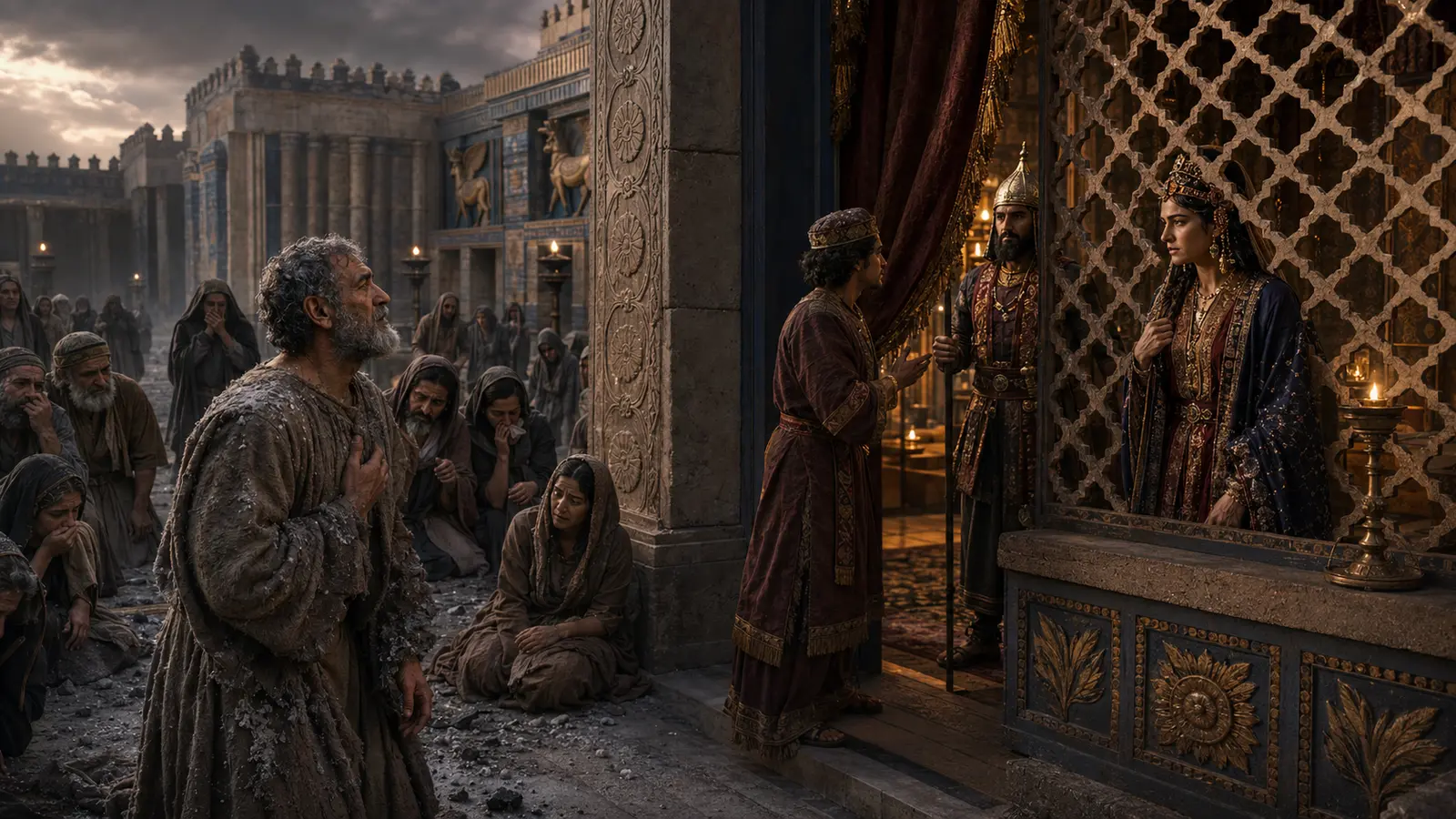
The decree had been proclaimed, and the city was enveloped in a heavy cloud of alarm. At the door of the palace, the sackcloth began to speak. Inside the palace, the hidden name trembled. And somewhere, beneath the fasting, sadness, and danger, God's hidden leadership was calling courage by its true name.
01
Introduction
The order had been announced, and the city was covered with a heavy cloud of panic. At the door of the palace, the sackcloth began to speak. Inside the palace, the hidden name trembled. And somewhere, beneath the fasting, sadness, and danger, God's hidden leadership was calling courage by its true name.
02
1.0 Introduction: When Security Becomes a Question
There are times when silence protects. But there are also times when silence betrays.
Esther 4 is a chapter in which a hidden identity is pushed toward public confidence. Until this point, Esther had continued to live in secret. He had carried his Jewish identity under the Persian crown. He lived in a safe palace, while his people were scattered and threatened throughout the empire. In the early stages of this narrative, his hiding was wise, or at least necessary. But now, the extermination order has changed everything.
Haman has given us the lot. The king has taken out his ring. Letters have been sent to every province, ordering the extermination of the Jews. Empire has turned hate into law. And now the question comes to Esther with terrible weight: what does her position mean? Is she a queen just to survive, or is she put there to pray and stand up for her people?
This text is about hidden security turning into costly confidence; because there comes a time when just living is not enough, but must turn into intercession.
Esther 4 is not a story of simple victory. Courage here is not loud, easy, or romantic. You are born in sorrow. You grow through confrontation. You are surrounded by danger. You are heading for a throne that can deny you. Esther is not brave because the danger is gone. He is brave because the danger is real, and his people are in great weakness.
God's name is still not mentioned. No prophet comes to say, "Thus says the Lord." No miracle intervenes and breaks that order. However, this chapter is full of theological weight. Mordecai speaks of help and deliverance that will come "from another place." Esther calls people to fast. People gather in grief. The hidden God is not spoken directly, but the shadow of his hand falls in every line. The absence of God's name is not the absence of God's hand. It is an invitation to read this narrative with eyes trained by exile: eyes that seek God's guidance in what appears to be fortune, covenant faithfulness under the noise of empire, and God's wisdom moving through ordinary human courage. [1]
This is the reality of faith in exile: where there is no visible temple, no thunder from heaven, and no easy security. What is there is a call accompanied by danger, a nation facing destruction, and a question echoing in the heart: 'Who knows, if you have not found the kingdom for such a time as this?'"
For disciples of Jesus today, Esther 4 questions whether our identity in Christ can remain a private secret when our neighbors are threatened. For church leaders, it asks whether we keep the power and influence we have been given as a badge of personal honor or use it as a stewardship trust. In terms of mission, it questions whether God's people can give a solid witness in royal courts without becoming slaves to those empires. Esther stands on the threshold between personal safety and self-sacrifice—and the Spirit still whispers through her narrative: the powers and positions we have are not possessions; it is a call to service.
03
2.0 Historical and Literary Context: From Death Command to Intercession
Esther 4 stands as the bridge of great transition between the shadow of the decree of death and the first rays of redemption. Chapter 3 concluded with a picture of the king and Haman sitting enjoying wine, while the city of Shushan was in turmoil and chaos. In contrast, Chapter 4 opens with a dirge: Mordecai tearing his clothes, covering himself with sackcloth and ashes, and uttering a cry of great anguish in the midst of the city.
This conflict of events carries great weight. In chapter 3, the death sentence is brought down from above; in chapter 4, a wailing cry rises from below. The Empire spreads the documents of destruction, and the people respond with deep mourning. Inside the palace there is feasting and laughter, outside the gates there is fasting and mourning. While Haman casts lots, Mordecai reads the signs of the season of God's leadership. The king's ring seals the destruction, but Esther's courage is about to open the dawn to dispel the darkness.
This conflict between feasting and fasting is one of the main literary beats in the book of Esther. The empire is enjoying itself with feasts, while the poor are drowning in mourning. The royal table becomes the altar where indifferent authority celebrates itself, while sackcloth reigns as the cloak of existential reality. In the broader structure of this narrative, feasts stand as symbols of power dynamics, arrogance, revelations of secrets, and reversals; while fasting uprooted that world of luxury and implanted dependence, humility, and strong community solidarity. [2]
This chapter also develops the main theme of Esther: the hidden leadership of God. This book does not mention God in its Hebrew text, but Mordecai's words show the hope that the redemption of the Jews does not depend on Esther alone. If he remains silent, help and deliverance will arise from elsewhere. This is not a passive attitude. Mordecai doesn't say, "Do nothing, because God will." Instead, he pushes Esther to realize that God may have put her there to participate in the redemption.
In this fashion, Esther enters the larger biblical narrative of God working in the midst of exile. As Joseph was taken to Egypt and later confessed, 'God sent me before you to preserve life' (Gen. 45:5); and when Moses stood before Pharaoh and witnessed how God can turn the seat of oppression into a platform of liberation (Ex. 3-14). It is like Daniel serving Babylon without kneeling before their gods (Dan. 1; 6), or how Nehemiah weeps for the city of Jerusalem by fasting, then he moves before the Persian king with a bold request (Neh. 1:4-2:8). Esther stands in the same stream: a daughter of the covenant in a foreign court, called to recognize the moment when hidden faith must turn into visible courage..
This chapter also reveals the difficult moral environment facing God's people in exile. Esther is inside the castle, but the security of her crown is only an outer shell that can burst at any moment. He holds the key to power, but that access is protected by the limits of death. He is crowned with a royal crown, but he does not have the freedom to approach the king. His position gives him a platform of opportunity, but it does not give him freedom of control.
Literarily, Esther 4 is a dialogue of awakening. Mordecai wakes Esther with news of the crisis. Esther warns Mordecai about the danger of approaching the king. Mordecai awakens Esther about the purpose of her position. Esther awakens the community by fasting. The hidden queen begins to be made into an intercessor.
This chapter is full of thresholds: the gate of the palace, the inner courtyard of the king, the border between hiding and being revealed, the border between just living and sacrificing oneself. Esther stands between rooms, between identity, between fear and calling.
And there, at that threshold, courage begins.
04
3.1 When the Mourning Reaches the Palace Gate (Esther 4:1–3)
When Mordecai learned all that had happened, he tore his clothes and put on sackcloth and ashes. He went to the center of the city, and wept with a loud and bitter voice.
This is not a private pain; it is a public outcry against the system. Mordecai's grief turns into an open social protest. He absolutely refuses to allow the extermination order to remain as a mere administrative document hidden in the royal offices. He brings the pain of a threatened nation out of hiding and puts it in public in the middle of the road.
The scriptures say that he arrived only in front of the king's gate, because no one wearing sackcloth was allowed to enter those gates. Here we see the moral structure of this empire: the palace has space for banquets, beauty, officials, and death orders; but there is no room at all for sorrow. Suffering is isolated and kept outside the gate. The king may sign the decree of destruction from inside the palace, but the cry of mourning is not allowed to enter under the cloak of sorrow.
This is not just a Persian political system; it is a perpetual temptation that repeats itself in every human power that seeks order without truth, celebration without justice, and pride without tears. Pharaoh sought the labor force of Israel, but he closed his ears so that he would not hear their cries of suffering (Ex. 1-2). Amos strongly condemned the services that were filled with songs while trampling the poor under their feet (Amos. 5:21-24). Even Jesus wept for the city of Jerusalem because it failed to recognize the things that bring it peace (Luke 19:41-44). Biblical faith absolutely refuses to keep sorrow outside the gate.
In every province, wherever the king's letter arrived, great mourning broke out among the Jews—they were ruled by fasting, weeping, and mourning, while a great multitude slept in sackcloth and ashes. The whole nation turned into a community of mourners.
Behind this mourning there is a deep secret. Before Esther's courage can take action, the grief of the people stands first to reveal the truth of the matter. Biblical hope does not skip over mourning to rush to a quick victory; instead, it carries a raw wound and places it before God, even in times when God's name is hidden behind the pages of history. When the empire writes the death sentence, the covenant people respond with tearful intercession.
05
3.2 When Esther First Tries to Cover Up Grief (Esther 4:4–8)
Esther's daughters and her eunuchs come to her and tell her about Mordecai, and she is very sad. He sends clothes for Mordecai to wear and removes his sacks. But Mordecai refuses.
This first response is loving, but not enough. Esther wants to cover Mordecai's grief. He might care about her. He may feel ashamed because his mourning has been public. He may not yet know the extent of the danger. In any case, the clothes that Esther sent cannot resolve the conflict.
There are sorrows that should not be covered up too quickly. There are sacks that must remain in the body visible until the truth is heard. Sometimes comfort given too early can be a way of "covering the cup," avoiding reality. Mordecai rejects the clothing because this season does not require the outward appearance to be restored; they need the truth to be faced openly.
This is where the leaders and disciples of Christ should reflect with great caution. Not every wound needs quick verbal comfort, and not every conflict is resolved with a simple slogan. Sometimes, the very first step of true love is not to try to fix the external image of the pain, but to sit and listen quietly until the cry calls its wound by its true name. Job's friends showed the highest wisdom when they sat quietly with him in the dust for seven days; but they turned into destroyers when they started looking for quick answers to something they did not understand (Job. 2:11-13; 16:2)
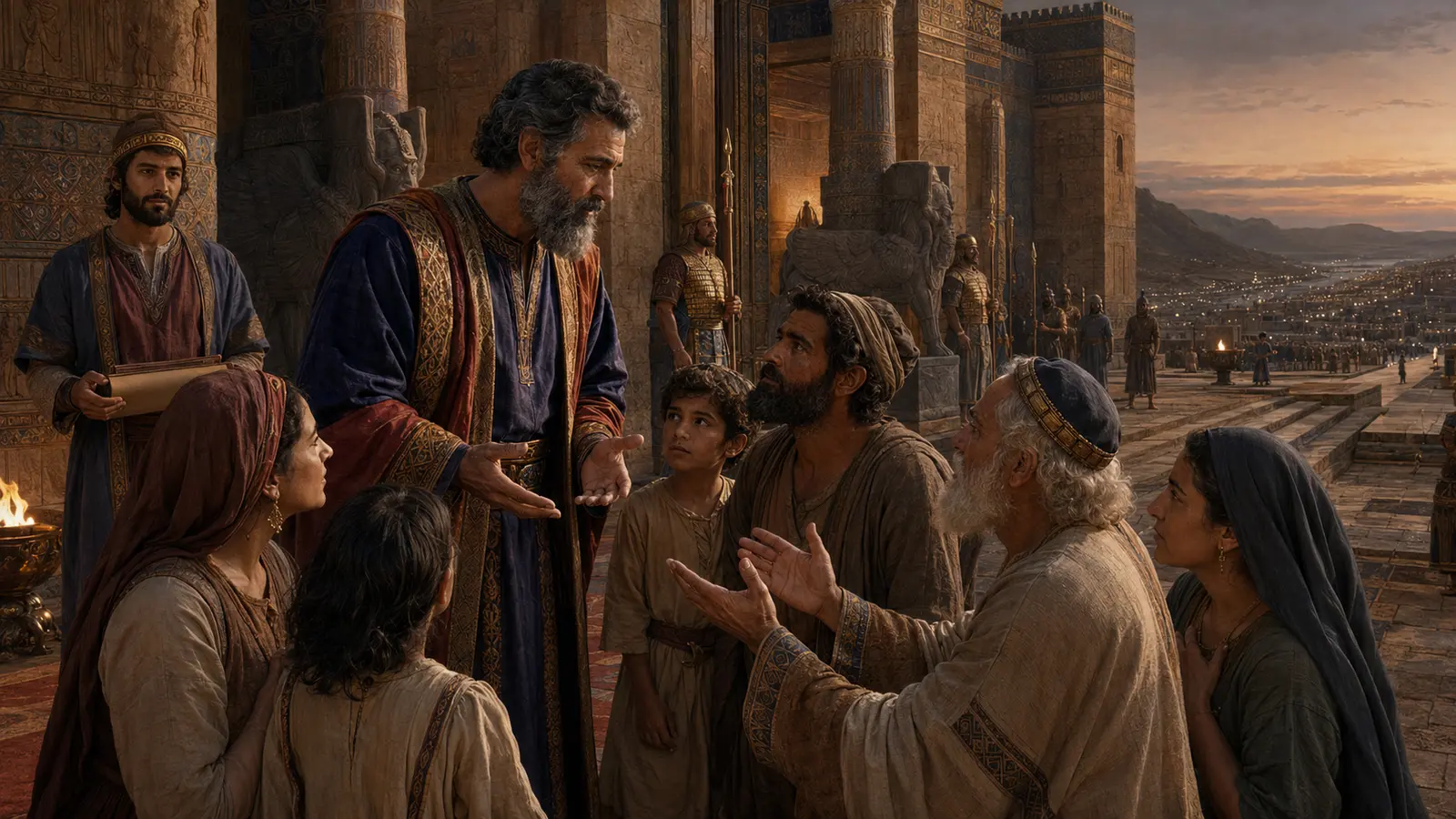
Then Esther sends Hathaki to investigate in depth the essence of the matter and its reasons. Mordecai reveals everything hidden to him: the full amount of money promised to Haman, the extermination order against the Jews, and Esther's duty to go before the king to ask for mercy and plead for her nation. Furthermore, he hands her a printed copy of the decree for Esther to hold in her hand.
These are not small things. Esther should not act based on street rumours; he must face the reality signed and sealed. The document becomes irrefutable evidence. The conflict is now no longer a distant fairy tale—it is turning into an official death warrant staring the queen in the face.
Mordecai's request is clear: Esther must go to the king, ask his permission, and plead for his people.
For the first time, Esther's hidden identity is connected to public responsibility. "His people" are in danger. The crown cannot abolish kinship. Castle walls cannot dissolve covenant ties. Like Moses raised in Pharaoh's house, Esther must decide whether her proximity to authority has separated her from the oppressed or prepared her to stand with them (Ex. 2:10-12; Heb. 11:24-26).
06
3.3 Reaching Authority Is Not the Same as Being Safe (Esther 4:9–11)
Esther sends a serious reply. Everyone knows the law: any man or woman who approaches the king in the inner courtyard without being called faces death, unless the king points a golden rod at him. And Esther has not been called to the king for thirty days.
This is the reality of his position. She is a queen, but not free. He is close to the throne, but has no guaranteed security. He has a title, but he is not sure of reaching the king. His crown is real, but weak.
These details prevent us from making Esther's call a simple interesting story. Mordecai's order is not an easy one. Not just saying, "Use your influence." It is saying, "Danger your life."
Esther's fear is not a foolish fear; it is an accurate assessment of the risk he faces. True courage does not deny the presence of danger. Tells the truth about the risk, then realizes what honesty requires.
The golden rod stands as the main symbol of this chapter: the thin line between life and death, approval and destruction. Esther must face a king whose mood swings have already shaken the foundations of the kingdom. The memory of Vashti's danger is still fresh in his mind. The truth is bitter: a queen can be banned, a queen can be forgotten, and a queen can be lost quite easily.
Scripture wants us to feel the weight of this time. Esther's call is costly because she is dealing with a dangerous system. His courage is not a safe play on the stage; it is obedience that trembles in a world full of uncertainty. That is where discipleship is witnessed: not outside the reality of history, but in the narrow path where fear and responsibility, wisdom and faith meet.
07
3.4 When Mordecai Mentions the Danger of Silence (Esther 4:12–14)
Mordecai's response is the theological core of this chapter.
He warns Esther not to think that she will survive in the king's house more than all the Jews. His hiding will not be able to save him in the end. His palace address cannot separate him from the fate of his people. If the day of judgment comes, he too is in danger.
Then comes the great declaration: if he remains silent at this time, help and deliverance will come to the Jews from another place, but he and his father's house will perish.
Mordecai does not mention God by name, but all his faith is in Him. His statement, 'there will be help elsewhere,' becomes a secret and cautious language that speaks of God's leadership. Redemption does not depend on Esther as the final source, but Esther is invited to be its link. This is the great mystery of faith: God's purpose is firm, but man's obedience is necessary and valuable. [3]
Mordecai's faith is not one of fear and panic, but it is also not one of laziness. He does not say, 'Everything is in your hands'—that would have placed an unbearable burden on Esther. He does not say, 'You have nothing to contribute'— that would absolve him of responsibility. His message is clear: 'God's plan is bigger than you, but your position is real and meaningful.' This is the beauty of covenant: God who fulfills his promises chooses to work through our obedience. Then, he leaves Esther facing the question of the century: 'Who knows if you didn't get the kingdom for a time like this?
Who knows?” Here we see the highest humility. Mordecai does not pretend to know every secret of God's plans, nor does he use coercive influence. He sees opportunities and reads the signs of the times. He looks at the remarkable story of a Jewish orphan who sat on the throne of Persia, then asks if this unusual elevation has a divine meaning.
We often do not see God's guidance through a perfect map, but through the eyes of faith. When we measure our time, the space we have, and the needs around us, we should question: What if I was put here for a purpose greater than myself? What if this opportunity, this voice, or even this serious trial, is an invitation to save others?
Mordecai's words strip Esther's crown of personal glory and turn it into a call to service.
08
3.5 When Esther Comes Out of Hiding and Enters into Intercession (Esther 4:15–17)
Esther responds by taking a stand. He tells Mordecai to gather all the Jews in Shushan and fast for him. Do not eat or drink for three days, night and day. She and her girls will also fast. Then he will go to the king, even though it is against the law.
And then comes his famous words: "If I perish, let me perish." These words are not a cry of despair, but the courage to surrender. Esther does not know the consequences of her decision, but she has chosen to obey the call. He cannot control the king's hand with the scepter of power. He cannot cancel the destruction order by himself. He cannot guarantee the safety of his life. But he is able to do one thing: to stand faithfully.
Fasting here has a great meaning. Although the Hebrew text does not directly mention prayer, in the Scriptural tradition, fasting is always accompanied by an urgent dependence on God. Moses fasted when he was in the presence of God (Ex. 34:28); the children of Israel fasted when they repented and during disasters (Judges 20:26; 1 Sam. 7:6); Ezra proclaimed a fast before a dangerous journey seeking protection (Ezra 8:21–23); and Nehemiah wept to heaven by fasting and praying before facing the king (Neh. 1:4). Esther's fast falls into the same biblical vein: where the body itself becomes a prayer when words are too small in the face of the enormity of the danger. [4]
The community fast surrounds Esther's risky decision with strong solidarity. True, he will enter the king's inner court alone, but he will not enter alone—he will enter carried on the shoulders of the prayers of his people. The burden that was his only, now becomes everyone's.
See also the change in Esther's relationship with Mordecai. Initially, Esther obeyed Mordecai's instructions to conceal her identity. Now he is the one who gives orders to Mordecai: gather the Jews and fast. Mordecai goes and does all that Esther commanded. The orphaned queen has become an instrument of redemption.
This is where the focus of this chapter changes. Mourning turns into realization. The diagnosis gives rise to an emergency fast. Fasting brings strong courage. And that courage becomes an intercession for redemption.
The castle still has rules. Haman still has command. The king still has the scepter. But Esther has found her voice.
09
4.1 God's Leadership Does Not Eliminate Man's Responsibility
The fourth chapter of the Book of Esther holds together two truths that we often mistakenly separate. On the one hand, Mordecai has a firm belief that God's deliverance will just happen; but on the other hand, he still encourages Esther to stand up and act. God's hidden faithfulness does not mean human obedience is not required. Rather, it is what gives that obedience foundation, weight, and eternal meaning.
There is no limping around and assuming things will fix themselves. If God is already working behind the scenes, then the question is not whether our actions are meaningful, but whether we will choose to participate in what He is doing.
This principle is revealed throughout the Scriptures: God promises Abraham that the nations will be blessed through his descendants, but Abraham must make a journey and leave his country (Gen. 12:1-3). God hears the cry of Israel in Egypt, but Moses must stand before Pharaoh (Ex. 3:7-10). God promises the restoration of Jerusalem, but Nehemiah must pray, plan, and rebuild the broken walls (Neh. 1–6). The kingdom of God is approaching in Christ Jesus, but the church is sent to be his witnesses to the ends of the earth (Mt. 28:18-20; Acts 1:8).
Indeed, God's supreme leadership is not a river to lie down on. it is the fire that ignites our courage.
10
4.2 Silence Has Seasons, But Speech Also Has Seasons
Esther's hidden identity has protected her until now. But in chapter 4, the disguise comes to an end. Mordecai condemns all forms of silence. He warns against silence "at this time." Summer has meaning.
Wisdom always asks: What time is this? Is it a season to be silent, or is it a time to be loud? Is this silence protecting the lives of others, or is it just protecting my pleasures? Is this hiding a wise strategy, or has it turned into fear?
There is "a time to be silent, and a time to speak," says the Ecclesiastes (Ecclesiastes 3:7). But the prophets teach us when silence becomes a sin: Nathan confronts David (2 Sam. 12:1-14), Elijah judges Ahab's wickedness (1 Ki. 21:17-24), Amos fights unjust worship systems (Amos. 5:21-24), and John the Baptist tells Herod the painful truth at the cost of his head (Mark 6:17-29). Silence can be wise, but it can also be tacit collaboration with evil.
For the disciples of Jesus today, this fact has a great weight of consideration. We must never confuse fear or caution with trust. There are times when love compels us to step into danger, justice demands to raise our voice, and the power we have must be used to fight for the voiceless.
11
4.3 Mourning and fasting are ways of resisting evil
Before Esther approaches the throne, the Jews mourn and fast. Their grief is not in vain. It is a protest of covenant faithfulness against death. They truly say that the commandment is evil. They refuse to normalize what the empire has legalized.
Fasting also removes the illusion of being in control. People cannot save themselves by their own strength. Esther cannot rely on beauty or rank alone. They put their bodies in a position of dependence.
In a world obsessed with noise, fasting teaches God's people to resist immediate fear, vanity, and self-sufficiency. There is a way to say: We are weak, but we are not abandoned.
For the church, this means a lot. Mission without prayer becomes strategy without surrender. Leadership without mourning turns into management without mercy. Discipleship without fasting can be a desire clothed in religious language. Esther 4 calls God's people to restore the dependence that touches all of life: to pray with our mouths, yes, but also with our calendars, our meals, our tears, and the burdens we carry together.
12
4.4 Esther as Intercessor and the Great Narrative of the Bible
Esther moves toward the throne on behalf of the condemned people. He risks his life to plead for others. And in the Scriptures he does not stand alone: Abraham prays for Sodom (Gen. 18:22-33), Moses stands between God's judgment and Israel's sin (Ex. 32:11-14, 30-32), Judah sacrifices himself for Benjamin (Gen. 44:18-34), and Nehemiah carries the sorrow of his people before the king (Neh. 1:4-11; 2:1-8).
Those examples of intercessors reach their perfection in Jesus, the true Intercessor. Esther enters the inner courtyard facing death; Jesus enters death itself to bring his people to life. Esther approaches the throne without being sure of being welcomed; Jesus opens the seat of grace for all who come through him (Heb. 4:14-16). Esther says, "If I perish, let me perish"; Jesus gives himself knowing that the Son of Man came "to give his life as a ransom for many" (Mark 10:45).
We should not force every aspect of Esther's life to conform to the story of Christ. However, Esther 4 creates a deep thirst for the greatest Intercessor: the One who not only risked his life, but brought it down to the grave; The one whose self-giving love on the cross completely overturned the command of sin and death against us; The one whose resurrection has been the greatest and final revolution of history.
Esther said, "If I perish, let me perish."
But Jesus, with incomparable love, says: "I will perish, so that my people may live." "
13
4.5 Discipleship, Church Leadership, and Mission
For discipleship, Esther 4 teaches us that identity is not a personal adornment. To be owned by God is to be owned by God's people and God's purposes in the world. Discipleship is not to continue living safely in a castle; it is a testimony of loyalty when the weak are in danger.
For church leadership, Esther 4 offers a strong warning against the culture of covering up grief too quickly to protect image. Mordecai's sacks must be allowed to appear. The church should be a safe community where suffering can speak its truth before official strategies are announced. Leaders have to learn to sit and listen at the gates of people's pain, before they sit in chairs and make statements.
In the context of mission, Esther 4 reminds us that God often works through the places we have been placed, even if they are hidden behind the veil of ordinary things. The mission is not just to cross the sea and go to distant lands; it includes realizing why God has placed us in offices, families, classes, markets, institutions, and our streets today. Wherever God's people are given a voice or space, that influence becomes a field of divine testimony. Our question should not just be, 'How can I protect my safety here?' but also, 'To whom have I been sent to be a blessing in this place?' "
14
5.0 Application of Life: Courage for a Time Like This
Don't cover up your grief too quickly. There is pain that must be felt before it can be healed. Ask yourself what the bags at your door are trying to tell you.
Remember that space is stewardship. Influence is not given for comfort, position, or mere survival. Ask yourself who needs your voice.
Know when to be silent and when to speak. You don't always need public honesty, but there are times when silence becomes betrayal.
Do not turn a blind eye to danger. Courage is not pretending that the king's law is harmless. Courage looks danger in the face and still chooses to face it honestly.
Seek God's face by fasting before taking action. Let prayerful dependence be the basis of your courage, so that what you do is the result of surrender, and not a cry of fear or a display of pride.
Do not leave alone those who enter the danger rooms; stand with them. Esther faces the king's throne, but her people carry the burden with her. True courage should be communal—don't leave our heroes alone.
Let your identity in God become a duty to others. You are not where you are by accident. Your talents, your opportunities, your experiences, and your narrative can be part of someone else's redemption.
Lead by listening before advising. Church leaders must learn from Mordecai's sackcloth and Esther's careful study. Honest leadership begins with accepting the truth of the wound.
Fulfill the mission where God placed you. Whether it is at work, at home, at school, on your platform of influence, or in your social space—that place can be a key pillar in the hidden strategy of God's mercy.
Measure your courage with the scales of love, not of noise. Esther's courage was not a theatrical performance; it was a costly love, walking cautiously, moved by prayer, and going to danger with unshakable loyalty.
15
6.0 Reflection Questions
1. Where in your life might you be trying to offer 'new clothes' of superficial comfort, instead of sitting and listening to someone's real grief?
2. What influence, position, or relationship has God placed in your hands, not for you, but for the benefit of others?
3. Is there an area where silence used to protect your safety, but now it hinders and hinders your obedience to God?
4. What fear do you need to honestly name before you act with courage?
5. Who is your spiritual partner who can fast, pray, and stand shoulder to shoulder with you as you move toward a difficult calling?
6. What is the 'gate' in the society around you that carries the cry and sadness that the church should listen to?
7. How can your leadership reduce power in protecting your status and power, and increase power in fighting and praying for the weak?
8. Where is God trying to take your church out of the fortress of security and comfort, towards the danger of witnessing powerful truths?
9. How does Jesus, as our great and eternal Intercessor, change and expand the way you understand Esther's courage?
10. What concrete step of obedience can you take this week, realizing that you were put there 'for just such a time'?
16
7.0 Response Request
God who hides himself, God of mercy,
You see the commandment before we can bear to read it.
You hear a cry at the gate.
You know the fear inside the castle.
You are there even if your name is not mentioned,
and you are faithful until the redemption has not yet appeared.
Teach us to mourn what is evil,
and let's not cover up the sadness too quickly.
Teach us to fast before we act,
listen before you speak,
and speak when silence would betray love.
Give us the courage of Esther,
not the courage to be sure of the result,
but the courage to surrender.
Give us the insight of Mordecai,
to see a time when a hidden position has become a holy calling.
For students learning to follow Jesus,
make identity turn into obedience.
For influential leaders,
turn power into service.
For churches sent on mission,
make our presence among the nations
be a testimony of your justice, your mercy, and your covenant love.
To those who stood outside the gate wearing sackcloth,
bring comfort and justice.
For those in the castle afraid to move forward,
awaken purpose and strengthen faith.
For communities under threat,
raise up intercessors, gather companions for the journey,
and turn fear into an act of trust.
when the time comes,
help us walk to the throne,
regardless of our rank, our beauty, our strength, or our cunning,
but relying on your hidden leadership, your covenant love fully revealed in Jesus Christ, our crucified and resurrected King.
Amen.
17
8.0 Next window
Esther 4 ends with closure, position, and the queen preparing to cross the line between safety and danger. He has accepted the summons, but the outcome is not yet known. The golden rod has not yet been stretched. The king has not yet heard his request. Haman's order still stands.
In Esther 5, courage will move from words to action. Esther will put on royal clothes and enter the inner courtyard. The king will see him. The rod will be stretched. But Esther will not reveal everything at once. He invites the king and Haman to a feast, and the narrative slows down, building tension around the table, pride, and hidden strategy.
This move makes sense. Courage doesn't always say everything at once. Sometimes wisdom prepares the table before it reveals the enemy. Esther's courage will be combined with patience, proper timing, and careful discernment. The hidden God in chapter 4 will continue to work through transformations that no empire can fully control.
People are fasting.
The queen is approaching.
The swing party is starting to take shape.
18
9.0 Bibliography
[1] BibleProject. "The Book of Esther." Old Testament Overviews. Portland, OR: BibleProject, 2026.
[2] Levenson, Jon D. Esther: A Commentary. Old Testament Library. Louisville: Westminster John Knox, 1997.
[3] Fox, Michael V. Character and Ideology in the Book of Esther. 2nd ed. Grand Rapids: Eerdmans, 2001.
[4] Berlin, Adele. Esther. JPS Bible Commentary. Philadelphia: Jewish Publication Society, 2001.
[5] Clines, David J. A. Ezra, Nehemiah, Esther. New Century Bible Commentary. Grand Rapids: Eerdmans, 1984.
[6] Moore, Carey A. Esther. Anchor Bible 7B. Garden City, NY: Doubleday, 1971.
[7] Wright, N. T. The New Testament and the People of God. Christian Origins and the Question of God 1. Minneapolis: Fortress, 1992.
[8] Wright, N. T. Jesus and the Victory of God. Christian Origins and the Question of God 2. Minneapolis: Fortress, 1996.
[9] BibleProject. "The Way of the Exile." Portland, OR: BibleProject.
[10] BibleProject. "Exile." Portland, OR: BibleProject.
Be the first to leave a comment.