

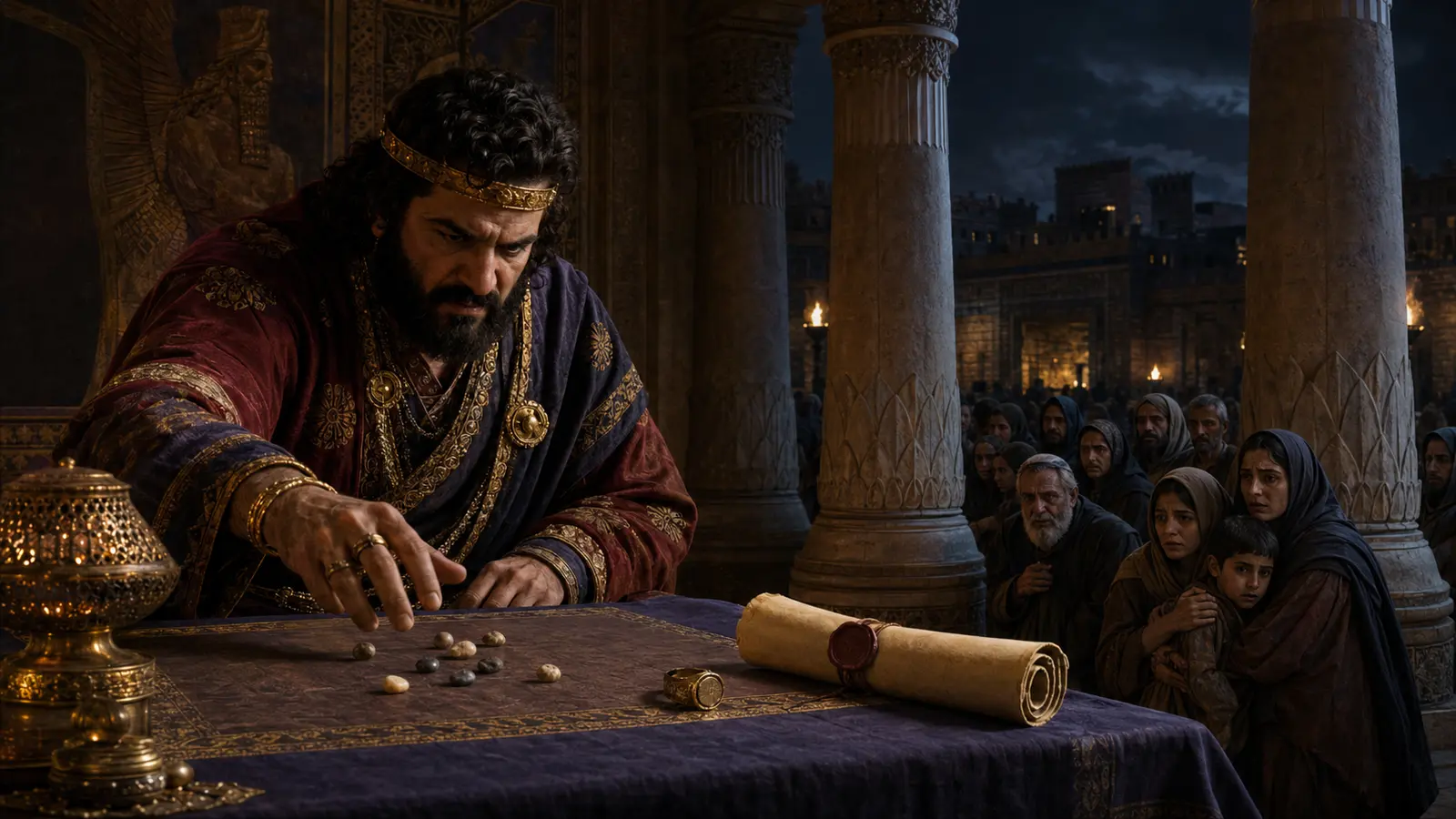
The Persian Empire had a throne, a signet ring, strict laws, and lavish banquets. Haman also had a vengeful rage disguised as 'public safety and security.' The dice of fate fell on the cold floor of history, but the providence of God was already ruling and holding what the empire thought was mere luck.
01
Introduction
The Persian Empire had a throne, a signet ring, strict laws, and lavish banquets. Haman also had a vengeful rage disguised as 'public safety and security.' The dice of fate fell on the cold floor of history, but the providence of God was already ruling and holding what the empire thought was mere luck.
02
1.0 Introduction: When Wounded Pride Turns to Public Violence
There is a type of anger that begins as a private injury but ends up being a social disaster. It begins in the small room of the swollen soul: no one is respected, no one is obeyed, no one is bowed down to. But when that anger is fed by pride and given the reins of power, it grows teeth. It turns into policy. It borrows the mantle of law. It calls itself order while preparing death.
Esther 3 is where the humor of the dollar begins to turn dark. In chapter 1, the palace looked funny because the drunken king couldn't even rule his own house. In chapter 2, the palace became a dangerous place because women who were weak were gathered for royal lust, and Esther ran into a hidden danger. But in chapter 3, the power of the state is directed towards genocide. A man named Haman is lifted up. Mordecai refuses to bow. Haman's wounded pride expands from targeting one individual to an entire nation. Lots are cast. Money is given. The decree is sealed. The date of annihilation is being planned. [1]
This text is about wounded pride turning into organized hatred, because evil is most dangerous when one person's anger is given legal authority.
God's name is still not heard, and Esther's voice is drowned in the silence of this chapter. Mordecai speaks loudly, not in words, but in his firm refusal. The king is again revealed to be morally empty—a leader who is easily swayed by the wishes of others. The palace is still loaded with wine, riches, messengers, laws, and the royal signet ring; but this time, the whole wheel of governance is turned to slaughter.
Esther 3 wants us to look at evil without spiritual ignorance. Evil is not always random chaos. Sometimes they are well organized. Sometimes they are polite. Sometimes he sits next to the throne. Sometimes they write letters in the official language. Sometimes they hide old resentments behind the language of public safety.
However, this chapter also asks us to read with hope. Votes are cast, but votes are not the final authority. Haman has a plan, but Haman is not the last one. The king takes off his ring, but the throne of Persia is not the throne of heaven. God's people are threatened, but his covenant has not been thrown away.
The danger is real. But under that order, God's providence is awake.
03
2.0 Historical and Literary Context: Amalek Ikuluni, Exile Under Threat
Esther 3 stands at the point where the hidden vulnerability of Jewish life in exile turns into open danger. Until now, the Jews have existed, but they have not been threatened as a nation. Esther has hidden her identity. Mordecai has served at the gate. The empire has continued with its parties, its politics, and its paperwork. But now the old question returns with force: Can the people of God's covenant live under a foreign power when hatred is organized against them?
This chapter introduces Haman, who is described as "the Agagite." This name is not just mentioned. It probably refers to Agag, the king of the Amalekites, and the never-ending conflict between Israel and the Amalekites. In the Torah, Amalek attacked Israel in the desert, targeting the tired and weak along the way. In 1 Samuel 15, Saul, from the tribe of Benjamin, failed to fulfill God's order regarding Agag. Now, in Esther, Mordecai is associated with Benjamin and Saul's clan, while Haman bears the shadow of Agag. The conflict of the past has moved from the desert and the kingdoms to the palace of Persia. [2]
Esther 3 is not just a tribal memory. It is the light of education. The Bible shows us how old patterns of enmity return in new clothing. Amalek is no longer just seen as desert invaders. Amalek now appears as a decorated official, wearing a king's ring. Ancient enmity has learned bureaucracy.
Literarily, Esther 3 is also a major turning point in the book. The exaltation of Haman, his command, and his feast with the king will later be answered by the exaltation of Mordecai, Mordecai's counter-command, and the celebration of the Jews. Therefore, this chapter is not the last word; it is going down the valley before climbing the mountain of great transformation. [3]
The main themes of this chapter are built on honor and shame, obedience and disobedience, anger and command, votes and laws, secrets and identities, while concluding with a feast and a shock. Mordecai's Jewish identity, which until now had been hidden in the relationship with Esther, appears at the gate. Haman's hatred turns into public policy. The king's authority is exercised with alarming ease. The city of Shushan ends in confusion when the king and Haman sit down to drink.
The dollar is having a party. The city is shaking. God's people face destruction.
04
3.1 When Haman Is Lifted Up (Esther 3:1)
"After these things," the king promoted Haman the son of Hamedatha, an Agagite, and placed him above all the princes who were with him.
The words "after those things" are important. Mordecai has just saved the king's life in chapter 2, but Mordecai is not rewarded. Instead, Haman is promoted. Here we meet the irony that hurts and cuts the liver the most in this chapter. Loyalty is forgotten, and pride is exalted. A faithful man remains at the gate, while a dangerous man rises near the throne.
These things happen often in the transfer world. The righteous are ignored. The proud are exalted. Those who serve quietly are not remembered, while those who desire honor receive titles. Esther's story does not hide the bitter truth: that administrative systems do not always reward good for good. It teaches us to live honestly in a world where recognition can be delayed and promotion can be unfair.
The raising of Hamani also creates an environment of crisis. Evil is more dangerous when it is not just a personal matter but an institutional one. A hateful person without authority can hurt. A hateful man with a king's ring can destroy.
The author does not explain why Haman is promoted. That silence is part of the irony. In Esther, the power of the state is given arbitrarily, completely separated from accountability and in conflict with the moral compass. Ahasuerus knows how to lift a man before he evaluates his character. The palace knows how to give a title, but it does not know how to do justice.
These things are not new in the Bible. Pharaoh had a throne, but his throne became a factory of oppression. Nebuchadnezzar was powerful, but his power demanded worship. Herod had a crown, but his crown was defended by shedding the blood of innocent children. Scripture repeatedly reveals authorities who forget that they are accountable to God. [4]
05
3.2 When Mordecai Refuses to Bow (Esther 3:2–4)
All the king's servants who were at the gate bowed down and worshiped Haman, because the king had ordered it. But Mordecai did not bow. He did not bow to him.
The emphasis of the description emphasizes the seriousness of the event: he did not kneel, nor bow down. His body becomes a sufficient testimony; he does not preach, but his posture preaches with a loud voice.
The text does not clearly tell us why Mordecai refuses. Perhaps it is because Haman is an Agagite, who carries the memory of Amalek. Perhaps the respect required had crossed a line that Mordecai could not cross. Perhaps Mordecai sees that honoring Haman would publicly justify a man whose pride was already poisonous. This complexity is important. Esther does not make Mordecai a moral compass to follow. But his refusal is clear.
Other servants ask him day after day: "Why do you break the king's order?" The issue is being politicized. Mordecai's refusal is not taken as his own will; it seems like disobeying royal order. Once again, Esther shows how the state tries to make its demands dictatorial and total. If the king orders to bow, refusal becomes rebellion.
Mordecai reveals that he is Jewish. His identity, which was hidden behind the narrative, now becomes the essence. The servants report him to Haman "to see if the words of Mordecai would stand." In other words, they are trying to see if covenant identity will be accepted as a reason for opposition.
This is one of the serious questions of transfer in this chapter: What happens when being of God is clearly seen in a system that demands that all people be the same without questioning?
Mordecai's refusal comes at a cost. It is not a heroic act. It is quiet, everyday resistance. It doesn't bow today. It doesn't bend tomorrow. Hainami when asked. It bends when viewed.
Sometimes honesty looks like standing still when everyone else bends their backs.
In this way, Mordecai stands next to Daniel's friends, who refused to bow before the golden image, and next to Daniel himself, who refused to stop praying even when prayer was made illegal. Later, Jesus will stand before the tempter and reject the kingdoms of the world on the condition of bowing the knee to the enemy. God's people are often tested in the area of worship, ultimate obedience, and public honesty. [5]
06
3.3 When One Person's Anger Turns into Hatred Against the Nation (Esther 3:5–6)
Haman sees that Mordecai does not bow or bow to him, and he is filled with anger. But he thinks it is too small a thing to attack Mordecai alone. Having already told Mordecai's people who they are, Haman seeks to destroy all the Jews throughout Ahasuerus' kingdom.
Here the wickedness of Haman's heart is revealed. He is not a person who just buried you. He is swollen. Mordecai's refusal wounds his pride so deeply that punishing one person seems too little. His soul needs a bigger platform. His revenge must be for the whole dollar.
That's how prejudice often works. It takes the fault of one person and applies it to all people. You refuse to see someone as a person. It turns the face of one man into the character of his people as a whole, the rejection of one man as evidence that all men must be removed.
Haman's hatred is also ancient. The name "Mwagagi" is now starting to burn and hurt. Amalek's enmity against Israel rises again, not in the desert, but in the palace. Haman does what Amalek has been doing: he attacks the presence of God's people.
Theologically, this scene looks back and forward. Back, it goes back to Pharaoh, who saw the increase of Israel as a threat and turned fear into policy. It refers to the serpent and his enmity against the seed of the woman. In the future, it gives birth to a desire for the kingdom of God, where the weak will not be treated as threats and justice will not be distorted by hatred. [6]
Evil here is not accidental. It is personal, of historical, political, and spiritual heritage. Haman's anger becomes a command because the empire gives him a sword to carry out his hatred.
07
3.4 When the Lots Are Cast (Esther 3:7)
In the first month, the month of Nisan, the twelfth year of the king, they cast puri, that is, lots, before Haman day by day and month by month, until the twelfth month, the month of Adar.
This is one of the most terrifying verses in Esther. Haman casts lots to determine the day of doom. The date of death is chosen by lot.
Finally the word puri gave birth to the name of Purim, a celebration that commemorates the liberation of the Jews. Here is the beginning of a great irony: the dice that Haman used to plan death, turn into a reminder of life for Israel. An instrument meant to spread terror is flourishing into the name of a happy holiday. [7]
Theologically, the casting of lots raises the question of luck and God's providence. Haman thinks that the future can be controlled by divination, luck, and timing. He wants the world itself to share his hatred. But Biblical philosophy does not fully accept that human destiny is achieved by chance. Proverbs says, "Lots are cast in the folds of a garment, but all its judgment comes from the LORD." Esther does not mention the proverbs clearly, but her story breathes the spirit and echo of those words [8]
Votes fall, but they don't dominate.
In a book in which God is hidden, the votes become a symbol of contested destiny. Is history guided by luck? And the dollar? And hatred? And faceless destiny? Ester slowly answers: no. History may look like lots on the floor, but under that floor is God's faithfulness hidden.
08
3.5 Hate When Learning the Language of Public Order (Esther 3:8–11)
Now Haman stands before the king—and this is where we see his tricks at work. He does not begin by mentioning Mordecai, nor does he touch upon the fault of any individual. Instead, he turns all Jews into a national threat: he presents them as a scattered and isolated society, with anti-universal laws, and indifferent to royal decrees. Then, he nails the final nail with a political argument: 'Therefore, it is not in the king's interest to tolerate them.
That is the speech of organized evil. Haman hides revenge behind the leadership of the state. He turns diversity into danger. He defines minority identity as treason. He points out that the stability of the dollar needs to be removed from them.
A system like this has a long history of pain. Whenever the authorities want to harm the weak, they often start by painting them as different, dangerous, useless, or dishonest. Hatred rarely appears in its true form; instead, it wears a mask of 'security.' You don't call yourself 'unity.' You don't call yourself 'wisdom.' He calls himself 'the law.' To complete his plan, Haman bribes a large sum of money into the king's coffers—and that's when cruelty is given a commercial appeal. King Ahasuerus, without even investigating, removes Haman's signet ring. He entrusts him with the money and the fate of those people, telling him to do with them anything that pleases him.
Once again, Ahasuerus reveals the vacuum of imperial power: he is strong but not wise. He signs what he does not see, and rules what he does not protect. His ring runs faster than his conscience in this season of decisions. See the dollar at its worst: one man's hatred, another man's indifference, and a system efficient enough to turn both into law.
The Biblical view of government does not show that all governments are wrong, as the Scriptures support peace and require rulers to administer justice. But where the government ignores the personality and the image of God in the poor, the law becomes an instrument of injustice, and the leaders abdicate their moral responsibility by making decisions arbitrarily, the state turns into an instrument of torture. It retains the appearance of a human institution on the outside, but essentially operates with the ferocity of a wild animal. [9]
09
3.6 When the Order Goes Out and the City Is Confused (Esther 3:12–15)
The king's scribes are called on the thirteenth day of the first month. Letters are written to captains, governors, and chiefs in every state, in every script and language. The order is to destroy, kill, and completely wipe out all the Jews—young and old, women and children—in one day, the thirteenth day of the twelfth month, the month of Adar, and confiscate their property.
The language used is final, undisputed: 'Destroy, kill, and wipe out.' Here, violence is not a side event; it is deliberate and systematic. It sweeps the elderly and children, women and men. It is a genocide given as an order.
Letters are sent by messengers to every corner of the United States, and the new law is officially announced in every state. The imperial communication system—which seemed silly and funny in the first chapter—now turns into a terrifying instrument of destruction. Previously, the king's letters only carried the fears of men who were afraid of being despised by their wives; this time, they carry the death sentence.
This chapter reaches its climax by showing a great and terrible rupture: while the king and Haman sit down to enjoy themselves with drinks, the whole city of Shushan is plunged into chaos and mourning.
The authorities are having a party while the city is mourning. The architects of death are drinking calmly while ordinary people are confused. This is the moral sleep of evil. You can sign death certificates and then pour the wine.
But the frustration of the city of Shushan is a clear sign that Haman's order does not have the support of the majority. The city is consumed with anxiety—a silent realization that evil is organized, and even the very center of government feels it. Behind the wheels of imperial law, the conscience of the people still refuses to be silent.
This chapter closes in darkness. But darkness is not the end of Esther's story. The decree has gone out, but another decree will also come; Haman has cast a lot, but the lot will be reversed. The king has given away his royal ring, but the ring will later serve a completely different purpose. The feast of death will be answered by the feast of redemption. This big change hasn't happened yet, but the narrative is already moving there.
10
4.1 Evil Often Hides Behind Law, Honor, and Public Order
Haman does not present himself as a murderer. He presents himself as a loyal servant who protects the interests of the king. This is one of the most immediate lessons of Esther 3: evil is more dangerous when it is clothed with honor.
The law can be used to protect the weak, but the law can also be used to put them at risk. Honor can recognize virtue, but it can also foster pride. Public order can serve justice, but it can also silence difference and punish covenant loyalty.
For God's people, discernment does not simply mean asking, "Is this legal?" but also, "Is this fair? Does it protect life? Does it show mercy and truth? Does it honor the image of God in the weak?"
11
4.2 The Dark Powers Are Real, But Not Final
Esther 3 helps us see what the New Testament later calls "authority." Evil is more than bad decisions in the hearts of individuals. You can take form in systems, behaviors, offices, economies, fears, traditions, and public myths that make violence seem necessary. Haman is angry, but the empire gives his anger roads, scribes, messengers, money, languages, and seals.
However, that fact does not remove the responsibility of the individual. Haman is guilty. Ahasuerus is guilty. The system itself is to blame. The scriptures teach us to look at the whole field of evil: from the sin that is hidden in the heart, the sin that disturbs the house, the sin that dominates the palace, to the one that is allowed in the public opinion.
Encouragingly, those powers are not final. They may roar, but they cannot rule forever. They can seal the commandments, but they cannot seal the future against God. The resurrection of Jesus reveals the deepest truth that is already whispered in Esther: God's hidden faithfulness can turn the seemingly final. [10]
12
4.3 Identity Can Be Dangerous in Exile
Mordecai's Jewish identity is known at the gate, and suddenly all the people are in danger. Esther has hidden her identity; Mordecai's identity is revealed. The narrative holds this tension together.
"There are times when concealment protects life, and there are times when one's identity must stand firm—even at the cost of life. This third chapter of Esther does not resolve that tension, rather it intensifies it. Mordecai's refusal clearly reveals the danger inherent in belonging to God, in a world that demands total and ultimate obedience from everyone.
The church must receive this with humility. True discipleship cannot be spiritual things hidden in private. There are times when our bodies, our decisions, our words—and even what we refuse to do—reveal our heavenly citizenship. Our test is not whether we are able to overcome every struggle; the test is whether we will be found faithful when the hour of testimony comes.
13
4.4 Covenant Threatened, But Not Abandoned
Haman's decree threatens Jews everywhere in the empire. From a human perspective, the situation is catastrophic. But that is when the Bible narrative teaches us to look with the eyes of faith.
Israel survived in the hands of Pharaoh; they survived before Amalek; they survived in the middle of the desert; and they survived even in the darkness of exile. This was not because Israel was strong, but because God is faithful to his promises. Esther chapter 3 raises the main question of the covenant: Will God, who promised to bless the nations through Abraham, agree to see Abraham's descendants completely wiped out from the earth? [11]
This chapter does not provide an immediate answer. It lets the weight drop. It allows the reader to feel the fear of the command. But the broader narrative says no. The covenant may be threatened, but it cannot be completely destroyed by Haman's wrath.
Through the Christian eye, that truth gets solid confirmation. The story of Esther is only part of a larger and longer biblical drama, showing God protecting and preserving the family through which blessings would flow to all nations. The Jews who were threatened with annihilation were not a marginal group in history; they were the people of the covenant, through whom the promise of Scripture was traveling toward the Messiah—and through that Messiah, toward the healing of the whole world.
14
4.5 The Cross-Shaped Model: Denial, Threat, and Disguised Victory
Mordecai's refusal creates danger. Later, Esther's intercession will need to be compromised. In the great narrative of the Bible, this structure finds its deepest fulfillment in Jesus, the faithful Israelite who rejects the false conditions of authority, stands before the rulers, and bears violence to bring about redemption.
Esther chapter 3 does not point to Christ through a simple one-to-one analogy. Instead, this chapter gives birth to a great spiritual thirst. It makes us long for a righteous King not at all like Ahasuerus, a stable kingdom unlike the Persian empire, and a Savior who can turn death—not just for one threatened nation within one empire, but for the entire creation.
At the cross, worldly powers seem to be winning once again through legal tricks, false accusations, public shaming, and cruelty. But the resurrection comes as a major historical turning point; the command of death is answered by God's eternal life. The Roman Empire hangs its sentence on the tree, but God raises the crucified King.
This is where the sweetness of the narrative fades. Real evangelical hope shines beneath the hidden destiny of the Book of Esther: when the world may seem abandoned, but God is not at all out of control. When the tomb can be seen sealed, morning is already on its way to remove it. [12]
15
5.1 For Apprenticeship
Refuse to get drunk on honor. Haman's life is driven by the need to bow down. The student must ask himself, "Where am I demanding recognition instead of learning humility?"
See how anger grows. Unhealed pride can turn a small offense into a serious atrocity. Take your anger before God before it becomes policy at home, church, work, or in the community.
Learn the art of honest rejection. There are times when your obedience to God is not expressed in many words, but in a steadfast silence, which costs everything, and which refuses to bow.
Keep your peace in God's providence, even where the dice of fate seem to have been thrown. There are situations that can seem like they have come to an end and have been decided; but the Book of Esther reminds us that God's hand works in secret, even under the things that the world has sealed.
Let your identity be shaped by covenant, not pressure. Mordecai's body remembers who he belongs to. Discipleship trains the heart until public honesty is possible.
16
5.2 For Church Leadership
Do not reward gifts without recognition. Ahasuerus raises Haman without testing his character. Church leaders must resist the temptation to give a platform to influential people while ignoring pride, cruelty, deceit, or thirst for power.
Protect the weak before the crisis becomes an outright disaster. Haman's violence grows because the system allows him to. Wise leadership listens early, investigates critically, and refuses to allow private pain to become community policy.
Never confuse legal approval with moral truth. The king's signet ring did not make Haman righteous. In the same way, the decision of the church can follow all the constitutional procedures and still lack sanctity, if it is used to oppress and oppress the weak.
Build a community where they can actually get to the gate. Mordecai's rejection occurs at the gate, the public place of decision and appearance. Churches need places where the uncomfortable truth can be spoken before the harm becomes institutionalized.
Lead with a pastoral spirit, not defensively. Ahasuerus protects comfort; Haman protects his soul. God's leaders protect people.
17
5.3 For Mission
Stand with vulnerable people. Esther 3 prepares the church to ask, "Who is put at risk when people in authority make careless decisions?"
Be aware of language that erases the dignity of other people. The true mission is not to preach by word of mouth only; but also standing firm against the narratives and propaganda that turn your neighbor into a threat, a burden, or an enemy
Bow before another kingdom. Mordecai's refusal is a clear declaration that the Persian empire has no final say. In the same way, the Church's mission is to demonstrate God's steadfast rule in the midst of worldly governments—systems that often confuse political power with moral truth.
Work faithfully in exile without surrendering identity. Esther is about the Jews living away from Jerusalem, in the hardships of the dispersion life. Missions often occur where God's people are not in control, where wisdom, courage, patience, and timing are needed.
Proclaim hope without turning a blind eye to the danger that exists. Esther chapter 3 does not diminish the magnitude of the threat, but at the same time, it does not surrender the fate of tomorrow into Haman's hands. The Christian mission has the responsibility to call evil by its true name, while boldly proclaiming that the mercy of God's covenant is deeper than any state decree.
18
6.0 Reflection Questions
1. Where are you tempted to seek respect in a way that makes you weak, angry, or demanding?
2. Have you ever seen one person's mistake turn into an unjust judgment against a whole group of people?
3. What pressure in your life wants you to "bend" in a way that breaks your trust in God?
4. Where can your church or ministry be tested to raise capacity without testing character?
5. Who are close to you who can be put at risk by decisions made far away about them?
6. What public language in your community turns weak people into threats instead of neighbors?
7. Where do you need to trust God because the "votes" seem already cast against you?
19
7.0 Response Prayer
God who hides himself but is faithful to the covenant,
when the votes are cast and the order is issued,
when the authorities sit down to drink
and the city trembled with confusion,
teach us not to give up.
Protect our hearts from Haman's hunger for honor.
Heal our pride before it turns into cruelty.
Expose every prejudice that hides behind laws, policies, and public order.
Give us eyes to see the weak,
and the courage to stand with those in danger.
When loyalty calls for refusal, make us steadfast.
When identity is expensive, make us wise.
When the dollar seems loud and your name seems hidden,
let us remind you that your covenant has not failed.
Hold the lot in your mercy.
Reverse the death warrants.
Prepare courage in hidden chambers,
raise up intercessors for the threatened people,
and turn the mourning, in your time,
to be a feast to remember the liberation.
Amen.
20
8.0 Next Chapter Window
Esther 3 ends with a shocking contrast: the king and Haman are drinking, while Shushan is confused. The decree is sealed. The date is set. Jews throughout the empire now live under the shadow of death.
But chapter 4 will move from palace policy to public mourning. Mordecai will wear sackcloth. The Jews will fast and weep. Esther, who is still hidden in the palace, will be called to enter the meaning of her position. The question of hidden identity will be a question of costly intercession.
The votes have been cast.
Now courage must be awakened.
21
9.0 Bibliography
[1] Esth 3:1–15. See also Jon D. Levenson, Esther: A Commentary, Old Testament Library (Louisville: Westminster John Knox, 1997), 66–76.
[2] Exodus 17:8–16; Deut 25:17-19; 1 Sam 15:1–35; Esth 2:5; 3:1. See Levenson, Esther , 66–68.
[3] BibleProject, “The Book of Esther,” Old Testament Overviews (Portland, OR: BibleProject, 2026); Michael V. Fox, Character and Ideology in the Book of Esther, 2nd ed. (Grand Rapids: Eerdmans, 2001), 157–64.
[4] Exodus 1:8–22; Daniel 3:1-30; Matthew 2:1–18; Psalm 2:1-12.
[5] Dan 3:1–18; Dan 6:1–10; Matthew 4:8–10; Acts 5:29.
[6] Gen 3:15; Gen 12:1–3; Exodus 1:8–22; Exodus 17:8–16; Deut 25:17–19.
[7] Esth 3:7; 9:20–32. See Adele Berlin, Esther , JPS Bible Commentary (Philadelphia: Jewish Publication Society, 2001), 38–42.
[8] Prov 16:33; Esth 3:7. See Levenson, Esther , 69–71.
[9] Deut 17:14–20; Psalm 72:1-4; Daniel 7:1-14; Rev 13:1-10.
[10] Eph 6:12; Colossians 2:13–15; Acts 4:24–28. See N. T. Wright, The New Testament and the People of God (Minneapolis: Fortress, 1992), 268–72.
[11] Gen 12:1–3; Exodus 2:23–25; Esth 4:13–14; Romans 9:1–5.
[12] Isaiah 53:1-12; Mark 15:1–39; Luke 24:13–27; 1 Cor 15:20–28.
Additional Used Books
Berlin, Adele. Esther. JPS Bible Commentary. Philadelphia: Jewish Publication Society, 2001.
BibleProject. "The Book of Esther." Old Testament Overviews. Portland, OR: BibleProject, 2026.
Clines, David J. A. Ezra, Nehemiah, Esther. New Century Bible Commentary. Grand Rapids: Eerdmans, 1984.
Fox, Michael V. Character and Ideology in the Book of Esther. 2nd ed. Grand Rapids: Eerdmans, 2001.
Levenson, Jon D. Esther: A Commentary. Old Testament Library. Louisville: Westminster John Knox, 1997.
Moore, Carey A. Esther. Anchor Bible 7B. Garden City, NY: Doubleday, 1971.
Wright, N. T. The New Testament and the People of God. Minneapolis: Fortress, 1992.
Be the first to leave a comment.