

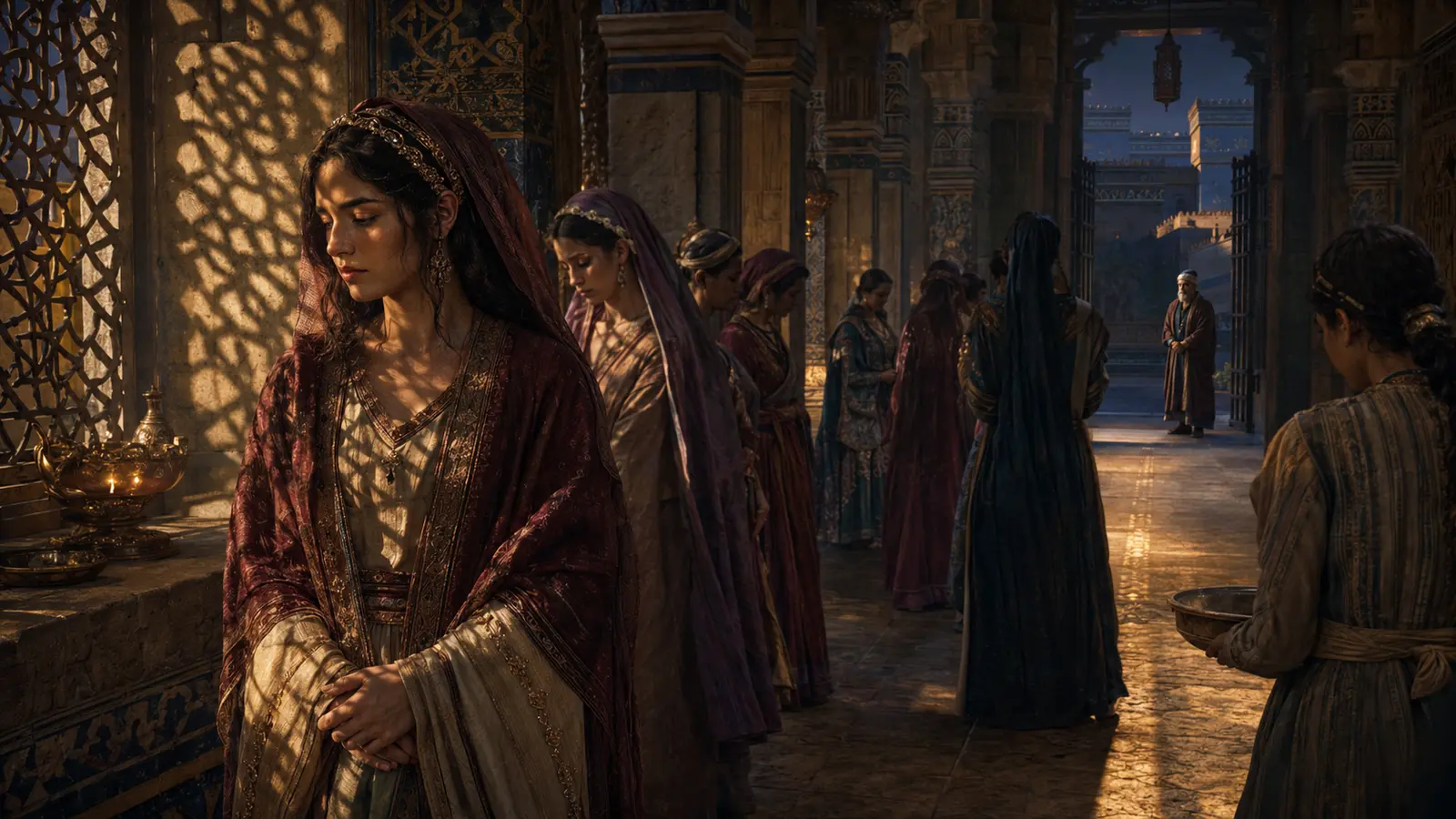
When empires seek beauty, they are often unaware that they are paving the way for God's providence. When the royal palace thinks it is choosing a queen, heaven is already preparing a savior. And when an act of faithfulness is written down and forgotten, the seemingly silent God is already keeping that memory.
01
Introduction
When empires seek beauty, they often do not know that they are paving the way for God's providence. When the royal palace thinks it is choosing a queen, heaven is already preparing a savior. And when an act of faithfulness is written down and forgotten, the seemingly silent God is already keeping that memory.
02
1.0 Introduction: When God's People Enter Rooms They Didn't Choose
What happens when God's people are taken and put into rooms that they themselves could not choose?
Esther 2 is a picture of open doors, but not every open door is gentle. The vacancy left in the palace gives rise to a great search throughout the empire. A Jewish orphan is entered into a royal contest. A hidden girl finds favor in the palace of a foreign king. A man sitting at the gate hears a murder plot. An act of loyalty is recorded, but it is not immediately rewarded.
At first glance, this chapter looks like promotion news. Esther gets up. He appears. He is chosen. She becomes the queen. But this story has deeper layers than a straightforward victory. This is not a simple princess story with just a happy ending. Esther does not enter the scene of covenant marriage like Rebekah at the well or Ruth at the threshing floor of Bethlehem.
He is absorbed into the machine of empire. Beauty is measured. Women are passed into the system. Identity is hidden. Authority is near, but freedom is narrow.
And yet, within this space of moral confusion and political danger, God's hidden work continues.
Esther 1 revealed the emptiness of imperial authority. Esther 2 now shows how God's providence begins to move through the cracks of that authority. The throne is still pagan. The palace is still full of twisted values. God's name is still not mentioned. But the Jewish woman is brought closer to the center of power, and the Jewish man performs an act of loyalty that will be important later.
This chapter teaches us that God's providence often moves through hidden people, controversial circumstances, delayed recognition, and ordinary acts of faithfulness.
The book of Esther invites readers to recognize God's work in a story filled with events that seem like luck, sudden change, danger, moral ambiguity, and hope. (1) That is why Esther 2 speaks strongly to believers who live in an environment similar to
displacement—when the environment is not ideal, when decisions are constrained, when identity has a cost, and when obedience does not bring immediate reward. Esther's God is not far away in such places. He often works under the floor of history, weaving redemption before anyone sees it by name.
03
2.0 Historical and Literary Context: Exile, Empire, and the Construction of Divine Providence
The book of Esther takes place in the dispersion of the Jews within the Persian Empire. Many Jews remained scattered throughout the empire instead of returning to Jerusalem after the exile. The story takes place in Shushan, one of the imperial capitals, far from temple worship, far from the promised land, and far from the visible signs of covenant life. God's people are still alive, but they live under foreign rule, immersed in an imperial world not created by the Torah.
That environment is important. Esther is not a story of a clean and perfect environment. It is the story of the people of the covenant living, enduring, and serving in a mixed space. The question beneath the surface is not just, "What happened to Esther?" rather, "How does God protect his people in exile when his name seems to be hidden and the world around them is not holy?" Levenson describes Esther as a narrative in which God's action is not explicitly stated, but implied through a hidden arrangement of cause, effect, and destiny. (2)
Esther 2 also advances the broader literary structure of the book. Chapter 1 created an open space: Vashti was eliminated. Chapter 2 fills that gap: Esther is lifted up. But this chapter doesn't just take Esther to the palace. It raises a second thread: Mordecai discovers a plot to kill the king. The thread seems small now, but later it will be decisive. The book of Esther often functions with a delayed significance. A small detail in one chapter becomes a hinge of change in another chapter.
This chapter expands on two main themes:
First, hidden. Esther is Jewish, but her identity is hidden. God is sovereign, but his name is not on the surface of the narrative. A faithful deed is recorded, but its reward is delayed.
Second, God's providence through ordinary events. Beauty contests, gatekeepers, royal memories, overheard conversations, one-man favors, and forgotten loyalties—all become instruments in a larger scheme. Fox correctly observes that Esther's theology emerges when the reader realizes that within history there is a logic that transcends ordinary human reason. (3)
The Persian environment is characterized by luxury, power hierarchies, and bureaucracy. Women are gathered, prepared, and brought forward for royal ceremonies. Men sit at the gate where information and authority pass. Memories are written and preserved. Empire seems to work for dominance, greed, and profit. But behind the formalities, the narrative quietly hints that there is another arrangement at work.
The Palace thinks it is planning Vashti's successor.
God's providence plans the salvation of his people.
04
3.0 Reading Esther 2 Within the Great Story of the Bible
Esther 2 should not be read as an isolated palace event. It should be read as part of the great story of the Bible about God preserving his covenant people among the nations. This chapter echoes the early stories of the people of Israel who were in the courts of foreign kings: Joseph in Egypt, Daniel in Babylon, and Moses in the house of Pharaoh. In every case, God's people find themselves within the systems of the empire, not because the empire is holy, but because God can place witnesses and instruments of redemption even under the shadow of worldly authority.
Joseph is sold to Egypt, falsely accused, forgotten in prison, and later raised to preserve life (Gen 50:20). Daniel serves Babylon while remaining faithful to the God of Israel (Dan 1:8; 6:10). Moses grows up in Pharaoh's house, but later he becomes an instrument that God uses to deal with Pharaoh's cruelty (Exodus 2-3). Esther stands within this biblical structure, albeit with a quieter and more ambiguous voice. Unlike Moses, he does not find the burning bush. Unlike Daniel, he does not offer a public prayer in this chapter. Unlike Joseph, he does not interpret dreams. But like them, he is placed in the house of a foreign king for the preservation of God's people.
This is where Esther's theology becomes as thin as a thread of silk but strong as a rope of salvation. The book doesn't say, "God did this." Instead, it teaches us to ask, "Who else but God could weave these events together?" The absence of God's name becomes an invitation to wisdom. We are invited to look beneath the visible machinery of empire and recognize the hidden faithfulness of the God of Israel.
Levenson observes that Esther's narrative structure is built on patterns of change, particularly in the banquet scenes and in her broad chiasmous movement from danger to redemption. (4) This means that Esther 2 is not just a transitional chapter. It is part of the gradual construction of change. A weak orphan is kept in the palace. The act of loyalty is recorded in the royal records. The hidden identity is protected until the hour of disclosure.
In the wider drama of the Bible, exile is not just a matter of geography. Exile is the condition of God's people living east of Eden, far from home, under powers that often distort human dignity. Wright's description of Jewish hope in the Second Temple period reminds us that exile was not just about place; it was also about living under foreign rule while people were waiting for the purposes of God's covenant to be fulfilled. (5) Esther 2 asks what loyalty looks like when God's people live in such a world. It does not provide simple principles. It offers a story: a fragile woman, a watchful guardian, a dangerous palace, a hidden identity, and a memory that will one day awaken in its own time.
05
4.1 When Regret Generates a New Quest
Esther 2:1–4
The chapter begins after King Ahasuerus' anger subsides. He remembers Vashti and what was decreed against her. The verse is short, but full of irony. The king who acted rashly and arrogantly in chapter 1 now lives with the consequences of his arrogance. But instead of repentance, the palace gives order.
Virgin girls must be gathered from all over the empire. They will be brought to Shushan, placed under the care of Hegai, and prepared with cosmetics. Then the woman who pleases the king will be queen instead of Vashti.
The idea pleases the king.
Already the chapter reminds us that imperialist solutions often exacerbate the very corruption they claim to solve. The domestic crisis of the king becomes a gathering of women from all over the empire. Desire is policy. Beauty is managed as a government function. The palace is efficient, but it is not fair.
This is important for theological reading. Scripture does not call us to praise the palace just because Esther will rise in it. The narrator does not baptize the system. The palace process treats women as commodities within the structure of male desire. Ester's rise is real, but it's happening within a very broken system.
And yet the providence of God moves through a system that does not know that it is being used. The decree that comes from the royal desire becomes the road that Esther takes to enter the palace. BibleProject summarizes the beginning of Esther as a series of strange events in which God is not mentioned, but the story is full of planned changes in the form of fate. (6)
This is one of the deep theological tensions in Esther: the Bible does not glorify empire, but neither does it entrust history to empire. Human authority acts from its motives. God, without justifying evil, can still turn events toward the preservation of the covenant.
06
4.2 When Hadasa Enters the Story
Esther 2:5–11
Now the narrative introduces Mordecai, a Jew in Shushan from the tribe of Benjamin, whose lineage is connected to exile. He brings up his cousin Hadassah, that is Esther, because she has no father or mother.
This introduction is gentle and important. Esther is not first introduced as a royal person, but as a weak person—an orphan in exile, in need of someone else's care. Before he is called handsome, he is a man who lost his parents. Before he is crowned, he is a carried man. The story wants us to see his weakness and also where he is placed. He is rooted in a Jewish identity, shaped by the pain of loss, and possessed by a force greater than his ability.
Verse 7 tells us that he was beautiful in form and appearance. Beauty will be important in the flow of the story, but theologically the text invites us to see beyond appearance. Esther has two names: Hadassah, her Hebrew name, and Esther, her Persian name. Hadassah probably means "myrtle tree," while the meaning of Esther is debated; it may be related to the Persian word for "star," or it may have echoes of Ishtar, the Mesopotamian goddess associated with love and power. (7)
These two names show the tension of the dispersion life. Hadassah speaks of covenant identity: rooted, hidden, fragrant, and owned by the people of Israel. Esther speaks of public life in the foreign world: visible, open, and moving within the language of empire. He is Hadassah before God and his people; she is Esther in front of the palace.
This helps us to read this chapter carefully. Esther doesn't just lose one identity and gain another. He lives in the tension between being covenantal inwardly and being made public in the world of empire. Like Daniel and his companions, who received Babylonian names while still remaining the property of the God of Israel (Dan 1:6-7), Esther carries the name given to her by the world without surrendering the deep story carried by her people.
When the king's decree was announced, Esther was taken and taken to the king's house. Those words are important. This is not narrated as a spontaneous and romantic affair. He is taken into the palace machine.
Then comes a recurring idea in this chapter: consent. Esther finds favor in Hegai's eyes. Hegai quickly gives her cosmetics, food, maids, and the best place in the harem. Approval does not erase the difficulty of his situation, but it does indicate that God's hidden hand is quietly planning the outcome. Berlin shows how this chapter repeatedly emphasizes Esther's approval and appeal, while allowing the reader to feel the complexity of her situation in the Persian palace. (8)
The language of approval invites us to compare Esther with Joseph, who repeatedly found approval in Egypt even when he was suffering from oppression (Gen 39:4, 21). In both stories, acceptance does not mean life is easy. It means that God preserves a person for a purpose that is not yet fully seen.
Meanwhile, Mordecai walks every day in front of the courtyard of the women's house to find out about Esther's condition and what is happening to her. That is a touching thing. The story of empire is not just a story of orders and thrones; it is also a story of caring, vigilance, and anxious love. Mordecai can't control the situation, but he stays close.
There is a discipleship in that. Sometimes honesty isn't loud enough. Sometimes it is walking every day near the place of another person's weakness, asking, watching, praying, and refusing to forget.
07
4.3 Consent When Walking Inside the House of Women
Esther 2:12–18
The process for each woman is described in a way close to medical language: twelve months of beauty preparations, six months for myrrh oil and six months for perfumes and ointments. Then each woman enters the king in the evening and leaves in the morning, being transferred to another house under the supervision of Shaashgazi. He would not return to the king again unless the king was interested in him and called him by name.
The sadness of this system should not be ignored. This is not covenant love. It is a palace election. Women are drawn into the structure of desire and cast aside. Esther is inside the structure. Moore's interpretation of Esther 2 emphasizes the political and imperial nature of this process, where Esther's rise occurs within the routines and pressures of the Persian royal harem. (9)
When Esther's turn came, however, she asked for nothing but what Hegai advised her. Once again he finds approval in the eyes of all who see him. The king loves her above all women, puts a royal crown on her head, and makes her queen instead of Vashti.
The script captures this uplift without turning it into a sugar-coated love story. Yes, Esther becomes queen—but the book never invites us to forget where she is. He is in the palace of Persia, crowned by the king of the Gentiles, his identity is hidden, and he has been appointed for a purpose that he does not yet fully see.
The king celebrates with a big feast, "Esther's feast," and gives tax exemptions and gifts. Empire turns individual passion into public celebration. But the reader knows something that the palace does not: this feast symbolizes more than the king's privileges. It signifies the placement of a woman through whom the threatened people will be saved later.
Here the theme of the party is getting deeper. In chapter 1, the feasts showed the pride of the empire. In chapter 2, a feast celebrates Esther's coronation. Later, Esther herself will use the feasts as instruments of courage and revelation. The table that once served the pride of empire will be the place where hidden truths will be revealed and evil turned.
08
4.4 When Wisdom Wears Silence
Esther 2:10, 20
Twice the narrator tells us that Esther did not inform her people or her family, because Mordecai had instructed her not to inform about it.
This silence is one of the most discussed aspects of this chapter. Is Esther's concealment wise, cowardly, influenced by circumstances, wise, or both? The text does not give us a simple moral label. It just tells us that being hidden is part of Esther's calling in this season.
That complexity is important because exile life often requires a more nuanced understanding than slogans. There are times in Scripture when public confession must be clear and immediate. Shadrach, Meshach, and Abednego must publicly reject idols (Dan 3:16–18). The apostles must say, "We ought to obey God rather than men" (Acts 5:29). But there are also times when the act of faithfulness walks quietly until the appointed time arrives. Ester 2 is in this second structure. His identity is not denied, but hidden.
This concealment is literary and theological. The heroine is hidden like the God of the book. Esther's silence reflects God's silence in the narrative. All this concealment prepares for a later revelation.
This does not mean that every silence is honest. There is a nervous silence. There is silence that protects injustice. There is a silence that betrays the weak. But Esther 2 teaches us that there is also a silence of discernment, a silence that awaits the moment when the truth can be spoken with redemptive power.
So a disciple of Jesus should not just ask, "Shall I say?" but, "What does faithfulness need now?" Sometimes honesty speaks immediately. Sometimes honesty waits, gathers courage, and prepares to speak when the door opens.
09
4.5 Deed Forgotten When Written
Esther 2:19–23
The chapter closes by bringing us back to Mordecai. He sits at the king's gate, the place where civil and political life passes. Esther continues to obey Mordecai as she did when she was raised by him. Their relationship continues to be alive even after Esther is raised.
Then Mordecai overhears the conversation of two of the king's eunuchs, Bigthan and Teresh, who plan to kill Ahasuerus. He tells Esther, Esther tells the king in the name of Mordecai, and the matter is investigated and found to be true. The conspirators are hanged, and the event is recorded in a book of records in front of the king.
Then—nothing happens.
There is no immediate reward. No promotion. There is no public honor. The deed is written, but Mordecai is not recognized.
This is a typical form of Esther. A story puts something on the shelf, and we are expected to remember it. An act of loyalty fades into royal memory. But what is written and forgotten by humans does not disappear before God's providence.
The chapter ends with a seed quietly planted.
Later, when the king is sleepless, the record will be read. A forgotten deed will return like a buried river springing up in a dry land. What seems late in chapter 2 will be decisive in chapter 6.
10
5.1 God's Providence Often Walks in Concealment
God is not mentioned in Esther 2, but the chapter is full of meaningful moments. Esther gets approval. He is lifted up at the right time. Mordecai hears the right conversation. The incident is recorded in the royal records. The story is stitched together by common details that later become decisive.
God's providence in Esther is not usually loud. Here there are no burning bushes, no split seas, no fire from heaven. Rather, endowment operates through time, consent, memory, office writing, relationships, and space. The God of Israel is not far away because He is silent. He acts in a more relaxed manner.
This type of endowment builds a mature faith. It teaches believers not to measure God's presence by only big signs. God can be present in an overheard conversation, an unexpectedly opened door, a name written down, a person giving permission, or a delay that seems like neglect.
A hidden God is still a faithful God.
11
5.2 Loyalty in Exile is Often Ethically Complicated
Ester 2 rejects light reading. The chapter is full of tension. Esther enters the house of a foreign king. His identity is being withheld. He is trapped within imperial systems not shaped by covenant values.
And he is still not abandoned. Here the Scriptures teach a serious pastoral matter: God's work is not limited by a clean environment. He meets his people in mixed areas. He can protect them, guide them, and keep them in their place of purpose even when exile makes life full of moral knots and emotional pain.
This should not make us celebrate bad compromises, but it should make us patient, humble, and discerning as we read stories of living under pressure. The Bible does not hide the wounds of exile. It shows God acting even in it.
In that sense, Esther is not an exemplary hero in every respect. He is a witness of God's wonderful mercy, able to act through weak people in mixed areas without God himself mixing with evil.
12
5.3 Consent Is Not the Same as Comfort
Esther gets approval again and again. But approval should not be confused with convenience. The language of consent does not erase the weakness of his method. He's been cleared, yes, but he's still in a dangerous system.
This distinction is important. Sometimes God gives permission in difficult places, not so that we feel safe, but so that His purposes move forward. Approval is not always comfort. Sometimes it's an order.
Joseph's approval in Egypt led him to ministry, false accusation, prison, and finally the role of life preserver. Esther's approval in Persia leads her to kingdom, danger, and finally intercession. Biblical approval is often the grace that places a person in the place of a costly calling.
13
5.4 Forgotten Loyalty Is Still Preserved In God's Economy
Mordecai's deed is recorded but not rewarded. That can be painfully felt by many of us. Many acts of obedience disappear into silence. Most of the offerings are not seen by anyone. Too much loyalty doesn't get immediate payoff.
Esther 2 reminds us that delayed recognition is not lost trust. In the kingdom of God, what seems to be forgotten may be waiting for its appointed hour. Heaven does not lose the memory of covenant faithfulness.
This does not mean that every act of faithfulness will be publicly rewarded in this life. Esther does not teach us a mechanical principle. It teaches a deeper truth: God can gather what human systems have neglected and weave it into his purposes. The memory of heaven is not weak. The Lord remembers.
14
5.5 Esther 2 and the Form of the Gospel of Hidden Redemption
When read within the entire Christian canon, Esther 2 whispers the clearest pattern in the Gospels. Redemption often begins in disguise. The kingdom comes as seed in the ground, leaven in flour, treasure hidden in the field (Mt 13:31-33, 44). God's work of salvation often begins far from the center of the public eye.
The cross itself is the most profound revelation of this pattern. Rome thought it eliminated a person who failed to claim to be the Messiah. Jerusalem's leaders thought they were eliminating the threat. But in the hidden wisdom of God, the place of shame was the throne of victory (1 Cor 1:18-25; Col 2:15). Wright's description of Israel's hope and the kingdom of God helps us to see how early Christian faith understood God's victory as the amazing fulfillment of Israel's story, not through earthly manifestations, but through the crucified and resurrected Messiah. (10)
Esther 2 is not the Gospel itself, but it is within the same biblical world where God brings down the proud through hidden ways, sets up the weak for the purpose of redemption, and brings life to a place where empire sees only use.
15
6.1 For the Student: Loyalty When Life is Bad
Believe in God in circumstances that you did not choose. Esther did not make her own way, but God was working in her. Some believers live in workplaces, families, institutions, or political environments that they would not have chosen. Esther 2 does not embellish those places, but it reminds us that God is not far from it.
Don't underestimate small acts of loyalty. Mordecai's overheard warning seemed to disappear, but later it was very important. A word truly spoken, a person quietly guarded, a duty faithfully performed, a temptation silently resisted—these may be the seeds that God will water in due time.
Remember that hidden is not meaningless. Other seasons are for preparation, not for appearance. A season of concealment can create wisdom, patience, courage, and discernment.
Hold on to your identity before God. Esther's public identity has been obscured, but her covenantal identity has not been erased. The student must learn to carry his identity before God even when the culture around him does not recognize that identity.
Ask for wisdom, not courage alone. Courage without wisdom can be greed. Wisdom without courage can be fear. The story of Esther will eventually require both.
16
6.2 For Church Leadership: Shepherding People in Mixed Positions
Lead with moral clarity and pastoral patience. Ester 2 is not ethically simple. Leaders should avoid quick readings that judge injured people too early or that justify broken systems too easily. The church must be able to call injustice by its name while walking gently with those who try to live in it.
Protect the weak. Mordecai's daily vigil is an example of pastoral care. He can't get Esther out of the palace, but he refuses to be emotionally distant from her. Church leadership must see those in vulnerable areas: youth, women, workers under pressure, families in conflict, believers in hostile environments, and people carrying hidden burdens.
Don't build service on appearance. Empires use beauty as currency. The church must resist the temptation to measure worth by external appeal, appearance, stage, wealth, education, or external brilliance. The Kingdom of God sees people, not products.
Keep honest memories. The act of Mordecai is written. In ministry, faithful service should not be easily forgotten. Leaders must foster a culture that remembers hidden work, honors silent servants, and refuses to reward visible performance.
Prepare people for calling, not just comfort. Esther's approval becomes an order. The leadership of the church should help the believers to realize how God can use their positions, their skills, their relationships, and their opportunities for others.
17
6.3 On Mission: Testimony in the Courtyard of the Empire
Realize the mission of God outside the religious areas. The story of Esther takes place in Shushan, not Jerusalem. God's mission does not end at the walls of the sanctuary. Workplaces, schools, courts, hospitals, prisons, markets, and government offices can all be places where covenant faithfulness is embodied.
Learn to exist without being absorbed. Esther lives within Persian structures, but the story continues to remind us of her Jewish identity. Mission in exile needs to exist among people without leaving obedience to God.
Serve the good of all without forgetting God's people. Mordecai saves the king from an assassination plot. This is an act of public loyalty within a foreign empire. God's people can seek the prosperity of the city while remaining attentive to the community of the covenant (Jer 29:7).
Expect late fruits. A mission often includes tasks whose results are not immediately visible. A conversation, a seed, an act of righteousness, a prayer, a hidden virtue—all may lie underground until God's appointed hour.
Prepare for a bold revelation. Esther's hidden identity will not remain hidden forever. Mission sometimes requires seasons of silent presence followed by times of costly witness. Wisdom asks God for the right time and the courage to speak when the hour comes.
18
7.0 Reflection Questions
Where in your life do you feel like Esther—placed in a situation you did not choose?
Have you ever confused the hiddenness of God with the absence of God?
What small act of loyalty have you ever given that seems to have been forgotten?
In what areas do you need wisdom to live faithfully in a morally ambiguous environment?
How can God be quietly preparing you before calling you publicly?
Who walks daily near the place of your weakness, as Mordecai did to Esther? And who needs you to do that for him?
How can your church honor hidden loyalty more than visible success?
Where can God be calling you to serve the good of all while making clear your covenant identity before him?
19
8.0 Response Prayer
O God of what is hidden and what is holy, You see your children even when they are scattered in Shushan, even when they carry two names, even when they go through doors that they did not choose.
When we feel small in big systems, remind us that the thrones are not the last, and the palace is not the destiny of history.
When our lives are filled with pressure, delay, or confusion, teach us to trust in your noiseless destiny.
Give us the approval of Esther without pride, the loyalty of Mordecai without seeking applause, and wisdom for places where loyalty is not easy.
Protect us from despair when obedience seems invisible. Write our loyalty in a place where forgetting cannot erase it. And when the appointed time arrives, bring to light what you were preparing in secret.
Make us strong in exile, pure in heart, patient in hiding, and ready for the work you weave.
Amen.
20
9.0 Next Window
Esther 2 ends in silence, but that silence is deceiving. The queen is put in her place. A faithful guard is posted at the gate. The plot is revealed. The deed is written.
Now the story is ready to enter its dark corner.
In Esther 3, a new person appears: Haman. What is hidden in Esther 2 will soon be tested by the open evil in Esther 3. Individual pride will grow into genocidal rage. The injured soul will be a public order. And the question that has been swirling behind the scenes will come to the fore:
What happens when God's people are not only hidden in exile, but are threatened with destruction?
The queen is in her place.
Danger is about to arrive.
21
Notes
1. BibleProject, "The Book of Esther," Old Testament Overview Guide, accessed 2026.
2. Jon D. Levenson, Esther: A Commentary, Old Testament Library (Louisville: Westminster John Knox, 1997), 17–21.
3. Michael V. Fox, Character and Ideology in the Book of Esther, 2nd ed. (Grand Rapids: Eerdmans, 2001), 235–47.
4. Levenson, Esther, 5–10.
5. N. T. Wright, The New Testament and the People of God, Christian Origins and the Question of God 1 (Minneapolis: Fortress, 1992), 268–79.
6. BibleProject, "The Book of Esther."
7. Levenson, Esther, 55–63.
8. Adele Berlin, Esther, JPS Bible Commentary (Philadelphia: Jewish Publication Society, 2001), 23–31.
9. Carey A. Moore, Esther, Anchor Bible 7B (Garden City, NY: Doubleday, 1971), 17–26.
10. Wright, New Testament and the People of God, 393–417.
22
Bibliography
Berlin, Adele. Esther. JPS Bible Commentary. Philadelphia: Jewish Publication Society, 2001.
BibleProject. "The Book of Esther." Old Testament Overview Guide. Accessed 2026.
Clines, David J. A. Ezra, Nehemiah, Esther. New Century Bible Commentary. Grand Rapids: Eerdmans, 1984.
Fox, Michael V. Character and Ideology in the Book of Esther. 2nd ed. Grand Rapids: Eerdmans, 2001.
Levenson, Jon D. Esther: A Commentary. Old Testament Library. Louisville: Westminster John Knox, 1997.
Moore, Carey A. Esther. Anchor Bible 7B. Garden City, NY: Doubleday, 1971.
Wright, N. T. The New Testament and the People of God. Christian Origins and the Question of God 1. Minneapolis: Fortress, 1992.
Be the first to leave a comment.