

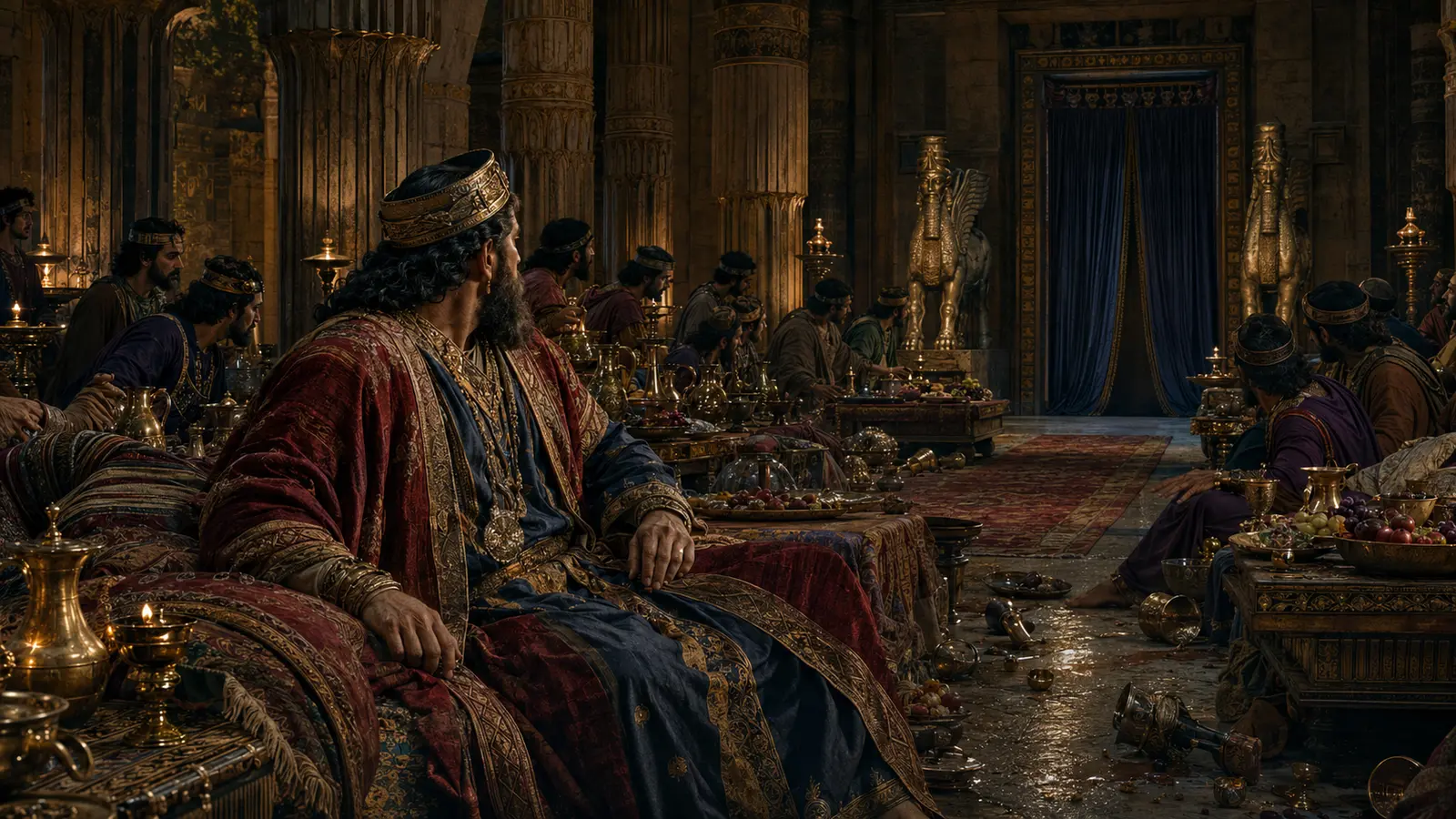
The empire spread its carpets, raised its golden cups, and bid the world marvel at its glory. But one woman said no. And in that refusal, the palace began to tremble—not because the throne seemed weak on the outside, but because the royal pride in the center was completely empty.
01
Introduction
The empire spread its carpets, raised its golden cups, and asked the world to marvel at its glory. But one woman said no. And in that refusal, the palace began to tremble—not because the throne seemed weak on the outside, but because the royal pride in the center was completely empty.
02
1.0 Introduction: When Power Needs an Audience
There is a kind of power that cannot rest unless someone is watching it. It must show itself. He must count his states, polish his gold, pass his princes before the people, and fill the room with music, wine, and applause. With this kind of power, it is not enough to rule; it must be praised. It is not enough to own property; must be seen owning it.
Esther 1 begins with a king ruling from India to Cush, over 127 provinces, sitting on the throne of Persia in the fortress of Shushan. Everything seems unmoved. The dollar is wide. The palace is magnificent. The party is long. Wine is plentiful. Officials are impressed. The rules are carefully written. Messengers are ready to carry royal words to the ends of the earth.
But beneath the silk curtains and marble columns, this frame reveals something fragile. A king who can command states cannot control his own anger. A ruler who shows his glory for 180 days cannot tolerate a single act of rejection. An empire that claims to have order is thrown into panic because of the refusal of one queen.
Esther 1 is a theological satire against empire: the palace shows glory but reveals fear; the king gives orders but cannot control himself; and through the rejection of one queen, God begins to open a hidden door for redemption.
God's name is not mentioned in Esther 1. No prophet says it. No angel is visible. There is no written prayer. Yet this chapter opens the secret work of God's leadership by showing us the world in which redemption will come: a world of drunken power, the fear of men touched in their pride, public shame, and foolish commandments. Before Esther enters the narrative, the palace must first reveal her illness.
In this chapter we will see three movements: first, the state plays its glory; second, Vashti's rejection reveals the weakness hidden beneath that glory; third, the foolish commandment becomes the first door to be opened for the exaltation of Esther.
Ester 1 is not just an introduction. It is the first crack in the wall.
03
2.0 Historical and Literary Context: Shushan, Exile, and Irony of Empire
The book of Esther is placed in the context of the Jews who remained in the Persian Empire after the Babylonian exile. Some of them had returned to Jerusalem, as the books of Ezra and Nehemiah tell us, but many continued to live scattered among the nations. Esther does not take place in Zion, nor in the temple, nor beside the altar, but in Shushan, one of the royal centers of Persian power.
This is a very important thing. Esther asks: What does faithfulness look like when God's people live away from Jerusalem, under foreign rule, within institutions with mixed values and political risks? What does the hope of the covenant look like when God seems hidden, prayer is not told, and redemption comes through weak human decisions?
Chapter 1 does not yet mention Esther or Mordecai. It gives us a platform before it gives us servants. It shows us the dollar before it shows us the exile community. The author slows down to describe the banquet, officials, gold, wine, law, and royal wrath because these details are not embellishments. It is a theological irony.
The king looks great, but his greatness has no roots. The council seems wise, but its wisdom is funny. The law seems heavy, but it becomes a tool to protect wounded pride. The White House appears safe, but reacts to a domestic crisis as if the entire dollar is at stake.
This chapter also introduces one of the main literary structures in Esther: the banquet. Esther is a book built around banquet tables. The first feasts reveal the pride of the dollar; After-parties become places of hidden courage, sudden change, and redemption. What begins as a royal display will end in Jewish joy. The dollar table will be answered with a Purim feast.
This chapter also prepares us for the main theme of the book: dramatic changes in circumstances. Vashti is eliminated, and the position remains vacant. That position will open the way for Esther. The rise of Esther will later be the way to the redemption of the Jews. The drunken king's need, the queen's refusal, and the foolish advice of fearful men become the first steps in the narrative of God's leadership that neither character sees yet.
God's name is not on the page. But absence is not abandonment. In Esther, God's leadership often comes through timing, irony, and unintended consequences. The White House thinks it is managing the scandal. In fact, a hidden door opens.
04
3.1 When the Empire Makes Its Glory Public
Esther 1:1–8
The chapter begins with geography and pomp: Ahasuerus rules over 127 provinces, from India to Cush. The author paints with a broad brush. This is not village politics. This is the power of the earth. The king sits in Shushan, and his empire stretches far beyond the horizon.
Then come the parties. First, the king makes a feast for his nobles and his servants, the Persian and Median army, the princes and governors of the provinces. This party lasts 180 days. Half a year of performances. Half year royal festival. The king shows "the riches of the splendor of his kingdom, and the honor of the glory of his majesty" (Esther 1:4).
Then comes another feast for all the people who were present in Shushan, great and small, for seven days in the courtyard of the garden of the king's house. The details are sumptuous: white linen curtains, purple linens, silver rings, marble pillars, gold and silver beds, precious stone floors. The wine is served in golden vessels, each vessel being different from the other. The royal wine flows abundantly.
This theme is almost overwhelming. And that is its purpose. The author piles on the details until the conceit begins to look ridiculous. The empire is dressed like a bejeweled bride, but acts like a drunken ruler at her own show. It has everything—except self-control.
Verse 8 says the drinking was "by commandment: no man was compelled." Even wine has rules. Even the ceremony has been incorporated into the bureaucracy. The empire can't just host a party; must control the party. Esther's world is full of orders, and chapter 1 teaches us early on that orders can be silly even when they sound formal.
This first theme reveals the test of human power: to confuse appearance with glory. The king wants to be seen. But the faith of the Bible teaches us that true glory is not the luster of wealth. True glory is the weight of character, mercy, justice, humility, and faithfulness. The palace is proud, but it lacks wisdom. It has gold, but no virtue.
05
3.2 When Women Party in Another Room
Esther 1:9
With almost imperceptible calmness, the author tells us that Queen Vashti also held a feast for the women in the royal house. This information is important. Esther's world is divided into rooms, access, gender, titles, and powers. Men feast in one place, women in another. The king shows his majesty; Vashti is preparing her party.
The queen is in the frame before she speaks. He is called by name before he refuses. He is not just a shadow in the king's world; he has his room, his honor, and his ability to choose.
The narrative does not tell us his motives, and we should not pretend we know more than what the text gives us. But the text shows that his refusal is not an act of shadow. It is a human act.
This little verse also sets up the great role of women in Esther. Vashti's refusal opens the door that Esther will later enter. Later, Esther will use the party not for personal display, but for strategy, courage, and intercession. In chapter 1, the parties reveal the folly of the dollar. Later, parties will be the place where hidden truths will be brought to light.
06
3.3 Rejection Reveals Weak Power
Esther 1:10–12
On the seventh day, when the king's heart was "rejoiced with wine," he orders seven eunuchs to bring Queen Vashti before him, wearing a royal crown, "to show the people and princes her beauty" (Esther 1:11).
Here the language of the show shifts from property to the woman's body. The same king who showed off the wealth of his kingdom now wants to show off the beauty of his queen. Vashti is called to be like another golden vessel in the king's feast, another ornament in the palace's feast.
But Vashti refuses.
The text does not explain why. Maybe he refuses to be humiliated. Maybe he refuses to be seen as a showpiece. Maybe he rejects the drunken festival. Perhaps the author hides his reason to refuse himself to stand in the middle: the royal command meets the human no.
And the king burns with anger.
The difference is stark. A king over 127 states is disturbed by the refusal of one woman. The dollar that seemed big now becomes very small. The author allows us to see humor and danger together. It's funny because the king looks stupid. It is dangerous because stupid power when shamed can turn violent.
"He who perseveres is better than a mighty man, and he who controls his spirit than a man who takes a city" (Proverbs 16:32). Ahasuerus can hold cities, states, and armies, but he cannot hold his own soul. A leader without self-control can command an entire system and still lose room.
This is one of Esther's profound lessons: insecure power often responds to shame by enacting policy. When pride is wounded, it runs to the law. A soul that cannot control itself tries to control all others.
07
3.4 When Council Turns Fear into Law
Esther 1:13–20
The king advises the wise who know the times. Their names are listed with official honor, as if great wisdom is about to appear. But what follows is funny.
Memukani says Vashti has not only wronged the king, but has wronged all the princes and all the people in all the states. His refusal, he claims, will make women all over the world despise their husbands. The domestic crisis of the palace turns, in the mouths of frightened men, into a state emergency.
This is irony at its finest. The council takes the rejection of one queen and contemplates the downfall of the entire community. The men who lead the empire are afraid that if one woman says no, every house will shake. Their counsel reveals not strength, but fear.
Memukani suggests that Vashti be removed, and that her royal position be given to someone "better than her." He also advises that an order be announced throughout the country so that all women respect their husbands, both young and old.
Irony is heavy. A king cannot get respect from his own queen, so he will legislate respect from every wife in the empire. But the forced respect has already been lost.
Respect is not created by command. Love is not brought by royal messengers. Authority without character is noise.
The council calls this wisdom. The author invites us to see folly dressed in official clothes.
08
3.5 Silly Words When They Ride On Royal Horses
Esther 1:21–22
The proposal pleases the king and the nobles. Letters are sent to every province of the king, in every script and in every language, declaring that every man should be prince in his own house and speak in the language of his people.
The chapter ends with the messengers carrying the fear of men who were touched in their pride throughout the empire.
This ending is written for the purpose of appearing funny. The mass media system is being used to publicize something that shouldn't need to be publicized. The White House has turned shame into law, and law into public comedy. The king wanted to show glory; he ends up showing his wounded self.
But beneath that humor, God's leadership is moving. Vashti is eliminated. The search for another queen will begin. Esther, still unnamed, still lurking outside the narrative, is already being drawn toward the palace through events that seem political, personal, and just silly.
This is how Esther teaches us to read history: not by calling every event good, not by pretending that evil is harmless, not by baptizing foolishness, but by observing how God can sew redemption even through the tangled threads of human vanity.
09
4.1 The Dollar May Shine, But It Is Not Last
Esther 1 begins with the dollar at its highest volume. Wealth, wine, officers, banquets, laws, messengers—everything is arranged to say, "This is power." But the Scriptures have taught us to be careful when we see such displays. Pharaoh had chariots. Nebuchadnezzar had a golden statue. Rome had crosses and legions of soldiers. Yet the God of Israel repeatedly reveals the difference between the real age and the human spectacle.
Dollars often seem permanent because they are noisy. It is built with stones. It is written by law. It wears purple. But Esther 1 shows us that under the cloak there may be fear. Under the party there may be a void. Under the command there may be concern.
God's people must learn to see clearly. We should not be naive about power, because power can hurt. But we should also not be intoxicated by it, because unjust power already has cracks.
10
4.2 God is hiding, but His leadership is already opening the door
God is not mentioned in Esther 1. However, this chapter begins the chain of events that will save the Jews. Vashti's removal creates a void that Esther will fill. The foolishness of the king becomes the hidden door of God's leadership.
This does not make the king's actions righteous. The Bible does not want us to call drunkenness wisdom or use someone as an object of display to be righteous. Instead, it teaches us that God's leadership is deeper than human motives. People can act out of pride, fear, lust, or insecurity, and yet God can bend the crooked path to redemption.
God's guidance does not make evil good; it means that evil does not get the last word.
God's leadership is not a perfume that we sprinkle on the wickedness of man. It is the deep realm of God, who can take the crooked planks of man's pride and yet build a door of mercy.
This is not an invitation to be a spectator. It is an invitation to have hope. When God appears silent, he may still be setting the stage. When the palace appears to be in disarray, mercy may already be moving behind the scenes.
11
4.3 Vashti's Refusal Reveals the Ethical Limits of Commandment
Vashti is not the main hero of this book, but her rejection is important. The narrative does not give us his speech, nor his description, nor his inner thoughts. However, his no reveals the weakness of the king and the fear of the council.
Vashti is not presented as a covenant teacher of Israel, and the author is not invited to construct a complete theology of her motives. Yet his rejection works literary like a mirror: it reveals the king's intoxicated pride, the council's fear, and the empire's failure to create true respect for the command.
There are times when refusal is an act of honesty. Not every command deserves to be obeyed. Not every authority is fair. Not every expectation should be respected. The wider narrative of the Bible gives us many examples: the Hebrew midwives reject Pharaoh's order to kill (Exodus 1:15-21); Daniel's friends reject the golden image (Daniel 3:16–18); the apostles say, "We ought to obey God rather than men" (Acts 5:29).
Vashti's act must be handled carefully. The text does not show him as a covenant teacher. However, his refusal becomes a mirror raised in front of the dollar. It shows that power can command bodies, but it cannot create respect. It can send mail, but it can't create a real deck.
12
4.4 The First Change Begins Before Anyone Knows It
Esther is a book of great transformations: mourning becomes joy, danger becomes redemption, the gallows condemns the one who made it, the forgotten man is honored, the people condemned to perish are saved. But the first change begins quietly in chapter 1. The Queen is removed. The palace is shaken. A new search will begin.
At first, this seems like a loss, a scandal, and a political folly. But in the hidden architecture of the narrative, it becomes preparation. Esther's path to the throne begins before Esther appears on the page.
This is often what God's leadership feels like in real life. It is rare to understand the beginning while we are still living in it. Some events feel like they are disrupted, delayed, or confused. Only later do we see that the door was opening in the wall.
13
5.1 For the Disciple of Christ
Don't be fooled by the show. Wealth, titles, platforms, numbers, and applause can hide spiritual emptiness. Ask yourself what behavior lives under the cloak.
Focus on anger. The king's anger reveals his insecurity. When anger quickly rises within us, it may be protecting an image of control, our public image, our perceived rights, or fear.
Do not confuse legality with wisdom. The king's decree was official, but foolish. Not everything written in the policy reflects justice, mercy, or truth.
Respect human dignity, especially where power wants to use people as ornaments. Vashti is called to be shown. God's people must resist every culture that treats people as property.
14
5.2 To the Leader
Don't turn your insecurities into policies. Ahasuerus is hurt in private, but he legislates in public. Leaders must learn to examine the heart before giving orders.
Lead by behavior, not by image. The king displays wealth because he has no moral weight. True leadership is not the size of the platform, but the health of the soul.
Learn to control yourself before using power. Proverbs 16:32 reminds us that controlling your spirit is better than conquering a city. A leader who cannot control his anger will eventually hurt the people he was called to serve.
Listen carefully when someone says no. Denial can reveal rebellion, but it can also reveal injustice, exhaustion, fear, or a neglected personality. Wise leadership asks before it crushes.
15
5.3 For Mission
Trust God when he works in secret without defending the sin of man. God's guidance does not make evil good; it means that evil does not get the last word.
Learn to see small cracks in large patterns. The refusal of one person revealed the weakness of the entire empire. Loyalty often begins with one real, costly act.
Recognize God's work in morally controversial areas. Esther begins in Shushan, not Jerusalem. God's people often serve in institutions where God's name is not respected, but his hand is not absent.
Prepare for doors you haven't seen yet. Esther has not yet appeared, but her door is beginning to be made. God may be preparing your next role through events that currently seem mundane, discouraging, or confusing.
16
6.0 Reflection Questions
1. Where are you tempted to be attracted to outward splendor while ignoring inner emptiness?
2. What kind of anger in your life might be revealing wounded pride or fear of losing control?
3. Where do you need the courage to say no to something that diminishes human dignity?
4. Have you ever seen God open a door through events that at first seemed chaotic or discouraging?
5. How can today's leaders avoid turning their insecurities into public policies?
6. What will it mean for you to trust God who works in secret this week without being careless, cynical, or fearful?
17
7.0 Response Prayer
God who hides himself but with the mercy of the covenant, You are not always mentioned in the palace, and your hand is not always visible on the table. But you see what the wine hides, you hear the power that silences, and you know how to open doors that no dollar intended to open.
Teach us not to worship the shine. Teach us not to fear the ages that tremble under its pride. Give us wisdom when the laws are noisy but justice is not there. Give us courage when humanity needs to refuse. Give us humility when our anger reveals our hidden idols.
When we live in Shushan, far from a place where your name seems easy to pronounce, help us to believe that you are still near. When history seems to be drunk with power, help us to believe that your leadership has not slept. When one door is closed and another one has not yet opened, teach us to wait with courage, to stay awake with discernment, and to walk faithfully in the light we have.
Prepare us, Lord, for roles that we don't see yet. Make us real people in theaters, people of personality in theater culture, and people of hope in the kingdom of fear.
Amen.
18
8.0 Next window
Esther 1 ends with the palace sending silly letters all over the world. The king has lost the queen, but he has not gained wisdom. The throne is still strong, but the narrative has shown us its weakness.
Now the empty space beside the king must be filled.
In Esther 2, the narrative shifts from dollar displays to hidden identities. An orphaned Jewish girl named Hadassah—known to the palace as Esther—will enter the royal lust system. Her beauty will open the door, but her hidden name will carry a deeper tension. At the same time, Mordecai will sit at the gate, he will watch carefully, and quietly he will do an act of loyalty that the king will forget, but God's leadership will remember.
The palace has got a crack.
The hidden name is about to enter.
19
A Simple Outline to Get Started With
BibleProject. "The Book of Esther." Old Testament Overview Guide.
20
Major Explanatory Comments
Berlin, Adele. Esther. JPS Bible Commentary. Philadelphia: Jewish Publication Society, 2001.
Clines, David J. A. Ezra, Nehemiah, Esther. New Century Bible Commentary. Grand Rapids: Eerdmans, 1984.
Levenson, Jon D. Esther: A Commentary. Old Testament Library. Louisville: Westminster John Knox, 1997.
Moore, Carey A. Esther. Anchor Bible 7B. Garden City, NY: Doubleday, 1971.
21
Literary and Theological Studies
Fox, Michael V. Character and Ideology in the Book of Esther . 2nd ed. Grand Rapids: Eerdmans, 2001.
Wright, N. T. The New Testament and the People of God . Minneapolis: Fortress, 1992.
Be the first to leave a comment.