

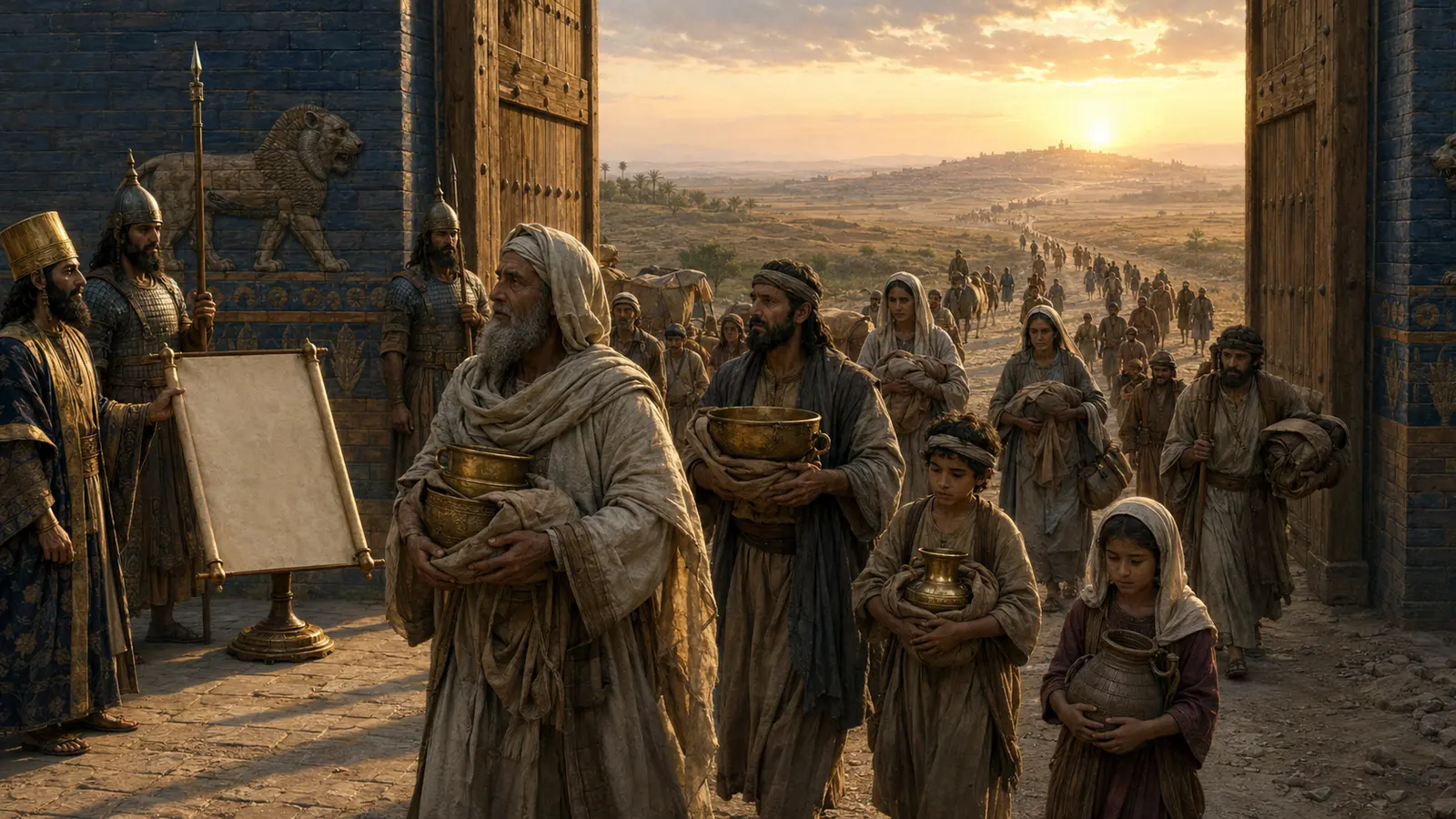
The empire speaks, but heaven has already moved. A pagan king signs a decree, but the covenant God has stirred the deeper current. The road home opens, the vessels come out of Babylon’s treasury, and a wounded people learn the first lesson of restoration: return is not human achievement, but divine mercy calling exiles back toward worship.
01
Introduction: When Homecoming Begins with a Stirred Heart
There are seasons when the door we thought was sealed suddenly opens. The phone call comes. The letter arrives. The opportunity appears. The long night loosens its grip. Yet the deepest question is not merely whether the door is open, but whether the heart is ready to walk through it.
Ezra 1 begins in that holy tension. Jerusalem has been burned. The temple has fallen. The vessels of worship have been carried into Babylon like trophies from a conquered faith [2 Kgs. 25:8–17; Dan. 1:1–2]. For decades, the people of God have lived under foreign skies, learning to sing the Lord’s song in a strange land [Ps. 137:1–4]. Then, without trumpet from Jerusalem or sword from David’s house, the first movement of return begins through the mouth of Cyrus, king of Persia.
But Ezra wants us to see beneath the surface. Cyrus may issue the proclamation, but the Lord stirs the king’s spirit [Ezra 1:1]. The empire may grant permission, but covenant mercy has already gone ahead. The people may gather silver, gold, goods, and beasts, but the true treasure is not what they carry in their hands. It is the call of God awakening courage in their bones.
This text is about exile becoming return, because God’s mercy opens the road home before God’s people have fully become whole.
Ezra 1 does not yet show us a rebuilt temple, a restored city, or a transformed people. It shows us the first tremor of grace. The door is open. The vessels are coming home. The journey begins.
02
Historical and Literary Context: The Door Chronicles Left Open
Ezra begins where Chronicles ends. The final words of 2 Chronicles announce that Cyrus king of Persia has been charged by the Lord to build him a house in Jerusalem, and that whoever belongs to God’s people may go up [2 Chron. 36:22–23]. Ezra 1 repeats that ending and turns it into a beginning. The last note of Chronicles becomes the first footstep of return.
Historically, this moment stands after Babylon’s conquest of Judah and the destruction of Jerusalem in 586 BC [2 Kgs. 25]. Babylon had broken the visible structures of Judah’s life: palace, temple, walls, priestly service, and public identity. But Babylon could not break the covenant faithfulness of the Lord. When Persia under Cyrus conquered Babylon in 539 BC, the political map changed; Ezra insists that the deeper change was theological. The God of Israel was not trapped in the ruins of Jerusalem or silenced by the rise of empires.
The chapter repeatedly draws attention to divine initiative. The Lord fulfills his word spoken by Jeremiah [Ezra 1:1; Jer. 25:11–12; 29:10]. The Lord stirs Cyrus [Ezra 1:1]. The Lord stirs the heads of families, priests, and Levites [Ezra 1:5]. The return is not presented as national self-rescue. It is not triumphalism. It is mercy.
Literarily, Ezra 1 moves in three scenes:
1. The decree of Cyrus opens the road of return [1:1–4].
2. The stirred remnant prepares to rebuild the house of God [1:5–6].
3. The temple vessels are restored from Babylon to Jerusalem [1:7–11].
This chapter also introduces one of the major themes of Ezra–Nehemiah: restoration begins with promise, but it remains incomplete. The people are allowed to return, but the temple is not yet rebuilt. The vessels come home, but the glory cloud is not described as returning. The house of God is named, but the human heart still needs deeper renovation. Ezra 1 is sunrise, not noon.
03
Walking Through the Text
When the Lord Stirs a Foreign King [Ezra 1:1]
Ezra opens with a startling claim: “the LORD stirred up the spirit of Cyrus king of Persia” [Ezra 1:1]. This is the theology of providence written in the language of empire. The hand that once stirred the waters of creation now stirs the heart of a king. The Lord who hardened Pharaoh in the exodus story now moves Cyrus in the return-from-exile story [Exod. 7:3–5; Isa. 45:1–7].
The verse also says this happened “that the word of the LORD by the mouth of Jeremiah might be fulfilled” [Ezra 1:1]. Exile was not random tragedy, and return is not random luck. Jeremiah had spoken of seventy years, a measured season of judgment after which God would visit his people and bring them back [Jer. 25:11–12; 29:10–14]. Ezra invites the reader to see history not as chaos, but as covenant time.
This does not mean the road home will be easy. A fulfilled promise is not the same as a finished restoration. God opens the door, but the people must walk. God stirs the king, but the remnant must rise. God remembers his word, but the community must relearn worship.
The first act of restoration is not human strength rising upward, but divine faithfulness bending down.
When an Empire Confesses What It Does Not Fully Understand [Ezra 1:2–4]
Cyrus announces that “the LORD, the God of heaven,” has given him all the kingdoms of the earth and charged him to build a house in Jerusalem [Ezra 1:2]. His language is astonishing. A Persian king becomes the public voice through which the return begins.
Yet we should read carefully. Cyrus recognizes the God of heaven, but the text does not require us to imagine him as a covenant convert. In the ancient world, kings often spoke respectfully of the gods of the peoples under their rule. Ezra’s interest is not in making Cyrus a model disciple, but in showing that the Lord can use even imperial policy to serve covenant purpose.
The decree calls the people to “go up” to Jerusalem and rebuild “the house of the LORD” [Ezra 1:3]. That phrase, “go up,” is more than geography. Jerusalem sits on the hills, but the journey upward is also spiritual. Return is ascent. The people must leave the security of Babylon for the uncertainty of obedience. They must exchange settled exile for costly hope.
Cyrus also commands neighbors to support the returnees with silver, gold, goods, beasts, and freewill offerings [Ezra 1:4]. This echoes the exodus, when Israel left Egypt with the wealth of their neighbors [Exod. 3:21–22; 12:35–36]. Ezra is quietly telling us: this is a new exodus. But this time there is no Red Sea, no pillar of fire, no Moses lifting a staff. There is a decree, a road, and a stirred remnant.
When the Remnant Rises from Settled Exile [Ezra 1:5–6]
Not everyone returns. Ezra names “the heads of the fathers’ houses of Judah and Benjamin, and the priests and the Levites” [Ezra 1:5]. These are the people whose spirits God stirred. The return begins with a remnant, not the whole nation. This is both hopeful and sobering.
It is hopeful because exile has not erased identity. Judah, Benjamin, priests, and Levites still exist. The covenant people have not dissolved into Babylonian dust. Names remain. Families remain. Worship leaders remain. Memory remains.
But it is sobering because return requires response. Some must have remained behind. Babylon had become familiar. Houses had been built. Businesses had grown. Children had been born who knew Jerusalem only through stories and tears. To return meant risk: ruined land, uncertain economy, hostile neighbors, hard labor, and the pain of beginning again.
Ezra does not shame those who remain, but he honors those who rise. Their neighbors strengthen their hands with gifts [Ezra 1:6]. The language of strengthening hands will matter throughout Ezra–Nehemiah, because rebuilding requires more than emotion. It requires resources, courage, leadership, and communal support.
Mercy opens the door, but obedience packs the bags.
When the Vessels Come Home [Ezra 1:7–11]
The chapter ends with a beautiful act of reversal. Cyrus brings out the vessels of the house of the Lord, which Nebuchadnezzar had carried away from Jerusalem and placed in the house of his gods [Ezra 1:7; 2 Kgs. 24:13; 25:14–15]. In Babylon, those vessels had become symbols of defeat. They seemed to say, “The God of Jerusalem has lost.”
But Ezra tells another story. The vessels were not forgotten. They had been kept through exile. What Babylon displayed as conquest, God preserved as promise. The sacred objects are counted, named, entrusted, and carried back by Sheshbazzar [Ezra 1:8–11].
The detailed inventory may feel slow to modern readers, but it matters. Restoration is not vague sentiment. Holy things are handled with care. The vessels belong to worship, and worship belongs at the center of the return. Before the altar rises in chapter 3, before the foundation is laid, Ezra lets us watch the vessels begin their journey home.
This scene also whispers of a deeper truth: God does not merely bring people out of exile; he restores vocation. The vessels were made for temple service. Israel was made to be a priestly people, a kingdom through whom the nations would see the wisdom and mercy of God [Exod. 19:5–6; Gen. 12:1–3]. The return of the vessels is a sign that God is restoring purpose, not merely property.
Still, the scene remains incomplete. Vessels return, but the house is not yet standing. Treasure comes home, but glory has not yet filled the temple. The chapter ends with movement toward Jerusalem, not arrival at fullness.
04
Theological Reflection
God Rules History Without Needing Ideal Instruments
Ezra 1 teaches us that God’s sovereignty is not embarrassed by complicated politics. The Lord can work through a Persian king without making Persia the kingdom of God. He can use imperial permission without baptizing imperial power. He can write mercy into the margins of empire.
This protects us from two errors. First, we must not imagine that God is absent when his people lack visible power. Israel has no king on David’s throne in Ezra 1, yet the Lord reigns. Second, we must not confuse political favor with complete restoration. Cyrus opens the door, but Cyrus cannot rebuild the heart.
Return Is Mercy, Not Achievement
The chapter begins with fulfillment, not human strategy [Ezra 1:1]. The people do not force God’s hand. They receive what God promised. This matters because shame often tells exiles that they must earn their way home. Ezra says the opposite. Return begins because God remembers his word.
Yet mercy does not produce passivity. The stirred people rise [Ezra 1:5]. Grace awakens movement. Forgiveness becomes pilgrimage. Hope puts sandals on its feet.
Worship Is the Goal of Restoration
Cyrus’ decree centers on rebuilding the house of the Lord [Ezra 1:2–3]. The vessels return because worship must return [Ezra 1:7–11]. In Ezra–Nehemiah, restoration is never merely about land, identity, safety, or public dignity. It is about the presence of God among a people ordered around worship.
This reaches backward to the tabernacle and temple, where God dwelt among his people [Exod. 40:34–38; 1 Kgs. 8:10–11]. It reaches forward to the hope of a deeper presence, where God’s dwelling is not confined to stone but embodied in the Messiah and shared with a Spirit-formed people [John 1:14; 2:19–21; Eph. 2:19–22].
The Open Door Still Reveals an Unfinished People
Ezra 1 is full of hope, but it is not naïve. The people return, but the book will show that return to land does not automatically mean return to covenant faithfulness. The temple will be rebuilt, but the glory will be strangely quiet. The walls will rise, but the heart will still wander. The scroll will be read, but obedience will remain contested.
Ezra 1 therefore creates longing. We need more than a decree. We need more than permission. We need more than recovered vessels. We need the God who brings exiles home to also rebuild the inner sanctuary of the heart [Jer. 31:31–34; Ezek. 36:24–27].
05
Life Application: Practicing Return Today
Pay attention to the holy stirrings. Not every restlessness is distraction. Sometimes God stirs the heart because a season of return has begun [Ezra 1:5].
Do not despise small beginnings. Ezra 1 is only a decree and a departure, yet it is the beginning of rebuilding. God often starts restoration with one obedient step.
Let worship become central again. The goal of return is not merely feeling better, becoming stable, or recovering reputation. The house of God must become central again in the life of the people [Ezra 1:3].
Receive help without losing humility. The returnees are strengthened by neighbors [Ezra 1:6]. Restoration is communal. Pride refuses help; wisdom receives it as provision.
Recover what exile misused. The vessels had been placed in foreign temples, but God brought them back for holy use [Ezra 1:7]. Gifts, time, bodies, homes, voices, and resources can be rededicated to God.
Do not confuse an open door with a finished work. Permission to rebuild is not the same as rebuilding. A new beginning must become sustained obedience.
Trust God’s faithfulness when visible power is absent. Judah has no throne, no army, no temple, and no wall. Yet the Lord is already moving history toward mercy.
06
Reflection Questions
1. What part of your life has experienced an open door from God but still needs obedient movement?
2. Where have you become comfortable in “Babylon,” even though God is calling you toward costly return?
3. What sacred “vessel” in your life needs to be recovered and rededicated to worship?
4. Where might God be using unexpected people or circumstances to support your rebuilding?
5. What would it look like for your return to become worship, not merely relief?
07
Response Prayer
Lord God of covenant mercy,
you remember your word when we forget our songs. You open roads where exile has taught us to build walls around our hope. Stir our hearts as you stirred Cyrus, as you stirred the heads of families, priests, and Levites. Awaken in us the courage to rise.
Bring home what has been carried away. Recover the vessels of our worship—our time, our speech, our bodies, our gifts, our homes, our communities. Cleanse what has been misused. Restore what has been buried in foreign treasuries. Teach us to handle holy things with reverence again.
Do not let us mistake the open door for the finished temple. Lead us beyond permission into obedience, beyond movement into worship, beyond outward return into inward renewal. Rebuild in us a dwelling place for your presence.
And when the road is long, when Jerusalem is still rubble, when the work is harder than we imagined, remind us that mercy began this journey before we took our first step.
Amen.
08
Window into What Comes Next: Names on the Road Home
Ezra 1 opens the door of return. Ezra 2 will slow down and name the people who walk through it. At first glance, a long list of names may seem like dry ground. But in the Bible, names are never mere data. They are memory, identity, belonging, and witness.
The vessels come home in Ezra 1; the people are counted in Ezra 2. Restoration is not only about sacred objects returning to sacred space. It is about a wounded community discovering that God has not forgotten their families, their towns, their priestly calling, or their place in the story.
The road has opened. Now the remnant must be remembered.
09
Bibliography
Williamson, H. G. M. Ezra, Nehemiah. Word Biblical Commentary 16. Waco: Word Books, 1985.
Williamson, H. G. M. Ezra and Nehemiah. Old Testament Guides. Sheffield: JSOT Press, 1987.
Kidner, Derek. Ezra and Nehemiah. Tyndale Old Testament Commentaries. Downers Grove: InterVarsity Press, 1979.
Clines, David J. A. Ezra, Nehemiah, Esther. New Century Bible Commentary. Grand Rapids: Eerdmans, 1984.
Boda, Mark J. Praying the Tradition: The Origin and Use of Tradition in Nehemiah 9. Berlin: de Gruyter, 1999.
Wright, N. T. The New Testament and the People of God. Minneapolis: Fortress, 1992.
BibleProject. “The Book of Ezra-Nehemiah.” Old Testament Overview Guide.
Be the first to leave a comment.