
At first glance, Ezra 2 looks like a register, a census, a long corridor of difficult names. But beneath the surface, this chapter is doing something holy. It is gathering scattered lives and saying: these are not forgotten refugees, not anonymous survivors, not debris left behind by history. These are the remembered people of God. Before the altar is rebuilt, before the foundation is laid, before the songs rise again in Jerusalem, the Lord lets his people hear their names. Restoration begins not only with a decree from a king, but with a divine remembrance that counts the returning remnant and restores them to the story.
01
Introduction: When Names Become a Form of Hope
There are moments in Scripture when the story slows down and begins to count. To modern readers, such passages can feel like a pause in the action. We want movement, conflict, and resolution. Instead, we are given lists: names, families, numbers, towns, priests, gatekeepers, singers, temple servants. But the Bible often slows down when something sacred is happening.
Ezra 2 is one of those moments.
Chapter 1 opened the door of return. Cyrus gave the decree. Hearts were stirred. The vessels of the temple began their journey home [Ezra 1:1–11]. But now the text pauses and says, in effect: let us look carefully at the people who are walking this road. Let us count them. Let us remember them. Let us name the families who left the relative security of Babylon for the ruined hope of Jerusalem.
This chapter matters because exile does more than displace bodies. It threatens identity. It scatters memory. It loosens people from place, from rhythm, from worship, from inherited belonging. Exile tempts a community to believe that it has become a blur in the dust of empire. Ezra 2 answers that temptation with a list.
This chapter teaches us that restoration is personal, communal, and remembered: God does not bring back “a mass”; he brings back a people whose names, callings, and places still matter.
The chapter is long because grace is patient. The chapter counts because covenant memory is precise. The chapter names because the Lord of restoration is not vague in his love.
02
Historical and Literary Context: A List That Bridges Ruin and Renewal
Ezra 2 stands between the decree of return in Ezra 1 and the rebuilding of worship in Ezra 3. That location is important. The people do not move immediately from imperial permission to liturgical renewal. There is first a moment of reckoning with who they are.
Historically, this list reflects the first wave of return from Babylonian exile under Persian rule, likely in the period opened by Cyrus after the fall of Babylon in 539 BC [Ezra 1:1; 2 Chron. 36:22–23]. The return is partial, not total. Many Judeans remained in Babylon. Those who return form a remnant, not the whole nation. The chapter thus places us in the fragile beginning of restoration: the people are no longer fully in exile, but neither are they fully restored.
Literarily, Ezra 2 has a twin in Nehemiah 7. The near-parallel list in Nehemiah shows that this register was treasured as a document of communal memory [Neh. 7:6–73]. That repetition tells us something: the list was not filler. It was identity-work. It testified that those rebuilding Jerusalem were not inventing themselves from scratch. They belonged to a story older than Babylon and deeper than Persian policy.
The chapter unfolds in a series of groupings:
1. The opening summary of those who returned from captivity [Ezra 2:1–2].
2. Lists of lay families and townspeople [Ezra 2:3–35].
3. Priests, Levites, singers, gatekeepers, and temple servants [Ezra 2:36–58].
4. Those unable to prove genealogy, including priests excluded from full service [Ezra 2:59–63].
5. The grand total, along with servants, singers, and animals [Ezra 2:64–67].
6. The people’s freewill offerings toward the house of God [Ezra 2:68–69].
7. The settling of the people in their towns [Ezra 2:70].
So this is not merely a census. It is a theological map. It names the restored community, distinguishes roles within it, protects the holiness of worship, and shows that the people who return are orienting themselves again around the house of God.
03
Walking Through the Text
“These Were the People”: Return as a Community, Not an Idea [Ezra 2:1–2]
The chapter begins: “Now these were the people of the province who came up out of the captivity” [Ezra 2:1]. That sentence carries both sorrow and hope.
They are “people of the province,” meaning Judah is still under imperial administration. The kingdom has not yet been restored. David’s throne is not functioning in visible glory. The return is real, but it is modest. Yet they also “came up” from captivity. The old biblical language of ascent returns. Jerusalem is not merely a location; it is a direction of obedience.
The mention of leaders, including Zerubbabel and Jeshua [Ezra 2:2], introduces a pattern that will matter throughout Ezra–Nehemiah: restoration needs leadership, but leadership exists for the sake of communal faithfulness, not self-display. The people are not returning around charisma alone, but around shared covenant identity.
Families and Towns: God Remembers Persons and Places [Ezra 2:3–35]
The bulk of the list names family groups and geographic communities. Some are counted by clan, others by town. This is more than administrative detail. It tells us that return is not abstract spirituality. God is restoring embodied lives.
Families matter in this chapter because covenant identity is carried through generations. Towns matter because belonging has a geography. The people are not floating souls. They come from households, villages, histories, inheritances. Babylon had displaced them, but it had not erased the structure of their belonging.
These names also reveal that the return is uneven and partial. Some places are represented in small numbers, others in larger groups. The remnant is real, but it is fragile. Still, the text’s patience in naming them suggests that smallness does not cancel significance. God is willing to tell the story of return through a remnant because divine faithfulness is not measured by crowd size.
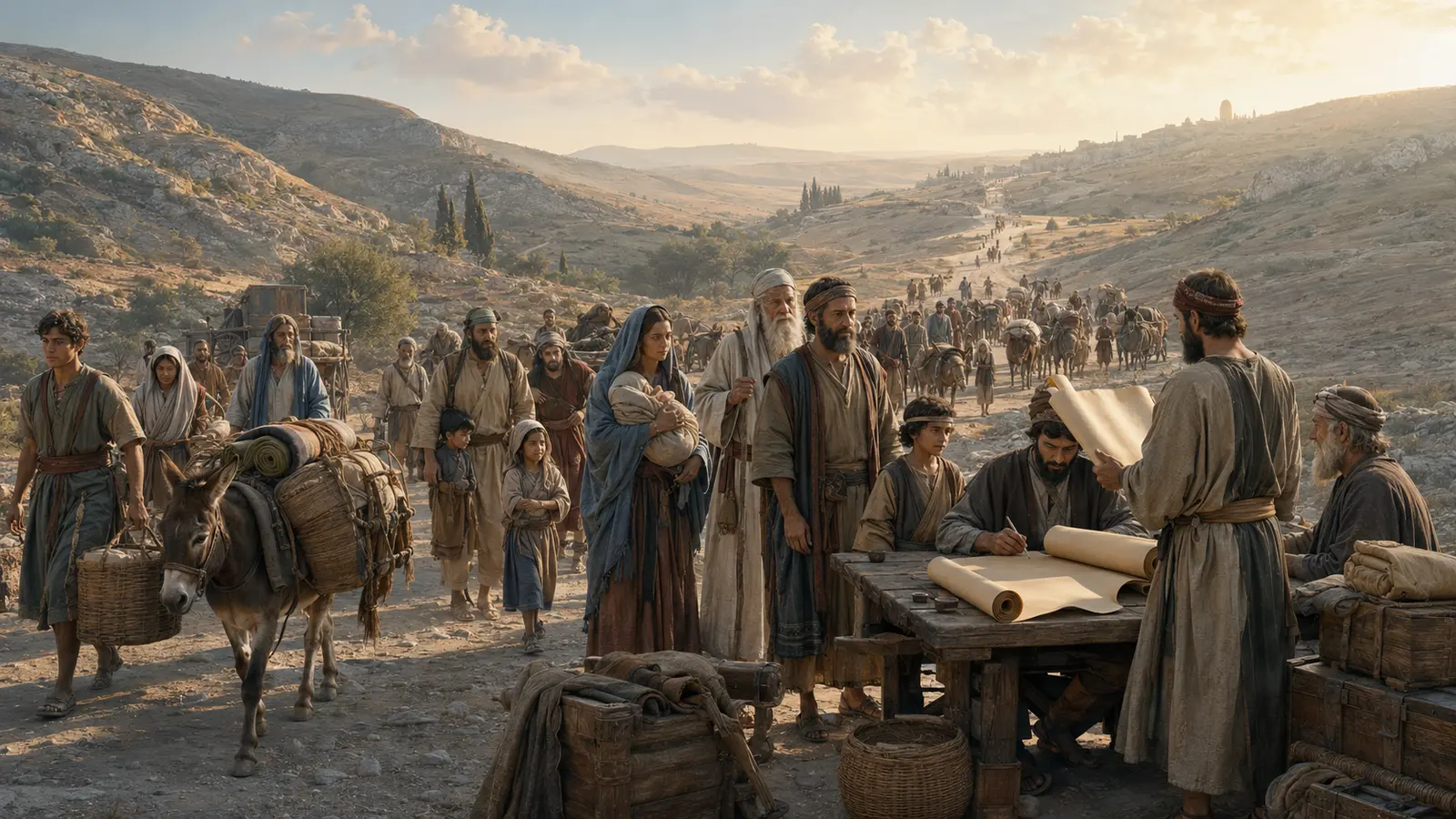
To human eyes, they may look like a tired caravan. To covenant eyes, they are a remembered people being gathered from the ashes.
Worship Personnel: A Restored Community Must Be Ordered Around the Presence of God [Ezra 2:36–58]
The list turns from general families to priests, Levites, singers, gatekeepers, and temple servants. That movement is deeply revealing. Restoration is not complete if people merely resettle the land. The community must be reoriented around worship.
Priests are named first in this section [Ezra 2:36–39], highlighting the priority of sacrificial and temple service. Levites, singers, and gatekeepers follow [Ezra 2:40–42]. Even the temple servants and the descendants of Solomon’s servants are carefully counted [Ezra 2:43–58]. In other words, the house of God requires a whole ecology of service.
This is one of the quiet beauties of Ezra 2. It honors visible and less-visible callings alike. Not everyone is a priest. Not everyone leads. Some guard. Some sing. Some assist. Some serve in ways that later readers may overlook. Yet the chapter names them because worship is communal labor. Holy life is sustained by many hands.
Here the text reminds us that God’s restored people are not simply a crowd with a religious memory. They are a worshiping community with differentiated roles. Their identity is not self-made; it is ordered toward the presence of the Lord.
Uncertain Genealogies and Excluded Priests: Holiness Cannot Be Improvised [Ezra 2:59–63]
One of the most striking moments in the chapter comes when certain families cannot prove their ancestral house or lineage [Ezra 2:59]. Even more arresting, some priests are excluded from the priesthood as unclean because they cannot find their names in the genealogical record [Ezra 2:61–62].
This is sobering. These men may well have sincerely believed themselves to be priests. But in the restored community, sincerity alone is not enough to establish priestly legitimacy. Holiness requires discernment. Worship cannot be rebuilt carelessly.
The governor instructs them not to eat of the most holy things until a priest could consult Urim and Thummim [Ezra 2:63]. The point is not cruelty but caution. The community is being rebuilt under the shadow of exile, and one of exile’s lessons is that disregarding God’s order leads to ruin. Therefore, return must include reverence, patience, and boundaries.
This scene teaches that grace does not abolish holiness. The God who brings the exiles home is also the God who protects the sanctity of his worship. Restoration is warm, but it is not casual.
The Total and the Offerings: Counted by God, Given Back to God [Ezra 2:64–70]
The whole assembly totals 42,360, besides servants and singers [Ezra 2:64–65]. The mention of servants, singers, horses, mules, camels, and donkeys [Ezra 2:65–67] grounds the story in ordinary material reality. This is not romantic return. It is practical, dusty, and logistically demanding.
Then comes one of the chapter’s most beautiful notes: when they arrive, some of the heads of fathers’ houses make freewill offerings for the house of God [Ezra 2:68–69]. Before the temple stands in full strength, the people give toward it. Their generosity is an act of hope. They invest in what does not yet fully exist because they believe God is rebuilding his dwelling among them.
Finally, the chapter ends with the people settling in their towns [Ezra 2:70]. The list closes not with spectacle but with habitation. The remnant begins to live again. The long road from exile moves toward ordinary faithfulness.
04
Theological Reflection
God Remembers What Exile Tries to Erase
Ezra 2 reveals a God who remembers names, families, and callings. Exile tries to reduce people to survival. Empire tends to flatten the particular. But the Lord’s restoration is textured. He remembers households, roles, and inherited responsibilities.
This matters theologically because Scripture consistently presents God as the one who knows his people personally [Exod. 3:7; Isa. 43:1; John 10:3]. The list in Ezra 2 is not sterile bookkeeping; it is covenant remembrance in written form.
Restoration Is Communal Before It Is Spectacular
Modern readers often look for the dramatic moment—the rebuilt temple, the public celebration, the miracle. Ezra 2 reminds us that much of God’s work happens through patient communal reconstitution. Before there is visible glory, there is numbering. Before there is liturgy, there is belonging. Before there is public power, there is communal structure.
In that sense, Ezra 2 rebukes our impatience. God is not in a hurry to bypass formation.
Worship Requires Both Welcome and Boundaries
The inclusion of priests, Levites, singers, and servants shows that God gathers many kinds of people into his service. But the excluded priests show that worship also requires discernment [Ezra 2:61–63]. The restored community is not built on vague spirituality. It is shaped by holiness.
This balance matters. Communities can become so open that they lose reverence, or so guarded that they lose mercy. Ezra 2 shows another way: a people who welcome the remnant, honor many forms of service, and still take the sanctity of worship seriously.
Generosity Is a Sign of Hope
The freewill offerings at the end of the chapter are not incidental [Ezra 2:68–69]. They reveal the heart of a people who believe that God’s house is worth building. Generosity here is not mere fundraising. It is covenantal participation. The people give because they understand that return is not just about receiving from God; it is also about responding to God.
05
Life Application: Living as a Remembered People
Do not despise the “lists” in your life. God often works through ordinary structures, patient rebuilding, and quiet faithfulness.
Remember that God knows your name. In seasons of displacement or obscurity, you are not lost in the crowd [Isa. 49:15–16].
Value the community, not just the platform. Restoration is not built only by visible leaders, but also by singers, servants, gatekeepers, and faithful households.
Honor holiness in worship. Grace welcomes us home, but it also teaches us to approach God with reverence [Heb. 12:28].
Give toward what God is rebuilding. Time, prayer, attention, resources, and service all become freewill offerings when laid before the Lord.
Let identity be rooted in God’s story. Exile tempts people to forget who they are. Ezra 2 reminds us to recover our place in the people of God.
06
Reflection Questions
1. In what areas of life do you most need to remember that God knows and remembers you personally?
2. Have you been tempted to despise small, slow, or ordinary forms of restoration?
3. What role might God be calling you to play in the rebuilding of his people—leading, serving, guarding, encouraging, giving, or praying?
4. How can your worship become more reverent without becoming cold?
5. What “freewill offering” of time, gift, or obedience is God inviting you to bring?
07
Response Prayer
God of Abraham, Isaac, and Jacob, God who remembers names and keeps covenant through generations, thank you that exile does not erase us from your sight.
When we feel scattered, count us again among your people. When we feel forgotten, speak our belonging over us once more. When we are tempted to measure worth by visibility, teach us the dignity of faithful service.
Order our lives around your presence. Give us reverence where we have become casual, patience where we have become hurried, and generosity where we have become guarded.
Make us a people who do not merely return outwardly, but who are inwardly restored to worship, holiness, and joy. And as you rebuild your house among your people, let us gladly bring what we have and place it in your hands.
Through your mercy, keep gathering your remnant. Through your Spirit, write our identity deeper than exile. Amen.
08
Window into What Comes Next: Fire Before Foundation
Ezra 2 ends with the people settled in their towns, counted and gathered, bearing gifts for the house of God. But a community cannot live on memory alone. The next question is urgent: how will worship begin again in a ruined place?
Ezra 3 answers with a surprising priority. Before the temple foundation is laid, the altar is rebuilt. Before the building rises, sacrifice resumes. Before the visible structure stands complete, the people turn their faces again toward the presence of God.
The names have been gathered. Now the fire must return.
09
Bibliography
Williamson, H. G. M. Ezra, Nehemiah. Word Biblical Commentary 16. Waco: Word Books, 1985.
Williamson, H. G. M. Ezra and Nehemiah. Old Testament Guides. Sheffield: JSOT Press, 1987.
Kidner, Derek. Ezra and Nehemiah. Tyndale Old Testament Commentaries. Downers Grove: InterVarsity Press, 1979.
Clines, David J. A. Ezra, Nehemiah, Esther. New Century Bible Commentary. Grand Rapids: Eerdmans, 1984.
Fensham, F. Charles. The Books of Ezra and Nehemiah. New International Commentary on the Old Testament. Grand Rapids: Eerdmans, 1982.
Blenkinsopp, Joseph. Ezra–Nehemiah: A Commentary. Old Testament Library. Philadelphia: Westminster, 1988.
BibleProject. “Ezra–Nehemiah.” Overview resources on the literary shape and theological message of the book.
Be the first to leave a comment.