

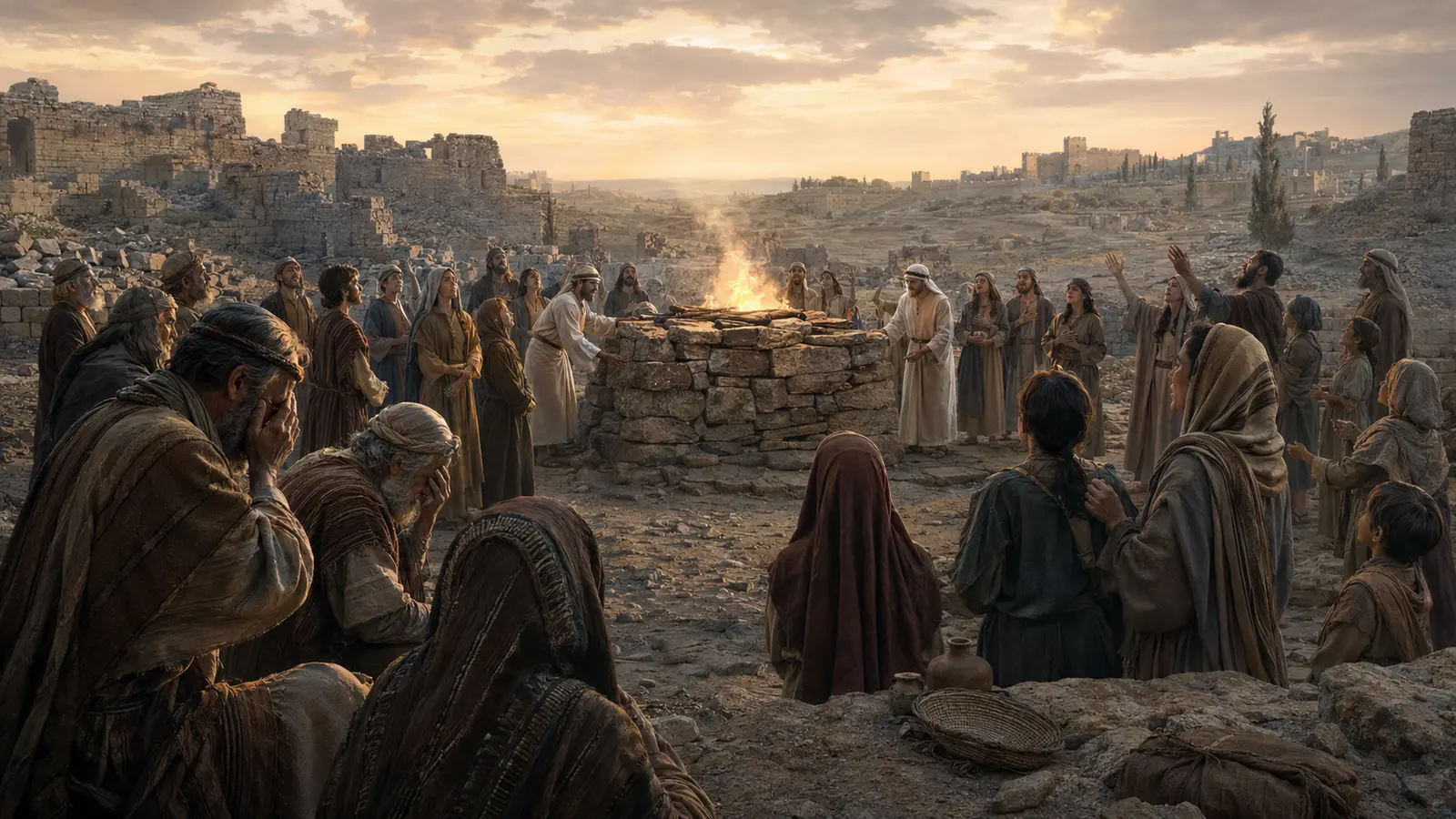
Before the walls stood, before the temple rose, before the city looked safe again, the altar was rebuilt. In a land still scarred by judgment and surrounded by fear, the returned exiles placed worship at the center. Smoke rose from the rubble. Songs returned to broken ground. Yet joy and grief mingled at the foundation, because restoration had begun, but glory had not yet come home in fullness.
01
Introduction: When Worship Begins Before Safety
Most of us want security before worship. We want the walls repaired, the economy stable, the opposition quiet, the future predictable. Then, we tell ourselves, we will pray with freedom. Then we will sing with full lungs. Then we will give, serve, rebuild, and obey.
Ezra 3 challenges that instinct.
The returned exiles are back in the land, but Jerusalem is not yet restored. The temple is not rebuilt. The city still bears the marks of Babylon’s fire. The surrounding peoples are not necessarily friendly. The future is fragile. Yet the first major act of the gathered community is not the construction of a wall, the formation of an army, or the writing of a political charter. It is the rebuilding of the altar.
This is a stunning priority. The people do not wait until life feels safe before they return to worship. They rebuild the altar “though fear was upon them because of the peoples of the lands” [Ezra 3:3]. Fear does not vanish; worship rises inside it.
Ezra 3 is about the first fire of return. It shows a community learning that restoration must begin at the place where life is offered back to God. The altar comes before the temple structure because surrender must come before visible success. Sacrifice comes before architecture. Obedience comes before celebration.
This text is about return becoming worship, because coming home is not enough unless the altar rises again at the center of life.
02
Historical and Literary Context: After the Names, Before the Opposition
Ezra 1 opened the door of return through the decree of Cyrus. Ezra 2 counted the returned community by families, towns, and temple roles. Now Ezra 3 shows what the remembered people do when they gather again in the land.
The chapter stands at a crucial turning point. The people have settled in their towns [Ezra 2:70], but in the seventh month they gather “as one man” in Jerusalem [Ezra 3:1]. The seventh month was heavy with Israel’s worship calendar: the Feast of Trumpets, the Day of Atonement, and the Feast of Booths [Lev. 23:23–43]. The timing matters. Israel’s return is being shaped by Israel’s Scripture. They are not inventing a new identity out of exile’s broken pieces; they are stepping back into the rhythms God gave them.
The chapter unfolds in two movements. First, the altar is rebuilt and sacrifices resume [Ezra 3:1–6]. Second, preparations begin for rebuilding the temple, the foundation is laid, and the people respond with praise, shouting, and weeping [Ezra 3:7–13].
This chapter is bright with hope, but it is not simple triumph. The altar rises, but fear remains. The foundation is laid, but some elders weep. The people sing of the Lord’s steadfast love, but the visible glory is not what the older generation remembers from Solomon’s temple. Restoration is real, but it is partial. The smoke rises, but the ache remains.
That is the honest beauty of Ezra 3. It refuses both despair and shallow celebration.
03
Walking Through the Text
When the People Gather as One [Ezra 3:1]
The chapter begins with unity: “the people gathered as one man to Jerusalem” [Ezra 3:1]. This phrase is more than a crowd description. It signals a people moving with a shared center. After exile, displacement, and scattered years, the community comes together around worship.
Unity in Ezra 3 is not built around comfort. The city is still wounded. The temple is still unfinished. The people are still vulnerable. But they gather because worship reorders a people before circumstances are fully repaired.
This gathering also echoes earlier moments in Israel’s story when the people assembled before the Lord to hear, renew, build, or repent [Exod. 19:7–8; Josh. 8:30–35; 2 Chron. 5:2–14]. The returned exiles are being re-formed as covenant people. The first sign of renewal is not private spirituality alone, but public, embodied, communal worship.
When the Altar Rises in a Land of Fear [Ezra 3:2–3]
Jeshua the priest and Zerubbabel the Davidic descendant lead the rebuilding of the altar [Ezra 3:2]. Priest and royal heir stand together, not yet in the fullness of messianic hope, but as signs of Israel’s old vocation being remembered. The altar is built “to offer burnt offerings on it, as it is written in the Law of Moses the man of God” [Ezra 3:2].
The phrase “as it is written” is essential. Worship is not rebuilt by nostalgia, impulse, or personal taste. It is shaped by Scripture. After exile, God’s people must learn again that sincerity without obedience is not covenant renewal.
Then comes the emotional center of the first movement: “They set the altar in its place, for fear was on them because of the peoples of the lands” [Ezra 3:3]. Fear is not hidden. The text does not pretend the returnees are brave in a simplistic way. They are afraid. But instead of letting fear drive them away from God, they let fear drive them toward God.
This is one of Ezra 3’s deepest lessons: worship is not the denial of fear; worship is fear brought under the rule of God. The altar becomes the center because the people know that survival without communion with God is not restoration.
When the Calendar Teaches the Heart Again [Ezra 3:4–6]
The people celebrate the Feast of Booths “as it is written” [Ezra 3:4]. This feast remembered Israel’s wilderness journey, when the people lived in temporary shelters and depended on the Lord’s provision [Lev. 23:39–43]. What a fitting feast for returned exiles. They too are a wilderness people again: home, but not settled; gathered, but not secure; hopeful, but still fragile.
The daily burnt offerings resume. The appointed feasts resume. Freewill offerings resume [Ezra 3:5]. Worship becomes rhythm again. This matters because restoration is not sustained by one emotional moment. It requires holy habits. The people need a calendar that trains their loves, a pattern that places God at the center again and again.
Verse 6 makes the tension plain: “From the first day of the seventh month they began to offer burnt offerings to the LORD. But the foundation of the temple of the LORD was not yet laid” [Ezra 3:6]. The altar functions before the building is complete. God meets his people in the beginning, not only at the finish line.
When Costly Preparation Becomes Worship [Ezra 3:7–9]
The second movement begins with practical preparation. The people give money to masons and carpenters. They provide food, drink, and oil to the Sidonians and Tyrians to bring cedar trees from Lebanon to the sea, according to the grant from Cyrus [Ezra 3:7].
This scene echoes Solomon’s temple preparations [1 Kgs. 5:1–12; 2 Chron. 2:8–16]. The restored community is not building a random shrine. They are seeking continuity with the first temple, the place where Israel had known the Lord’s dwelling among them. Cedar comes again. Skilled workers gather again. Leaders organize again.
Yet the scale is humbler. This is not Solomon’s golden age. The community is smaller, politically dependent, and economically limited. Still, they prepare. Hope puts hands to work.
In the second year after their arrival, Zerubbabel, Jeshua, the priests, Levites, and the returned exiles begin the work [Ezra 3:8]. Levites twenty years old and upward are appointed to supervise the work of the house of the Lord. Restoration requires ordered service, not merely zeal.
When the Foundation Receives a Song [Ezra 3:10–11]
When the builders lay the foundation, the priests come in vestments with trumpets, and the Levites with cymbals, “according to the directions of David king of Israel” [Ezra 3:10]. The moment reaches backward to David’s organization of temple worship and Solomon’s dedication of the first temple [1 Chron. 16:4–7; 2 Chron. 5:12–13].
Their song is simple and ancient: “For he is good, for his steadfast love endures forever toward Israel” [Ezra 3:11]. This refrain had been sung in Israel’s worship before [1 Chron. 16:34; 2 Chron. 7:3; Ps. 136:1]. Now it rises again from a people who have learned its meaning through judgment and mercy.
They do not sing, “We are strong.” They do not sing, “Our future is secure.” They sing, “He is good.” They do not anchor hope in their rebuilt foundation, but in the Lord’s enduring covenant love.
A foundation without praise would be mere construction. Praise turns the work into worship.
When Tears and Shouts Mingle at the Foundation [Ezra 3:12–13]
The chapter ends with one of the most human scenes in Ezra–Nehemiah. Many priests, Levites, and heads of fathers’ houses who had seen the first temple weep with a loud voice when they see the foundation of the new house [Ezra 3:12]. Others shout aloud for joy. The sound is so mixed that the people cannot distinguish the joyful shout from the sound of weeping [Ezra 3:13].
This is not a contradiction. It is restoration in real life.
The younger generation sees beginning. The older generation remembers loss. Some see promise; others feel the ache of comparison. Both responses are understandable. Ezra does not silence either group. He lets grief and joy share the same air.
The elders’ tears remind us that restoration does not erase memory. The people can praise God and still mourn what was lost. The foundation is good, but it also reveals how much has been broken. The shout is real, and so is the sob.
This scene prepares us for the prophetic word of Haggai: “Who is left among you who saw this house in its former glory? How do you see it now?” [Hag. 2:3]. Yet Haggai also declares that the Lord is with them and that future glory belongs to God’s promise, not human measurement [Hag. 2:4–9].
04
Theological Reflection
Worship Must Be Rebuilt at the Center
Ezra 3 teaches that restoration begins with the altar. The people need homes, protection, leadership, and economic stability, but first they need restored communion with God. The altar is the place of surrender, atonement, dedication, and renewed covenant life.
For believers today, the altar points beyond itself to Christ, whose self-giving love accomplishes what repeated sacrifices could only anticipate [Heb. 10:1–14]. Yet the principle remains: life must be reordered around worship, not merely improved around the edges.
Scripture Shapes True Renewal
Twice the chapter says the people act “as it is written” [Ezra 3:2, 4]. Return is not spiritual improvisation. After judgment, the people need more than passion; they need instruction. The Word of God becomes the architecture of their renewal.
This is a needed word for every generation. Communities can rebuild programs, buildings, platforms, and reputations while leaving Scripture at the margins. Ezra 3 insists that genuine restoration asks: What has God spoken, and how must we obey?
Fear Can Become a Place of Worship
The altar rises because fear is upon them [Ezra 3:3]. Fear can make us hide, control, compromise, or attack. But in Ezra 3, fear becomes a summons to worship. The people do not wait for fear to leave before obeying.
Faith is not always the absence of trembling. Sometimes faith is trembling hands placing stones back on the altar.
Restoration Holds Joy and Grief Together
The mingled sound at the foundation is one of the Bible’s great images of honest hope. God’s people are allowed to rejoice without pretending nothing was lost. They are allowed to grieve without denying that God is at work.
This protects us from shallow triumphalism and hopeless nostalgia. The restored community must learn to sing with tears in its throat.
05
Life Application: Rebuilding the Altar Today
Put worship before visible success. Do not wait until every wall is repaired before returning to prayer, Scripture, fellowship, and surrender.
Let Scripture shape your rebuilding. Ask not only, “What do I want to restore?” but “What has God written for my life and community?”
Bring your fear to the altar. Fear does not have to rule you. It can become the very place where you seek God more deeply.
Recover holy rhythms. Daily offerings, feasts, and freewill gifts remind us that renewal is sustained through repeated practices, not one-time emotion.
Honor both builders and worshipers. Masons, carpenters, priests, Levites, singers, and supervisors all matter in the work of restoration.
Make room for mixed emotions. In seasons of rebuilding, some will shout and some will weep. Mature community can hold both.
Do not measure the future only by the past. Memory is a gift, but nostalgia can become a prison. God’s coming glory is not limited to yesterday’s shape.
06
Reflection Questions
1. What “altar” needs to be rebuilt at the center of your life before other visible repairs can last?
2. Where are you waiting for safety before obeying God?
3. What rhythm of worship, Scripture, prayer, or generosity needs to be restored in your daily life?
4. Are you more tempted to despise small beginnings or to ignore the grief of what has been lost?
5. How can your community make space for both joyful shouting and honest weeping?
07
Response Prayer
Lord God of mercy,
rebuild the altar in the middle of our ruins. Teach us not to wait for perfect safety before we worship you. When fear surrounds us, gather our trembling hearts and help us place the first stones of obedience where they belong.
Let your Word shape our return. Save us from rebuilding according to pride, nostalgia, hurry, or human applause. Make our lives a living offering, ordered around your presence.
Give us courage for small beginnings. Give us patience for slow foundations. Give us tenderness for those who weep and gratitude for those who shout. Teach us to hear both sounds without shame, because you are the God who meets us in honest restoration.
May the fire of worship rise again. May the songs of covenant love return to our mouths. May our homes, churches, and communities become places where your steadfast love is remembered and embodied.
For you are good, and your mercy endures forever.
Amen.
08
Window into What Comes Next: When Opposition Wears a Friendly Face
Ezra 3 ends with sound carrying far away: shouting, weeping, praise, and pain mingled over the foundation. But public restoration rarely goes unnoticed. When worship rises and rebuilding begins, opposition soon follows.
Ezra 4 will show that resistance does not always arrive with a sword in its hand. Sometimes it comes with an offer of help. Sometimes it speaks the language of shared worship while carrying the seeds of confusion, rivalry, and fear.
The altar has risen. The foundation has been laid. Now the community must learn discernment: how to rebuild faithfully without becoming proud, fearful, or compromised.
The fire has returned. Now the test begins.
09
Bibliography
Williamson, H. G. M. Ezra, Nehemiah. Word Biblical Commentary 16. Waco: Word Books, 1985.
Williamson, H. G. M. Ezra and Nehemiah. Old Testament Guides. Sheffield: JSOT Press, 1987.
Kidner, Derek. Ezra and Nehemiah. Tyndale Old Testament Commentaries. Downers Grove: InterVarsity Press, 1979.
Clines, David J. A. Ezra, Nehemiah, Esther. New Century Bible Commentary. Grand Rapids: Eerdmans, 1984.
Fensham, F. Charles. The Books of Ezra and Nehemiah. New International Commentary on the Old Testament. Grand Rapids: Eerdmans, 1982.
Blenkinsopp, Joseph. Ezra–Nehemiah: A Commentary. Old Testament Library. Philadelphia: Westminster, 1988.
BibleProject. “The Book of Ezra-Nehemiah.” Old Testament Overview Guide.
Be the first to leave a comment.