

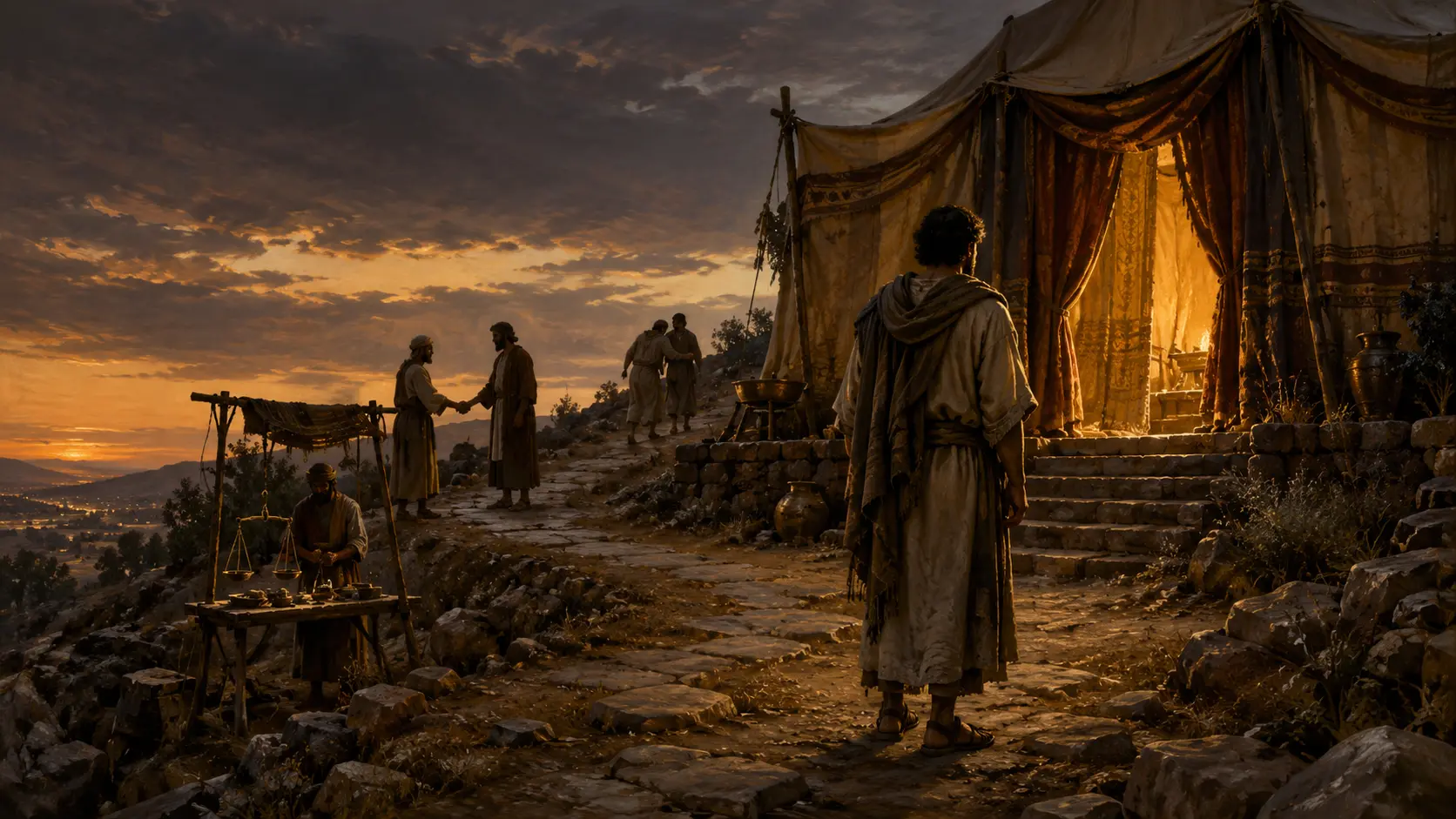
The hill is holy, but the question is human. Who may come near and remain? Not the polished voice alone, but a whole life learning to live before God.
01
1.0 Introduction: Can Worship and Everyday Life Belong to Different Worlds?
We can sing with conviction in worship, then speak carelessly about a neighbor or use money in ways that deepen another person’s desperation. Psalm 15 stands between sanctuary and street and refuses to let those worlds remain separate.
The poem asks, “Yahweh, who may sojourn in your tent? Who may dwell on your holy hill?” Its answer describes a person whose inner and public life are becoming one: walking with integrity, speaking truth, refusing slander, keeping costly promises, and rejecting exploitation.
Psalm 15 is not a staircase by which impressive people climb into God’s favor. Psalm 14 has just exposed human corruption, while Psalm 5:7 grounds entrance in steadfast love. Kidner observes that these qualities are what God creates in a person, not merely qualifications he discovers already finished. Grace welcomes and reforms the guest.
This text is about worship becoming integrity, because the God who welcomes people into his presence intends heart, speech, relationships, promises, and money to tell the same truth.
02
2.0 Historical and Literary Context: A New Section Begins at the Temple Gate
BibleProject reads Psalms 15–24 as a shaped unit framed by two “temple entrance” poems, Psalms 15 and 24. Psalm 19 stands at the center celebrating Yahweh’s Torah, linking divine presence, the hoped-for king, and a Torah-shaped life.
The transition from Psalm 14 is sharp. Psalm 14 longs for salvation from Zion; Psalm 15 arrives at the holy hill and asks what kind of life belongs there. The previous poem exposed people who live as though God were absent. This one portrays people learning to live as though God is near.
Kidner notes that the question-and-answer form may echo sanctuary admission practices. Yet the answer searches the conscience rather than listing rituals. “Tent” evokes worship and hospitality: Yahweh is Host. What kind of life can become at home in God’s presence?
03
3.0 Walking Through the Text
04
3.1 Psalm 15:1 — When the Worshiper Stops at the Door
“Who may sojourn in your tent? Who may dwell on your holy hill?” To sojourn is to be received as a guest; to dwell suggests settled belonging. The worshiper wants more than a brief sacred moment. He wants life near God.
Divine presence is comfort, but never casual. We cannot leave our treatment of people, business practices, or speech outside the sanctuary like dusty sandals. We carry our actual selves to the door.
05
3.2 Psalm 15:2 — When the Heart, Hands, and Mouth Tell One Story
The answer begins positively: the person “walks with integrity, does what is right, and speaks truth in the heart.” Kidner notes that the Hebrew word often rendered “blameless” carries the sense of being whole, wholehearted, or sound. Integrity is not sinless perfection; it is the opposite of a divided life.
Walking concerns life’s pattern; doing right concerns action; truth “in the heart” reaches motive. Psalm 12 described smooth lips and divided hearts. Psalm 15 answers with wholeness.
06
3.3 Psalm 15:3 — When the Tongue Refuses to Turn Neighbors into Material
The faithful person does not slander, do evil to another, or “take up” a reproach against a neighbor. Kidner notes that the word behind slander can suggest going around and circulating damaging information. Holiness therefore tests not only what we say to God but what we do with another person’s name.
A truthful fact can still be used cruelly for entertainment or humiliation. Love does not require secrecy about abuse; protection may require truthful reporting. Psalm 15 condemns speech that needlessly spreads disgrace. Holiness distinguishes accountable truth from passing darkness mouth to mouth.
07
3.4 Psalm 15:4 — When Worship Chooses Its Loyalties and Keeps Its Word
The psalm asks what kind of character we admire. The faithful person refuses to celebrate corruption and honors those who fear Yahweh. This is not permission for contempt; it is moral allegiance. Whose way receives our applause, imitation, platform, and trust?
Then comes a costly line: this person “swears to his own hurt and does not change.” Integrity appears when keeping one’s word is inconvenient. Kidner notes that Scripture does not praise harmful vows; the point is that personal discomfort alone does not make our word disposable.
08
3.5 Psalm 15:5 — When Money Cannot Buy the Verdict
The final tests enter marketplace and courtroom. The righteous person does not exploit the needy through lending or accept a bribe against the innocent. Kidner highlights the danger of profiting from another person’s distress.
The bribe completes the picture. Money must not purchase a verdict, silence a witness, or make the innocent expendable. Then comes the promise: “The one who does these things will never be moved.” This is not immunity from sickness, persecution, grief, or loss. The stability lies deeper: the life being formed by God is anchored in the faithful Host whose presence it seeks.
09
4.0 Theological Reflection
First, God’s presence gathers the whole life. Psalm 15 refuses spirituality in which worship is sacred but speech, contracts, leadership, and money are morally neutral. Temple theology becomes neighborhood ethics.
Second, integrity is wholeness formed by grace, not flawless performance used to earn grace. Psalm 14 prevents self-congratulation; Psalm 15 prevents grace from becoming permission for fragmentation. The God who receives sinners also remakes them.
Third, holiness is social. Slander, exploitation, corrupted admiration, broken promises, and bribery all injure community. To live near the Holy One is to become safer for neighbors, especially those with less power.
Fourth, stability comes from allegiance, not control. “Never moved” does not mean never wounded. It means we need not purchase security through lies, exploitation, or compromised justice.
10
5.0 Canonical and Christological Horizon
Psalm 15 reaches back to Sinai and the tabernacle, where the holy God dwelt among a redeemed people. Torah joined worship to neighbor-love, forbidding slander, exploitative lending, and purchased justice. Holiness was never meant to remain behind a curtain.
Psalm 24 later asks a similar entrance question, and Isaiah 33 joins dwelling near God with righteous conduct and refusal of oppressive gain. The prophets repeatedly insist that worship without justice is contradiction, not devotion.
The standard creates longing for the truly undivided human. The New Testament presents Jesus as the faithful Israelite whose heart, words, loyalties, and actions tell one story. “No deceit was found in his mouth” (1 Pet. 2:22). He remains faithful even when obedience leads to the cross.
The cross prevents Psalm 15 from becoming a ladder of pride. We enter God’s household by mercy. The risen Messiah gives the Spirit and forms a temple made of people (1 Cor. 3:16–17; 1 Pet. 2:5). “Who may dwell?” becomes a communal vocation: what kind of people are we becoming because God dwells among us?
Revelation’s final horizon is God dwelling with humanity in renewed creation. Psalm 15 is a small school for that future: grace training ordinary lives to become truthful, just, faithful, and hospitable to divine presence.
11
6.0 Life Application
1. Carry worship into Monday. Identify one relationship, financial decision, or promise where worship must become obedience.
2. Close the gossip circuit. Before repeating a damaging story, ask whether sharing it protects someone, repairs truth, or merely spreads disgrace.
3. Make promises slowly and keep them seriously. If a commitment becomes impossible or harmful, seek an honorable solution rather than quietly making your word meaningless.
4. Audit how you profit. Ask whether your fees, lending, employment practices, or bargaining power increase another person’s vulnerability.
5. Honor character more than charisma. Let the fear of Yahweh outweigh status, popularity, and usefulness.
6. Keep justice beyond purchase. Refuse gifts, loyalties, or relationships that pressure you to ignore truth or sacrifice the innocent.
7. Practice grace-shaped integrity. When you discover a divided place, confess it, repair what can be repaired, receive mercy, and take the next truthful step.
12
7.0 Reflection Questions
1. Which part of my life is easiest to leave outside the door when I worship?
2. Where is there a gap between what I say publicly and what I know inwardly?
3. Have I repeated someone’s failure in a way that served curiosity, power, or self-importance rather than love?
4. What promise, financial practice, or loyalty is currently testing my integrity?
5. If God is forming the church as his dwelling place, how should my presence make life safer, truer, and more just for others?
13
8.0 Response Prayer
Yahweh, holy Host, receive us by your mercy and make us whole in your presence. Bring heart, mouth, hands, promises, loyalties, and money under your loving rule. Guard our tongues from carrying wounds from house to house. Give us courage to keep our word, compassion that will not profit from another person’s distress, and justice that cannot be bought. Through Jesus, the faithful and risen King, form us by your Spirit into a people in whom truth and love live together. Let our worship become a life that welcomes your presence. Amen.
14
9.0 Window into What Comes Next
Psalm 15 has brought us to the door and described the integrity of the guest. Psalm 16 steps further inside with the voice of trust: “You are my Lord,” “Yahweh is my chosen portion,” and “in your presence there is fullness of joy.” The doorway of integrity opens into the deeper confession that the greatest gift of God’s house is God himself.
15
10.0 Bibliography
BibleProject. The Book of Psalms: Study Notes. Portland, OR: BibleProject.
BibleProject. Visual Commentary: Psalm 8—Study Notes. Portland, OR: BibleProject.
Goldingay, John. Psalms, Volume 1: Psalms 1–41. Baker Commentary on the Old Testament Wisdom and Psalms. Grand Rapids: Baker Academic, 2006.
Kidner, Derek. Psalms 1–72. Kidner Classic Commentaries. Downers Grove, IL: IVP Academic, 2008.
Wright, N. T. After You Believe: Why Christian Character Matters. New York: HarperOne, 2010.

Be the first to leave a comment.