

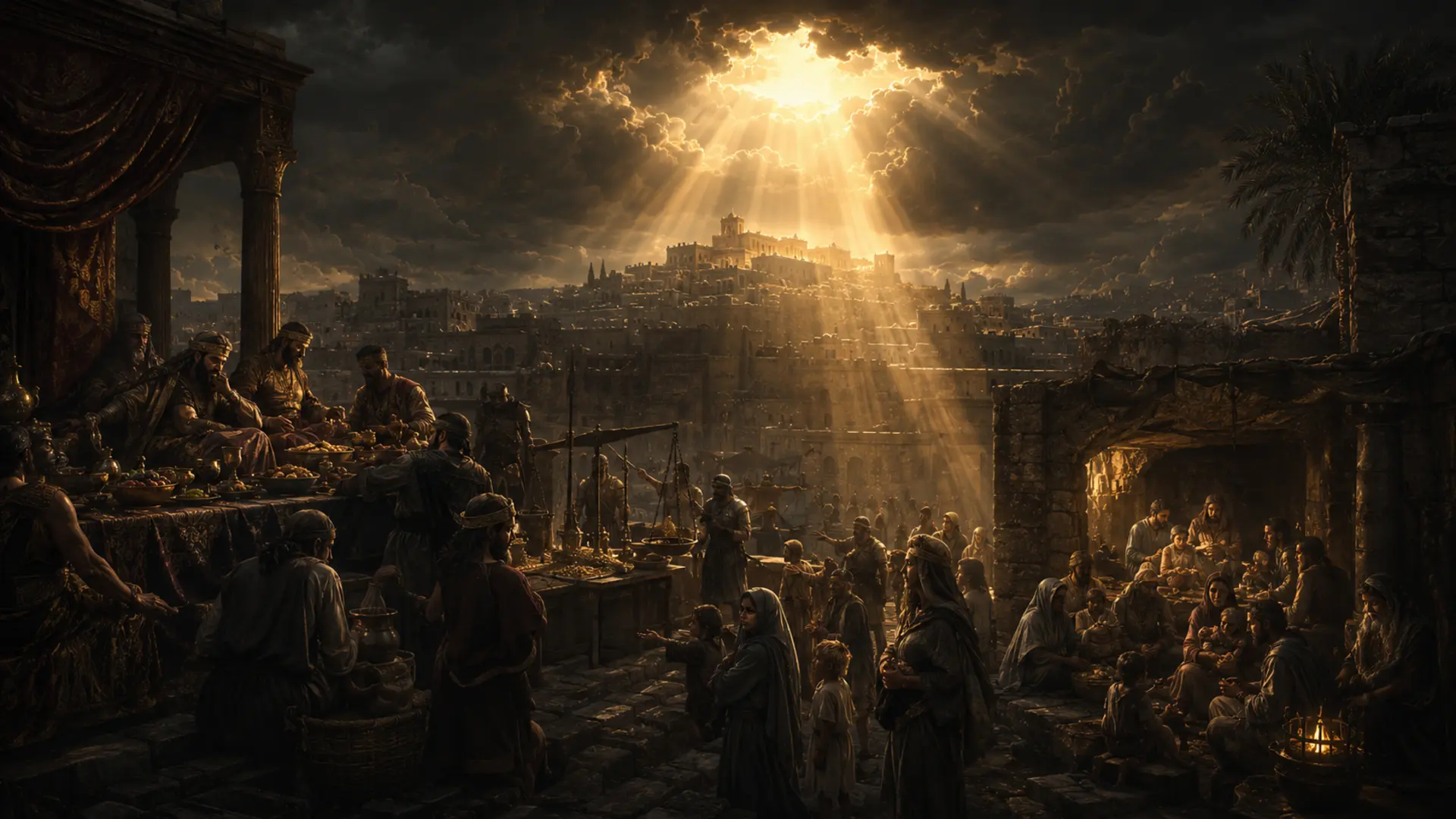
The fool closes the door and says, “No one is watching.” But heaven has a window. Yahweh looks down, stands among the faithful, and turns the cry of the weak toward Zion.
01
1.0 Introduction: What Happens When We Live as Though God Is Not There?
Some unbelief is spoken in arguments; other unbelief is built into habits. A person may never deny God publicly and yet arrange life as though no divine gaze rests on them. Psalm 14 confronts that atheism of practice.
“The fool says in his heart, ‘There is no God.’” Here this is not mainly a philosophical lecture about whether a deity exists. It is a moral decision to discount God: God is not here, God will not interfere, God need not be consulted. Once that conviction settles in the heart, corruption travels outward. People cease to seek God, devour others “as they eat bread,” and mock the refuge of the weak.
Yet the psalm turns the camera upward. The God whom the fool removes from the room is looking through heaven’s window. He sees, he is present among the righteous, and the poem ends longing for salvation from Zion.
This text is about practical atheism being exposed by divine presence, because the God whom human arrogance discounts is looking, dwelling among the faithful, and moving history toward restoration.
02
2.0 Historical and Literary Context: The Closing Psalm of a Troubled Landscape
Psalm 14 belongs to Book 1 and closes the cluster of Psalms 3–14. Psalms 1–2 introduce the Torah-shaped righteous one and Yahweh’s anointed king. Psalms 3–7 place David under pressure. Psalm 8 envisions God exalting weak humanity to share his rule. Psalms 9–14 widen the picture: David is joined by the poor and afflicted, while enemies become the wicked, oppressors, and nations.
BibleProject notes that Psalm 14 closes this unit with a portrait of the wicked and a cry for deliverance from Zion. Psalm 13 was personal; Psalm 14 widens the lens to a damaged human landscape.
Kidner sees godlessness revealing itself in two directions: contempt for God’s order in verses 1–3 and oppression of God’s people in verses 4–6. Goldingay sees human corruption repeatedly set against Yahweh’s looking, presence, and promised restoration. The psalm reappears with variations as Psalm 53, showing its continuing relevance.
03
3.0 Walking Through the Text
04
3.1 Psalm 14:1 — When the Heart Removes God from Everyday Life
“The fool says in his heart, ‘There is no God.’” The Hebrew nabal does not describe low intelligence. Kidner calls it aggressive perversity; Goldingay renders it “scoundrel.” The biblical fool is morally disordered. Nabal in 1 Samuel 25 becomes a narrative picture: arrogant, ungrateful, and blind to moral reality.
The statement is made “in his heart,” the center of intention and desire. Goldingay suggests the sense “God is not here” or “God is not involved.” The wicked lives as though God will never call him to account.
The result is social: “They are corrupt; their deeds are vile.” What people believe about accountability shapes the world they build. When God is pushed beyond the horizon, appetite easily becomes law and other people become material to use.
05
3.2 Psalm 14:2–3 — When Yahweh Looks Through the Window
The fool says God is not here; verse 2 answers by naming Yahweh first: “Yahweh looks down from heaven.” Goldingay notes that the verb can picture someone leaning through a window. Earth says heaven is irrelevant; heaven is already watching.
Yahweh looks for “anyone who understands, anyone who seeks God.” Wisdom here means living before God and receiving his guidance rather than inventing goodness on our own terms.
But the survey is devastating: “All have turned away … there is no one who does good, not even one.” The language echoes the corrupt world before the flood (Gen. 6:11–12). Paul later gathers these lines into Romans 3:10–12. His point is not that everyone commits every possible evil, but that Jew and Gentile alike stand under sin. Psalm 14 becomes part of the gospel’s leveling truth: no one can boast; all need grace.
06
3.3 Psalm 14:4–5 — When People Are Devoured Like Bread
The psalm asks, “Do all these evildoers know nothing?” They “devour my people as though eating bread” and “never call on Yahweh.” The image is chilling because eating bread is ordinary. Oppression has become routine. People can damage livelihoods, exploit weakness, and then return to ordinary life as though nothing happened.
Goldingay suggests their bread may be gained through another person’s loss. Instead of calling on God, they secure life through predation.
Then terror enters: “For God is present in the company of the righteous.” The decisive fact about the weak is God’s presence among them. The exploiters appear secure and the faithful exposed, yet heaven has not abandoned the ground.
07
3.4 Psalm 14:6–7 — When the Refuge of the Poor Becomes Israel’s Hope
“You frustrate the plans of the poor, but Yahweh is their refuge.” The weak take shelter in God. A refuge is where vulnerable people hide from storm or attack. The scoundrel laughs because he assumes no one is there; the psalm says he has miscalculated.
Then the poem turns toward Zion: “Oh, that salvation for Israel would come out of Zion! When Yahweh restores his people, let Jacob rejoice and Israel be glad!” Zion symbolizes Yahweh’s royal presence and covenant rule. The psalm that began with “God is not here” ends by naming the place from which rescue is expected.
The final word is restoration, not corruption; rejoicing, not devouring.
08
4.0 Theological Reflection
First, practical atheism is a moral posture before it is an intellectual slogan. The question is not only what we say about God but what our decisions assume about his presence and judgment.
Second, sin is both universal and social. Psalm 14 refuses to pretend corruption belongs only to “those people,” and it refuses to reduce sin to private mistakes. Hearts turn aside, and communities learn to devour.
Third, God identifies himself with a vulnerable community. “Yahweh is among the righteous company.” Divine presence is not always displayed through visible dominance.
Fourth, biblical hope is restorative. Verse 7 longs for God to restore his people—the setting right of their life and joy under his reign.
09
5.0 Canonical and Christological Horizon
Psalm 14 echoes Genesis 6 and the prophets’ exposure of societies where worship survives while justice collapses. Forgetting God and consuming neighbors belong to the same disease.
Romans 3 brings Psalm 14 directly into the apostolic proclamation. Paul uses its universal language to insist that all are under sin, then announces that God’s righteousness is revealed through Jesus Messiah and received by faith (Rom. 3:21–26). The psalm removes boasting; the gospel opens grace.
Jesus embodies the faithful Israelite who seeks the Father, rejects predatory power, and identifies with the poor. At the cross, rulers act as though the righteous can be devoured without consequence. Resurrection is God’s answer: the One treated as abandoned is vindicated and enthroned.
The church cannot use “God is among the righteous” as a license for pride. Rescued by mercy, we are formed by the Spirit into a community where the weak find refuge. We still pray for creation’s final restoration.
10
6.0 Life Application
1. Examine your practical theology. What do your spending, speech, sexuality, leadership, and use of power say about whether you believe God sees?
2. Refuse routine harm. Never let another person’s pain become as ordinary to you as eating bread.
3. Notice who pays for your comfort. Ask whether your convenience depends on someone being silenced, underpaid, manipulated, or ignored.
4. Seek God rather than securing life through control. Prayer refuses to make predation the price of safety.
5. Become refuge-shaped community. Churches should protect the vulnerable, hear truthful testimony, practice justice, and resist exploitation.
6. Let Romans 3 destroy spiritual superiority. Grace makes us humble before it makes us confident.
7. Keep praying for restoration. Christian hope does not call corruption normal; it waits and works for the world God will set right.
11
7.0 Reflection Questions
1. Where am I tempted to behave as though God does not see or care?
2. Whose suffering has become too ordinary for me to notice?
3. Do I seek God for guidance, or mainly ask him to bless decisions already made?
4. How can my church or household become a concrete refuge for people with little power?
5. How do Jesus’ cross and resurrection correct both despair about humanity and pride in my own goodness?
12
8.0 Response Prayer
Yahweh, God who looks from heaven and dwells among the weak, expose every place where I live as though you were absent. Cleanse the heart that excuses corruption and the habits that make another person’s pain ordinary. Teach me to seek you, to do good, and to refuse the easy bread of exploitation. Be the refuge of those who have been mocked, consumed, or pushed aside. Form your church into a shelter of truth, justice, and mercy. From Zion fulfilled in your Messiah, let your saving reign spread until Jacob rejoices and creation shares the freedom of your new world. Through Jesus, the crucified and risen King, amen.
13
9.0 Window into What Comes Next
Psalm 14 ends with God among the righteous and salvation hoped for from Zion. Psalm 15 walks toward that holy hill and asks, “Yahweh, who may dwell in your sacred tent?” After exposing the world that lives as though God is absent, the Psalter now describes the integrity of people who know they live in God’s presence.
14
10.0 Bibliography
BibleProject. The Book of Psalms: Study Notes. Portland, OR: BibleProject.
BibleProject. Visual Commentary: Psalm 8—Study Notes. Portland, OR: BibleProject.
Goldingay, John. Psalms, Volume 1: Psalms 1–41. Baker Commentary on the Old Testament Wisdom and Psalms. Grand Rapids: Baker Academic, 2006.
Kidner, Derek. Psalms 1–72. Kidner Classic Commentaries. Downers Grove, IL: IVP Academic, 2008.
Wright, N. T. How God Became King: The Forgotten Story of the Gospels. New York: HarperOne, 2012.
Be the first to leave a comment.