

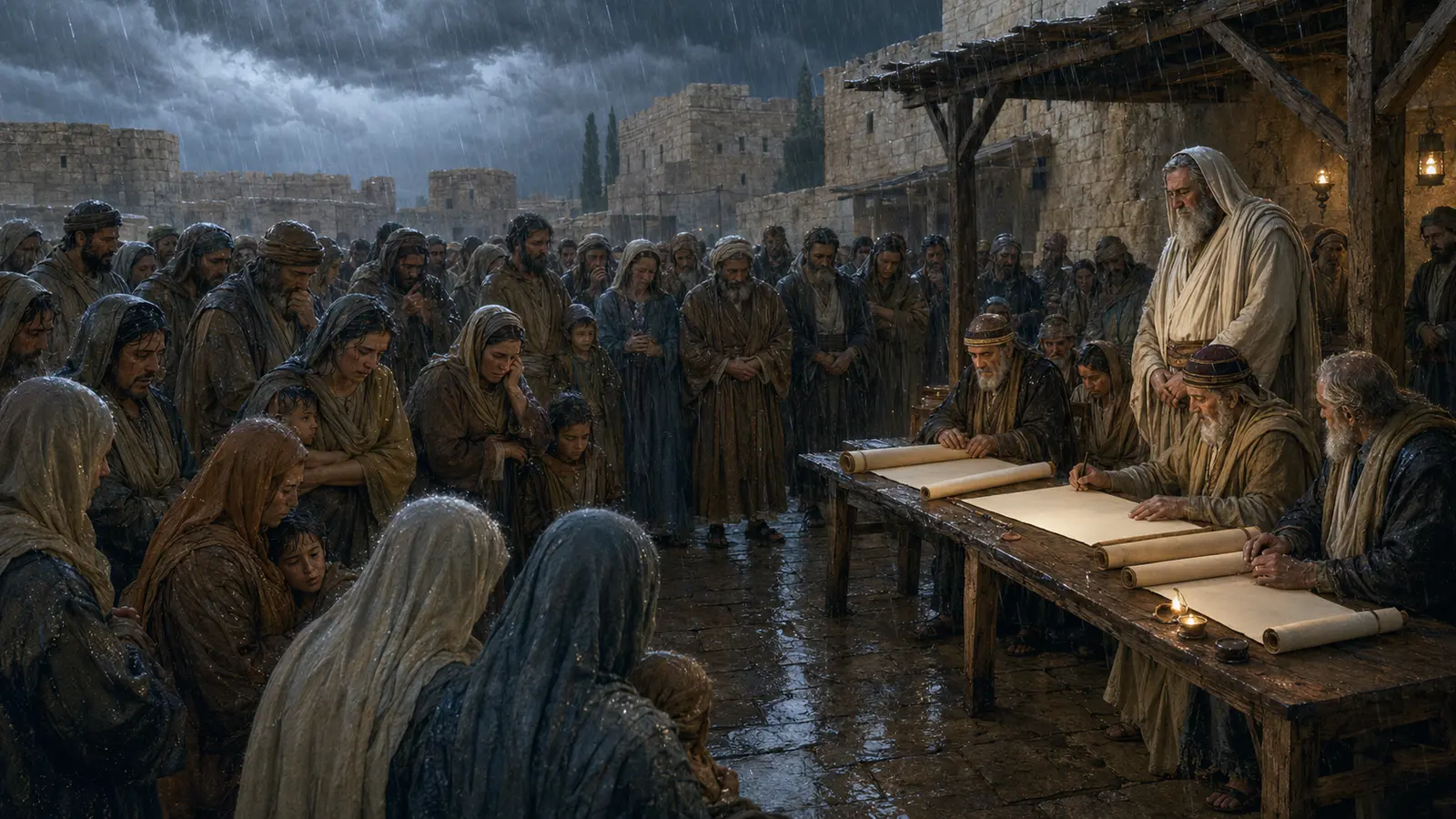
The teacher has prayed with torn robe and trembling hands. Now the people gather in the rain, weeping before the house of God. Confession becomes action, but the action is painful, complicated, and unfinished. Ezra 10 does not give us a simple victory song. It gives us a sobering picture of a restored community trying to cut away compromise with human hands, while the deeper wound of the heart still waits for the healing only God can give.
01
Introduction: When Confession Must Move, But Movement Still Hurts
There are moments when prayer must rise from the ground and become action.
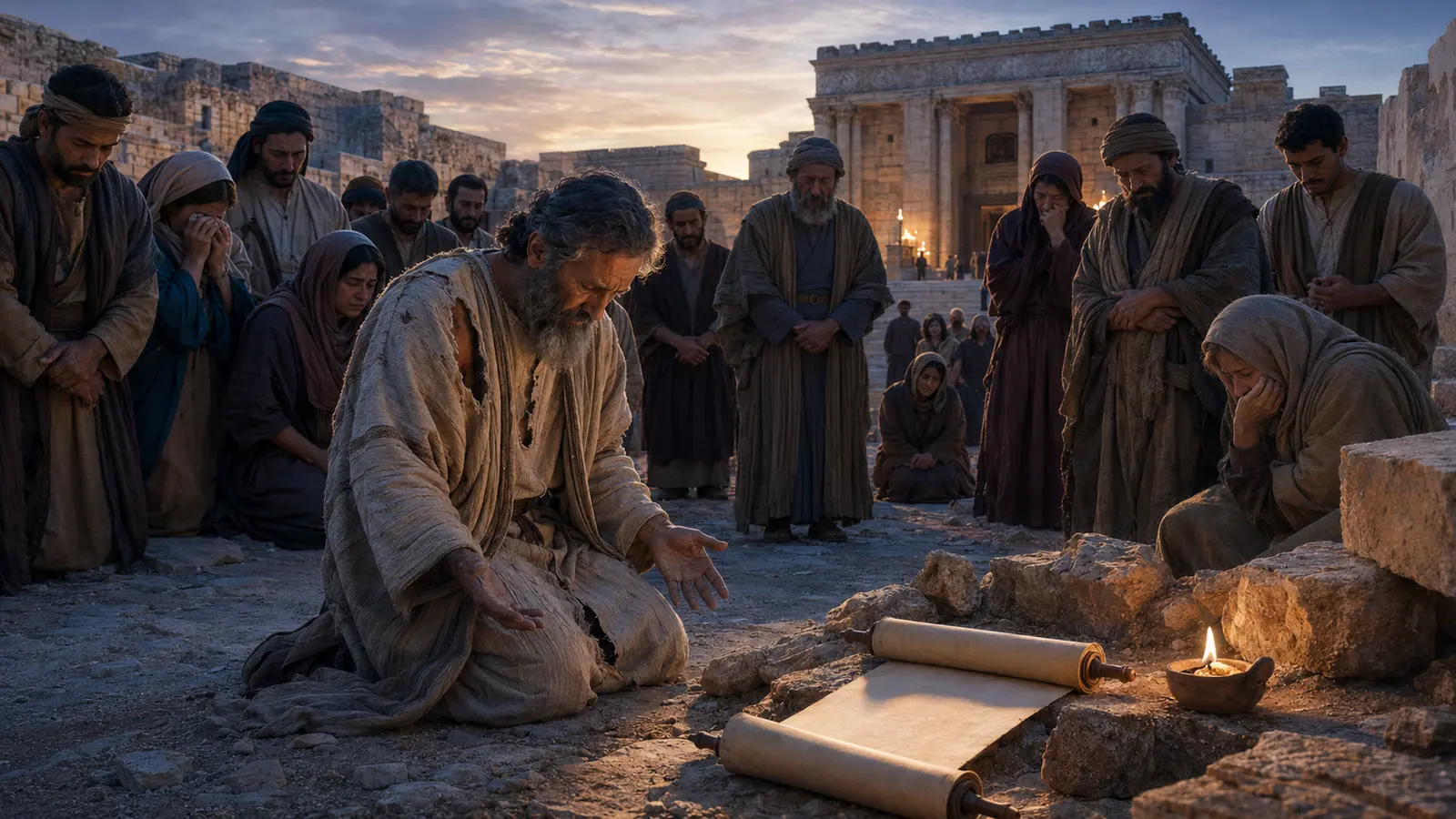
Ezra 9 ended with confession. Ezra had torn his garments, pulled hair from his head and beard, fallen on his knees, and spread out his hands before the Lord. He did not blame the people from a distance. He entered the grief of the community and prayed, “our iniquities have risen higher than our heads” [Ezra 9:6].
Ezra 10 begins with that prayer still in the air. The people gather around him, weeping bitterly [Ezra 10:1]. A man named Shecaniah speaks hope into the crisis: “Even now there is hope for Israel in spite of this” [Ezra 10:2]. But the hope he proposes is costly: the community must make a covenant to put away the foreign wives and the children born to them [Ezra 10:3].
This chapter is one of the most difficult in Ezra–Nehemiah. It should not be handled lightly. It deals with marriage, family, covenant identity, holiness, leadership failure, communal pressure, and reform. The text is honest enough to show tears, trembling, rain, resistance, investigation, and a long list of names. It does not end with celebration. It ends with a register of those implicated.
Ezra 10 is not a neat resolution. It is a painful reform within an unfinished story.
This text is about confession becoming costly reform, because God’s people must confront compromise honestly, even while human reform exposes the need for deeper heart renewal.
02
Historical and Literary Context: The Hard Ending of Ezra’s Reform
Ezra 10 completes the Ezra section that began in chapter 7. Ezra came from Babylon as a priest and scribe skilled in the Law of Moses [Ezra 7:6]. He had set his heart to study, do, and teach the Law of the Lord [Ezra 7:10]. He arrived safely in Jerusalem with sacred treasure and a renewed company of returnees [Ezra 8]. Then he discovered that the restored community, including its leaders, had entered covenant compromise through marriages that threatened Israel’s holiness and worship [Ezra 9:1–2].
Ezra 10 records the community’s response.
The issue must be understood carefully. The Old Testament does not condemn marriage to a foreigner simply because of ethnicity. Ruth, Rahab, Zipporah, and others show that foreigners who turn toward the Lord can be welcomed into the covenant story [Josh. 6:25; Ruth 1:16–17; Matt. 1:5]. The crisis in Ezra 9–10 is covenantal and worship-related: marriages had bound the returned community to surrounding peoples and practices described as “abominations” [Ezra 9:1; Deut. 7:3–4]. The fear is that Israel will repeat the idolatrous patterns that led to exile.
Yet Ezra 10 remains morally and pastorally weighty. The proposed solution is severe, and the wider biblical witness includes strong concern for the vulnerable and a prophetic witness against treacherous divorce [Mal. 2:13–16]. Ezra–Nehemiah itself often shows reforms that are real but incomplete, necessary but not final, sincere but still unable to transform the heart fully.
The chapter unfolds in five scenes:
1. The people gather around Ezra in tears, and Shecaniah proposes covenant action [10:1–4].
2. Ezra leads the officials and people into an oath [10:5–8].
3. The assembly gathers in the rain, trembling before God and the weather [10:9–15].
4. A commission investigates the cases over time [10:16–17].
5. A list names those found guilty among priests, Levites, singers, gatekeepers, and Israel [10:18–44].
Ezra 10 asks us to feel the burden of restoration after compromise. What happens when mercy brings people home, but their loves remain tangled with the old world?
03
Walking Through the Text
When Tears Gather Around the Prayer [Ezra 10:1]
The chapter opens with Ezra praying, confessing, weeping, and casting himself down before the house of God [Ezra 10:1]. His grief is public, embodied, and priestly. He is not performing sorrow; he is carrying the wound of the community before the Lord.
Then a very great assembly gathers around him—men, women, and children—and the people weep bitterly [Ezra 10:1]. This is important. The crisis is communal, not merely administrative. The tears are not only Ezra’s tears. The grief spreads.
The presence of women and children reminds us that covenant failure never affects only the decision-makers. Families are involved. Vulnerable people are involved. The consequences of compromise reach farther than the moment of sin.
Ezra 10 begins, therefore, not with policy but with mourning. Reform without tears can become cruel. Tears without obedience can become sentimental. The chapter holds both in tension.
When Hope Speaks in the Midst of Guilt [Ezra 10:2–4]
Shecaniah son of Jehiel speaks to Ezra. He admits the sin: “We have broken faith with our God and have married foreign women from the peoples of the land” [Ezra 10:2]. But he does not stop there. “Yet even now there is hope for Israel in spite of this” [Ezra 10:2].
That sentence is a small lamp in a dark room.
Biblical hope is not denial. Shecaniah does not minimize the sin. He names it. But he also believes that guilt is not the end if the people return to God.
He proposes a covenant to put away the foreign wives and their children, according to the counsel of Ezra and those who tremble at the commandment of God [Ezra 10:3]. This proposal is severe and difficult. It reflects the community’s urgent concern to preserve covenant holiness after exile. But it also raises painful questions, especially about the women and children affected by the reform.
Shecaniah then calls Ezra to rise, act, and be strong [Ezra 10:4]. The teacher who fell in grief must now stand in leadership.
When Confession Becomes an Oath [Ezra 10:5–8]
Ezra rises and makes the leading priests, Levites, and all Israel swear that they will do as proposed [Ezra 10:5]. Confession now becomes covenant obligation. The crisis will not be left as emotional sorrow.
Then Ezra withdraws, fasting and mourning over the faithlessness of the exiles [Ezra 10:6]. Even after action begins, grief continues. This detail matters. Ezra does not become cold once the reform process begins. His leadership remains marked by sorrow.
A proclamation is sent throughout Judah and Jerusalem requiring all returned exiles to gather in Jerusalem. Anyone who does not come within three days will forfeit property and be excluded from the assembly [Ezra 10:7–8]. The urgency is intense. The community treats the crisis as a covenant emergency.
This scene shows both seriousness and strain. Strong measures may be necessary in moments of communal crisis, but the chapter also makes us feel how heavy such reform becomes when sin has entangled many lives.
When the Assembly Trembles in the Rain [Ezra 10:9–15]
All the men of Judah and Benjamin gather in Jerusalem within three days. It is the ninth month, and the people sit in the open square before the house of God, trembling because of the matter and because of the heavy rain [Ezra 10:9].
This image is unforgettable: a soaked assembly, trembling under heaven, facing the consequences of covenant unfaithfulness.
Ezra stands and names the sin: “You have broken faith and married foreign women, and so increased the guilt of Israel” [Ezra 10:10]. He calls them to make confession and do God’s will by separating from the peoples of the land and from the foreign wives [Ezra 10:11].
The assembly answers loudly that they must do as Ezra says [Ezra 10:12]. Yet they also recognize the practical complexity: the people are many, it is the rainy season, and the matter cannot be resolved in one or two days because many have transgressed [Ezra 10:13]. They propose that officials handle the matter case by case, with elders and judges from each city, until God’s fierce wrath is turned away [Ezra 10:14].
This is a crucial moment. The people accept the seriousness of the sin, but they also slow the process. The cases must be investigated. Reform must be careful, not chaotic. Even painful obedience requires order.
Verse 15 notes some opposition or dissent from a few named men [Ezra 10:15]. The chapter does not pretend unanimity was easy. Real reform often meets resistance—not always because people love sin, but sometimes because the proposed action is difficult, contested, and costly.
When Reform Requires Patient Investigation [Ezra 10:16–17]
Ezra and selected heads of fathers’ houses begin investigating the matter on the first day of the tenth month, and by the first day of the first month they finish dealing with all the men who had married foreign women [Ezra 10:16–17].
Three months pass. This is not mob action. It is structured inquiry.
This matters pastorally. When communities address sin, especially sin that affects families, they must resist the temptation to act with careless speed. Truth must be established. People must be heard. Leaders must avoid both denial and rashness.
Ezra 10 shows reform under pressure, but also reform with process.
When the List Becomes a Mirror [Ezra 10:18–44]
The chapter ends with a list of those found guilty, beginning with priests [Ezra 10:18–22], then Levites, singers, gatekeepers [Ezra 10:23–24], and finally others of Israel [Ezra 10:25–44]. The list is sobering.
The priests appear first because holiness begins at the place of worship. Those who serve near the altar must not treat covenant faithfulness lightly. Some offer a ram as guilt offering [Ezra 10:19], showing that the issue is treated as sin requiring atonement.
The final verse states that all these had married foreign women, and some of the women had borne children [Ezra 10:44]. The chapter ends there. No celebration. No song. No declaration that the community is now whole.
That silence is important.
Ezra 10 is not a simple happy ending. It is a severe attempt at reform after severe compromise. It may remove an immediate danger, but it cannot create the new heart promised by the prophets. The list becomes a mirror: the returned people are still capable of the old unfaithfulness. The deeper exile remains within.
04
Theological Reflection
Hope Can Speak Truth Without Softening Sin
Shecaniah says, “Even now there is hope” after naming the community’s faithlessness [Ezra 10:2]. This is biblical hope: honest, not sentimental. It does not pretend the wound is small. It believes God’s mercy can still meet the people in truth.
Communities need this kind of hope. Hope that denies sin cannot heal. Truth without hope can crush. Ezra 10 holds both together.
Holiness Is Costly When Compromise Has Become Embodied
The crisis is not abstract. It involves marriages, households, children, leaders, and community identity. This reminds us that compromise never remains merely private. Over time, it becomes embodied in relationships, habits, loyalties, and structures.
That is why repentance can be costly. Sin often enters quietly but leaves painfully.
Human Reform Can Be Necessary and Still Incomplete
Ezra 10 records a real attempt to address covenant unfaithfulness. The people confess, gather, investigate, and act. Yet the chapter’s tone remains heavy. The reform is not portrayed as the final cure for Israel’s heart.
This is one of Ezra–Nehemiah’s great theological lessons. Reform matters. Obedience matters. Leadership matters. But external correction cannot by itself create inward transformation. The people still need the deeper work promised in Jeremiah and Ezekiel: a new covenant, a new heart, and the Spirit of God within [Jer. 31:31–34; Ezek. 36:26–27].
The Vulnerable Must Never Be Invisible
Ezra 10:44 quietly mentions children. That small note forces us to read the chapter with pastoral trembling. Covenant unfaithfulness creates consequences for people who did not design the crisis.
Any application of this chapter must therefore avoid harsh simplicity. Holiness matters deeply, but so do justice, mercy, protection, and care for the vulnerable [Mic. 6:8; Zech. 7:9–10]. Communities must confront sin without forgetting those wounded by both sin and reform.
05
Life Application: Practicing Costly Repentance with Humility
Let confession become action. Prayerful grief is necessary, but repentance must eventually move into concrete obedience.
Keep hope alive without minimizing sin. “Even now there is hope” is powerful because the sin has been honestly named.
Count the cost before compromise. Sin may enter as a private decision, but its consequences often touch families, communities, and future generations.
Address communal sin carefully. Urgency must be joined with wisdom, process, evidence, and pastoral care.
Begin reform with leaders. The list starts with priests because those entrusted with spiritual influence must be accountable first.
Protect the vulnerable. When sin has created complex damage, repentance must include concern for those most affected by the consequences.
Seek heart renewal beyond external correction. Removing a visible compromise is not the same as receiving a transformed heart.
06
Reflection Questions
1. Where has God called you to move from confession into concrete obedience?
2. What compromise in your life may have consequences beyond yourself?
3. How can you pursue holiness without becoming careless toward vulnerable people?
4. Are there areas where leaders in your community need humble accountability before calling others to reform?
5. What external changes are needed in your life, and what deeper heart renewal must you ask God to give?
07
Response Prayer
Holy and merciful God,
we come with trembling hearts. We confess that we often let compromise grow until obedience becomes painful. We confess that our choices touch more lives than we first imagine. We confess that we need more than outward return; we need inward renewal.
Give us courage to act when confession requires obedience. Give us wisdom to move carefully where sin has created complex wounds. Give us tenderness toward the vulnerable, accountability for leaders, and humility for the whole community.
Do not let us hide behind easy hope that refuses truth. Do not let us speak hard truth without mercy. Teach us the narrow road of holy love.
And where human reform reaches its limits, do what only you can do. Write your Law upon our hearts. Give us new desires. Put your Spirit within us. Make us faithful from the inside out.
Through Jesus Christ, the faithful covenant keeper and healer of broken people,
Amen.
08
Window into What Comes Next: From Ezra’s Reform to Nehemiah’s Lament
Ezra 10 closes the Ezra section with a heavy list. The temple stands. The teacher has come. The people have confessed. Reform has begun. Yet the ending is sobering, not triumphant.
The story will now move to Nehemiah. The temple has been rebuilt, but Jerusalem’s walls remain broken. The people have faced covenant compromise, but the city still lies exposed. Nehemiah 1 will begin not with a decree, but with a report of disgrace, a servant’s tears, and a prayer that gathers Israel’s long failure into the mercy of God.
Ezra tore his robe before the house.
Nehemiah will weep for the city.
The work of restoration is not finished, because God is still rebuilding a people.
09
Bibliography
Williamson, H. G. M. Ezra, Nehemiah. Word Biblical Commentary 16. Waco: Word Books, 1985.
Williamson, H. G. M. Ezra and Nehemiah. Old Testament Guides. Sheffield: JSOT Press, 1987.
Kidner, Derek. Ezra and Nehemiah. Tyndale Old Testament Commentaries. Downers Grove: InterVarsity Press, 1979.
Clines, David J. A. Ezra, Nehemiah, Esther. New Century Bible Commentary. Grand Rapids: Eerdmans, 1984.
Fensham, F. Charles. The Books of Ezra and Nehemiah. New International Commentary on the Old Testament. Grand Rapids: Eerdmans, 1982.
Blenkinsopp, Joseph. Ezra–Nehemiah: A Commentary. Old Testament Library. Philadelphia: Westminster, 1988.
BibleProject. “The Book of Ezra-Nehemiah.” Old Testament Overview Guide.
Be the first to leave a comment.