

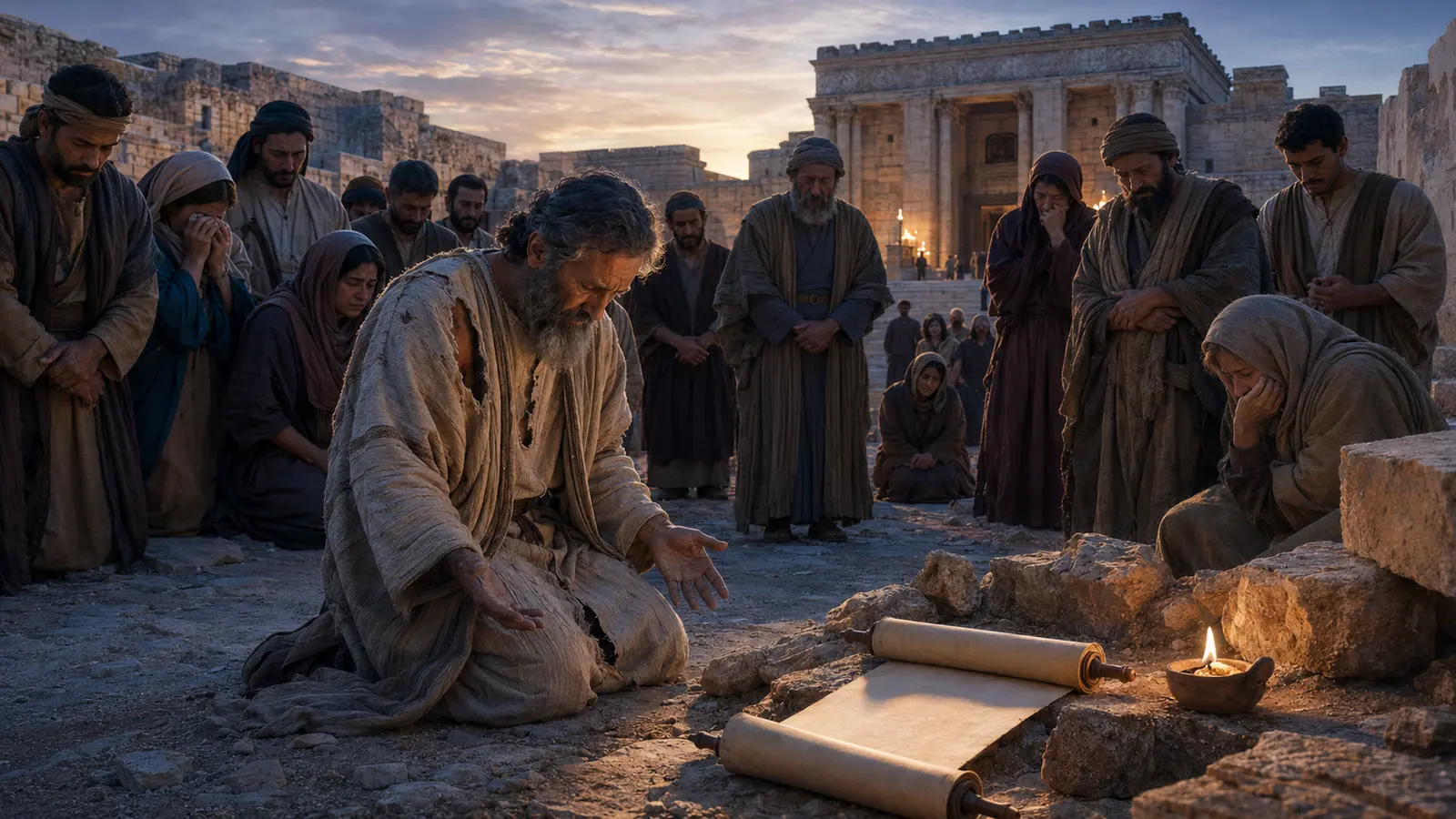
Ezra arrives with the scroll, the treasure, and the good hand of God upon him. But the greatest danger is not on the road from Babylon. It is inside the restored community. The temple stands, the sacrifices continue, the people have returned—yet the heart is still vulnerable to old patterns. So the teacher of the Law does not begin with a lecture. He tears his robe, pulls hair from his head and beard, sits appalled, and prays under the weight of a mercy they have already begun to endanger.
01
Introduction: When Return Does Not Mean Renewal
There is a painful kind of disappointment that comes after hope has already begun.
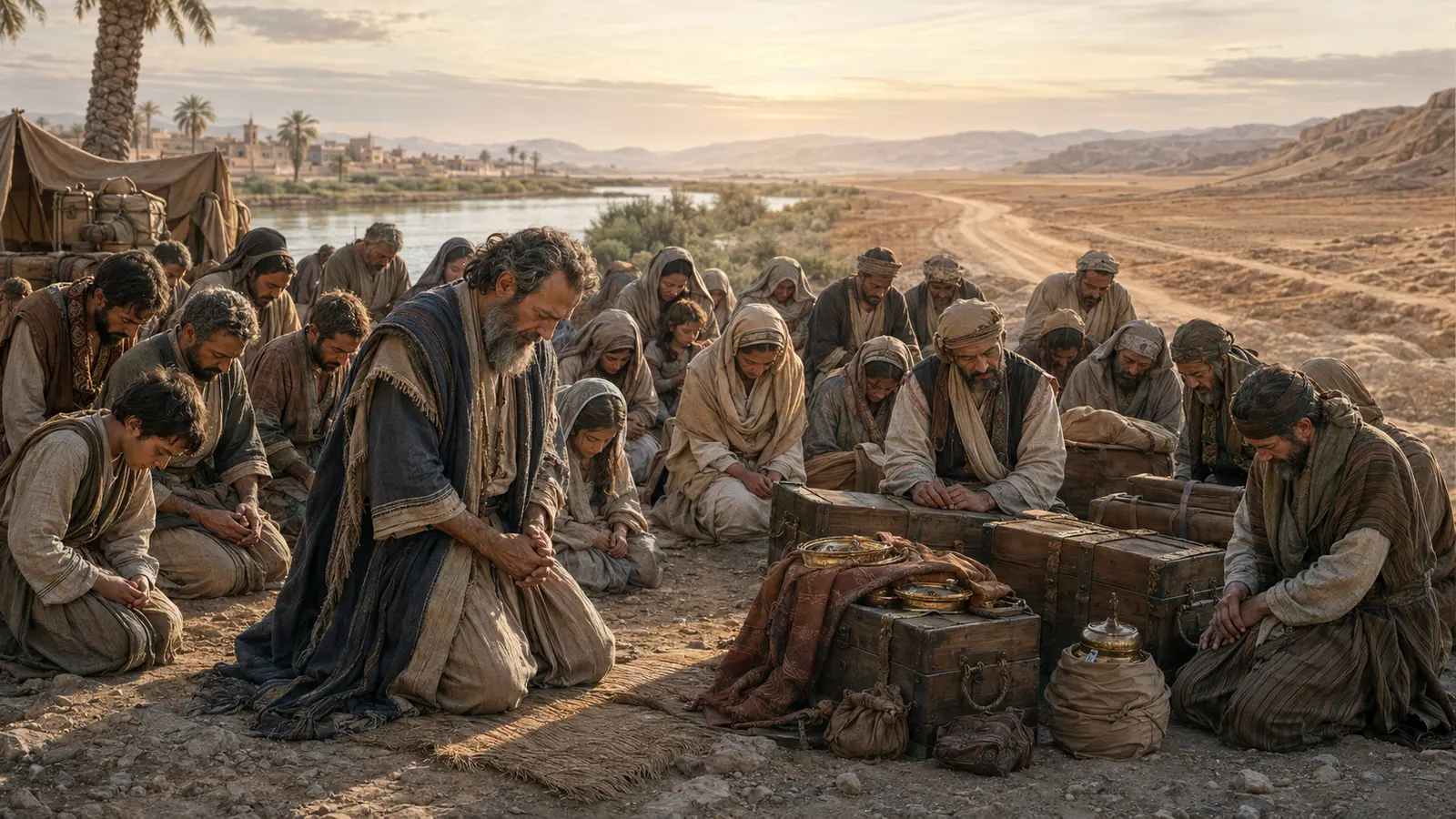
It is one thing to find ruins in a ruined place. It is another thing to find compromise after restoration has started. Ezra has come safely to Jerusalem. The treasure has been delivered. Sacrifices have been offered. The king’s commissions have been handed over. The good hand of God has carried the people across the dangerous road [Ezra 8:31–36].
But then the leaders come with news that breaks the heart of the teacher.
The people, including priests and Levites, have not separated themselves from the peoples of the lands and their abominations [Ezra 9:1]. Some have entered marriages that threaten Israel’s covenant identity, and the officials and chiefs have been foremost in the unfaithfulness [Ezra 9:2]. The crisis is not merely social. It is theological. The returned people are repeating patterns that led to exile.
Ezra responds with grief. He tears his garment and cloak. He pulls hair from his head and beard. He sits appalled until the evening sacrifice [Ezra 9:3–4]. Then he prays one of the most searching prayers in the book. He does not stand above the people as if their sin has nothing to do with him. He says, “Our iniquities have risen higher than our heads” [Ezra 9:6].
This text is about return being exposed as incomplete, because God’s people can come home outwardly while still needing deep covenant renewal in the heart.
Ezra 9 asks a question every generation must face: What good is a rebuilt temple if the people are still rebuilding the old patterns that destroyed it?
02
Historical and Literary Context: The Crisis After the Safe Arrival
Ezra 9 begins after the successful journey of Ezra 8. The movement from Babylon to Jerusalem has been completed. The sacred gifts have been delivered. Worship has resumed. Official support has been secured. Everything appears ready for Ezra’s teaching ministry to flourish.
Then the crisis surfaces.
Ezra 9–10 forms a difficult and sobering unit. The issue concerns marriages with surrounding peoples and the danger of covenant compromise. This must be handled carefully. The Old Testament does not forbid marriage with foreigners simply because they are ethnically foreign. Ruth the Moabite is welcomed into Israel and becomes part of David’s line because she turns in covenant loyalty to the God of Israel [Ruth 1:16–17; 4:13–22]. Rahab likewise is received through allegiance to Israel’s God [Josh. 2:9–13; 6:25].
The issue in Ezra 9 is not ethnicity as such. It is idolatrous allegiance and covenant unfaithfulness. The language of “abominations” recalls the practices of the nations that Deuteronomy warned Israel not to imitate [Deut. 7:1–4; 12:29–31]. The danger is that the returned community, newly spared by mercy, will again absorb the patterns of worship and life that led to judgment.
Literarily, Ezra 9 unfolds in four scenes:
1. The leaders report covenant compromise among the people and leaders [9:1–2].
2. Ezra responds with public grief and appalled silence [9:3–4].
3. Ezra rises at the evening sacrifice and prays in shame [9:5–7].
4. Ezra confesses the mercy of a remnant and the danger of renewed unfaithfulness [9:8–15].
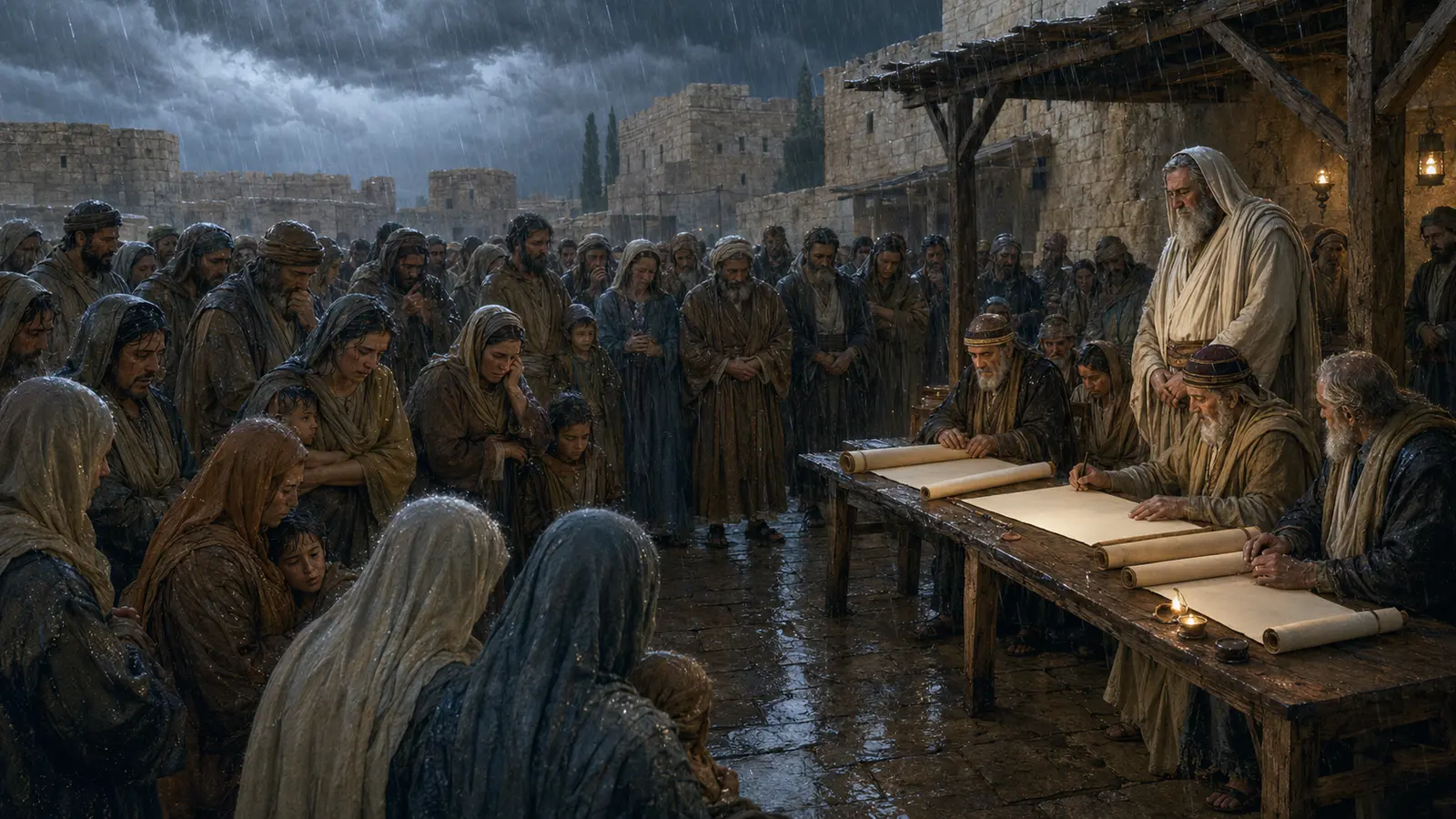
The chapter is not yet the reform action of Ezra 10. It is the spiritual diagnosis. Before policies are proposed, before assemblies gather in the rain, Ezra 9 brings the sin into the presence of God through grief, confession, and theological memory.
03
Walking Through the Text
When the Leaders Bring a Wound into the Light [Ezra 9:1–2]
The chapter begins: “After these things had been done, the officials approached me” [Ezra 9:1]. The timing is important. After safe arrival. After worship. After provision. After mercy. Then comes exposure.
The leaders report that the people of Israel, the priests, and the Levites have not separated themselves from the peoples of the lands with their abominations [Ezra 9:1]. The inclusion of priests and Levites is especially serious. Those called to guard holiness have themselves become entangled.
The report continues: “They have taken some of their daughters to be wives for themselves and for their sons, so that the holy seed has mixed itself with the peoples of the lands” [Ezra 9:2]. The phrase “holy seed” is weighty and easily misunderstood. It does not mean biological superiority. It refers to Israel’s covenant vocation—to be a holy people belonging to the Lord and set apart for his purposes [Exod. 19:5–6; Deut. 7:6].
The deepest wound comes at the end: “the hand of the officials and chief men has been foremost in this faithlessness” [Ezra 9:2]. Leaders have not merely failed to prevent the compromise; they have led in it. When leaders normalize unfaithfulness, the whole community learns to live with divided allegiance.
This is why the crisis is so grave. The restored community is young, fragile, and called to embody holiness after exile. If its leaders repeat the old drift, the return itself becomes endangered.
When the Teacher Grieves Before He Speaks [Ezra 9:3–4]
Ezra’s response is embodied grief. He tears his garment and cloak. He pulls hair from his head and beard. He sits appalled [Ezra 9:3].
He does not rush into strategy. He does not immediately form a committee. He does not manage the optics of the crisis. He mourns.
In Scripture, torn garments often signal grief, repentance, horror, or crisis before God [Gen. 37:29; Josh. 7:6; 2 Kgs. 22:11]. Ezra’s physical response shows that sin is not merely a problem to solve. It is a wound in covenant relationship.
Then “all who trembled at the words of the God of Israel” gather around him [Ezra 9:4]. This is a beautiful and searching phrase. Not everyone is described this way. The people who gather are those who still have spiritual sensitivity to the Word. They tremble—not in servile panic, but in reverent seriousness. They know that the Word of God is not light speech.
Ezra remains appalled until the evening sacrifice [Ezra 9:4]. That timing matters. The evening sacrifice is a place of prayer, atonement, and renewed appeal to mercy [Exod. 29:38–42; Ps. 141:2; Dan. 9:20–21]. Ezra’s grief waits at the threshold of worship.
When Shame Becomes Prayer [Ezra 9:5–7]
At the evening sacrifice, Ezra rises from his fasting, with torn garment and cloak, and falls on his knees, spreading out his hands to the Lord [Ezra 9:5]. His posture is surrender. His prayer begins not with accusation, but with shame: “O my God, I am ashamed and blush to lift my face to you” [Ezra 9:6].
This is not shallow embarrassment. It is covenant shame—the recognition that the people have sinned against mercy.
Ezra says, “our iniquities have risen higher than our heads, and our guilt has mounted up to the heavens” [Ezra 9:6]. He identifies with the people. Though he has just arrived and is not personally named among the offenders, he prays “our.” This is priestly intercession. He bears the community before God.
He then remembers the long story of guilt: “From the days of our fathers to this day we have been in great guilt” [Ezra 9:7]. Kings, priests, and people have been handed over to foreign kings because of their sins. The present crisis is not isolated. It belongs to a tragic pattern that led to sword, captivity, plunder, and shame.
Ezra understands sin historically. He knows that communities inherit patterns. The past is not an excuse, but it is a warning. The sins that ruined earlier generations can return in the lives of those who think exile itself cured them.
When Mercy Is Named as a Peg in the Holy Place [Ezra 9:8–9]
Ezra’s prayer turns to mercy: “But now for a brief moment favor has been shown by the LORD our God” [Ezra 9:8]. God has left a remnant and given them “a peg in his holy place,” that their eyes might be brightened and they might receive a little reviving in slavery [Ezra 9:8].
The image of a peg is humble but powerful. A peg gives something a secure place to hang. It suggests stability, foothold, attachment, a small but real claim in the house. The returned community does not yet have full glory, independence, or complete transformation. But they have a peg. They have mercy. They have a place again.
Ezra is deeply aware that this restoration is undeserved. The people are still servants under Persian rule, yet God has not forsaken them [Ezra 9:9]. He has extended steadfast love before the kings of Persia, giving them reviving to set up the house of God, repair its ruins, and receive protection in Judah and Jerusalem.
Mercy makes the sin more serious, not less. To compromise after judgment is tragic. To compromise after mercy is heartbreaking.
When the Commandment Exposes the Present Crisis [Ezra 9:10–12]
Ezra asks, “And now, O our God, what shall we say after this?” [Ezra 9:10]. The question is devastating. What can be said when mercy has been met with renewed unfaithfulness?
He recalls the commandment given through the prophets, warning that the land was polluted by the uncleanness and abominations of the peoples [Ezra 9:11]. The people were not to give their daughters to their sons or take their daughters for their sons, nor seek their peace and prosperity in ways that would compromise covenant faithfulness [Ezra 9:12].
The language draws deeply from Deuteronomy’s warnings about intermarriage leading Israel’s heart after other gods [Deut. 7:3–4]. The danger is spiritual allegiance. Israel’s calling was to be holy for the sake of God’s presence and ultimately for the blessing of the nations. But holiness cannot bless the nations if it dissolves into the same patterns from which it was called to witness.
Here again we must read with care. The biblical story is not anti-foreigner. The issue is not bloodline purity in a racial sense. It is covenant loyalty and worship. The nations are not excluded from mercy; they are invited to turn to the Lord. But Israel must not abandon its vocation by joining itself to practices that corrupt worship and justice.
When Grace Leaves the Community Speechless [Ezra 9:13–15]
Ezra closes by acknowledging that God has punished the people less than their iniquities deserved and has given them a remnant [Ezra 9:13]. This is the logic of mercy: judgment was real, but it was not total. God left a people alive.
Then Ezra asks the piercing question: should they now break God’s commandments again and intermarry with peoples who practice such abominations? Would not God be angry until he consumed them, so there would be no remnant or survivor? [Ezra 9:14]
The prayer ends without a proposed solution. Ezra simply stands before God: “Behold, we are before you in our guilt, for none can stand before you because of this” [Ezra 9:15].
That ending matters. Ezra does not resolve the crisis in prayer. He brings the community to the place where no excuse remains. This is confession before action. The people must first stand under the truth.
Ezra 9 ends in exposed guilt, but not hopelessness. The very act of prayer means the door of mercy has not yet closed.
04
Theological Reflection
Return Does Not Automatically Transform the Heart
Ezra 9 is one of the clearest examples of Ezra–Nehemiah’s central tension: the people have returned to the land, but the deeper exile of the heart remains unresolved. The temple is rebuilt. The sacrifices have resumed. The teacher of the Law has arrived. Yet covenant compromise persists.
This warns us against outward definitions of renewal. A church can reopen. A ministry can restart. A person can return to visible religious practice. But the deeper question remains: has the heart been reordered toward God?
Holiness Is Vocation, Not Superiority
Ezra’s concern for separation must be read through the lens of Israel’s calling. Israel is holy because God set the people apart for covenant relationship and priestly witness [Exod. 19:5–6]. Holiness is not contempt for others. It is consecration to God for the sake of the world.
When holiness becomes pride, it betrays its purpose. When mission becomes compromise, it loses its power. Ezra 9 stands in the tension between guarding covenant faithfulness and remembering that God’s promise to Abraham always aimed at blessing all families of the earth [Gen. 12:3].
True Leaders Grieve Sin Before Managing It
Ezra tears his garments and sits appalled before he acts [Ezra 9:3–4]. This is not weakness. It is spiritual seriousness. He understands that sin is not merely organizational disorder; it is relational betrayal before God.
Leadership that cannot grieve will become harsh, shallow, or political. Leadership that only grieves and never acts will become passive. Ezra 9 gives us the first movement: let sin become grief before God.
Confession Is Communal and Hopeful
Ezra prays “our” even though he has just arrived [Ezra 9:6–7]. He does not use communal language to avoid responsibility, but to intercede. He stands with the people under God’s mercy and truth.
Confession is hopeful because it tells the truth in the presence of the God who has already shown mercy. Ezra’s prayer remembers judgment, but also favor, remnant, reviving, and steadfast love [Ezra 9:8–9]. Confession does not deny grace; it depends on grace.
05
Life Application: Facing Compromise After Mercy
Do not assume outward return equals inward renewal. Rebuilt habits, restored routines, and visible worship must still be joined to a transformed heart.
Treat sin as relational betrayal, not merely a problem to manage. Ezra’s grief teaches us to recover holy seriousness before God.
Guard holiness without becoming proud. Separation from sin must never become contempt for people. Holiness is consecration for God’s mission.
Examine leadership patterns. When leaders are foremost in compromise, repentance must begin with those who carry influence.
Learn to tremble at the Word again. A tender heart still takes God’s speech seriously, even when the surrounding culture treats obedience lightly.
Tell the truth about inherited patterns. Some sins are not isolated incidents; they are old pathways returning in new clothes.
Let mercy deepen repentance. The fact that God has spared, restored, and revived us should make compromise more grievous, not less.
06
Reflection Questions
1. Where might your life show outward return but inward compromise?
2. What sin have you been managing that God is calling you to grieve and confess?
3. How can you pursue holiness without becoming harsh, proud, or exclusionary?
4. Are there old family, community, or spiritual patterns that are reappearing after a season of mercy?
5. What would it mean for you to stand honestly before God without excuses, trusting his mercy?
07
Response Prayer
Lord God of mercy and holiness,
we come before you with no excuses. You have opened roads for us, restored what we did not deserve, and given us a peg in your holy place. Yet our hearts still wander. Our old patterns still rise. Our obedience is often thinner than our songs.
Teach us to grieve what grieves you. Give us hearts that tremble at your Word, not because we are afraid of your cruelty, but because we trust your holiness. Save us from shallow repentance and from outward religion that leaves the inner life untouched.
Make us holy without making us proud. Make us open to your mission without making us careless with your covenant. Show us where compromise has entered through comfort, fear, desire, or imitation.
Thank you that judgment is not the only word. Thank you for remnant mercy, for reviving grace, for the place you give us again when we do not deserve to stand. Write your Law deeper than our habits. Rebuild the heart that exile did not heal.
Through Christ, our faithful priest and covenant keeper,
Amen.
08
Window into What Comes Next: When Confession Becomes Costly Action
Ezra 9 ends with prayer, shame, and exposed guilt. The teacher of the Law has not yet proposed a plan. He has simply brought the wound into the presence of God.
Ezra 10 will show the community responding with tears, trembling, and a difficult reform. The chapter will raise hard questions about holiness, marriage, family, leadership, and the limits of human reform. It will not allow easy answers. It will show a community trying to act on confession, while also leaving us with the ache of restoration that still cannot fully heal the human heart.
The robe has been torn.
Now the people must decide whether their hearts will be torn too.
09
Bibliography
Williamson, H. G. M. Ezra, Nehemiah. Word Biblical Commentary 16. Waco: Word Books, 1985.
Williamson, H. G. M. Ezra and Nehemiah. Old Testament Guides. Sheffield: JSOT Press, 1987.
Kidner, Derek. Ezra and Nehemiah. Tyndale Old Testament Commentaries. Downers Grove: InterVarsity Press, 1979.
Clines, David J. A. Ezra, Nehemiah, Esther. New Century Bible Commentary. Grand Rapids: Eerdmans, 1984.
Fensham, F. Charles. The Books of Ezra and Nehemiah. New International Commentary on the Old Testament. Grand Rapids: Eerdmans, 1982.
Blenkinsopp, Joseph. Ezra–Nehemiah: A Commentary. Old Testament Library. Philadelphia: Westminster, 1988.
BibleProject. “The Book of Ezra-Nehemiah.” Old Testament Overview Guide.
Be the first to leave a comment.