

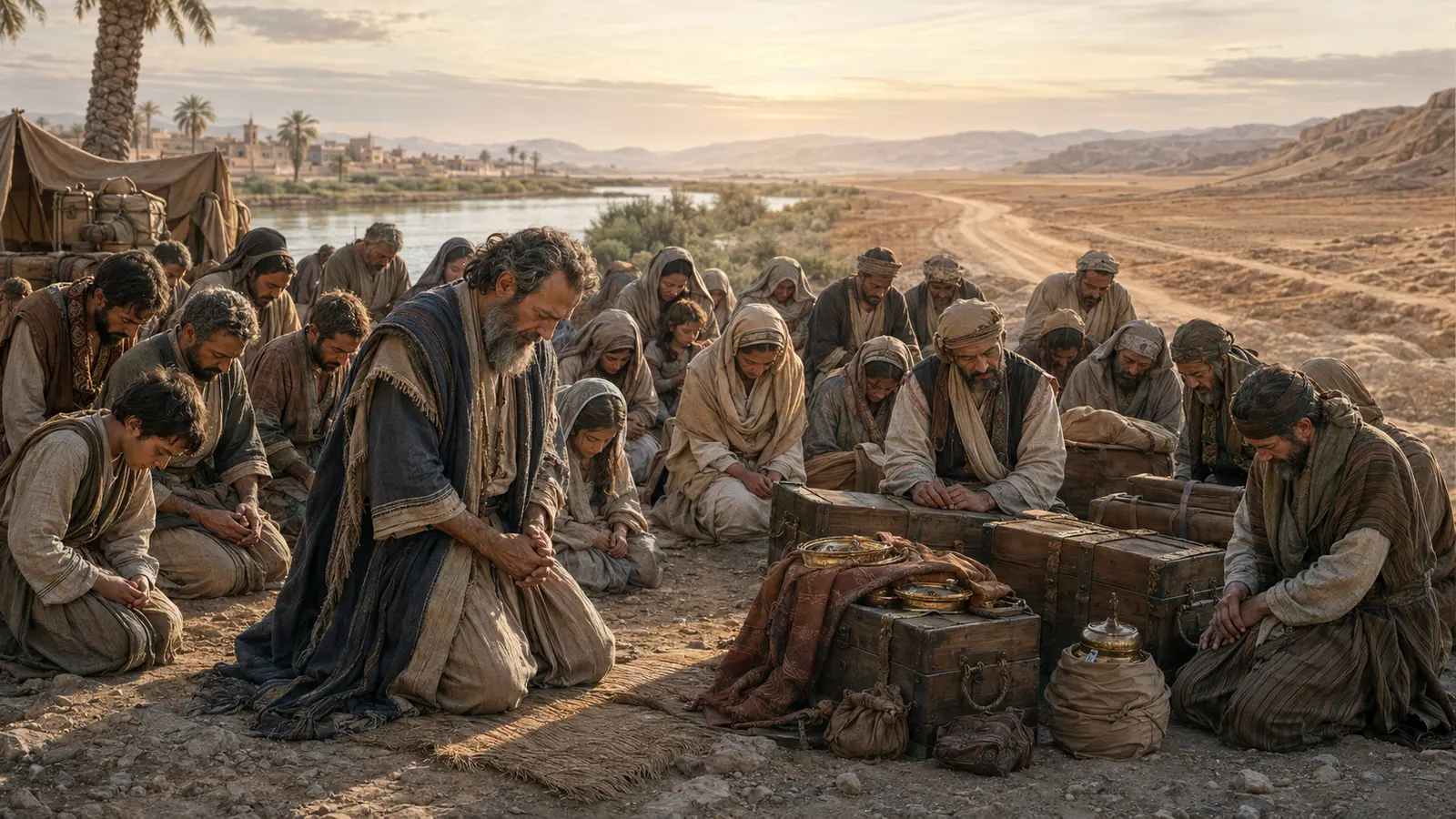
The scroll has found a servant, but the servant must now lead a people through danger. Between Babylon and Jerusalem lies a road of risk, responsibility, and holy dependence. Ezra gathers families, searches for Levites, proclaims a fast, entrusts sacred treasure, and walks without a military escort because he has testified that the good hand of God is upon all who seek him. This is faith with sandals on—careful, prayerful, accountable, and brave.
01
Introduction: When Faith Must Walk the Road It Has Preached
There are moments when our words must become footsteps.
Ezra has already told the king that the hand of God is for good upon all who seek him [Ezra 8:22]. That confession is beautiful in the palace. But now Ezra must live it on the road. The journey from Babylon to Jerusalem is long and exposed. There are families, children, servants, temple vessels, silver, gold, and sacred offerings. There are dangers along the way—bandits, ambushes, hunger, fear, and the heavy burden of responsibility.
Ezra could ask for soldiers. The empire would likely provide them. But because he has publicly testified to the protecting hand of God, he is ashamed to ask the king for military escort [Ezra 8:22]. So he proclaims a fast at the river Ahava. The people humble themselves. They seek from God a straight way for themselves, their children, and all their goods [Ezra 8:21].
Ezra 8 is not reckless spirituality. Ezra does not say, “God will protect us,” and then behave carelessly. He gathers the people. He notices the absence of Levites. He sends wise leaders to recruit temple servants. He weighs the treasure carefully. He appoints priests to guard it. He records accountability. He fasts and prays. Then he walks.
This text is about confessed faith becoming embodied trust, because the people who proclaim God’s hand must learn to walk the dangerous road with humility, wisdom, and prayer.
02
Historical and Literary Context: The Journey Between Commission and Community
Ezra 7 introduced Ezra as priest, scribe, and teacher of the Law of the Lord. He had set his heart to study, do, and teach God’s instruction in Israel [Ezra 7:10]. Artaxerxes granted him authority, resources, and permission to lead another group of exiles to Jerusalem. Ezra ended the chapter blessing God, because the good hand of the Lord had strengthened him [Ezra 7:27–28].
Ezra 8 now narrates the journey itself. It is a chapter of transition, but not mere travel detail. It shows the spiritual character of Ezra’s leadership. The road becomes a testing ground where prayer, planning, accountability, holiness, and trust must walk together.
The chapter unfolds in five movements:
1. The list of those who go up with Ezra [8:1–14].
2. The discovery that no Levites are present and the recruitment of servants for the house of God [8:15–20].
3. The fast at Ahava and prayer for safe passage [8:21–23].
4. The weighing and entrusting of temple treasure [8:24–30].
5. The safe arrival in Jerusalem, the delivery of treasure, and renewed worship [8:31–36].
Ezra 8 belongs to the larger movement of restoration where the community must be formed by Torah, worship, and faithful leadership. The temple already stands, but now a teacher of the Law comes with people, gifts, and sacred responsibility. The chapter teaches that restoration is not sustained by inspiration alone. It requires ordered trust.
03
Walking Through the Text
When Names Become Pilgrimage [Ezra 8:1–14]
Ezra begins with a list of family heads and those registered with them who went up from Babylon during the reign of Artaxerxes [Ezra 8:1]. Like Ezra 2, this list may feel slow to modern readers, but it matters deeply. These are not anonymous travelers. They are families stepping into covenant risk.
The list includes priestly and Davidic connections, along with representatives from various families [Ezra 8:2–14]. The movement is communal and generational. The return is not merely Ezra’s private mission. It is a shared pilgrimage of households.
Lists in Ezra–Nehemiah often do holy work. They remember the people. They give shape to the community. They say that restoration is not an idea floating above history; it is carried by named persons and families willing to leave Babylon and walk toward Jerusalem.
The road home is theological, but it is also dusty. It has names. It has children. It has possessions. It has fears. It has responsibility.
When a Missing Ministry Must Be Found [Ezra 8:15–20]
Ezra gathers the travelers by the river that runs to Ahava, and they camp there three days [Ezra 8:15]. As he reviews the people and priests, he finds no Levites among them. This is a problem.
The mission is centered on the house of God, the teaching of the Law, and the ordering of worship. Levites are not decorative. They serve, assist, teach, guard, and support the worshiping life of the community [Num. 3:5–13; Deut. 33:10]. A journey meant to strengthen temple worship cannot casually proceed without them.
Ezra responds with practical wisdom. He sends leading men and men of insight to Iddo at Casiphia, asking for ministers for the house of God [Ezra 8:16–17]. The result is provision: Sherebiah, Hashabiah, Jeshaiah, and temple servants come, “by the good hand of our God on us” [Ezra 8:18–20].
This scene is a beautiful union of planning and providence. Ezra notices the gap. He takes action. God provides. The good hand of God does not make leadership passive; it makes leadership attentive and hopeful.
Spiritual communities often suffer when missing ministries are ignored. Ezra teaches us to pause, examine, recruit wisely, and seek God’s provision for what the work truly requires.
When Fasting Becomes the Road’s First Step [Ezra 8:21–23]
Before the caravan moves, Ezra proclaims a fast at the river Ahava [Ezra 8:21]. The purpose is clear: “that we might humble ourselves before our God, to seek from him a safe journey for ourselves, our children, and all our goods.”
This is leadership at its most tender and serious. Ezra does not only pray for the mission in general. He names the vulnerable: children and possessions. He knows that faith travels with real people and real risks.
Then he explains why he did not ask the king for soldiers and horsemen: he had told the king that the hand of God is for good on all who seek him, and that God’s power and wrath are against those who forsake him [Ezra 8:22]. Ezra’s public testimony now shapes his private decision.
This does not mean it is always wrong to use available protection. Nehemiah later accepts a military escort [Neh. 2:9]. Ezra’s decision is shaped by his particular testimony and situation. The principle is not that faith must refuse all ordinary means. The principle is integrity: our actions should not contradict the God we have proclaimed.
So they fast. They seek God. And “he listened to our entreaty” [Ezra 8:23].
Prayer here is not ornament. It is dependence. Fasting is not religious theater. It is embodied humility. Before their feet touch the road, their hearts bow low.
When Holy Treasure Requires Holy Accountability [Ezra 8:24–30]
Ezra appoints twelve leading priests and weighs out the silver, gold, and vessels given for the house of God [Ezra 8:24–27]. The numbers are large. The treasure is sacred. The responsibility is heavy.
Ezra tells them, “You are holy to the LORD, and the vessels are holy” [Ezra 8:28]. This sentence holds together identity and stewardship. Holy people must handle holy things in holy ways.
He commands them to guard the treasure until it is weighed before the chief priests, Levites, and heads of fathers’ houses in Jerusalem [Ezra 8:29]. Then the priests and Levites receive the weighed silver, gold, and vessels [Ezra 8:30].
This is not distrust; it is accountability. Ezra does not spiritualize responsibility away. He creates clear processes for receiving, guarding, transporting, and delivering what belongs to God.
Many communities fail here. They pray loudly but handle resources loosely. They speak of holiness but neglect accountability. Ezra 8 refuses that split. Prayer at Ahava and weighed treasure belong together. Faith does not replace careful stewardship; faith requires it.
When the Good Hand Brings Them Home [Ezra 8:31–36]
The caravan departs from Ahava on the twelfth day of the first month [Ezra 8:31]. Ezra testifies that the hand of God was upon them, and he delivered them from the hand of the enemy and from ambushes by the way [Ezra 8:31]. The feared dangers were real. The deliverance was real.
They arrive in Jerusalem and rest three days [Ezra 8:32]. Even holy journeys require rest. The work of God does not erase human limits.
On the fourth day, the silver, gold, and vessels are weighed into the house of God and recorded by weight [Ezra 8:33–34]. The trust given at the beginning is fulfilled at the end. What was consecrated in Babylon is delivered in Jerusalem.
Then the returned exiles offer burnt offerings to the God of Israel: twelve bulls for all Israel, ninety-six rams, seventy-seven lambs, and twelve male goats as a sin offering [Ezra 8:35]. Again, the language of “all Israel” matters. This small returned community worships on behalf of the whole covenant people.
Finally, they deliver the king’s commissions to the satraps and governors, who support the people and the house of God [Ezra 8:36]. The chapter ends with both worship and administrative cooperation. God’s hand has carried them through the road and into the next stage of service.
04
Theological Reflection
The Hand of God Does Not Cancel Human Responsibility
Ezra repeatedly speaks of the good hand of God [Ezra 8:18, 22, 31]. Yet the chapter is full of careful action. Ezra gathers, inspects, sends, recruits, fasts, appoints, weighs, entrusts, records, rests, sacrifices, and delivers documents.
This is a vital biblical balance. Trusting God does not mean neglecting wisdom. Depending on grace does not mean ignoring preparation. The hand of God works through responsible obedience.
Leadership Requires Integrity Between Testimony and Practice
Ezra’s refusal to ask for soldiers is rooted in what he had told the king [Ezra 8:22]. He does not want his actions to contradict his public witness. Again, this does not establish a universal rule against protection, but it does reveal a heart of integrity.
Faithful leadership asks: Do my decisions align with what I proclaim about God? Are my methods consistent with my message?
Prayer and Accountability Belong Together
Ezra fasts and prays for safe passage [Ezra 8:21–23]. He also weighs the treasure and appoints trustworthy guardians [Ezra 8:24–30]. The chapter refuses to separate spirituality from administration.
A healthy community prays like everything depends on God and stewards like everything belongs to God. Prayer without accountability becomes carelessness. Accountability without prayer becomes self-reliance.
Restoration Includes the Vulnerable
Ezra prays for “ourselves, our children, and all our goods” [Ezra 8:21]. This small phrase widens the emotional world of the chapter. Restoration is not only about leaders, documents, and temple vessels. It is about children on dangerous roads.
God’s work must always consider the vulnerable. A mission that forgets children, families, the weak, or the exposed has forgotten something central to the heart of God.
05
Life Application: Walking the Road with Holy Trust
Pause before major movement. Ezra camps at Ahava before proceeding. Some journeys need prayerful review before action.
Notice what is missing. Ezra sees that no Levites are present. Faithful leadership identifies gaps rather than pretending all is well.
Seek God before seeking safety. Protection matters, but dependence matters more. Let prayer be the first step of the road.
Align practice with testimony. Do not proclaim trust in God while quietly building your life on fear.
Handle holy resources with accountability. Money, gifts, time, influence, and sacred responsibilities should be weighed, guarded, and delivered faithfully.
Remember the vulnerable in every plan. Ask how decisions affect children, families, new believers, the poor, and those with less power.
Rest after hard journeys. The travelers rest three days in Jerusalem. Rest can be an act of wisdom, not weakness.
06
Reflection Questions
1. What journey or responsibility in your life requires prayerful trust rather than anxious control?
2. Where do you need to pause and examine what is missing before moving forward?
3. Are your decisions consistent with what you publicly confess about God?
4. What sacred treasure has God entrusted to you, and how are you guarding it with accountability?
5. Who are the vulnerable people affected by your obedience, leadership, or decisions?
07
Response Prayer
Lord God whose good hand guides the road,
teach us to walk with humble trust. Before we move, make us still enough to seek you. Before we lead, make us wise enough to notice what is missing. Before we speak of faith, make our lives honest enough to embody it.
Protect us, our children, and all that you have entrusted to us. Deliver us from dangers we can see and dangers hidden along the way. But even more, deliver us from pride, haste, carelessness, and fear.
Make us faithful stewards of holy treasure. Let our prayers be deep and our accountability clear. Let our worship be sincere and our leadership clean. Help us carry what belongs to you with reverence until it reaches the place you have appointed.
And when we arrive after long roads, teach us to rest, to give thanks, to offer worship, and to remember that every safe arrival is mercy.
Amen.
08
Window into What Comes Next: When the Holy People Face an Unholy Compromise
Ezra 8 ends with safe arrival, delivered treasure, worship, and support for the house of God. The journey has succeeded. The hand of God has protected the people.
But the next chapter will reveal that the greatest danger was not on the road. It was inside the community.
Ezra 9 will confront the painful issue of covenant compromise through intermarriage with surrounding peoples. The teacher of the Law, who arrived safely with sacred treasure, will now tear his garments and sit appalled because the holy seed has mingled in ways that threaten Israel’s vocation.
The road has been guarded.
Now the heart of the community must be examined.
09
Bibliography
Williamson, H. G. M. Ezra, Nehemiah. Word Biblical Commentary 16. Waco: Word Books, 1985.
Williamson, H. G. M. Ezra and Nehemiah. Old Testament Guides. Sheffield: JSOT Press, 1987.
Kidner, Derek. Ezra and Nehemiah. Tyndale Old Testament Commentaries. Downers Grove: InterVarsity Press, 1979.
Clines, David J. A. Ezra, Nehemiah, Esther. New Century Bible Commentary. Grand Rapids: Eerdmans, 1984.
Fensham, F. Charles. The Books of Ezra and Nehemiah. New International Commentary on the Old Testament. Grand Rapids: Eerdmans, 1982.
Blenkinsopp, Joseph. Ezra–Nehemiah: A Commentary. Old Testament Library. Philadelphia: Westminster, 1988.
BibleProject. “The Book of Ezra-Nehemiah.” Old Testament Overview Guide.
Be the first to leave a comment.