

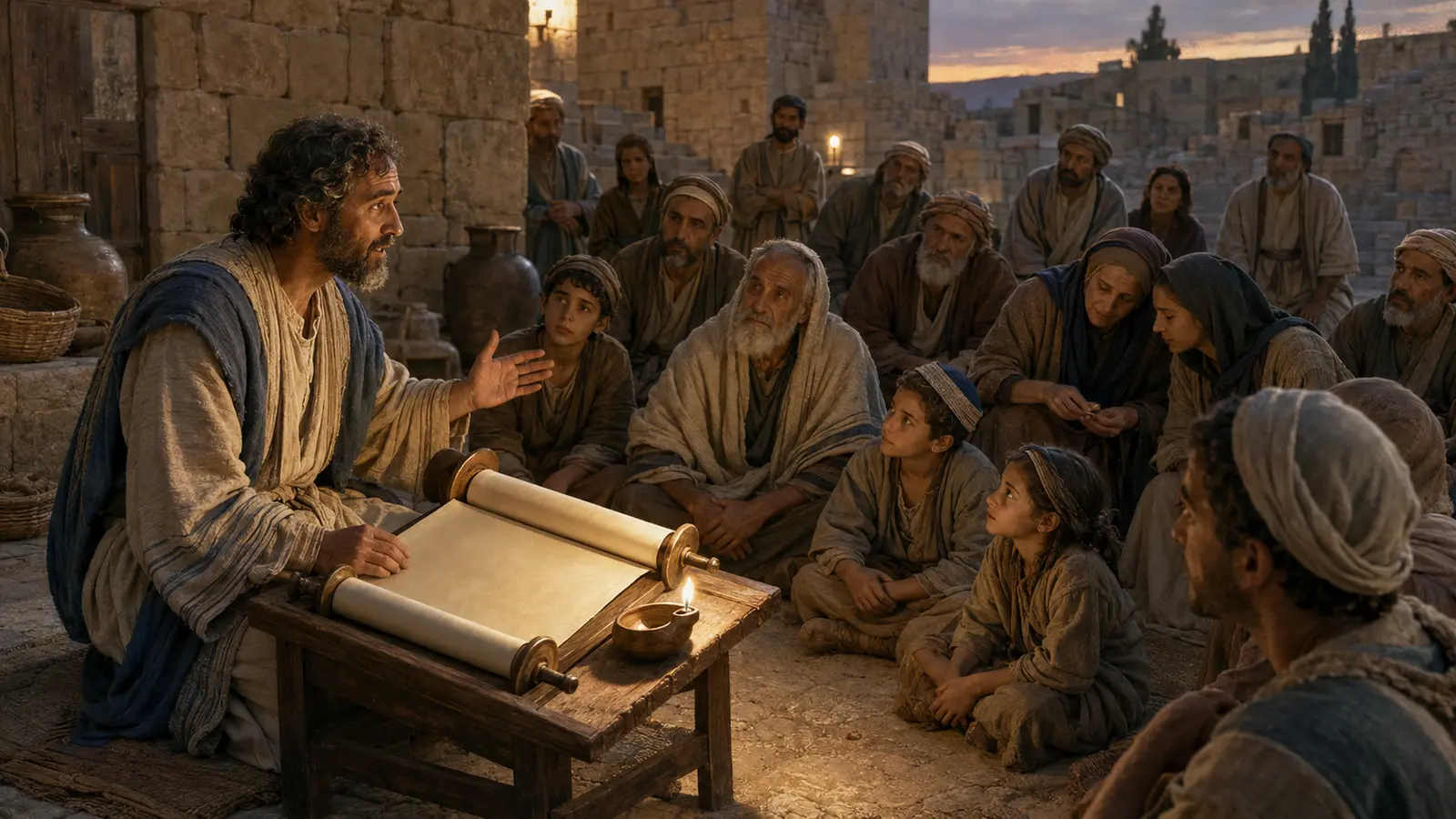
The temple has been rebuilt, but the people still must be formed. Stones can stand while hearts wander. Altars can smoke while obedience grows thin. So the story turns from cedar and sacrifice to Scripture and teaching. Ezra comes up from Babylon with the scroll in his bones, the hand of God upon him, and a holy calling: to study, to do, and to teach the Law of the Lord.
01
Introduction: When Rebuilding Needs Teaching
It is possible to rebuild a house and still leave a family unrepaired.
Ezra 1–6 told the story of return, altar, foundation, opposition, prophetic renewal, temple completion, dedication, and Passover joy. The house of God stands again. The people have tasted the mercy of return. The worship calendar has begun to breathe. Yet Ezra–Nehemiah knows a hard truth: a rebuilt temple does not automatically produce a rebuilt people.
A community can recover its buildings and still lose its way. It can restore worship forms while the heart remains untrained. It can celebrate Passover and still need deeper obedience. So Ezra 7 begins a new movement in the book. The focus shifts from the rebuilding of the temple to the reforming of the community through the Law of God.
Ezra is introduced not first as a builder, governor, warrior, or fundraiser, but as a priest and scribe “skilled in the Law of Moses” [Ezra 7:6]. His life is summarized in one of the most important verses in the book: “Ezra had set his heart to study the Law of the LORD, and to do it and to teach his statutes and rules in Israel” [Ezra 7:10].
That order matters. Study. Do. Teach. The scroll must enter the servant before it shapes the community.
This text is about rebuilt worship becoming Scripture-shaped formation, because God’s people need more than a restored house; they need hearts trained by the Word and strengthened by the gracious hand of God.
02
Historical and Literary Context: A New Phase of Restoration
Ezra 7 takes place many decades after the temple’s completion in Ezra 6. The narrative moves to the reign of Artaxerxes king of Persia [Ezra 7:1]. The first movement under Zerubbabel centered on the temple [Ezra 1–6]. The second movement under Ezra centers on Torah instruction and communal reform [Ezra 7–10].
This fits the broader pattern of Ezra–Nehemiah: each major restoration leader is connected to Persian permission, divine providence, opposition or crisis, and a partial renewal that reveals the need for deeper transformation. Zerubbabel rebuilds the temple. Ezra brings the Law. Nehemiah later rebuilds the wall. Yet none of these works, by themselves, can fully heal the heart of the people.
Ezra 7 unfolds in four major scenes:
1. Ezra’s identity and priestly-scribal lineage are introduced [7:1–6].
2. Ezra journeys from Babylon to Jerusalem with the good hand of God upon him [7:7–10].
3. Artaxerxes issues a decree authorizing Ezra’s mission [7:11–26].
4. Ezra blesses God for turning the king’s heart and strengthening him [7:27–28].
The chapter is full of repeated themes: the Law of Moses, the God of heaven, the hand of God, royal authorization, temple support, wisdom, judgment, and teaching. It shows that God can use imperial power to create space for renewal, but the true center of renewal is not the king’s decree. It is the Word of God embodied in a faithful servant.
03
Walking Through the Text
When the Servant Is Rooted in a Priestly Story [Ezra 7:1–5]
Ezra is introduced through genealogy. His ancestry is traced back through priestly lines to Aaron the chief priest [Ezra 7:1–5]. To modern readers, this may feel like a slow beginning. But in Ezra–Nehemiah, names and lines matter. Restoration is not self-invention. Ezra’s ministry is rooted in covenant memory.
By tracing Ezra to Aaron, the text presents him as a legitimate priestly figure. He is not merely an educated man with religious interests. He stands within the priestly calling of Israel, the vocation of teaching, guarding holiness, and helping the people live before the presence of God [Lev. 10:10–11; Deut. 33:10; Mal. 2:7].
This matters because the temple has been rebuilt. A rebuilt temple needs more than walls and offerings; it needs priests who understand holiness and scribes who can teach the Law. Ezra’s genealogy says: God is not only restoring structures; he is raising servants suited for the next stage of renewal.
When Skill in the Law Becomes a Gift for the Community [Ezra 7:6]
Ezra is described as “a scribe skilled in the Law of Moses that the LORD, the God of Israel, had given” [Ezra 7:6]. This phrase is rich. The Law is not merely national tradition or religious literature. It is gift: the Law that the Lord had given.
Ezra’s skill is therefore not academic pride. It is stewardship. He has been entrusted with the sacred wisdom that forms God’s people. His learning is for service, not status.
The verse also says the king granted Ezra all that he asked, “for the hand of the LORD his God was on him” [Ezra 7:6]. The hand of God is one of the key phrases in Ezra 7. It names providence, favor, protection, and empowerment. Ezra is skilled, but skill alone does not explain his mission. The invisible hand of God is guiding the visible permission of the king.
In biblical terms, this is not a competition between preparation and grace. Ezra studies deeply, and God’s hand rests upon him. Faithfulness and favor meet.
When the Journey Is Measured by Grace [Ezra 7:7–9]
Ezra comes up from Babylon with Israelites, priests, Levites, singers, gatekeepers, and temple servants [Ezra 7:7]. The list echoes earlier restoration language. This is another return, another movement from exile toward worship.
The journey begins in the first month and reaches Jerusalem in the fifth month [Ezra 7:8–9]. The text marks time carefully, but it interprets the journey theologically: Ezra arrives “for the good hand of his God was on him” [Ezra 7:9].
Again, the journey is not explained only by logistics. Roads, permissions, companions, and provisions matter, but Ezra wants us to see grace beneath them. The good hand of God carries the servant toward the city.
This phrase is deeply pastoral. The hand of God does not remove all risk, as Ezra 8 will show when the travelers fast and seek protection [Ezra 8:21–23]. But God’s hand gives courage to move. Grace is not always a smooth road; sometimes it is the strength to walk the road with trust.
When the Heart Is Set: Study, Do, Teach [Ezra 7:10]
Ezra 7:10 is the heart of the chapter: “For Ezra had set his heart to study the Law of the LORD, and to do it and to teach his statutes and rules in Israel.”
This verse is a spiritual anatomy of faithful teaching.
First, Ezra set his heart to study. Study is not casual here. It is devotion, discipline, and desire. The heart is not opposed to the mind; the heart is the center of attention, will, affection, and intention. Ezra gives himself to the Word because the people of God cannot be formed by a teacher who has only skimmed the surface.
Second, Ezra set his heart to do it. The teacher must become a practitioner. The scroll must become flesh in habits, decisions, worship, justice, holiness, and courage. In Scripture, knowing without doing is a dangerous illusion [Deut. 6:1–9; James 1:22].
Third, Ezra set his heart to teach. Teaching comes last, not because it is least important, but because it must flow from studied obedience. Ezra does not teach as a performer of religious information. He teaches as one who has placed his own life under the Word.
This is one of the great leadership texts in the Old Testament. It gives a pattern for every pastor, Bible instructor, parent, small-group leader, and disciple: study deeply, obey humbly, teach faithfully.
When the King Authorizes the Mission [Ezra 7:11–26]
The decree of Artaxerxes is long and formal. It authorizes Ezra, “the priest, the scribe of the Law of the God of heaven,” to go to Jerusalem and inquire about Judah and Jerusalem according to the Law of God [Ezra 7:11–14]. It permits offerings, provides resources for temple worship, and commands treasurers beyond the River to supply what is needed [Ezra 7:15–22].
The decree recognizes the importance of the temple and the Law. Artaxerxes wants the house of the God of heaven honored so wrath does not fall on the king and his sons [Ezra 7:23]. His motives are imperial and religious in the Persian sense. Yet, as before with Cyrus and Darius, Ezra sees God at work through royal policy.
The decree also gives Ezra authority to appoint magistrates and judges who know the laws of God, and to teach those who do not know them [Ezra 7:25]. This is crucial. Ezra’s mission is not only liturgical support for the temple. It is public instruction and communal ordering under the Law.
The chapter therefore shows a movement from temple restoration to Torah formation. The community must become a people whose life is taught, judged, and shaped by the Word.
Yet this too carries tension. External authorization can support reform, but it cannot guarantee heart transformation. A king can empower Ezra to teach the Law, but only God can write the Law on the heart [Jer. 31:31–34; Ezek. 36:26–27]. Ezra 7 opens a necessary stage of renewal, but it also points beyond itself.
When Ezra Blesses the God Who Turns Hearts [Ezra 7:27–28]
The chapter ends in first-person praise. Ezra blesses “the LORD, the God of our fathers,” who put such a thing into the heart of the king, to beautify the house of the Lord in Jerusalem [Ezra 7:27]. He recognizes that favor before the king and his counselors is the mercy of God [Ezra 7:28].
Then Ezra says, “I took courage, for the hand of the LORD my God was on me” [Ezra 7:28]. This is not self-confidence. It is God-strengthened courage. Ezra is aware of the size of the task. He must lead people, carry resources, teach Scripture, confront disorder, and help shape a fragile post-exilic community.
He does not say, “I was enough.” He says, in effect, “God’s hand was upon me, and I was strengthened.”
That is the posture of faithful ministry: humble courage under the hand of God.
04
Theological Reflection
The Temple Needs the Torah
Ezra 7 teaches that rebuilt worship must be joined to Scripture-shaped formation. The house of God has been restored, but the people need instruction. Sacrifice without obedience becomes hollow. Temple without Torah becomes fragile.
This pattern runs throughout Scripture. God’s presence among his people is always connected to God’s instruction for his people [Exod. 19–20; Deut. 6:4–9; Ps. 119:105]. Worship and Word belong together.
The Teacher Must Be Formed Before Teaching
Ezra 7:10 offers a holy order: study, do, teach. The teacher is not a mere messenger of unused truth. The teacher is a servant being shaped by the Word before speaking the Word.
This does not mean teachers must be perfect. Ezra himself will face hard and complicated reforms. But it does mean that teaching must come from submitted life. Authority in Scripture is not performance; it is faithful surrender.
God’s Hand Works Through Human Preparation
Ezra is skilled in the Law, and the hand of God is upon him [Ezra 7:6]. These are not opposites. God’s grace does not make study unnecessary; it makes study fruitful. Human diligence does not replace dependence; it becomes the vessel through which dependence is expressed.
The chapter therefore calls us away from both laziness and self-reliance. Prepare deeply. Depend completely.
Imperial Favor Can Assist Renewal, But Cannot Complete It
Artaxerxes gives authority, resources, and permission. These are gifts of providence. But the larger story will show that reform remains incomplete. External structures can support obedience, but they cannot create new hearts.
Ezra 7 therefore raises hope while preserving longing. The Law is coming to Jerusalem through a faithful teacher. Yet the people still need the deeper covenant renewal promised by the prophets—a renewal written not only on scrolls, but on hearts [Jer. 31:33].
05
Life Application: Becoming Servants of the Scroll
Set your heart before you set your schedule. Ezra’s discipline begins with desire. Ask God to awaken love for his Word, not mere duty.
Study before speaking. Do not rush to teach what you have not patiently received, wrestled with, and understood.
Practice before instructing. The Word must become obedience in your own life before it becomes counsel for others.
Teach for formation, not display. Biblical teaching is not performance. It is service that helps God’s people become faithful.
Recognize the hand of God in open doors. When favor, resources, or permission come, receive them with gratitude and humility.
Do not confuse external support with inward renewal. Programs, buildings, funds, and permissions can help, but the heart must still be formed by God.
Take courage under God’s hand. The work may be larger than you, but you are not carrying it alone.
06
Reflection Questions
1. Have you set your heart to study the Word of God, or only to use it when needed?
2. Where is God calling you to obey before you teach, advise, or correct others?
3. What open door in your life should be received as evidence of God’s gracious hand?
4. Are you relying more on external structures than inward formation?
5. How can you help your family, church, or community become more deeply shaped by Scripture?
07
Response Prayer
Lord God of heaven,
thank you for giving your Word as light for the road home. Thank you that you do not only rebuild houses of worship, but call your people to become living witnesses shaped by your instruction.
Set our hearts like Ezra’s heart. Teach us to study with hunger, obey with humility, and teach with faithfulness. Save us from speaking truth we refuse to practice. Save us from using Scripture for display while keeping our lives outside its reach.
Let your good hand be upon us. Open doors that serve your purpose, provide what strengthens your people, and give courage for the work you have entrusted to us. When the task feels too large, remind us that your hand is stronger than our weakness.
Write your Word not only on pages before us, but within us. Form our homes, churches, ministries, and communities by your truth. Make us a people whose worship is deepened by obedience and whose teaching is warmed by love.
Through Christ, the living Word and true temple of your presence,
Amen.
08
Window into What Comes Next: When the Journey Requires Trust
Ezra 7 introduces the servant of the scroll. Ezra has favor, authority, resources, and a calling. The hand of God is upon him. But the journey from Babylon to Jerusalem is still ahead, and the road is not without danger.
Ezra 8 will slow down to show the practical and spiritual weight of that journey. People must be gathered. Levites must be found. Treasure must be entrusted. Fasting and prayer must cover the road. Ezra must decide whether to rely on imperial protection or public trust in the God whose hand he has proclaimed.
The scroll has found a servant.
Now the servant must lead a people along the road of trust.
09
Bibliography
Williamson, H. G. M. Ezra, Nehemiah. Word Biblical Commentary 16. Waco: Word Books, 1985.
Williamson, H. G. M. Ezra and Nehemiah. Old Testament Guides. Sheffield: JSOT Press, 1987.
Kidner, Derek. Ezra and Nehemiah. Tyndale Old Testament Commentaries. Downers Grove: InterVarsity Press, 1979.
Clines, David J. A. Ezra, Nehemiah, Esther. New Century Bible Commentary. Grand Rapids: Eerdmans, 1984.
Fensham, F. Charles. The Books of Ezra and Nehemiah. New International Commentary on the Old Testament. Grand Rapids: Eerdmans, 1982.
Blenkinsopp, Joseph. Ezra–Nehemiah: A Commentary. Old Testament Library. Philadelphia: Westminster, 1988.
BibleProject. “The Book of Ezra-Nehemiah.” Old Testament Overview Guide.
Be the first to leave a comment.