

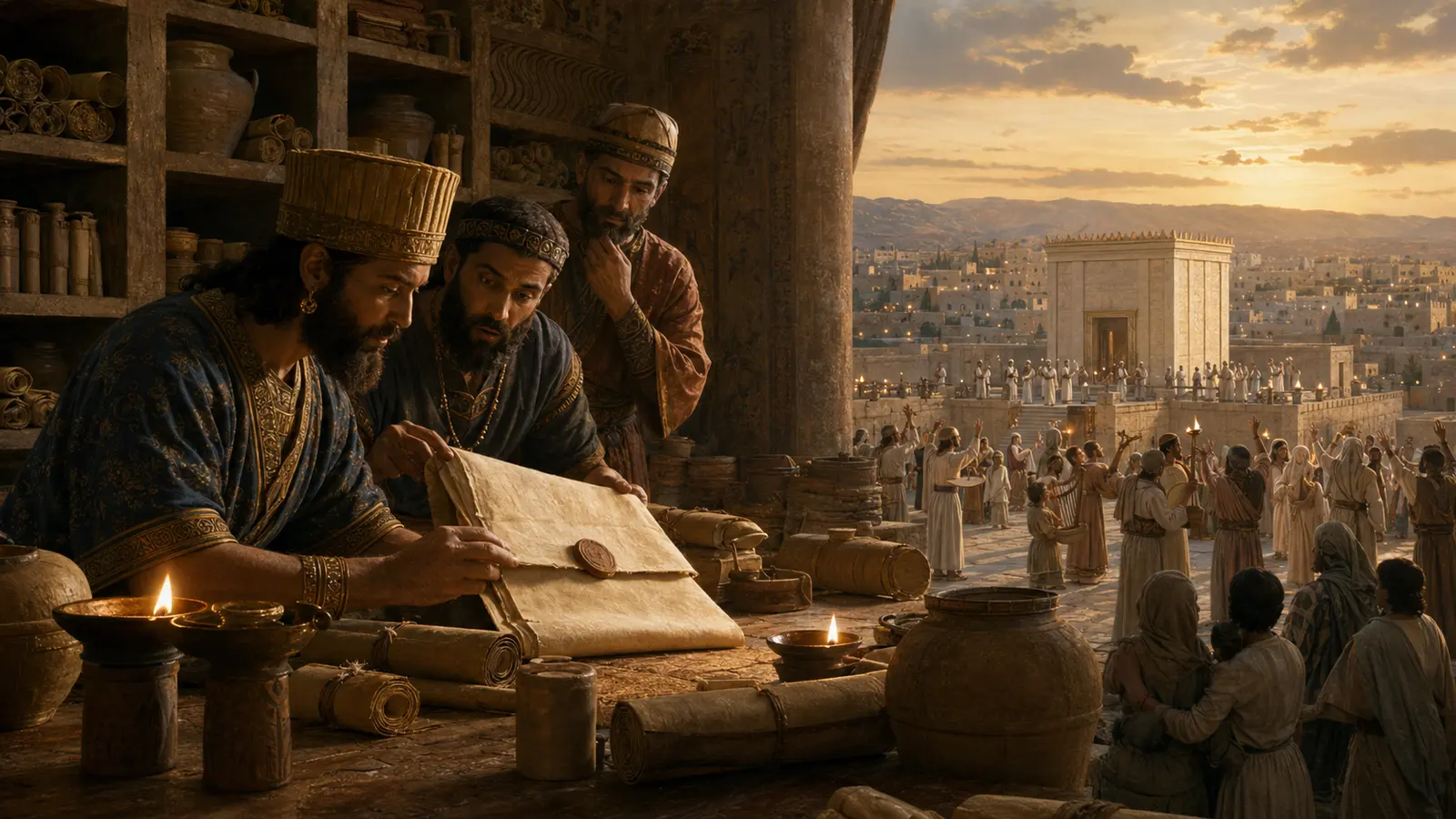
The question sent to the empire becomes the doorway of provision. The archive is searched, the old decree is found, and the work that fear had stopped begins to move again under unexpected protection. Yet the true wonder is not that Darius confirms Cyrus, but that God turns delay into completion, opposition into support, and a rebuilt house into a table of Passover joy.
01
Introduction: When God Turns Investigation into Provision
Sometimes the thing we fear will stop the work becomes the very channel God uses to sustain it.
In Ezra 5, the temple rebuilding resumed under the prophetic ministry of Haggai and Zechariah. The people rose again, not because opposition vanished, but because the Word of God became stronger than the atmosphere of fear. Then came the official question: Who gave you permission to build this house? Tattenai sent a report to Darius, asking for the archives to be searched [Ezra 5:17].
Ezra 6 answers that question.
The search is made. The decree of Cyrus is found. Darius not only permits the work to continue; he commands the provincial officials to support it financially and materially [Ezra 6:6–12]. What looked like a threat becomes provision. What seemed like another bureaucratic delay becomes confirmation. The empire’s archive becomes, unexpectedly, a witness to God’s faithfulness.
But Ezra 6 is not merely about legal vindication. It moves from decree to completion, from completion to dedication, from dedication to Passover. The temple is finished. Sacrifices are offered. Priests and Levites are set in order. The returned exiles celebrate the feast that remembers the first exodus. Joy returns to Jerusalem.
Still, the chapter is quietly restrained. There is no fire from heaven as in Leviticus 9. No glory cloud fills the house as in Solomon’s temple [1 Kgs. 8:10–11]. The temple is completed, but the story is not consummated. Restoration is real, yet still waiting for deeper fullness.
This text is about delayed rebuilding becoming covenant joy, because God can turn imperial scrutiny into provision and unfinished obedience into worshipful completion.
02
Historical and Literary Context: From Prophetic Reawakening to Temple Completion
Ezra 6 completes the first major section of Ezra–Nehemiah: the return under Zerubbabel and the rebuilding of the temple [Ezra 1–6]. This movement began with Cyrus’ decree, the return of the temple vessels, and the gathering of the remnant [Ezra 1–2]. It continued with the altar, foundation, opposition, delay, and prophetic reawakening [Ezra 3–5]. Now the house is finally completed and dedicated.
Historically, the chapter sits in the reign of Darius I. The temple is completed in the sixth year of Darius, traditionally dated to 515 BC [Ezra 6:15]. That date carries symbolic weight: roughly seventy years after the destruction of the first temple in 586 BC, the second temple stands. Jeremiah’s word of return and restoration continues to echo behind the narrative [Jer. 25:11–12; 29:10].
Literarily, Ezra 6 moves in four scenes:
1. The decree of Cyrus is found in the archives [6:1–5].
2. Darius commands support and protection for the rebuilding [6:6–12].
3. The temple is completed and dedicated with ordered worship [6:13–18].
4. The returned exiles celebrate Passover and the Feast of Unleavened Bread with joy [6:19–22].
The chapter is full of reversals. Opposition becomes assistance. Inquiry becomes authorization. Delay becomes completion. Exile gives way to Passover joy. Yet the quiet absence of visible glory reminds us that the deeper hope of God’s presence is still stretching forward.
03
Walking Through the Text
When the Archive Remembers What the People Feared Was Lost [Ezra 6:1–5]
Darius orders a search of the royal archives, and a scroll is found at Ecbatana in the province of Media [Ezra 6:1–2]. The location matters. The decree was not found in Babylon where Tattenai expected, but in another royal archive. God’s faithfulness was not absent; it was stored in a place the investigators had not first imagined.
The memorandum recalls Cyrus’ original authorization: the house of God in Jerusalem is to be rebuilt, sacrifices are to be offered, its dimensions are specified, expenses are to be paid from the royal treasury, and the vessels taken by Nebuchadnezzar are to be returned [Ezra 6:3–5].
This is more than administrative memory. In Ezra’s theological telling, the archive becomes an instrument of providence. Human documents cannot create God’s promise, but God can use human documents to protect what he has promised.
The people had been accused, delayed, and questioned. Yet somewhere in the empire’s records, the old mercy was waiting to be found.
This is a tender reminder: what God has spoken is not lost simply because people forget it. His purposes do not depend on the memory of opponents, officials, or even weary builders. The God who stirred Cyrus also preserved the evidence needed in Darius’ day.
When the King Commands the Opponents to Help [Ezra 6:6–12]
Darius’ response is forceful. Tattenai and his associates are commanded to keep away and let the work continue [Ezra 6:6–7]. Then the reversal deepens: the cost of rebuilding is to be paid in full from the royal revenue of the province Beyond the River [Ezra 6:8]. The officials who investigated the work must now support it.
Darius also orders that animals, wheat, salt, wine, and oil be supplied daily for the sacrifices, “that they may offer pleasing sacrifices to the God of heaven and pray for the life of the king and his sons” [Ezra 6:9–10]. The Persian king’s motives are not purely covenantal. He wants prayer, stability, and divine favor for his dynasty. Yet Ezra shows that even mixed motives can be gathered into God’s providence.
The decree includes severe penalties for interference [Ezra 6:11–12]. The language is harsh, as imperial decrees often were. But within the narrative, its function is clear: the work is protected.
Theologically, this scene is not telling us to put ultimate hope in rulers. Ezra–Nehemiah is far too honest for that. The same imperial world that opens doors can also create vulnerability. But the chapter does show that God can turn the machinery of power in service of his purposes. The heart of the king is not beyond the reach of the Lord [Prov. 21:1].
When the Temple Is Finished Through Prophetic Strength [Ezra 6:13–15]
Tattenai obeys Darius’ decree, and the elders of the Jews build and prosper “through the prophesying of Haggai the prophet and Zechariah the son of Iddo” [Ezra 6:14]. Ezra refuses to let us forget the spiritual engine of the work. The project is not completed by imperial permission alone. It is completed through prophetic encouragement.
The verse also says they finish the building “by decree of the God of Israel and by decree of Cyrus and Darius and Artaxerxes king of Persia” [Ezra 6:14]. The order is crucial. God’s decree comes first. Human decrees matter, but they are secondary. The empire’s orders are real, but they are not ultimate.
The temple is finished on the third day of Adar in the sixth year of Darius [Ezra 6:15]. The house that had been burned now stands again. The people who had wept over ruins now see completion. The work that had stopped now reaches its appointed moment.
Yet the completion is quiet compared to earlier temple scenes. When the tabernacle was completed, the glory of the Lord filled it [Exod. 40:34–38]. When Solomon’s temple was dedicated, the cloud filled the house [1 Kgs. 8:10–11]. Here, Ezra says simply: the house was finished.
This quietness matters. It does not cancel the restoration, but it keeps longing alive. The second temple is a true mercy, but not the final fulfillment of all prophetic hope.
When Dedication Becomes Ordered Worship [Ezra 6:16–18]
The returned exiles celebrate the dedication of the house of God with joy [Ezra 6:16]. They offer bulls, rams, lambs, and a sin offering for all Israel—twelve male goats, according to the number of the tribes of Israel [Ezra 6:17].
This detail is beautiful. The returned community is mainly from Judah, Benjamin, priests, and Levites, yet the offering is for “all Israel.” Their worship reaches beyond their visible size. The remnant prays and sacrifices as a sign of the whole covenant people.
The priests and Levites are appointed in their divisions “as it is written in the Book of Moses” [Ezra 6:18]. Again, Scripture shapes restoration. The rebuilt house must be served by ordered worship. Joy does not replace obedience; it is formed by obedience.
The dedication is not merely the opening of a building. It is the reordering of communal life around the presence and holiness of God.
When Passover Returns to a Rebuilt House [Ezra 6:19–22]
The chapter ends with Passover [Ezra 6:19]. This is a powerful conclusion. Passover remembers the night when the Lord delivered Israel from Egypt by blood, judgment, and mercy [Exod. 12]. Now the returned exiles celebrate it after a new exodus from Babylon.
The priests and Levites purify themselves, and the Passover lamb is slaughtered for all the returned exiles, for their fellow priests, and for themselves [Ezra 6:20]. Purity, worship, and communal participation are held together.
Verse 21 expands the circle: the Passover is eaten not only by the returned exiles but also by everyone who had separated themselves from the uncleanness of the peoples of the land to worship the Lord [Ezra 6:21]. This is an important moment. Ezra–Nehemiah often wrestles with separation, identity, and holiness. Here, separation is not ethnic pride; it is worship-oriented allegiance. Those who turn from uncleanness to seek the Lord join the feast.
The people keep the Feast of Unleavened Bread with joy for seven days, “for the LORD had made them joyful and had turned the heart of the king of Assyria to them” [Ezra 6:22]. The phrase “king of Assyria” likely evokes the long history of imperial oppression, from Assyria to Babylon to Persia. God has turned the heart of empire toward the strengthening of his people.
The final note is joy. Not shallow joy. Not joy without memory. But joy after delay, joy after opposition, joy after purification, joy around the table of redemption.
04
Theological Reflection
God Can Preserve Mercy in Hidden Places
The decree is found in the archive [Ezra 6:1–2]. What seemed uncertain had already been recorded. This teaches us that God’s faithfulness may be hidden for a season without being absent.
In seasons of delay, we often assume that silence means abandonment. Ezra 6 says otherwise. Sometimes mercy is waiting in an archive, a memory, a promise, a word already spoken but not yet publicly vindicated.
Human Authority Is Real but Not Ultimate
Ezra 6 takes imperial authority seriously. Cyrus decrees, Darius searches, officials obey. But the chapter names God’s decree first [Ezra 6:14]. This is the proper order of faith.
God’s people may work within political systems, benefit from legal protections, and pray for rulers. But their confidence rests deeper than empire. The Lord who moves history is not dependent on the stability of human power.
Completion Does Not Remove Longing
The temple is finished, and the people rejoice. Yet the absence of a visible glory-cloud keeps the story open. This temple is real, but it is not final. The rebuilt house points forward to a deeper dwelling of God with humanity.
In the larger biblical story, that longing moves toward Jesus, who speaks of his body as the temple [John 2:19–21], and toward the Spirit-formed people of God as a holy dwelling place [Eph. 2:19–22]. The house is rebuilt in Ezra 6, but the fullness of divine presence still waits ahead.
True Joy Is Worshipful, Purified, and Shared
The joy of Ezra 6 is not mere emotional relief. It is connected to dedication, sacrifice, purification, Scripture-shaped order, and Passover remembrance. The Lord “made them joyful” [Ezra 6:22].
This joy is also shared with those who separate themselves from uncleanness to seek the Lord [Ezra 6:21]. Holiness opens the door to true fellowship. The feast belongs to those who turn toward the God of Israel in reverent worship.
05
Life Application: Receiving Joy After Delay
Trust God’s hidden faithfulness. What you cannot see may still be preserved by God for the right moment.
Let scrutiny refine rather than paralyze you. Questions and investigations do not always mean defeat; God can turn them into confirmation.
Keep God’s decree above human decrees. Respect proper authority, but do not let human systems become your deepest source of confidence.
Receive help without worshiping the helper. Darius supports the work, but God remains the giver behind the provision.
Celebrate completion with humility. Finished work is a gift. Dedicate it back to God rather than making it a monument to yourself.
Make joy holy, not shallow. True joy grows in purified worship, remembered mercy, and obedient community.
Keep longing even after progress. A rebuilt house is worth celebrating, but every partial restoration points us toward the fullness God has promised.
06
Reflection Questions
1. Where might God’s mercy be hidden from your sight but not absent from your story?
2. How do you respond when your motives or work are questioned?
3. Are you placing more confidence in human approval than in God’s command?
4. What completed work in your life needs to be dedicated back to the Lord?
5. How can your joy become more deeply rooted in worship, repentance, and remembered deliverance?
07
Response Prayer
Lord God of covenant faithfulness,
thank you that what we fear is lost is never lost to you. You remember promises hidden from human eyes. You preserve mercy in places we did not know to search. You turn questions into confirmation and opposition into provision.
Teach us to build under your decree before every human decree. Help us respect earthly authorities without making them our saviors. Give us courage to continue when the work is inspected, misunderstood, or delayed.
When you bring completion, keep us humble. When you give joy, make it holy. When you restore what was broken, teach us to dedicate it back to you with clean hands and grateful hearts.
Gather us again around the feast of redemption. Purify us from divided loyalties. Make room among us for all who turn from uncleanness to seek your name.
And let every rebuilt place point us toward the greater dwelling you have promised—the presence of God among his people, the true temple raised in Christ, and the Spirit making our lives a holy home for your glory.
Amen.
08
Window into What Comes Next: When the Teacher Comes with the Scroll
Ezra 6 brings the first movement to a joyful close. The temple is completed. The house is dedicated. Passover is celebrated. The returned exiles taste the mercy of God around a restored table.
But a rebuilt temple does not automatically produce a rebuilt people.
Ezra 7 will move the story forward many decades and introduce Ezra himself: priest, scribe, teacher of the Law of the God of heaven. The next phase of restoration will not center on stones, cedar, and sacrifice alone, but on the Word of God forming the community from within.
The house has been rebuilt.
Now the people must be taught.
09
Bibliography
Williamson, H. G. M. Ezra, Nehemiah. Word Biblical Commentary 16. Waco: Word Books, 1985.
Williamson, H. G. M. Ezra and Nehemiah. Old Testament Guides. Sheffield: JSOT Press, 1987.
Kidner, Derek. Ezra and Nehemiah. Tyndale Old Testament Commentaries. Downers Grove: InterVarsity Press, 1979.
Clines, David J. A. Ezra, Nehemiah, Esther. New Century Bible Commentary. Grand Rapids: Eerdmans, 1984.
Fensham, F. Charles. The Books of Ezra and Nehemiah. New International Commentary on the Old Testament. Grand Rapids: Eerdmans, 1982.
Blenkinsopp, Joseph. Ezra–Nehemiah: A Commentary. Old Testament Library. Philadelphia: Westminster, 1988.
BibleProject. “The Book of Ezra-Nehemiah.” Old Testament Overview Guide.
Be the first to leave a comment.