
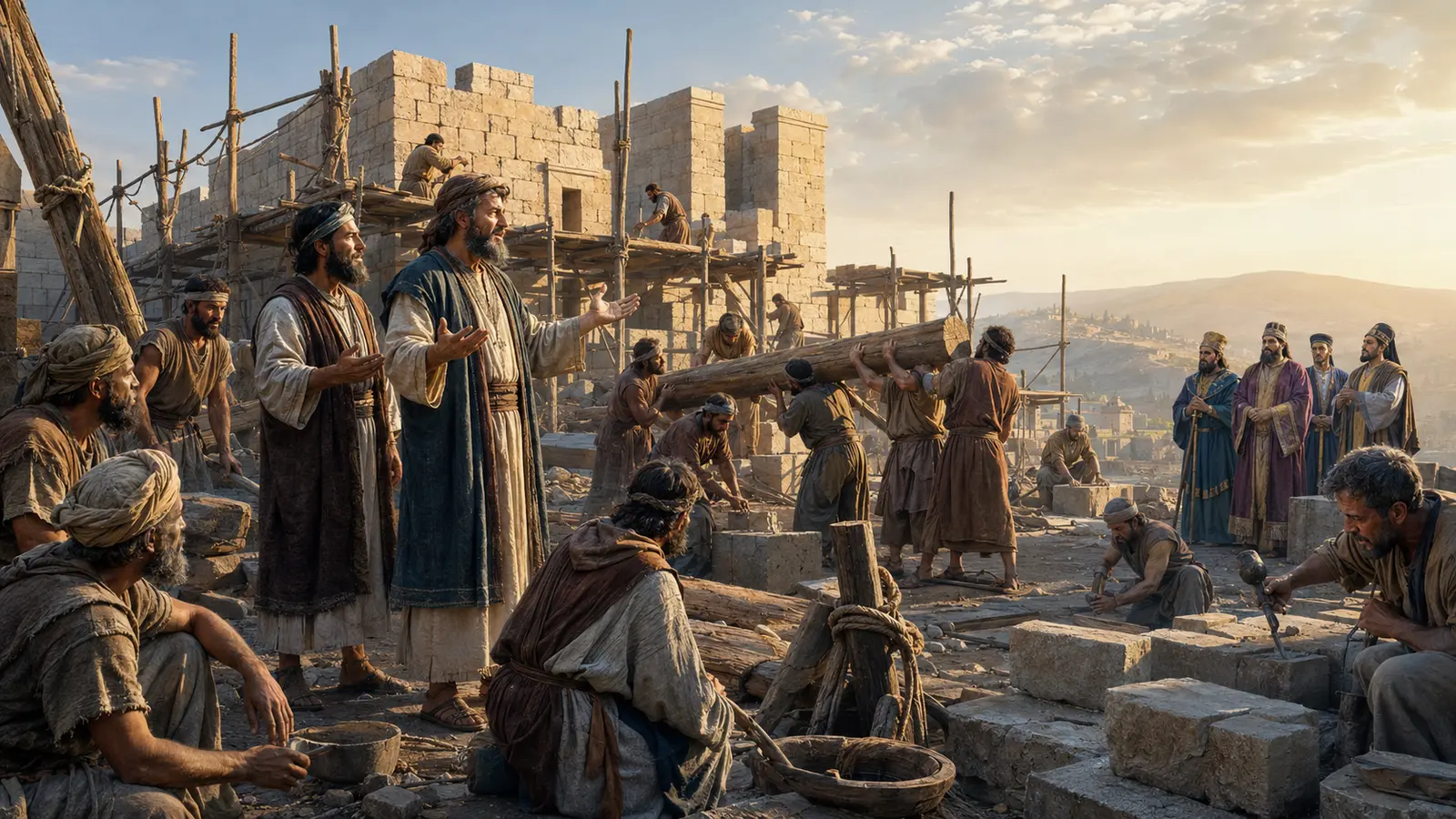
The work had stopped. Fear had settled like dust over the unfinished foundation. Then the Word of God came through the prophets, and tired hands rose again. Ezra 5 is a chapter about holy reawakening: when discouragement has delayed obedience, God does not merely send better circumstances—he sends his Word, courageous leaders, and the quiet confidence that his eye is upon his people.
01
Introduction: When Obedience Needs to Be Reawakened
There are seasons when God’s work does not die suddenly; it slowly sleeps.
The first fire was real. The altar rose. The foundation received songs. The people shouted and wept until joy and grief became one sound [Ezra 3:10–13]. But then opposition came. Discouragement weakened their hands. Fear entered the building site. Political pressure stopped the work [Ezra 4:4–5, 24]. And once a work has stopped, it can begin to feel normal for it to remain unfinished.
That is the danger Ezra 5 addresses.
The people are not in Babylon anymore, but Babylon’s shadow still lingers in their courage. They are back in the land, but the house of God remains incomplete. They have experienced mercy, but delay has trained them to live with a half-built obedience.
Then God speaks.
Haggai and Zechariah prophesy to the Jews in Judah and Jerusalem “in the name of the God of Israel” [Ezra 5:1]. Zerubbabel and Jeshua rise and begin to rebuild [Ezra 5:2]. Opposition does not vanish. Officials question them. Letters are written. The empire still watches. But the people now work under a deeper reality: “the eye of their God was on the elders of the Jews” [Ezra 5:5].
This text is about delayed obedience becoming renewed courage, because the Word of God can awaken tired hands when fear has made unfinished work feel permanent.
02
Historical and Literary Context: After Delay, Before Vindication
Ezra 5 follows the stoppage of Ezra 4. The temple work had ceased until the second year of Darius king of Persia [Ezra 4:24]. Historically, this places the renewed work around 520 BC, the same period reflected in the prophetic ministries of Haggai and Zechariah [Hag. 1:1; Zech. 1:1].
This chapter stands between paralysis and completion. Ezra 4 shows opposition stopping the work; Ezra 6 will show Darius confirming the earlier decree and supporting the temple’s completion. Ezra 5 is the bridge: the work resumes before imperial approval is fully clarified. That is important. The people do not wait for every administrative question to be settled before obeying the prophetic word.
The chapter unfolds in four movements:
1. The prophets speak, and the leaders rise [5:1–2].
2. Persian officials question the authority of the builders [5:3–5].
3. Tattenai writes a formal report to Darius [5:6–17].
4. The Jewish elders testify to their identity, sin, exile, and the decree of Cyrus [5:11–16].
Theologically, Ezra 5 shows that God rebuilds his people through Word, leadership, memory, and providence. The prophetic word restores courage. The leaders act. The community remembers its story truthfully. And the eye of God guards the work even while officials investigate it.
03
Walking Through the Text
When the Prophets Speak into Delay [Ezra 5:1]
The chapter begins not with a new decree, but with a prophetic word: “Now the prophets, Haggai and Zechariah the son of Iddo, prophesied to the Jews who were in Judah and Jerusalem” [Ezra 5:1]. This is the turning point.
The people had already received permission to rebuild through Cyrus. They had already laid the foundation. But external pressure and internal fatigue had stalled obedience. What they need now is not merely policy. They need the living Word of God.
Haggai’s message exposes misplaced priorities: the people are living in paneled houses while the Lord’s house lies in ruins [Hag. 1:4]. Zechariah’s message lifts their eyes to the power of God: “Not by might, nor by power, but by my Spirit” [Zech. 4:6]. Together, the prophets confront both comfort and fear. Haggai says, “Consider your ways.” Zechariah says, “Do not despise the day of small things” [Hag. 1:5; Zech. 4:10].
Ezra summarizes their ministry simply: they prophesied “in the name of the God of Israel, who was over them” [Ezra 5:1]. That final phrase matters. The people are under Persian rule, but they are more deeply under God’s authority. Empires may regulate construction, but the covenant Lord reigns over the builders.
When Leaders Rise with the Word [Ezra 5:2]
The Word of God does not remain in the air. It enters bodies. It becomes movement.
“Then Zerubbabel… and Jeshua… arose and began to rebuild the house of God that is in Jerusalem” [Ezra 5:2]. The same leaders connected with the earlier foundation now rise again. Their calling had not expired during the delay. Their courage had to be rekindled.
The verse adds that “the prophets of God were with them, supporting them” [Ezra 5:2]. This is a beautiful picture of spiritual leadership. The prophets do not merely rebuke from a distance; they stand with the builders. They strengthen the work by remaining near the people who must obey.
Restoration needs both proclamation and presence. A word shouted from afar may awaken, but a word embodied alongside the workers sustains. Haggai and Zechariah help create an atmosphere where obedience becomes possible again.
The temple is rebuilt not only by masons and carpenters, but by prophets who hold the community under the promise of God.
When the Work Is Questioned Again [Ezra 5:3–5]
As soon as the work resumes, scrutiny returns. Tattenai, governor of the province Beyond the River, along with Shethar-bozenai and their associates, ask, “Who gave you a decree to build this house and to finish this structure?” [Ezra 5:3]. They also ask for the names of the men responsible [Ezra 5:4].
This is not the same kind of hostile manipulation we saw in Ezra 4. Tattenai’s inquiry appears formal and administrative. He does not immediately stop the work. He investigates.
Still, the question is serious. The community is vulnerable. They have already suffered opposition through official channels. A new investigation could easily become another stoppage.
Then Ezra gives the theological center of the chapter: “But the eye of their God was on the elders of the Jews, and they did not stop them” [Ezra 5:5].
What a quiet thunderclap.
God’s eye is not surveillance; it is care. It is covenant attention. The God who saw Israel’s affliction in Egypt now sees the elders rebuilding in Judah [Exod. 3:7]. The God who neither slumbers nor sleeps watches over the fragile work [Ps. 121:3–4].
The officials may ask for names, but God knows his servants. The empire may review documents, but God watches the work. The inquiry continues, but the builders are not stopped.
When the Empire Receives a Testimony [Ezra 5:6–10]
Tattenai sends a letter to Darius. The letter describes the temple as “the house of the great God” and notes that the work is being done diligently [Ezra 5:8]. This phrase is striking. Whether Tattenai fully understands Israel’s God or is simply reporting what he sees and hears, the letter bears witness that something significant is happening in Jerusalem.
The officials report their questions: Who authorized the building? What are the names of those responsible? [Ezra 5:9–10]. The matter now moves toward the imperial archive.
But unlike the accusations in Ezra 4, this letter does not twist the story into a threat. It seeks verification. God’s providence can work not only through miraculous rescue, but through fair procedure, honest reporting, and the restraint of officials who do not abuse power.
This is another reminder that God’s sovereignty often moves quietly. He does not always remove the bureaucratic process; sometimes he protects his people within it.
When the Elders Tell the Truth About Their Story [Ezra 5:11–16]
The response of the Jewish elders is one of the most theologically rich moments in the chapter. They begin with identity: “We are the servants of the God of heaven and earth” [Ezra 5:11]. Before they name Cyrus, before they explain documents, before they defend their legality, they name their belonging.
They are not rebels. They are servants.
They then locate the present project within the long story of Israel: this temple was built many years ago by a great king of Israel [Ezra 5:11]. They remember Solomon without pretending that glory alone defines them.
Then they confess why the temple was destroyed: “Because our fathers had angered the God of heaven, he gave them into the hand of Nebuchadnezzar” [Ezra 5:12]. This is remarkable honesty. They do not blame Babylon alone. They do not claim victimhood without repentance. They interpret exile as covenant judgment.
Yet judgment was not the final word. They testify that Cyrus issued a decree for the house of God to be rebuilt and returned the temple vessels that Nebuchadnezzar had taken [Ezra 5:13–15]. Sheshbazzar was appointed governor and laid the foundations [Ezra 5:14–16].
Their testimony holds together four truths: identity, memory, confession, and promise. They know who they are. They remember what was lost. They confess why judgment came. They appeal to the mercy that opened the road home.
A community that can tell the truth like this is being spiritually rebuilt even before the temple is finished.
When the Search Is Requested [Ezra 5:17]
The chapter ends with Tattenai asking Darius to search the royal archives in Babylon to see whether Cyrus had indeed issued such a decree [Ezra 5:17]. The question remains unresolved at the end of the chapter.
Ezra leaves us waiting.
But this waiting is different from the paralysis of chapter 4. The people are working. The prophets are supporting. The officials are investigating. The eye of God is watching. The story is suspended, but not lifeless.
Faith often lives here: between obedience and vindication, between renewed work and official confirmation, between the prophetic word and the public outcome.
04
Theological Reflection
God Reawakens His People Through His Word
Ezra 5 shows that the Word of God is not merely informational; it is formative and catalytic. Haggai and Zechariah speak, and the work resumes [Ezra 5:1–2]. The prophetic word confronts apathy, fear, and resignation.
This is a recurring biblical pattern. God creates by speaking [Gen. 1:3]. God calls Abram by speaking [Gen. 12:1–3]. God summons Israel through Moses [Exod. 3:10]. God raises dry bones through prophetic proclamation [Ezek. 37:1–14]. Here, God reawakens temple rebuilding through his prophets.
When obedience has stalled, the deepest need is often not a new strategy but a fresh hearing of God’s Word.
Leadership Must Rise Under the Word, Not Above It
Zerubbabel and Jeshua rise because the prophets speak [Ezra 5:2]. This is healthy leadership. They do not use God’s Word as decoration for their own ambition; they respond to it in costly obedience.
In the biblical vision, leaders are not owners of God’s work. They are servants under God’s command. The elders later say it plainly: “We are the servants of the God of heaven and earth” [Ezra 5:11]. That sentence should be written over every ministry, church, family, and rebuilding project.
God’s Eye Gives Courage Under Scrutiny
“The eye of their God was on the elders” [Ezra 5:5]. This does not mean they avoid questions or difficulty. It means scrutiny does not define reality. They are seen by God before they are evaluated by empire.
This is deeply pastoral. Many people stop obeying because they feel watched by critics, systems, or past failures. Ezra 5 teaches us to live under a higher gaze. God’s eye is not crushing; it is strengthening. He sees with covenant faithfulness.
Honest Confession Belongs to True Restoration
The elders do not hide the sins of their ancestors [Ezra 5:12]. Their defense includes confession. This is mature covenant memory. They do not sanitize the past, but neither do they let the past become the final word.
True restoration requires this balance. A community that cannot confess sin will repeat it. A community that cannot receive mercy will be imprisoned by it. Ezra 5 shows a people learning to say: we sinned, God judged, God showed mercy, and now we rebuild.
05
Life Application: Rising Again After Delay
Let the Word of God interrupt your delay. When obedience has stalled, return to Scripture not for information only, but for summons, correction, and courage.
Rise even before every circumstance is resolved. The builders resume while questions are still pending. Faith sometimes obeys before the paperwork is complete.
Seek prophetic companionship. Haggai and Zechariah stand with the builders. Rebuilding requires voices that speak truth and remain present.
Live under God’s eye more than human scrutiny. Critics, officials, and systems may ask hard questions, but the gaze that matters most is the faithful attention of God.
Tell your story truthfully. Do not hide failure, but do not let failure be the whole story. Confession and mercy belong together.
Strengthen tired leaders. Zerubbabel, Jeshua, and the elders needed support. Those carrying responsibility often need encouragement more than accusation.
Keep working while waiting. Some answers come from archives later. Today’s calling is to obey what God has already made clear.
06
Reflection Questions
1. Where has fear, delay, or discouragement made unfinished obedience feel normal?
2. What word from Scripture is God using to summon you back to the work?
3. Who are the prophetic voices God has placed near you to strengthen your hands?
4. Are you living more under the eye of God or under the fear of human scrutiny?
5. How can you tell the truth about past failure while still moving forward in mercy?
07
Response Prayer
Lord God of heaven and earth,
speak again over our unfinished places. Where fear has made us pause too long, awaken courage. Where delay has become comfortable, disturb us with mercy. Where our hands have grown tired, strengthen us by your Word.
Send us voices like Haggai and Zechariah—voices that tell the truth, lift our eyes, and stand with us in the work. Raise leaders who do not stand above your Word, but under it. Teach us to say with humility and courage: we are servants of the God of heaven and earth.
Let your eye be upon us. When people question, accuse, inspect, or misunderstand, remind us that we are first seen by you. Your gaze is our courage. Your presence is our shelter. Your promise is our strength.
Help us confess honestly where sin has wounded the story. Help us receive mercy where shame has tried to close the future. And help us keep building while we wait for the next door to open.
In the name of the One who is the true temple, the faithful servant, and the living Word among us,
Amen.
08
Window into What Comes Next: When the Archive Confirms the Promise
Ezra 5 ends with a question sent to the royal archives: did Cyrus truly decree that the house of God should be rebuilt?
Ezra 6 will answer with surprising force. The search will uncover the decree. Darius will not only permit the work; he will command support for it. What looked like danger will become provision. What seemed like another bureaucratic threat will become a channel of divine faithfulness.
The prophets have spoken. The builders have risen. The eye of God is upon them.
Now the empire will discover what heaven has already remembered.
09
Bibliography
Williamson, H. G. M. Ezra, Nehemiah. Word Biblical Commentary 16. Waco: Word Books, 1985.
Williamson, H. G. M. Ezra and Nehemiah. Old Testament Guides. Sheffield: JSOT Press, 1987.
Kidner, Derek. Ezra and Nehemiah. Tyndale Old Testament Commentaries. Downers Grove: InterVarsity Press, 1979.
Clines, David J. A. Ezra, Nehemiah, Esther. New Century Bible Commentary. Grand Rapids: Eerdmans, 1984.
Fensham, F. Charles. The Books of Ezra and Nehemiah. New International Commentary on the Old Testament. Grand Rapids: Eerdmans, 1982.
Blenkinsopp, Joseph. Ezra–Nehemiah: A Commentary. Old Testament Library. Philadelphia: Westminster, 1988.
BibleProject. “The Book of Ezra-Nehemiah.” Old Testament Overview Guide.
Be the first to leave a comment.