

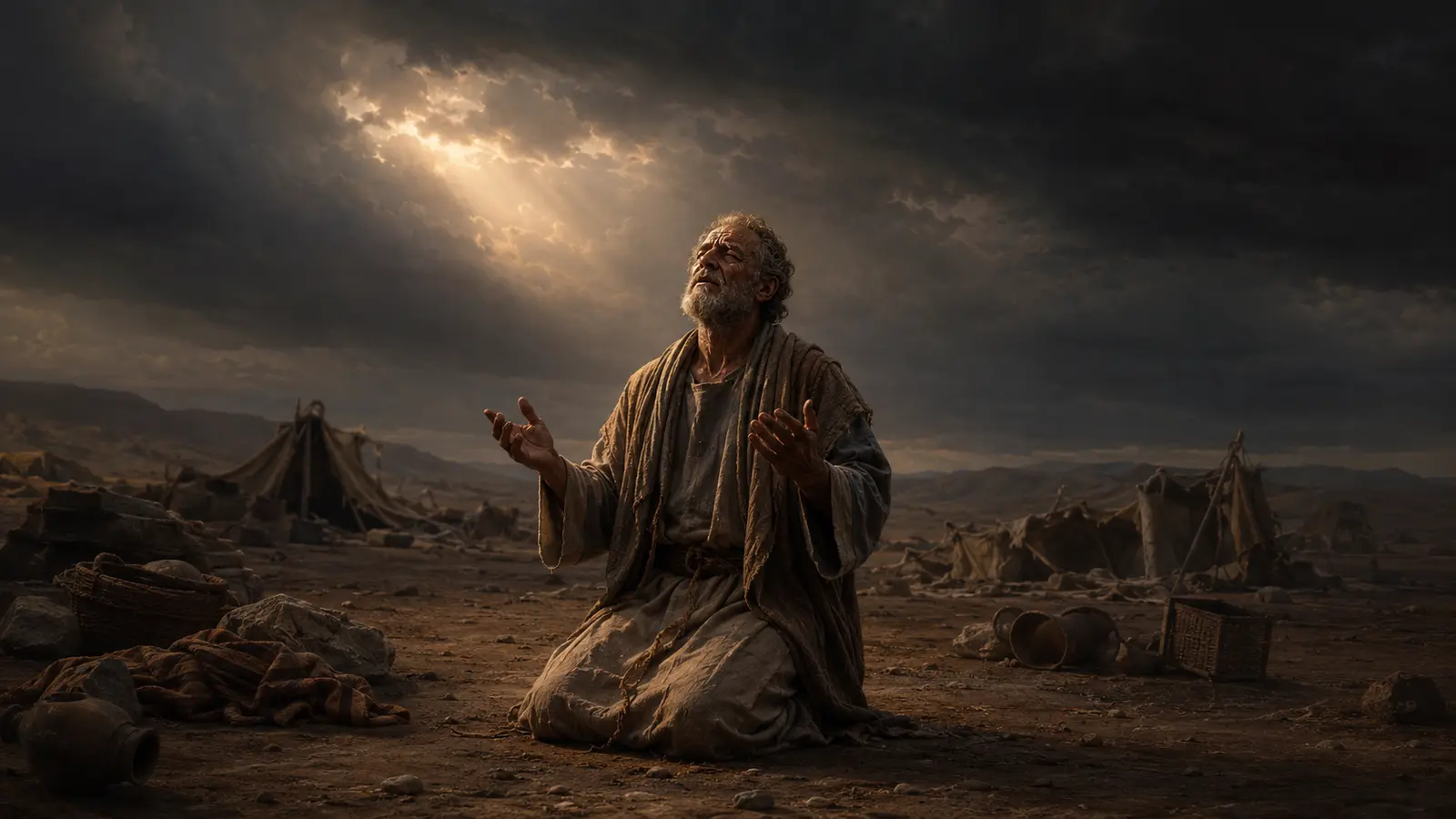
There are times when life seems to fit together well. The table is full. Children are laughing. The work of our hands bears fruit. Prayer is felt like a roof over a house, and thanksgiving goes through the rooms like the morning light.
01
Introduction
The day begins with blessings counted like sheep in the field.
It ends with ashes gathering on a torn garment.
Between earth and heaven, a question rises like smoke:
Will the human heart love God when the gifts are gone?
02
1.0 Introduction: When Blessings Are No Longer Proof
There are times when life seems to fit together well. The table is full. Children are laughing. The work of our hands bears fruit. Prayer is felt like a roof over a house, and thanksgiving goes through the rooms like the morning light.
Then, sometimes without warning, the roof tears open.
Job 1 begins in order and ends in destruction. It begins with a person who is described as "perfect and righteous," a person who fears God and abstains from evil. It ends with the same man sitting in sorrow, having lost his possessions, his servants, and his children in just one day. This chapter does not allow us to quickly say what religious people often say eagerly: "Surely this happened because he sinned." Before any human explanation can say a word, the narrator has already told us the truth—Job is righteous.
That is what makes this chapter so disturbing. Job's suffering is not characterized as punishment. His loss is not described as the fruit of hidden rebellion. This wound is deeper than a simple moral calculation. The question is not, "What did Job do wrong?" The question is, "What is faith when blessings are no longer visible?"
This text is about worship that turns into testimony, because Job teaches us that God deserves to be worshiped not only when his hands are full of gifts, but also when his ways are hidden in darkness.
Job 1 does not answer every question raised by suffering. It opens the door to a long and holy argument. It invites us to stand between the garden of heaven and the broken ground of earth, a place where the accuser speaks, the righteous suffer, and faith is tested without being fully explained.
03
2.0 Historical and Literary Context: Prologue Before the Ash Heap
Job 1 is the prose prologue section of the book, which continues through Job 2. The next large part of the book will move into heavy Hebrew poetry: laments, debates, accusations, wise reflections, and God's speeches from the storm. But before the poetry begins, the narrator gives us the frame of the story.
Job lives in the land of Uzi, outside the familiar geographical center of Israel's covenant. He is not identified as Israel's king, priest, or prophet. He stands on the edge of the Bible map, but his life becomes a window to the question of all mankind: Can the righteous suffer? Can faith remain faith when it doesn't seem to be rewarded?
The camera of this frame goes up and down. On earth, Job is the righteous, rich, generous, careful, and priestly head of the house for his children. In heaven, the "sons of God" appear before Yahweh, and among them comes "the devil"—the accuser, the opposing character who opposes the meaning of Job's piety.
The point is not whether Job has religion on the outside. Everyone agrees that they have. The point is the intention. "Does Job fear God for nothing?" That question strikes like thunder at the root of worship. Is Job's self-sacrifice a true love for God, or a wise investment in God's protection? Is he a servant—or a client? Is God worshiped as God—or used as a hedge around prosperity?
This is where the book begins to reveal the weakness of a simple theology of reward and punishment. The moral order of Scripture is not rejected: wisdom is important, justice is important, evil destroys. But Job refuses to reduce God's rule over the world to a vending machine, where obedience always buys a tangible reward. The wisdom tradition of the Bible knows that righteousness is good, but Job insists that the righteous can still sit in the dust.
This chapter also looks back and forward in the Bible. Behind, it echoes Eden, a place where the voice of doubt questioned the integrity of man's obedience and the goodness of God. On the sidelines, it speaks to Proverbs, which often express organized systems of wisdom, and psalms of lamentation, where faithful people cry out from unspeakable pain. Next, it prepares us for the righteous one who suffers, Jesus Christ, who loses everything, is falsely accused, and yet surrenders himself to the Father.
04
3.1 Job's Life Under the Light: Righteousness Before Loss (Job 1:1–5)
The book opens with a moral image: Job is "perfect and upright," a man who fears God and shuns evil. These four details are important. They set the stage for all the drama. Job is not a sinless man in the theoretical sense, as if he does not need mercy. But his heart is whole. His life has a direction. He respects God. He opposes evil. He is the kind of person that wisdom literature would normally expect to thrive.
And he is really thriving. Seven sons, three daughters, thousands of animals, many servants—Job is shown as the greatest of all the people of the east. These numbers indicate a state of completeness and abundance. His house doesn't just save itself; it overflows.
But Job's greatness is not only economic. He is a spiritually alert person. His children have a feast, and Job wakes up early after that to offer burnt offerings for them. He says, "Maybe my children have sinned and blasphemed God in their hearts." Job is not a man of small doubts; he is priestly in love. He carries his family before God.
Already the words "bless" and "curse" begin to vibrate under the text. Job fears that careless prosperity may lead his children to inner contempt for God. He knows that blessings can be dangerous when the heart forgets the Giver. Before the accuser speaks in heaven, Job is already protecting worship on earth.
05
3.2 The Court Opens: The Accuser Questions Worship (Job 1:6–12)
The scene is suddenly transferred from earth to heaven. The sons of God appear before Yahweh, and the accuser comes among them. The reader is taken behind the curtain, not to satisfy curiosity, but to protect Job's integrity. From the beginning we know what Job's friends will know later: his suffering is not punishment for secret evil.
Yahweh speaks of Job with joy: "Have you looked at my servant Job?" God repeats the narrator's explanation. Job is perfect, upright, God-fearing, and abstaining from evil. The heavens confirm what the earth has already shown.
But the accuser opposes Job's meaning of justice. "Does Job fear God for nothing?" The charges are subtle and poisonous. They suspect that human worship cannot be true love; it is personal interests dressed in religious clothing. The accuser says that Job serves God because God has built a fence for him—around him, his house, his work, and his possessions.
This is the main question of Job 1: Is worship a business?
If God blesses me, I praise him. If God protects me, I obey him. If God gives me children, health, honor, and security, I call him good. But what happens when the fence falls? What remains when the gifts are taken away and God himself seems to hide?
God allows temptation, but with limits. The accuser can touch what Job has, but not Job himself. This permission is troubling, and the text does not make it smooth. However, it is important to note that evil is not the supreme ruler. The accuser does not rule the world. He only acts within limits. This chapter gives us a mystery, but not the belief of two corresponding gods. There is darkness in the story, but no two gods are alike.
06
3.3 The Day of Fall: When the Messengers Bring the Storm (Job 1:13–19)
Tragedy strikes Job with a terrible rhythm. One messenger is still talking when another arrives. The repetition becomes like a doomsday dance:
"The bullocks were plowing..."
"The fire of God fell..."
"The Chaldeans formed three armies..."
"The great wind came..."
Human cruelty and natural disaster come together. Looters steal. The fire is consuming. The enemy kills. The wind blows the house where Job's children were having a feast. The seemingly orderly world in verses 1–5 now seems violently disrupted.
The destruction that erases the order in verses 1–5, now seems to bring about greater chaos at the end. Job's children are dead. The house of feasting becomes a grave, and the table of joy falls under the blast of the wind.
The narrator does not stop to explain the psychology of grief. He lets the speed of the messengers do the work. Loss does not come with courtesy. It does not interfere. It piles sorrow upon sorrow before the soul has a chance to breathe.
There is pastoral wisdom here. Some injuries cannot be processed with neat steps. Sometimes grief comes in waves so close together that one can only tear the garment and fall to the ground.
07
3.4 The Garment Torn by the Body That Worships God (Job 1:20–22)
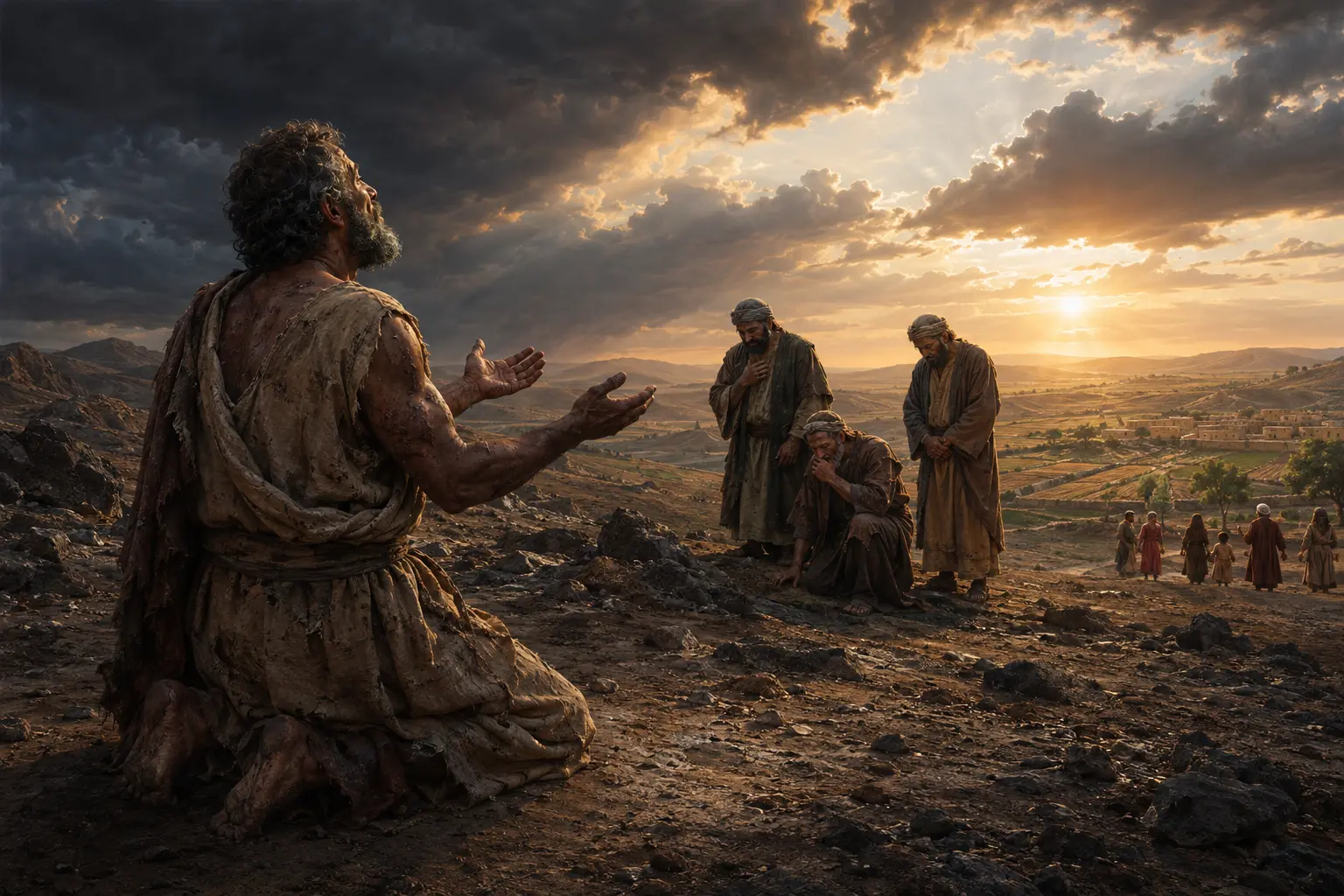
Job stands up. He tears his garment. He shaves his head. He falls down.
These are signs of mourning involving the body. Job does not pretend. You don't call a tragedy a "blessing." He does not hide his sorrow behind religious calmness. His body speaks the truth: something sacred has been torn.
Then comes a surprising sentence: "He worshiped."
The worship of Job is not to deny the truth with a smile. Not emotionally numb. It is sorrow bent towards God. His words are among the most well-known in the Scriptures: he came out of his mother's womb naked, and naked he will return; Yahweh gave, Yahweh has taken; may the name of Yahweh be blessed.
We should ponder these words with great caution. This is not a simple statement to be thrown at someone else's funeral, nor is it a rule to drown out the cries of mourning. Job himself, in the coming season, will complain, question, and curse the day he was born. However, in this first shock of tragedy, he reveals a great truth: life is a trust, not our property. We come into the world empty-handed, and we leave empty-handed. Everything that exists between the dawn of birth and the sunset of death is a loan given to us, not a property we own.
The chapter closes with the judgment of the narrator: "In all that, Job did not sin or consider God foolish." Job still does not understand. He still hasn't found peace. But he has not cursed God. The plaintiff's claim fails—at least in this first attempt.
Faith still breathes amid the fallen ruins.
08
4.1 Job's Rights Must Be Protected Before His Sufferings Are Translated
The narrator tells us that Job is righteous before he tells us that Job is suffering. That setting is important. If we overturn it, we become like those friends. We see pain and assume guilt. We see corruption and invent hidden sin.
Job 1 teaches us to be careful interpreters of other people's suffering. Not every injury is a judgment. Not every loss is a subject that we are empowered to explain. Sometimes the holiest thing we can say is, "I don't know why this happened, but I will stay with you."
09
4.2 Plaintiff's Question Reveals Business Religion
"Does Job fear God for nothing?" it is not a question about Job alone. It is a question about all worship. Do we love God, or do we just love the life that God gives us? Are we looking for his face, or are we just looking for his fence?
Are we saying blessings are bad? Nope. Job's welfare is not condemned. Family, work, animals, land, parties—these are gifts. But gifts become dangerous when they replace the Giver. The accuser believes no human can love God more than reward. Job's life becomes a testimony against that lie.
10
4.3 Evil Is Real, But Not Final
The accuser is at work. Looters kill. The fire is falling. The wind destroys. Job 1 does not invite us to a simple hope that assumes that the world is safe and without pain. The world is beautiful, but it is also dangerous.
However, evil is limited. The accuser must obtain permission. He cannot cross the line that God has set. Although the pain of the story remains, but that understanding protects us from despair. The darkness is real, but it does not sit on the throne.
11
4.4 Job First Shows the Righteous Suffering
Job is not Jesus. We must allow Job to stand in his own sorrow. But the story of Job creates a new way to interpret suffering biblically: the righteous can suffer undeservedly. The innocent can be accused. A faithful servant can lose everything and still surrender to God.
That way eventually leads a person to Christ, who was made naked, mocked, burned, and left to die, but did not return evil for evil. On the cross, Job's question deepens: Can God be trusted when the righteous sufferer is crushed? In the resurrection, the answer rises—not as a neat explanation, but as a new creation that opens the grave.
12
5.0 Lifetime Use
Do not measure a person's right by the extent of his suffering. Pain is not always the receipt of sins committed in secret. In the Bible, the suffering of the righteous has a greater secret than the simple thoughts of men.
Let grief be real before it becomes eloquent. Allow the season of mourning to pass in the truth of feelings, not in forced words.
Examine whether your faith is entirely based on visible blessings. Ask yourself gently: Am I only worshiping God while the fence is still standing?
Do not use Job 1:21 as a weapon against mourners. The confession of victory was the fruit of the inner altar of Job's own mouth; let it never be a shorthand formula tossed about by an impatient comforter ignorant of the gravity of the storm.
Hold onto your gifts with gratitude, not ownership. Children, work, health, service, reputation, wealth—these are treasures entrusted to you.
When the details are hidden behind the veil of God's mystery, learn the silence of faithful presence. Sometimes, the main worship that remains is not beautiful words or songs of praise, but the same wounded and tired body that humbly turns towards the presence of God.
Look to Christ when Job's path is shrouded in darkness. He is the Righteous One who suffered and walked into the midst of the greatest loss, opened the grave, and started a new creation.
13
6.0 Reflection Questions
1. Where have I been tempted to assume that suffering always reveals a person's secret failure?
2. What blessings in my life have quietly been the basis of my security?
3. Can I tell the difference between true sorrow and faithless accusations?
4. How can I sit with someone in pain without rushing to explain his injury?
5. What would it mean this week to worship God not as business, but as hope?
14
7.0 Request for Response
Lord of the hidden court and broken field,
We come with hands that cannot hold life strong enough. We confess that we often love the fence more than the Saint who surrounds us. We praise you when the table is full, but we tremble when the wind hits the house.
Teach us the faith of Job without forcing us to pretend that the pain is small. Give us the courage to tear the garment when sorrow is real, the humility to fall before you when the answers are hidden, and the gentleness to sit next to those who suffer without turning theology to stone.
Protect us from the voice of the accuser. Protect us from worship that is only agreement. Protect us from judging wounds we do not understand.
And when our day of loss comes, meet us there. Not with light words, not with cold notes, but with your presence. Lead us to Jesus, the righteous one who suffers, who entered our dust, carried our sorrows, and rose as the first light of the renewed world.
May your name be blessed in the morning. May your name be blessed in the night. May your name be blessed when our hands are full. May your name be blessed when all we have left is you.
Amen.
15
8.0 The Next Window: When the Wound Reaches the Body
Job 1 tests the meaning of worship through the loss of wealth, servants, and children. But the accuser is not finished. In Job 2, the question becomes closer: What happens when suffering touches the body itself?
The fence has fallen around Job's house. Soon the pain will seep into his skin. His wife will speak from within the same destruction. His friends will arrive and, for seven days, will offer the best service they will ever offer: silence.
The story moves from worship amid the fallen remains to friendship on a pile of ashes.
The speeches haven't started yet. The wound is still gathering its voice.
16
9.0 Bibliography
Alter, Robert. The Wisdom Books: Job, Proverbs, and Ecclesiastes: A Translation with Commentary. New York: W. W. Norton, 2010.
BibleProject. "The Book of Job." Old Testament Overview Guide.
Clines, David J. A. Job 1–20. Word Biblical Commentary 17. Dallas: Word Books, 1989.
Crenshaw, James L. Old Testament Wisdom: An Introduction. Louisville: Westminster John Knox, 2010.
Hartley, John E. The Book of Job. New International Commentary on the Old Testament. Grand Rapids: Eerdmans, 1988.
Walton, John H., and Tremper Longman III. How to Read Job. Downers Grove: IVP Academic, 2015.
Wright, N. T. The New Testament and the People of God. Minneapolis: Fortress, 1992.

Be the first to leave a comment.