

There are sufferings that we can describe from a distance. A broken plan. A lost opportunity. A house shaken by grief. A season of tears that still leaves a little room for a person to stand.
01
1.0 Introduction: When Pain Touches the Self
There are sufferings that we can describe from a distance. A broken plan. A lost opportunity. A house shaken by grief. A season of tears that still leaves a little room for a person to stand.
Then there is suffering that enters the body.
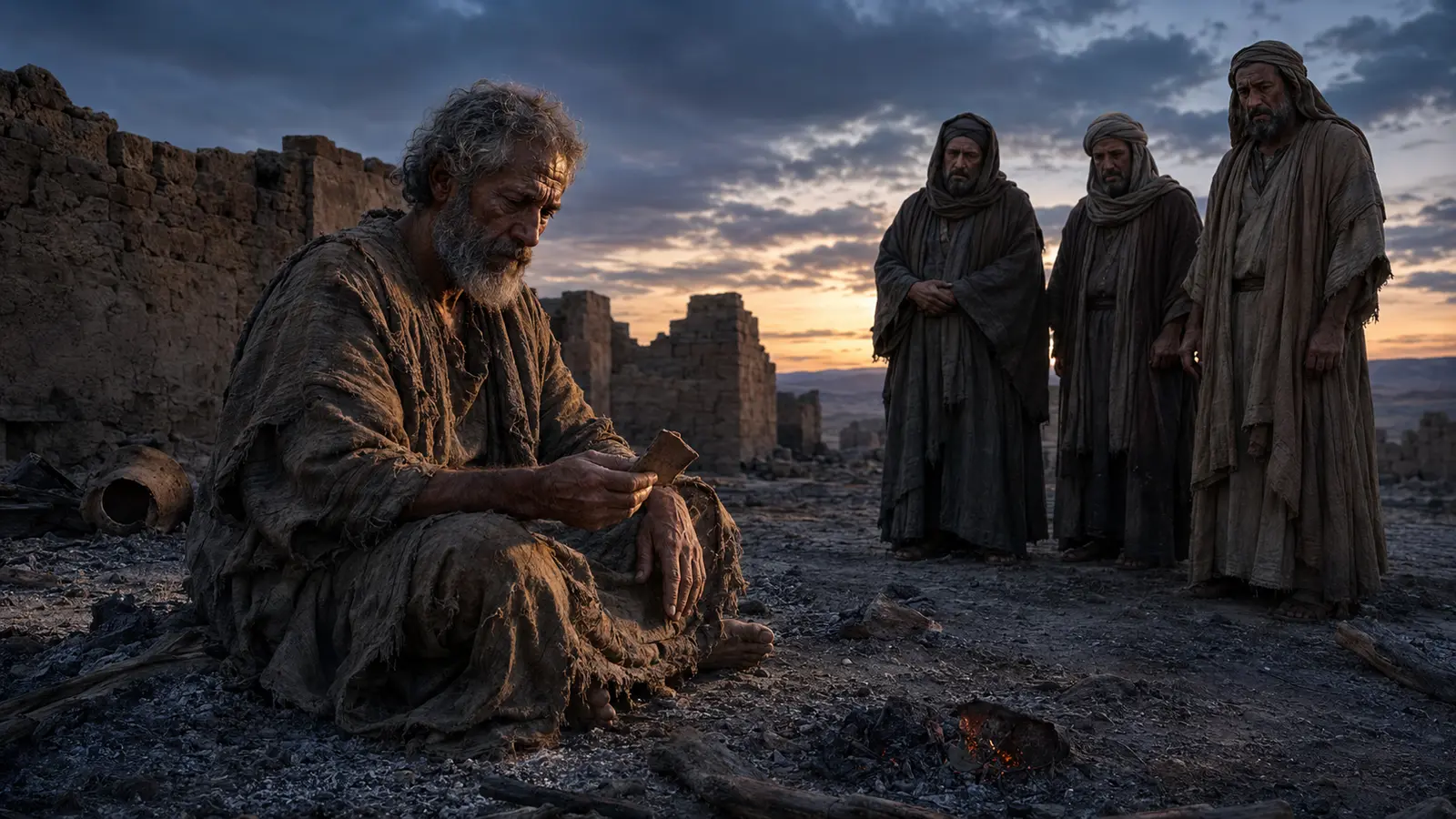
Job 2 is the chapter in which grief comes closest. In Job 1, disaster fell upon Job's possessions, his servants, and his children. The world around him collapsed. In Job 2, the blow comes very close. The wound reaches the skin. Pain enters the nerves. Shame is attached to the body. The righteous man who once stood with honor before the nobles now sits in the ashes, scratching himself with a broken tile.
The second chapter does not only deal with physical pain. It speaks of temptation that sinks deeper. The accuser's claim is made: Job may be able to endure external losses, but he will certainly not remain faithful when suffering touches his body. The battlefield is shrinking. The question is no longer whether Job can worship when the hedge of protection falls around his house, but whether he can remain faithful when pain invades his soul through his body.
However, Job 2 also gives us one of the quietest and most profound events in all of Scripture. Before the argument begins, before the theology turns to accusation, Job's friends come, sit with him, and do not say a word for seven days and seven nights. For one holy week, they do the best thing they will do in the whole book: they go through pain.
The second chapter teaches us that faithfulness in suffering is not the victory of noise, but patience; and that true friendship does not begin with explanations, but with shared silence in the middle of the ashes.
Job 2 takes us from the temptation of heaven to the pain of the body, from the voice of the wife to the silence of friends, from the justice of the sufferer to the limits of human comfort. It's a dark threshold before the poems begin.
02
2.0 Historical and Literary Context: The Second Test Before the First Speech
Job 2 completes the prose introduction that began in chapter one. These opening chapters prepare the reader for all that follows in the poetic discourse. If Job 1 laid the groundwork for Job's justice and established the challenge of heaven, Job 2 increases the weight of the conflict and puts in their place the main human characters who will speak in Job's suffering.
Once again, the figure moves between heaven and earth. The arrangement makes sense. On earth, Job looks like a broken man. In heaven, Job appears as a servant
honest The reader is given the chance to see a heavenly event so that we do not miss an earthly event. This is one of the great mercies of the book: we know something that Job does not. His suffering is not evidence that God has forsaken him or that hidden evil has finally been revealed. The narrator has already defended Job against that interpretation.
The second chapter also adds to the book's challenge against simplistic reward theory. If the world were a simple and automatic moral system, Job's wounds would be easy to explain: pain means guilt; sickness means God's wrath. But the introduction to the book rejects that reading. Job is persecuted not because he is wicked, but because his faithfulness has become the scene of the fiercest struggle.
Literarily, Job 2 sets up three major themes that will dominate the rest of the book:
1. Physical suffering - not imaginary pain, but pain felt in the body.
2. Struggle about speech – what should be said in the face of suffering?
3. The tension between silence and theology – when do words help, and when do they hurt?
The second chapter also serves as a bridge. It closes the narrative preparation and introduces us to the poetic essence of the book. Job is now sufficiently stripped, wounded enough, and surrounded enough that mourning breaks out in chapter 3. The ash heap becomes the pulpit of agony.
03
3.1 Heaven Repeats Its Judgment: Job Is Still God's Servant (Job 2:1-3)
The chapter begins with an event similar to Job 1. The council of heaven gathers again. The accuser reappears. Yahweh is speaking again. But this repetition is not for nothing. It is set on purpose.
God asks the accuser if he has looked at Job. Then comes an important statement: Job "even now clings to his integrity, although you stirred me up against him to destroy him without cause."
The last words carry a lot of weight: without reason.
It does not mean that Job is sinless in the absolute sense. It means his suffering is not due to a hidden moral fault that would prove the accuser's charge. The testimony of heaven still stands. Job is still a servant of God. Job still has a whole heart.
Job is still, in the deepest sense, innocent of the calamity that befell him.
This is one of the main theological anchors in chapter two. The body may be covered with sores, but heaven does not change its judgment. Visible affliction does not erase invisible righteousness.
Human societies often do the opposite. We see suffering, and we bring down the sufferer. We see someone lowered to the ground, and we begin to wonder that he must have done something. Job 2 teaches us that trouble can hide honesty rather than reveal hypocrisy.
04
3.2 "Skin to Skin": Temptation Enters (Job 2:4–6)
The prosecutor is now changing strategy. He says external losses are not enough. "Skin for skin! Yes, all that a man has will give for his life." In other words: one can endure the loss of possessions and even relationships if one's soul is not yet physically touched. But if you touch the body, then the real intention will be revealed.
The accusation is serious, but it shows something. Physical pain is different. They reduce the range of vision. They exhaust the soul. They can make every request seem serious. There is a difference between being sad about what happened around you and suffering about what is happening inside you.
Again God allows the test, and again sets a limit: the accuser can torture Job's body, but he must give up his life. Even there, under the shadow of pain, God's authority still stands. The accuser acts, but has no end of power. He is permitted, but not enthroned.
Scripture does not explain why God allows this. It just tells. Job is not given a complete philosophy of suffering. He is drawn into a mystery that he will have to live before he can talk about.
05
3.3 Ash Heap of the Living One: Job's Body Attacked (Job 2:7–8)
The plague falls: "evil boils from the sole of his foot to the crown of his head."
This is a whole body torture. An adult has been touched. The statement from the way to the bottom tells us that the pain is not in one place; completely surrounded him. Job's body, which once had the strength to stand in public with dignity, has now become a torture chamber.
Then the narrator gives us one of the most memorable images in Scripture: Job sits in the ashes, scratching himself with a tile.
That's not just a medical thing. It is a theological picture.
A person who once offered a sacrifice now sits in a place associated with destruction and mourning. The greatest man of the East has turned into a disgrace. A broken tile in his hand, ashes beneath him, disease upon him—he looks like a man descending to death while he is still alive.
That picture also teaches us something about suffering: it often doesn't just stay inside. Pain lowers a person in front of society. It does not change the way a person stays in a place. It affects respect, order of life, memory, and the way a person sees himself. Job is not only hurting; he has been brought down and placed in visible disgrace.
But even then, there is no indication in the text that God has changed his mind about Job. Ashes is real, but not the last word about him.
06
3.4 Voices From Home: Job's Wife Speaks (Job 2:9–10)
Job's wife now enters the narrative with a sentence that has been heard for centuries: "Do you still cling to your integrity? Curse God, die."
His words are often dealt with too quickly, and sometimes too harshly. We should read them with more compassion than contempt. He has also lost children. He has also seen the house collapse. He also sees the person he loves breaking before his eyes. His speech does not come from an indifferent heart, but from the destruction that has touched the inside.
However, the direction of his advice is sad. He sees Job's righteousness as useless. What did you bring him? Why should he cling to envy when envy seems to bring only pain? Better to deny that broken relationship and let death end the suffering.
In the echo of his voice, the temptation of this second chapter is heard with a clarity shrouded in pain. The accuser no longer speaks face to face; now temptation creeps in through the nearest pulse of the human heart. Sometimes, the most intense spiritual struggles do not come in the form of terrifying and overt evil, but come driven by the logic of despair—a logic born in the midst of deeply wounded love.
Job's answer is modest and admirable: "You speak like one of the foolish women. Shall we receive good from God, and not receive evil?"
Here we see the heart of Job; He does not accuse his wife, nor do they ignore the wounds that make her suffer. Instead, he is simply challenging the false logic that suffering invalidates God's right to be worshiped and honored by man.
His statement does not mean that evil has a good reputation, or that God finds comfort in human suffering. Apart from that, his words testify that life with God cannot be made into an easy contract to get uninterrupted pleasures. If we receive good as an incomparable gift from the hand of God, we have no right to strip Him of His holiness and righteousness as soon as the times turn bitter.
The narrator again closes the scene: "In all that Job did not sin with his lips."
This testimony is very important. At the gate of the first chapter, we saw Job passing safely without committing sin or blaming God for mistakes; here, the writer's pen puts a unique weight on the declaration of his mouth. This is a hint that prepares us to see how Job will soon come to speak with greater confidence before his Creator.
The second chapter does not claim that Job will remain silent without saying something dangerous, painful, or unruly. Except, it only reveals to us that at that moment, and through that particular answer, he has not yet crossed the line of apostasy.
07
3.5 Good Service of Friends: Seven Days of Silence (Job 2:11–13)
Three friends—Eliphaz, Bildad, and Zophar—hear about Job's trouble and come to comfort him. At first, the act is loving. They plan to meet. They travel together. They intend to stick with him.
When they see Job from a distance, they almost do not recognize him. They cry loudly, tear their clothes, and throw dust into the air. They have not yet become theologians there; they are mourners. They feel the shock of what suffering has done to their friend.
Then comes the holy silence: they sit down with him seven days and seven nights, and no one says a word, "because they saw that his suffering was very great."
Here we can see a clear picture of pastoral presence in the book. Before they can explain, they accompany him. Before they argue, they sit down. Before they defend God, they respect grief.
Seven days and seven nights symbolize perfection. Their visit is not urgent. It's sharing grief to the fullest. They go down to the ash heap with Job. For a week, sympathy is stronger than certainty.
That's where one of the book's great ironies emerges: friends are never more accurate than when they're silent.
08
4.1 Integrity is not erased by pain
Job's wounds do not have the power to cancel the judgment that has already been given in heaven. This matter carries a special weight; for in the logic of this world, suffering visible to the eyes of the flesh is often enough to erase or change a person's honor and reputation. But at the gate of this second chapter, God still stands and calls Job by a close name: "My servant."
And Job, in the midst of the ashes, still clings to his perfection.
This reveals to us a great secret: that a person's honesty cannot be measured by the scale of outward appearance. Man may appear in the eyes of men as a cursed and utterly depraved creature, and yet, in the spirit world, be held with marvelous firmness in the palm of God.
09
4.2 Physical Suffering Increases the Severity of Spiritual Trial
There is a serious reason why the accuser transfers the struggle from the realm of property and wealth to the human skin. Physical pain has a tendency to bind us and constrict us within our own limits; they have the ability to completely remove from us all notions of self-confidence and reveal our real weaknesses as creatures of the soil.
However, this second chapter does not view the body as a garment to be despised. Rather, it reveals how God takes life and the reality of the body with a unique seriousness. Job's pain has a great meaning because his body has value in the eyes of the Creator. This book categorically rejects all kinds of superficial attitudes that ignore the suffering of flesh and blood as if it has no effect on the relationship between man and God.
10
4.3 The Most Dangerous Temptations Often Come in the Language of Despair
Job's wife tempts him with luxury, lust for power, or pride. Temptation comes wearing weariness: "Enough. Let go. Finish."
There is a type of suffering that whispers, "Since it hurts, then there is no point." Job 2 sees the temptation and resists it. Integrity means refusing to let pain be the last word to define life.
11
4.4 Silence Can Be Faithful Than Words
Friends get off to a good start because, at least in the short term, they understand that suffering deeper than words should not be met with quick theories.
The book will show later how their speeches turn into burdens instead of comfort. But Job 2 gives us a lasting lesson: presence precedes description. In the valley of sorrow, silent solidarity may be truer than polished teachings.
12
4.5 Job's Ash Heap Points Forward to the Descent of the Messiah
We must admit: Job is not Jesus, and we must protect the unique voice of this book. But Job's storm and humiliation becomes a foreshadowing of what will be fulfilled in Christ—a picture of the Righteous One who, though disfigured and afflicted, still clings to his faithfulness before God.
Here is a secret parallel: where Job sat on ashes, Christ hangs on the cross. Where Job was isolated and misunderstood by his friends, Christ is left alone by his disciples. When Job refused the temptation to curse God, Christ fully surrenders himself to the hands of the Father, even to death. In both seasons, the mystery of the suffering of the innocent is not dismissed; rather, it opens the door to a revelation that is deeper and more glorious than the simple theology of suffering as a reward.
13
5.1 Don't Read Torture as Simple Evidence of Guilt
Job 2 forbids hasty judgments. Sickness, pain, and suffering are not direct evidence of God's punishment. We must learn to be slower and gentler translators of our fellow man's wounds.
14
5.2 Hold On When Your Emotions Fall
Job's integrity is not the same as emotional stability. He is in pain. However, he still holds on. Sometimes honesty isn't joy, it isn't openness, it isn't confidence—it's just a refusal to leave God in the dark.
15
5.3 Protect Your Speech in Seasons of Pain
Pain tempts us to say words that make despair seem like the ultimate truth. Job 2 reminds us that speech has meaning. Not because we have to pretend, but because our tongues often reveal whether sorrow turns toward God or away from Him.
16
5.4 Be a Friend Who Knows How to Sit on Ashes
We often rush to correct, explain, defend, or advise. The friends were more faithful when they saw that Job's suffering was so great, so they kept silent. We should study their silence before repeating their speeches.
17
5.5 Take the Body Seriously in Service
Job's suffering is physical. Therefore, the service of compassion cannot be only imaginary. The church must care for sickness, fatigue, disability, pain, sorrow, and mental pain. A spiritual education that ignores the body is not a biblical education.
18
6.0 Reflection Questions
1. What does Job 2 teach me about the difference between apparent suffering and spiritual reality?
2. Have I ever misinterpreted someone's pain as evidence that God was against them?
3. How do physical sufferings test faith unlike external losses?
4. When I am in pain, what kind of speech usually rises from my heart?
5. How can I be a friend who gives presence before explanation?
6. Who might God be calling me to sit in the ashes with this week?
19
7.0 Response Request
Lord of the wounded and the waiting,
We come before you as frail creatures—dust and breath, skin and soul. We admit how quickly we judge what we do not understand. We see pain and assume guilt. We hear the silence and rush to fill it. We fear the ash heap because it reminds us of how little control we really have.
Teach us through Job.
When suffering hits the skin, give us the grace to hold on. When despair speaks through weary lips, give us discernment to contradict its advice. When the body hurts and the spirit weakens, protect us from betraying our integrity.
Make us best friends. Reduce the speed of our tongues. Soften our hearts. Teach us to sit with those who suffer, to respect tears, to share silence, and to reject the pride of easy answers.
And when our own path passes through ashes, keep us close to Jesus, the Man of Sorrows, who knows the pain of the body, abandonment, and sorrow from within. May his faithfulness sustain us. May his cross confirm us. His resurrection reminds us that suffering is terrible, but not final.
Hold your servants, O God, until they can only sit in the dust before you.
Amen.
20
8.0 The Next Window: When the Silence Breaks
Job 2 ends in silence, but not peaceful silence. It's the silence before the explosion. The wound is deeper. Friends have arrived. The pile of ashes has become a waiting circle.
In Job 3, the silence will be broken.
And when you crack, you won't crack and give birth to a well-organized theology. You will burst and give birth to mourning. Job will curse the day of his birth. The protagonist of the book's introduction will be a dissenting voice in poetry. A man who has not sinned with his lips will begin to speak from the pit of sorrow.
The book is about to teach us that faithfulness is not only kneeling down to worship, but also crying out of the darkness without letting go of God.
21
9.0 Bibliography
Alter, Robert. The Wisdom Books: Job, Proverbs, and Ecclesiastes: A Translation with Commentary. New York: W. W. Norton, 2010.
Clines, David J. A. Job 1–20. Word Biblical Commentary 17. Dallas: Word Books, 1989.
Crenshaw, James L. Old Testament Wisdom: An Introduction. Louisville: Westminster John Knox, 2010.
Hartley, John E. The Book of Job. New International Commentary on the Old Testament. Grand Rapids: Eerdmans, 1988.
Longman III, Tremper, and John H. Walton. How to Read Job. Downers Grove, IL: IVP Academic, 2015.
Newsom, Carol A. The Book of Job: A Contest of Moral Imaginations. Oxford: Oxford University Press, 2003.
Seow, C. L. Job 1–21: Interpretation and Commentary. Illuminations. Grand Rapids: Eerdmans, 2013.


Be the first to leave a comment.