

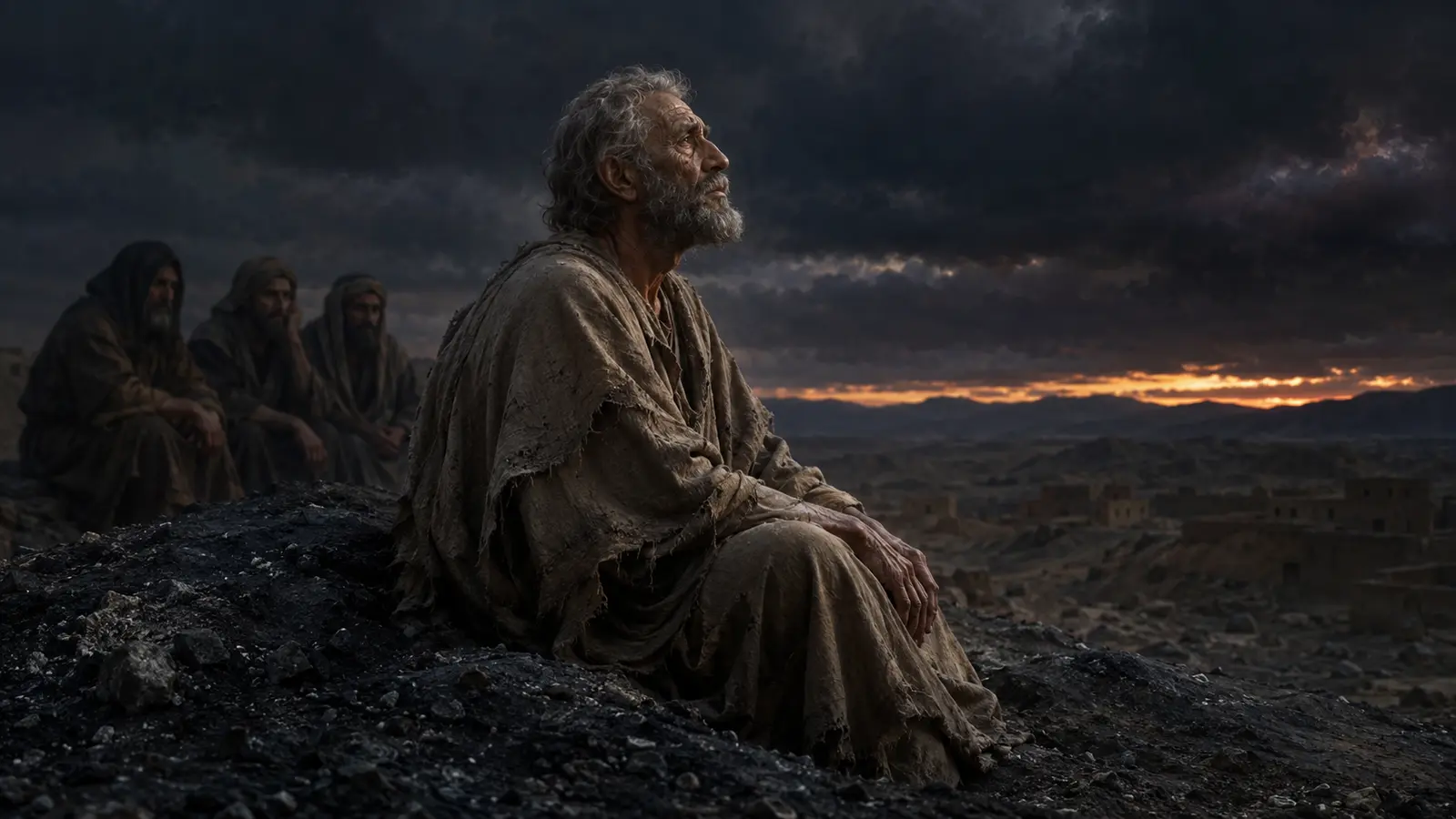
At the end of Job 2, the friends sit with Job for seven days and seven nights. No one speaks, because his suffering is so great. The silence is holy, but it is not yet perfect peace. It is the silence of the room in which sorrow still breathes. It is the silence before the cry.
01
1.0 Introduction: When Silence Breaks into Mourning
There is silence that heals, and there is silence that gathers thunder.
At the end of Job 2, the friends sit with Job for seven days and seven nights. No one speaks, because his suffering is so great. The silence is holy, but still not perfect peace. It is the silence of the room in which sorrow still breathes. It is the silence before the cry.
Job 3 is when that cry finally comes out.
The man who tore his clothes and worshiped now opens his mouth and curses the day of his birth. He does not curse God, as the accuser predicted. But he also does not remain in external calm. He asks why he was born. He imagines a world in which the day of its beginning would be engulfed in darkness. He longs for rest. He wonders why light is given to the afflicted, and life is given to those whose souls are full of pain.
This chapter may disturb readers who want Job to remain the quiet sufferer of chapters 1–2. But the Scriptures do not protect us from Job's pain. They allow us to hear it. The Bible does not edit the sufferer to appear polite. It gives grief a voice and puts that voice in the Holy Scriptures.
This text is about silence that turns into mourning, because Job teaches us that faith does not always speak in quiet sentences; sometimes faith lives on by speaking the truth from the ashes.
Job 3 is not a chapter of disrespectful rebellion. It is a look of indescribable pain. Job does not teach about death. He describes the unbearable experience of life under torture. His words are harsh because his suffering is severe. The pastoral task is not to reprimand him so that he is smart, but to listen to him carefully enough to hear the wound that lies beneath the words.
02
2.0 Historical and Literary Context: The First Speech of the Wounded Man
In the third chapter, when the main poetic flow of the book of Job begins, the Prose Introduction has introduced us to Job's justice, the heavenly council, the challenge of the accuser, the fall of Job's house, the suffering of his body, and the arrival of his friends. Now the conversation begins—not with friends, but with Job.
That makes sense. Friends will begin to talk as if Job needs to be taught, corrected, and explained. But the book gives Job the first voice. Before theology responds to pain, pain speaks.
This chapter is often called Job's lament. It has two main movements. First, Job curses the day of his birth and the night of his conception (vv. 1-13). Second, Job laments the misery of those who long for death but remain trapped in pain (vv. 14-26). The chapter begins with darkness and ends with turmoil. The main desire that runs through the entire speech is rest—calmness, sleep, silence, release from the chaos that invaded his life.
Job's language deliberately turns creation back. The beginning begins with God saying, "Let there be light." Job 3 prays for the day of his birth to be dark. Genesis organizes days, nights, months, and seasons. Job asks that his day not be counted among the days of the year. Creation celebrates life. Job wishes the doors of his mother's womb would remain closed.
This grief is not ordinary grief. It is such a deep sadness that it imagines the destruction of the world at the very place where Job entered it.
This chapter is also close to the Psalms of lamentation and curse of Jeremiah on his birth (Jer. 20:14-18). Like those scriptures, Job gives language to the faithful who suffer and fail to understand life under pain. However, Job's lament has a special intensity because it follows the testimony of the introduction: this man is innocent in relation to the calamities that befell him. His cry is not the cry of a man exposed in sin; it is the cry of a person crushed under a mystery.
03
3.1 When the Wound Opens Its Mouth (Job 3:1–2)
"After that, Job opened his mouth and cursed the day of his birth."
This opening is simple, but powerful. Job "opens his mouth." This statement implies more than ordinary speech. The silence is broken. The one who sat without a word in pride now gives language what his body has been carrying.
For seven days, grief was speechless. Now the words are coming like flood waters.
The author does not say that Job cursed God. That distinction is very important. The accuser said Job would curse God to his face. Job does not. Instead, he curses "his day"—the day closed by his birth. He wants the beginning of his life erased from the creation calendar.
We should not soften these words or look for a quick fix. Job's words are saturated with darkness—they have no place in greeting cards and should not be turned into light sermons of comfort. However, this is the solid light of the Scriptures: they prove to us that the Bible reserves a special place for prayers uttered from the very edge of human endurance.
04
3.2 When the Light is Asked to Return to Darkness (Job 3:3–10)
Job begins by calling for darkness to fall on the day of his birth and the night of his conception. "May the day I was born be lost." "Let there be darkness on that day." "May God who is above not seek it." "Let no light shine upon it."
This is the language of creation in retrospect. In Genesis, light is God's first word against darkness. In Job 3, Job asks the darkness to return the day to his hands. He wants the calendar to have a wound in it, a missing day, a place where the light never came.
He speaks of clouds, darkness, barrenness, silence, and extinguished stars. He calls those who curse the day, those who are ready to awaken Leviathan. His image is universal. Job's suffering seems greater than personal pain; it seems as if creation itself has betrayed him. The organized world no longer seems organized. The light that used to mean life is now seen as the revelation of pain.
Why such strong language?
Because Job doesn't just say, "I wish my life was easy." He says, "I wish my life had never started." The wound is so deep that he thinks of the deletion of his nature. His pain doesn't just want tomorrow's relief; they want a different yesterday.
However, even at this point, Job does not take the power of his life into his own hands, nor is there any plan to withdraw from the world. He takes his impossible cry and turns it into a language that he throws before God. This distinction is pastoral and very powerful. Mourning is a gift that prevents our pain from swallowing us up and becoming silent destruction.
05
3.3 Why Was I Received In Life? (Job 3:11–13)
Job's curse now turns into a series of questions: "Why didn't I die in the womb?" "Why didn't I give up when I came out of the womb?" "Why did the knees receive me?" "Why did my breasts suck?"
These are not philosophical questions asked from a quiet study room. It is a cry from the garbage. Job repeats the first acts of love that received him on earth. The knees that received him, the breasts that fed him, the human compassion that kept him alive—all now seem painful to remember.
What was a sign of love now, in Job's agony, appears as the beginning of sorrow.
Verse 13 shows his deepest desire: "For then I would lie down and rest; I would sleep; then I would find rest." Rest is the word behind this cry. Job longs for peace. He longs for sleep without nightmares, silence without wounds, silence without fear.
This desire for rest is not evil. It is for humanity. Suffering wears out the soul. Pain can make life seem like a long day without the shadow of evening. Job's tragedy is that he can only think of rest in the place of death.
Here the reader should listen carefully. Most people who suffer deeply do not first need to be rehabilitated; they need someone to understand that they are more tired than normal tiredness. Job is not making a quiet theological statement that death is good. He tells us that life has become unbearable.
06
3.4 The Strange Peace of Hell (Job 3:14–19)
Now Job imagines the realm of the dead as a place where social differences are silenced. Kings and counselors, nobles with gold, infants who never saw the light, the wicked, the weary, the prisoners, the slaves, the young and the great—they are all there.
In life, there are bridges. Others build ruins for themselves. Others fill the house with money. Others dictate. Others are ordered. Others suppress. Others are imprisoned. Others shout commands. Some carry whips of slavery.
But in Job's mind, death levels the playing field. The wicked cease to trouble. The tired find pleasure. Prisoners no longer hear the voice of the taskmaster. A slave is free from his master.
This is not the full biblical hope of the resurrection. Job is not yet singing about the new creation. He looks at the silence of Hell and sees, at least, the end of violence. Death seems to him not glory, but the absence of suffering.
The emotional core is still rest. Job is looking for a place where the noise stops.
There is a bitter irony here. Friends came to comfort him, but Job thinks of comfort among the dead. The living are sitting near him, but he longs to be with those who are beyond words. His loneliness is deep. He is surrounded by people, but he is still alone.
07
3.5 Why is Light Given to the Sorrowful? (Job 3:20–23)
Now Job stops cursing his beginnings and asks a broader question: "Why is light given to him who is in trouble, and life to those who are in pain in spirit?"
This argument expands the scope of this chapter beyond the context of Job alone. Job speaks for the whole company of the "troubled" and the "sorrowful of spirit," those who, in their despair, cry out for death and seek it with a zeal that surpasses the hunting of hidden treasures. His personal turmoil transforms into a literary bridge that connects his pain with the reality of human existence in the world.
Why does life go on when life seems like suffering? Why does the morning come to those who are afraid to wake up? Why does the light shine on those who receive it as another day of pain?
Then Job describes himself as "a man whose way is hidden, whom God has surrounded." This statement hurts because in Job 1 the accuser said God has put a hedge around Job to protect him. Now Job feels surrounded not by protection but by imprisonment. What seemed like a blessing now seems like a hardship. He sees no way forward. His way is hidden.
His world has become a closed room.
This scene stands as one of the deepest psychological markers in the entire chapter. Suffering can change the meaning of our language. Protection can be seen as a button. Light can be seen as a burden. Life can be seen as a judgment rather than a gift.
Job does not know what we know from the introduction. He doesn't know about heavenly talks. All he knows is that the God who once seemed to surround him with blessings now seems to surround him with pain.
08
3.6 No Ease, No Rest, No Rest (Job 3:24–26)
Job ends with the faithfulness of the body: "My groaning comes instead of my food, and my groanings are poured out like water."
Sorrow has become his food. Grunting has become his drink. His inner pain spills out. He can't stop it.
Then comes a frightening statement: "What I fear comes to me, and what I fear befalls me." Job's suffering is not only physical and material; it is also psychological. The fear has become reality. Fear is wearing a body.
The last line gathers the whole chapter in a dark echo: "I have no rest, nor rest; I have no rest, but trouble comes."
Pleasure. Calmness. Rest. That is what Job desires. Trouble. Turmoil. Chaos. That is what he receives.
Job 3 ends without resolution. No answer comes down. No friend comforts him yet. There is no voice of God speaking from the storm. This chapter allows the mourning to stop.
Sometimes that's where faithful reading should stop: not for solutions, but for testimonies.
09
4.1 Mourning is not contrary to faith
Job's speech is shocking, but it is not a denial of God. He does not pretend that pain is meaningless because God does not exist. His pain is especially intense because God has meaning. He lives in a world where creation, life, blessing, and justice should have meaning.
Mourning is a wounded faith but still looking at God's world. It rejects superficial self-denial. It rejects feigned happiness. It also refuses to let pain remain mute. Job teaches us that there are times when the sentence of faith is not "I am fine," but "Why was I born?"
10
4.2 Job's Darkness Brings Creation Back Without Overcoming Creation
Job prays for darkness to swallow his day. He wants the light of his beginning to be erased. His words turn creation back because his experience feels like creation is collapsing.
But the fact that these words are in the Scriptures means that God is not threatened by the darkness of the tormentor. The Creator allows the cry against the light to be heard in his own Word. That does not make the darkness final. It shows that the truth of God is strong enough to carry the speech of those who cannot yet see the dawn.
11
4.3 Passion for Rest Reveals the Fatigue of Suffering
Job's recurring desire is rest. He wants peace, sleep, silence. This should make us compassionate. People in deep pain often do not ask for explanations. They pray for relief. They are tired.
A wise society learns to hear the weariness that lies beneath harsh words. Sometimes the sentence "I wish I had never been born" means, "I can't bear this pain alone." Such words should evoke gentleness, presence, and quick help—not impatience to correct him theologically.
12
4.4 Job Gives Tongues to the Poor
In verses 20-23, Job speaks not only on his own behalf but also on behalf of all those who are suffering in spirit. This is the mercy part of Scripture. The Bible gives words to people whose pain often leaves them speechless.
The community of believers should go beyond the point of talking about the broken hearted, and instead enter the altar to pray with them. This third chapter of Job stands as a safe refuge for everyone who has not yet found the explosive power of praise, but possesses enough honesty to give relief to his pain in the dark.
13
4.5 Christ Enters the Darkness Mentioned by Job
Job wants darkness to cover the day. At the cross, darkness covers the land. Job feels he has been left to suffer without explanation. Jesus cries, "My God, my God, why have you forsaken me?"
Job longs for rest from pain. Jesus enters into death itself, not as a way to escape, but as a faithful Son who carries human sorrow to the grave.
However, Christ is resurrected. This does not silence Job's lamentation; it pays the horizon. Resurrection tells us that darkness can speak, but it does not get the last word. The grave may offer rest, but God intends more than rest from pain—he intends for a new creation, healed bodies, restored justice, and wiped away tears.
14
5.1 Don't Rush People From Job 3
Some grief must be felt before it can be healed. When someone speaks from pain, don't jump to a conclusion that the text itself has not yet reached.
15
5.2 Let Pain Become Prayer Before It Becomes Severe Pain
Job's lament is dangerous, but it is pronounced. Silent despair can be a prison. True mourning opens a window. Bring sorrow in words before God and before trustworthy people.
16
5.3 Listen to the Passion Beneath the Strong Words
When the wounded speak dark words, find out what their pain is trying to achieve. In Job 3, under the curse there is a desire for rest. A wise observer listens beneath the words.
17
5.4 Take Disappointment Seriously and Gently
Job's passion for death should never be glamorized. When someone feels trapped in life and longs for death, they need immediate compassion, companionship, prayer, and practical help from trusted people, pastoral care providers, counselors, and health professionals. No one should stay alone in that darkness.
18
5.5 Remember that the Scriptures Give You Permission to Mourn
You don't need to pretend to be spiritual before God. The Bible has tears, complaints, questions, groans, and endless prayers. God is not honored by pretending. He is respected when it really comes to his presence.
19
5.6 Hold on to the Word That Is Beyond Ashes
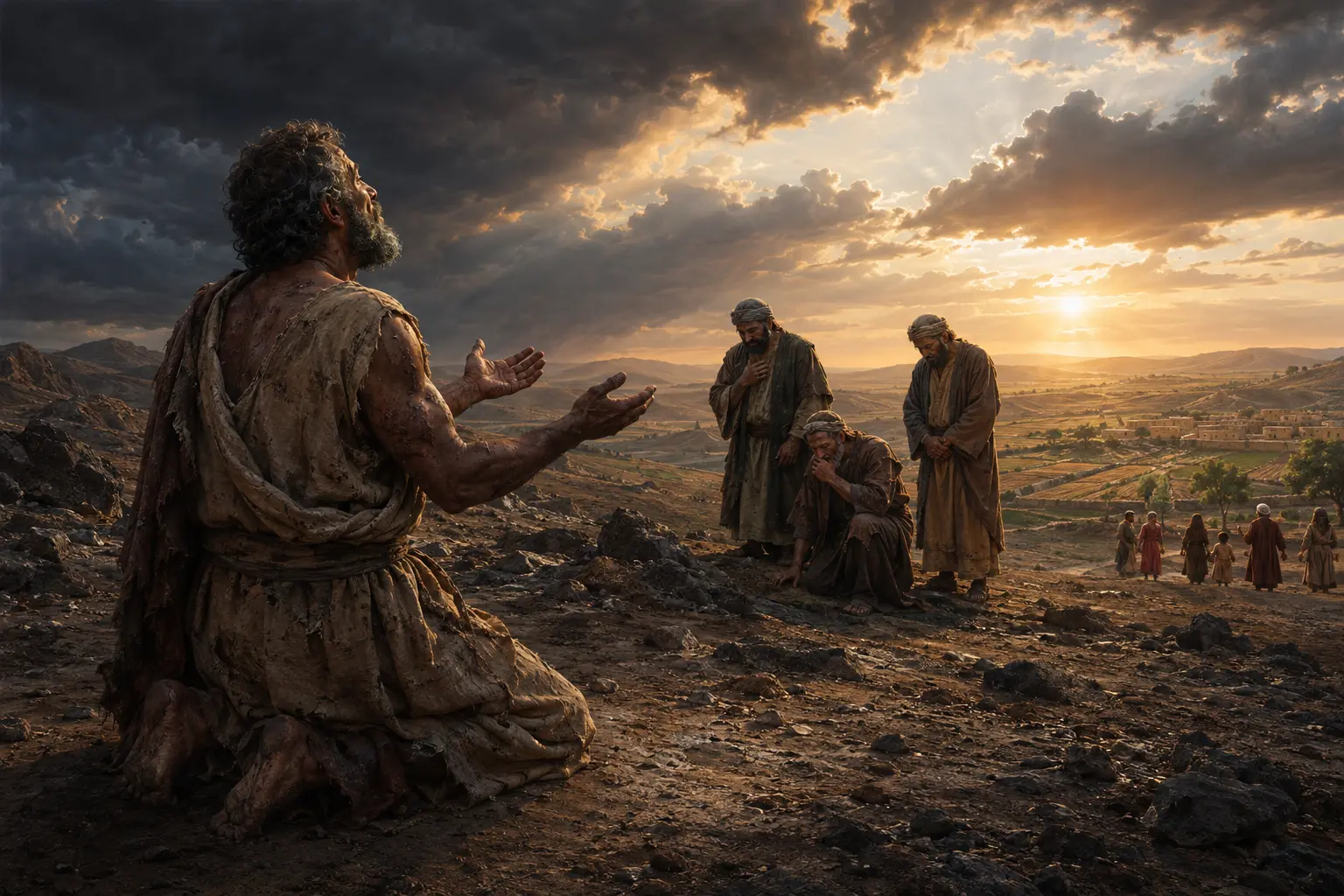
Job 3 is not the last chapter. The mourning is real, but it is not the whole story. If you cannot see the end, let society remind you: God who seems to be silent is not far away, and the storm has not yet spoken.
20
6.0 Reflection Questions
1. What sadness in my life has remained silent because I was afraid that it is too dark to bring it before God?
2. Have I ever confused mourning with unbelief, in myself or in someone else?
3. Where do I most deeply desire rest now?
4. How can I be a safer listener for people speaking from pain?
5. What does Job 3 teach me about the difference between true pain and final despair?
6. How does the cross of Christ help me to respect mourning without surrendering hope?
21
7.0 Response Request
God of the dawn we have not yet seen,
We come to you from a place where silence breaks. We bring the words we are afraid to say, the sorrows we have embellished too much, the groans that have become our daily bread.
Teach us to mourn without shame.
When the light feels heavy, stay with us. When the way is hidden, let's take it. When we feel surrounded and can't find the road ahead, let us remind ourselves that we are not left in the dark.
Give us the courage to speak the truth, and give us friends who can listen without fear. Save us from easy answers. Save us from despair and loneliness. Save us from the lie that our pain must be hidden from your presence.
Lead us to Jesus, who entered the darkness, wept with the abandoned, rested in the grave, and rose again with healing in his hands. His resurrection may be distant music that we cannot always hear but we can still believe.
Until the storm blows, let's keep breathing. Until the morning comes, let us continue to be held. Until the tears are wiped away, teach us to pray from the ashes.
Amen.
22
8.0 The Next Window: When Comfort Begins to Speak Too Early
Job 3 ends in turmoil. The silence is broken, and what happens is not quiet teaching but raw lamentation. Job has not cursed God, but he has cursed the day the light touched his life for the first time.
Now friends will start replying.
In Job 4, Eliphaz speaks first. His words will begin gently, almost cautiously, but underneath there is a dangerous assumption: suffering must fit into a moral framework that we already understand. Friends came to comfort Job, but their comfort will soon turn into judgment.
The wound has spoken. Now theology will answer. And the question before us will be whether theology can survive its tears.
23
9.0 Bibliography
Alter, Robert. The Wisdom Books: Job, Proverbs, and Ecclesiastes: A Translation with Commentary. New York: W. W. Norton, 2010.
BibleProject. "The Book of Job." Old Testament Overview Guide.
Clines, David J. A. Job 1–20. Word Biblical Commentary 17. Dallas: Word Books, 1989.
Crenshaw, James L. Old Testament Wisdom: An Introduction. Louisville: Westminster John Knox, 2010.
Hartley, John E. The Book of Job. New International Commentary on the Old Testament. Grand Rapids: Eerdmans, 1988.
Walton, John H., and Tremper Longman III. How to Read Job. Downers Grove, IL: IVP Academic, 2015.
Wright, N. T. The New Testament and the People of God. Minneapolis: Fortress, 1992.

Be the first to leave a comment.