


It doesn't scream. It's not mocking. It may even start with respect. It recalls the old powers of the sufferer. It quotes well-known truths. It talks about the justice of God, the weakness of man, and the moral order of the world. On the surface, it sounds like wisdom.
01
1.0 Introduction: Information Arrives Too Early
There is a kind of comfort that starts gently but carries a hidden knife.
It doesn't scream. It's not mocking. It may even start with respect. It recalls the old powers of the sufferer. It quotes well-known truths. It talks about the justice of God, the weakness of man, and the moral order of the world. On the surface, it sounds like wisdom.
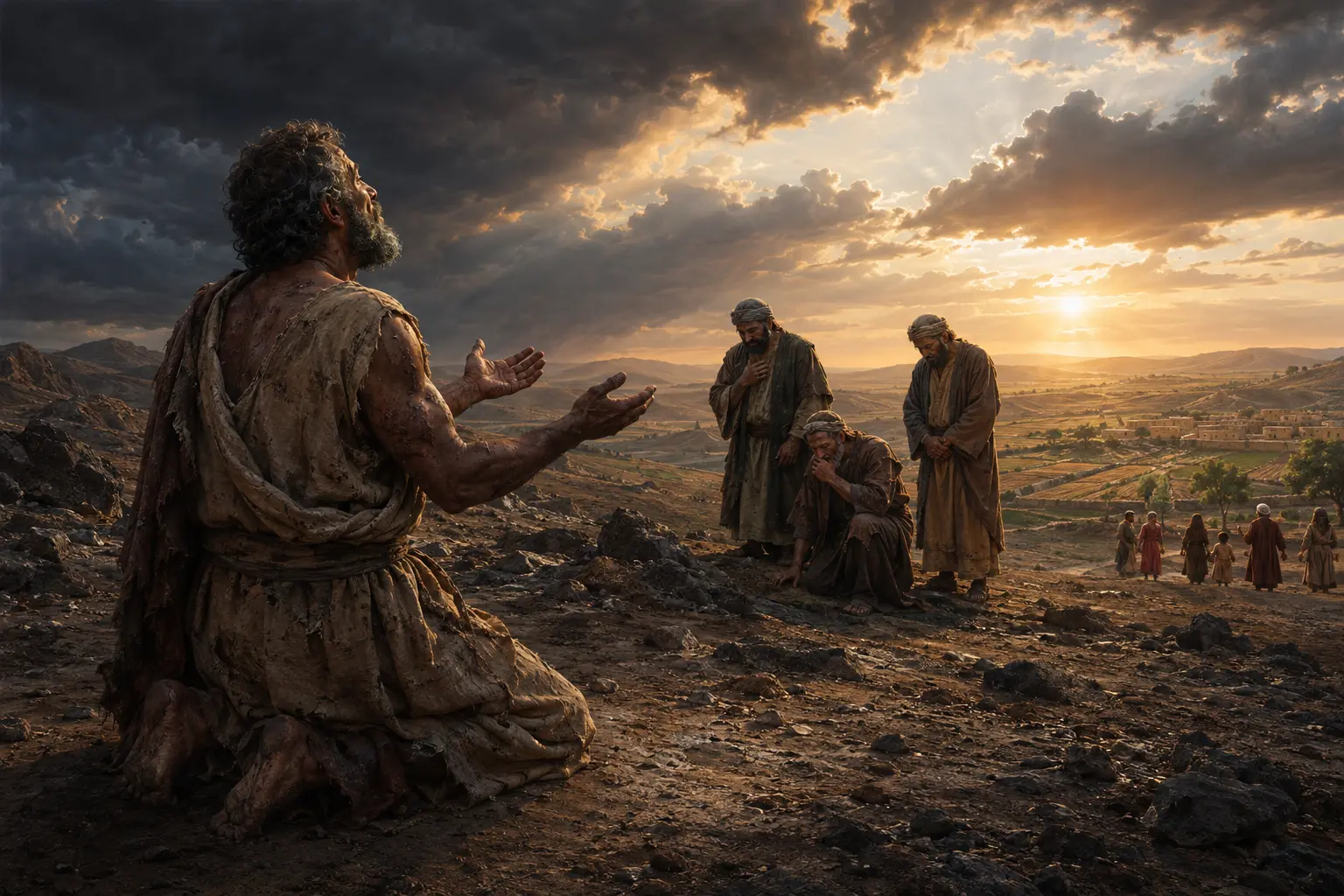
But when the person suffering is Job—proclaimed by God himself to be blameless and upright—the usual explanation begins to be dangerous.
Job 4 is the first speech of Eliphaz the Temanite. For seven days, Job's friends were silent because they saw that his suffering was too great. In Job 3, Job broke the silence with a cursed lamentation, wishing his birthday would never dawn. Now Eliphaz answers. His speech is not yet as strong as the speeches that will follow later. He speaks cautiously, almost hesitantly. He acknowledges Job's past service to others. He tries to restore Job's courage. But beneath his words there is a belief that will be the greatest fault of friends: suffering must somehow reveal guilt.
Eliphaz does not know what the reader already knows; he has never heard the secrets of the heavenly council. He does not know that Job's sufferings have come 'without cause'—that this great calamity is not the punishment of hidden sin. For that reason, he resorts to the only thing he knows: the wisdom of reception, the moral order in the world, the principle of reward for deeds, and a mystical vision about the weakness of man before God.
The big challenge is not that every word of Eliphaz is a lie. On the contrary, most of what he says has truth in it if viewed in the right context. Humans are weak creatures, evil often reaps bitter fruits, and God is so holy that no creature can stand before Him with self-satisfied pride. However, truth turns cruel when it is used without wisdom and discernment. A hammer may be an invaluable tool in the garage, but it is a dangerous weapon when brought into the infirmary.
This text is about comfort that turns dangerous, because Eliphaz teaches us how true words can be false evidence when they are spoken without compassion, humility, and attention to the real story of the sufferer.
Job 4 teaches us to ask not only, "Is this statement true?" but also, "Is this the right word for
this injury?”
02
2.0 Historical and Literary Context: The First Friend Speaks
Job 4 begins the first cycle of discourse between Job and his three friends. The book has now fully entered the poetic discourse. Job spoke first in chapter 3, not to accuse his friends, but to curse the day of his birth and mourn the pain of living under torture. Eliphaz answers as the first friend, and probably the oldest among them.
His speech runs from Job 4 to Job 5. Chapter 4 contains the first part: the beginning of
caution, recalling the piety of Job, statements about the theology of rewards for works, and night visions about the filth and weakness of humans. Chapter 5 will continue with warnings: seek God, accept return, and have hope of restoration.
Eliphaz represents the view of traditional wisdom. He believes that the world is governed by a stable moral order: a good man may slip, but he is not completely destroyed; and a wicked man may prosper for a while, but in the end he is cut off. This philosophy was not born of malice or cruelty, but sprung from the genuine fountain of biblical wisdom. The book of Proverbs repeatedly teaches that righteousness leads people to life, while wickedness leads them to destruction. Likewise, the Psalms emphasize that God upholds the righteous and holds the wicked accountable.
But Job's narrative has already disrupted that simple arrangement. The prologue tells us that Job
he is righteous, but disaster has fallen on him. Job reveals what happens when the general principle of wisdom is taken as the perfect explanation for each individual wound.
Eliphaz is not yet an enemy. It's a friend trying to help. But he becomes the first example of dangerous pastoral behavior: speaking from the correct system while failing to truly hear the person who is suffering.
03
3.1 The Beginning of Caution: "Who Can Refrain from Speaking?" (Job 4:1–2)
Eliphaz begins cautiously: "If someone tries to talk to you, will you get tired? But who can stop himself from talking?"
Its beginning shows tension. He knows that words can tire Job. He knows Job is in a raw wound. He knows words can sting a wounded man. However, he feels compelled to say it.
Here is wisdom and danger. Wise, because Eliphaz understands that speaking in front of someone who is suffering requires care. Dangerous, because he thinks his need to speak is greater than Job's need to be understood.
Many hurtful words start like this: "I don't want to make you angry, but..." Sometimes that sentence is a sign of courage. Sometimes it is a warning that the speaker is about to cross a sacred boundary.
Eliphaz's question should provide a serious warning to every counselor, preacher, pastor, parent, and friend: Who can restrain his words? There are times when love has to raise its voice. But there is also the emergency of love, which requires the wisdom to remain silent—even for a short while.
04
3.2 Remembering Job's Past Powers (Job 4:3–4)
Eliphaz then recognizes Job's past experience. Job has taught many. He has strengthened the weak hands. His words have supported those who were stumbling. He has strengthened the trembling knees.
This is a good and important thing. Job was not only rich; he was a moral and spiritual help to others. He knew how to comfort. He knew how to energize. He was a teacher of wisdom and a healer of broken hearts.
Eliphaz takes Job back to remember his own ministry. It is possible that his intention was to awaken Job's courage by saying, 'You used to support others not to fall; now let the same wisdom stop you.' This reminder would be of great comfort and gentleness if it ended up being an invitation to love.
But the commemoration is already beginning to move towards blame. Job once strengthened others, but now he himself is shaken. Job once encouraged the weak, but now he himself is troubled. Eliphaz will soon point out that Job's brokenness now shows the failure of his hope.
Here again the pastoral lesson is serious. We have to be careful when we remind sufferers of their past strengths. A person who once encouraged others may feel even more ashamed when they fail to encourage themselves now. Strength in one season does not eliminate the possibility of a fall in another season.
Even those who once strengthened their shaky knees, may one day need someone to hold them from falling.
05
3.3 When Ancient Wisdom Is Turned Against Present Pain (Job 4:5–6)
Eliphaz continues: "But now they have come to you, and you are tired; they have touched you, and you are troubled. Is not your fear of God your hope? And the perfection of your ways is not your hope?"
This is the part that turns its opening. Eliphaz sees Job's mourning as incongruous. Job was able to counsel others, but now suffering has come to him, he is overwhelmed. Shouldn't his devotion to God have given him courage? Shouldn't his integrity have given him hope?
There is a deep truth here: honoring God and living righteously can sustain a person in suffering. Job's own life has already shown that. In chapters 1–2, he does not curse God. He holds his integrity.
But Eliphaz does not understand the nature of mourning. He thinks the pain means Job has lost the right hope. He still does not understand that mourning can be the language of faith under pressure. Job's cry in chapter 3 does not mean that Job has abandoned God; it means that Job refuses to hide the depth of his grief.
Eliphaz confuses emotional breakdown with spiritual failure.
This is a very common mistake. We see tears and think faith is weak. We hear dark questions and think respect for God has disappeared. But the Scriptures give us the psalms of lamentation, the complaints of Jeremiah, the objection of Habakkuk, and the speeches of Job because God knows that faith sometimes speaks with trembling knees.
06
3.4 The Doctrine of Recompense: "Who Is Righteous That Ever Perished?" (Job 4:7-11)
Now Eliphaz lays down his first principle: "Remember, who was innocent that perished? Or where were the righteous cut off?"
This is the root of the theology of Job's friends: the innocent are never destroyed, and the upright are never completely cut off. In their world, those who cultivate evil and sow misery reap what they sow; the wicked are destroyed by the breath of God's wrath. To emphasize his point, Eliphaz uses the heavy image of a lion—describing how a roaring lion, a fierce lion, and even the teeth of the lions being broken and torn apart.
This image is powerful. Evil may seem strong, like a lion in its prime, but God can break its teeth. Evil may roar, but its roar will not last.
As a general rule of wisdom, this is not trivial. Scripture often teaches that evil destroys itself. Those who sow injustice reap sorrow. Violence devours the violent. Pride collapses under its own weight.
However, Eliphaz rushes to use the principle too quickly without thinking. When he says that, Job is sitting on the ashes; her children are dead, and her whole body is full of sores of torture. If it is true that the innocent are never destroyed and the righteous are never cut off, then what is the meaning of this tragedy of Job? Eliphaz may not have said it outright yet, but the message hidden beneath his words is clear: Job's pain must be the result of some hidden fault.
This is where wisdom stops being a comfort and turns into an accusation.
The challenge is not that the moral system is false; the problem is that Eliphaz sees the process as a simple commercial machine. He leaves no room for the suffering of the innocent, the mystery of the heavenly council, the delay of justice, spiritual trials, or the complexity and vastness of God's world. His theology is well organized enough to provide answers to Job, but it does so by misreading him and mistreating him.
07
3.5 Night Visions: When Allegory Is Used to Justify Certainty (Job 4:12–16)
Now Eliphaz returns to personal vision. The word came to him secretly. His ear received a whisper. In the thoughts of night visions, when deep sleep falls upon men, fear came to him. His bones shook. The spirit passed before his face. The hair on his body stood up. A figure stood, but he could not recognize it. There was silence, then a sound.
This event is terrifying. It carries an air of mystery: darkness, whispering, trembling, spirit, silence, invisible form.
Eliphaz's vision gives his speech authority. He doesn't just quote tradition; he has received something. But here we have to be careful. Spiritual experiences can be real, powerful, but still require discernment. A vision can make a speaker humble, but it can also make him unwilling to be corrected.
The content of the vision does not appear to be evil. They emphasize the holiness of God and the weakness of creatures. But Eliphaz uses that vision as part of his argument that Job should not hold too much of his integrity. The mystery of the night becomes a tool to strengthen his perspective.
Here is a warning. Spiritual experience should make us more humble, not more confident that we understand someone else's suffering.
08
3.6 Man's Weakness Before God (Job 4:17-21)
The voice asks: "Can man be righteous before God? Can man."
to be clean before his Creator?"
Then the vision makes a point from the big to the small. If God does not believe his servants and even his angels find them guilty, are not those who live in earthen houses, whose foundation is dust, crushed like moths?
This language reminds us of a serious truth. Human life is fragile. We are creatures that live in clay houses. From morning to night, our lives can be broken. We die without wisdom.
There is truth here. Scripture repeatedly teaches about our mortality and our limitations. We are not God. We don't see it all. We are earthen vessels, the leaves of the field, the breath passing through the lungs for a short time.
However, in the context of Job, this truth turns into a tool to oppress him. Eliphaz uses the concept of human weakness as a tool to undermine Job's defense before it is even complete. He suggests that Job should not hold fast to the defense of his innocence, on the basis that no man can be pure before God.
Again, this statement is partially true, but it is pastorally misdirected. Job does not claim to be equal with God. He does not claim sinless perfection. He claims that his suffering is not the punishment he deserves for some hidden evil. The prologue has already told the reader that Job is right.
Eliphaz's vision cannot override God's testimony about Job.
09
4.1 True Words Can Be False Comfort
Eliphaz says many things that sound biblical: God is holy, humans are weak, evil brings destruction, fear of God brings hope. Danger is not an obvious lie. Danger is truth used without wisdom.
The word may be doctrinally correct but pastorally wrong. Job 4 teaches us that comfort requires more than accuracy. It requires the right timing, compassion, humility, and attention to the person in front of us.
10
4.2 Mourning is not the Fall of Integrity
Eliphaz thinks that Job's pain contradicts his piety. But Job's mourning is part of his righteousness. He refuses to pretend. He rejects the easy plays of faith. He puts the truth of his situation into words.
The church must study this subject thoroughly. Tears are not betrayal. Questions are not always rebellion. A trembling voice may still be directed to God.
11
4.3 The Theory of Direct Payments Too Little for Job's Injury
Eliphaz's world has a moral order, but it is an oversimplified order. He knows that sin brings destruction, but he cannot imagine that a righteous person can suffer undeservedly.
Job does not reject the moral order. He reveals the danger of making the process too easy. God's world is not chaos, but neither is it a coin-mining and commodity-dispensing machine. Wisdom sees patterns; humility admits that there is a difference from the mysteries.
12
4.4 Spiritual Experience Must Bow to Awareness
Eliphaz's night vision is powerful, but power alone does not guarantee proper use. The question is not
just, "Did I get some experience?" but, "How should this experience be interpreted, and how should it be applied to this suffering man?"
Personal revelations, inner promptings, dreams, and spiritual knowledge should never be used to crush the wounded or ignore what God has already revealed about mercy, justice, and humble love.
13
4.5 Christ Reveals an Innocent Suffering and Dying—Then Justified
Eliphaz asks, "Who is innocent that ever perished?" The cross will one day provide an answer in a way that Eliphaz could not imagine.
On the cross we see Jesus—He who is holy and spotless—drinking the cup of shame, condemnation, loneliness of abandonment, and death. At the cross, the simple theology of reward for works completely falls apart. The righteous one who suffers is cut off—not because he has any guilt, but because he sinks with his faithful love into the dark depths of our evil and pain.
But the dawn of resurrection comes to glorify him and give him victory. Therefore, the final answer of the Christian faith is not that the innocent will not be tortured; but it is that the suffering of the righteous does not have the authority to give the last word, because God has resurrected the one who was crucified
14
5.1 Ask if Your Words Are Required
Eliphaz asks, "Who can refrain from speaking?" Before you step into someone else's pain, ask: Is this a time to speak, or is it a time to listen more?
15
5.2 Don't turn a person's Past Strengths into Present Shame
A person who once made others strong may now be weak. Don't say, “You helped others—
why can't you help yourself?” Instead say, "You carried many; now let us carry you."
16
5.3 Reject Quick Ethical Disclosures
Don't think suffering reveals guilt. Sometimes suffering reveals the brokenness of the world. Sometimes they reveal the limits of our understanding. Sometimes they are places where faith is tested in a way that is invisible to others.
17
5.4 Let Doctrine Serve Compassion
Good theology should make us quicker to cry with others, not quicker to accuse them. It should make us faithful in being with them. The doctrine that makes us cold has lost the fragrance of wisdom.
18
5.5 Be Careful With "God Told Me" Language
Spiritual inspirations should be held with respect and humility. Never use a personal vision, dream, or word to place a burden on a wounded person that God has not clearly given you to carry with him.
19
5.6 Create a Space for Mourning in the Community of Faith
If the church becomes a place to celebrate the language of victory only, then people with wounds like Job's will be condemned to suffer in their loneliness. The biblical community must know how to worship with all voices: praise and lamentation, courage and complaint, thanksgiving and tears.
20
6.0 Reflection Questions
1. Have I ever spoken too quickly to someone in pain because I couldn't stand the silence?
2. Where have I confused a person's mourning with a lack of faith?
3. Do I tend to interpret suffering in simplistic explanations of cause and effect?
4. How can I allow theological truth to be more compassionate, not harsher?
5. Have I ever used spiritual experience or "wisdom" to avoid deep listening?
6. What would it mean for me to be a comforter who carries the truth with tears?
21
7.0 Response Request
God of wisdom and mercy,
Teach us how to speak close to those who dwell in the ashes.
Forgive us for the times we responded to wounds with patterns, tears with doubts, and mourning with corrections. Forgive us for speaking because the silence scared us. Forgive us for turning true words into heavy stones.
Give us the humility of those who know only in part. Give us ears before answers, tears before theories, presence before explanations. Let our theology be a cup of cold water, not a knife in hand.
When we are like Eliphaz, slow us down. When we are in Job's position, hold us firmly in your hand. And as we sit next to those who suffer, teach us to remember that holy ground can be covered with dust, disease, and unanswered questions.
Lead us to Jesus, the innocent sufferer, the wisdom of God, the friend who does not break the bruised reed. May his cross teach us that righteousness can suffer, and may his resurrection teach us that suffering will not reign forever.
Make us faithful comforters—true, gentle, patient, and humble.
Amen.
22
8.0 The Next Window: When Counseling Turns into a Call to Repentance
Job 4 opens Eliphaz's first speech with warning, memory, reward of deeds, and night vision. He's not done yet. In Job 5, he will move from diagnosis to treatment. He will plead with Job to seek God, accept divine punishment, and hope for restoration.
Some of what he will say will sound good. Some of it will reflect deep biblical truths. But the wound remains: Eliphaz speaks for the wrong case. He thinks Job's pain must fit within his framework.
The first word of comfort has already begun to bend towards accusations. The question now is whether wisdom can still learn to kneel beside suffering without trying to control it.
23
9.0 Bibliography
Alter, Robert. The Wisdom Books: Job, Proverbs, and Ecclesiastes: A Translation with Commentary. New York: W. W. Norton, 2010.
BibleProject. "The Book of Job." Old Testament Overview Guide.
Clines, David J. A. Job 1–20. Word Biblical Commentary 17. Dallas: Word Books, 1989.
Crenshaw, James L. Old Testament Wisdom: An Introduction. Louisville: Westminster John Knox, 2010.
Hartley, John E. The Book of Job. New International Commentary on the Old Testament. Grand Rapids: Eerdmans, 1988.
Walton, John H., and Tremper Longman III. How to Read Job. Downers Grove, IL: IVP Academic, 2015.
Wright, N. T. The New Testament and the People of God. Minneapolis: Fortress, 1992.

Be the first to leave a comment.