

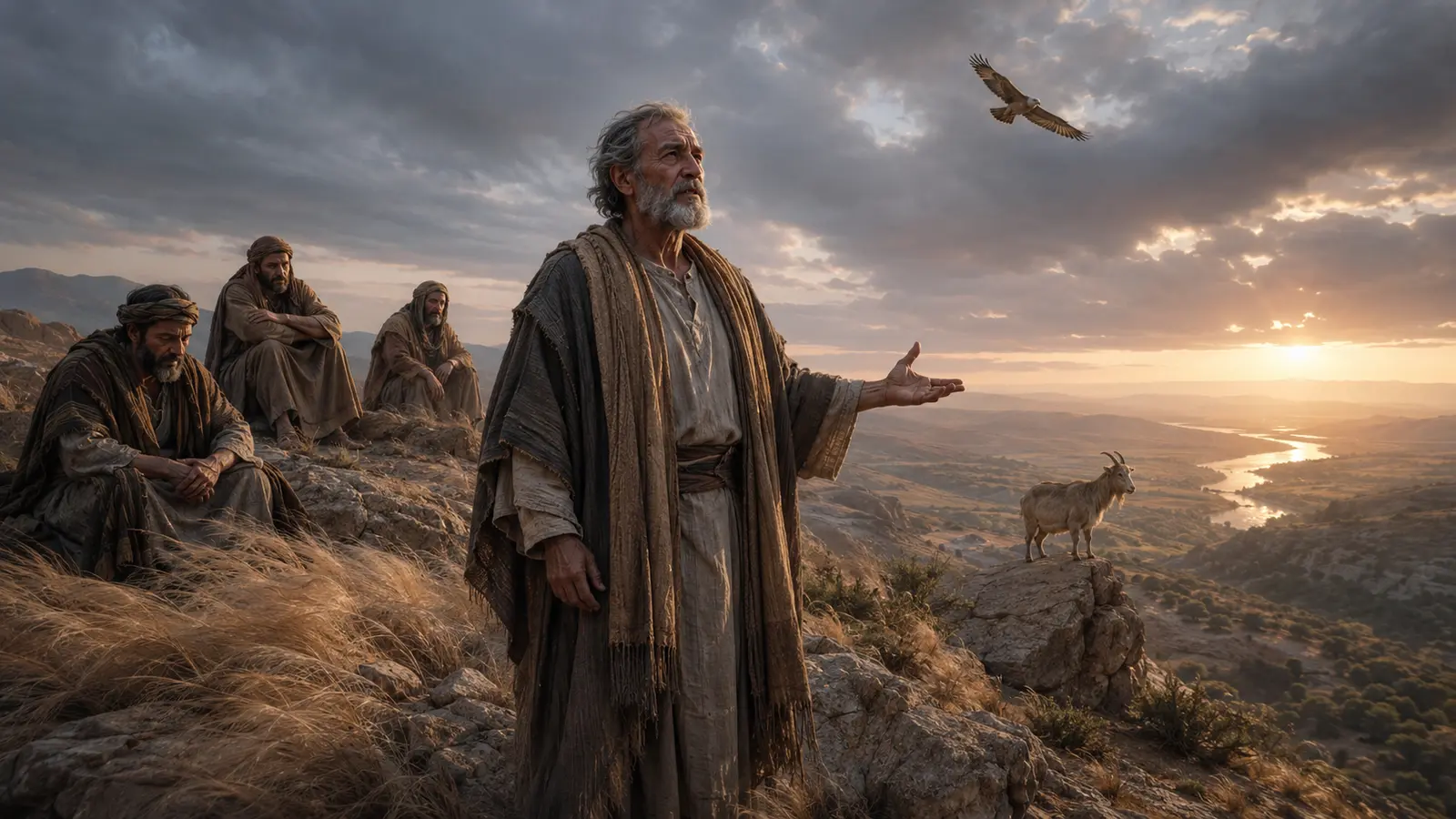
Sometimes, the injured person is not ignorant. It's not that he doesn't have the skills. Sometimes the sufferer has heard every sermon, memorized every proverb, but still sits under a sky that refuses to reveal itself. Job 12 is not the speech of a man who has lost his theological orientation. It is the speech of a man whose theology has become too serious to be satisfied with simple religious answers. He knows God is wise and powerful. But when he is there on the ash heap, divine wisdom no longer looks like a neat, well-ordered classroom; it seems like an earthquake that shakes kings, counselors, nations, and the hearts of men.
01
Job's Ridicule, Animal Wisdom, and God Shaking Earth's Thrones
Sometimes, the injured person is not ignorant. It's not that he doesn't have the skills. Sometimes the sufferer has heard every sermon, memorized every proverb, but still sits under a sky that refuses to reveal itself. Job 12 is not the speech of a man who has lost his theological orientation. It is the speech of a man whose theology has become too serious to be satisfied with simple religious answers. He knows God is wise and powerful. But when he is there on the ash heap, divine wisdom no longer looks like a neat, well-ordered classroom; it seems like an earthquake that shakes kings, counselors, nations, and the hearts of men.
02
1.0 Introduction: When an Injured Person Responds to Teachers
Zophar has just spoken with a strong and definite position. He has accused Job of having too many words, mocked his claims of righteousness, referred to the unfathomable wisdom of God, and urged him to repent so that light may return to his life. Zophar's theology had attractive language but lacked personality and showed a hard spirit. He spoke of hidden wisdom but used it to judge. He spoke of mercy, but made Job's suffering seem less than what he deserved.
Now Job answers.
Chapter 12 opens Job's long response that continues into chapter 14. This is Job's first detailed response to all three of his friends together after the completion of the first round of their speeches. He does not answer Zophar alone; he faces a whole group of comforters. Their advice has been like a chorus that has been repeated over and over again. Their words differ in tone, but their conclusion is the same: Job's pain is proof of his guilt.
Job absolutely refuses to agree with that.
His answer begins with heavy irony: "Surely you are the people, and wisdom will die with you" (Job 12:2). This wounded man still has an edge in his words. He refuses to let his friends claim wisdom just because they speak with confidence. He will not allow their neat thought system to silence the truth of his life.
However, chapter 12 is not just defensive. Job is doing something deeper. He takes the same themes that his friends use—wisdom, tradition, creation, divine power—and turns them inside out. It is as if he is saying: "You speak as if I do not know that God is a great ruler. I know very well. Even animals know that. The problem is not that I have forgotten God's power. The problem is that God's power, as I see it now, is terrifying."
Therefore, this chapter stands at a very important place in Job's journey. It shows that Job's struggle is not rebellion or disbelief that rejects God. It is a wounded faith that struggles with a God that it can never let go of. Job does not challenge God's authority, but questions how it works. We do not dismiss wisdom, but he opposes wisdom that is superficial, self-aggrandizing, and detached from reality.
This chapter asks us a question to ponder:
What happens when the doctrine of God's sovereignty is true, but the victim finds himself experiencing it as a threat that haunts him?
03
2.0 Historical and Literary Context: Job's Fourth Discourse Begins
Chapter 12 opens Job's fourth major discourse, which continues through Job 14. These three chapters form one broad cycle of thought:
Job reprimands his friends and explains the power of God that disrupts human systems (Job 12).
Job announces his intention to negotiate with God directly (Job 13).
Job laments the weakness of man and asks if hope can survive after death (Job 14).
In the debate so far, friends have appealed to the established wisdom of the past. Eliphaz relied on spiritual experience and moral inquiry. Bildad relied on the traditions of his ancestors. Zophar used theological arguments about God's hidden wisdom. But Job now insists that they do not have any secret knowledge. Their proverbs are common, and their claims are not new. What they know, Job also knows well.
The literary flow of chapter 12 has three main parts:
1. Job's sarcastic rejection of the excellence of his friends (12:1–6).
2. Job's call to creation as a witness that God's hand rules all life (12:7-12).
3. Job's heavy and dark song about God's wisdom and power in overturning human order (12:13-25).
That last part is very important. It sounds like a praise, but it is a praise sung to the sound of a great symphony. Job lists God's power over buildings, prisoners, water, counselors, judges, kings, priests, elders, nations, leaders, and light. However, almost every example emphasizes disruption: God destroys, locks in, stops water, brings floods, usurps power, leads captives, silences leaders, and makes nations wander.
This does not mean that Job is blaspheming; it just means he rejects unrealistic ideological theology. He sees the instability of the world and mentions God as the one whose power is behind it all. His problem is not that God is weak. His problem is that God is powerful, and that power has not yet manifested itself to him as mercy.
This chapter also prepares the reader for God's future speeches from the whirlwind. Job ponders and turns to creation—animals, birds, land, fish—as witnesses that God's hand rules life. Later, God will also answer Job through the same creation: wild goat, wild donkey, ostrich, horse, eagle, Behemoth, and Leviathan. Job seeks the testimony of creation to challenge the lightness of his friends' ideas; God will also turn to creation to expand Job's horizons.
Therefore, Job 12 is not the last word, but a faithful word in the middle of the storm. It speaks from a place where suffering has made easy answers no longer available.
04
3.1 "Wisdom Will Die With You" — Ridicule Against Spiritual Self-Esteem (12:1-6)
Job begins with a stinging sarcasm: "Surely you are the people, and wisdom will die with you" (12:2). He does not praise their understanding, but exposes their pride. They have spoken as if they were the standard of humanity, as if wisdom itself would collapse and disappear if they stopped speaking.
This is the first step of Job's answer: he rejects the monopoly of wisdom.
"I also have understanding like you; I am not inferior to you," he says (12:3). Job does not claim to know everything, but he does know enough to realize that his friends are not giving new revelations from heaven. They are simply repeating the known facts in a way that is completely out of proportion to its tragedy.
There is great pastoral significance here. Often people who suffer are treated as if the pain has made them mentally or spiritually weak. Others talk about them, measure them, instruct them, and correct them, as if suffering has erased their ability to think. Job opposes the humiliation. He is wounded, but not stupid; confused, but not empty-headed; he suffers, but he is not spiritually dead.
Then Job mentions the social injury underlying the theological argument: "I have become a joke to my friends" (12:4). This is heartbreaking. Job was once a man of great honor. Now he is treated as a negative example of the subject. His friends are not only against him; they despise him. His suffering has completely changed the way others perceive him.
He describes himself as a man who called out to God and was answered, a righteous and innocent man who has now become a freak. The irony hurts: Job's very relationship with God, once a symbol of righteousness, now seems to make him a mockery.
Verse 5 expands the wound: "In the thoughts of a comfortable man there is contempt for tragedy." Those who are well in life often talk carelessly about misfortune. From the comfort of a chair, suffering seems light. At a full table, hunger sounds like just a classroom lesson. For a healthy person, illness becomes a theological topic rather than a cry of pain. Job sees this well—his friends are "at ease." Their lives are not ruined, their children are not buried, and their bodies are not wounded. So they can discuss the tragedy as an imaginary concept, while Job is forced to live in it like a house without a roof.
Then Job makes a shocking observation: "The tents of robbers prosper, and those who provoke God are safe" (12:6). This directly challenges their view of worldly rewards. If suffering always means guilt, and prosperity means justice, why do robbers live unmolested? Why do those who anger God seem safe? Job does not deny moral order altogether, but reveals that the real world does not conform to the simple formulas of his friends. Sometimes the wicked sleep safe while the righteous scratch their wounds in the ashes.
Note: Comfortable people must be very careful: a life of ease can make them make cruel statements they think are wise.
05
3.2 “Ask the Animals” — Creation Knows What Friends Refuse to See (12:7–12)
Job now turns from his friends to creation: "But now ask the animals, and they will teach you; and the birds of the air, and they will tell you" (12:7). Animals become Job's witnesses. Animals, birds, land, and fish all testify to one truth: "the hand of the LORD has done this" (12:9).
This is an amazing thing. Job does not distance himself from the truth of God's action. He does not say, "God has nothing to do with my suffering." He says the opposite: God's hand is everywhere. The life of every living creature and the breath of all mankind is in His hand (12:10). But this confession does not comfort Job yet. For his friends, the hand of God is a guarantee of moral order; for Job, God's hand is the great secret behind the world where the suffering of the innocent and the peace of the wicked await answers.
This is the second step of Job's answer: he uses creation to challenge simple theological characterizations.
Animals know something that friends have forgotten: that life is not tied to our formulas. Creation is woven of dependence, danger, hunger, and great divine mysteries. This world does not run according to a small map carefully drawn within safe walls. God's hand is holding every breath, but His action cannot be turned into a predictable machine that dispenses rewards and punishments at the push of a button.
There is also an underhanded rebuke here. Zophar had spoken of God's hidden wisdom as if Job needed basic instruction. Job responds by saying that even the animals know that lesson. The issue is not whether God rules; the issue is whether friends understand how humans should speak with great humility about the regime.
Verse 11 adds a wise proverb: "Does not the ear try words, as the palate tastes food?" Job calls for discernment. Not every religious word should be swallowed just because it mentions the name of God. The ear must taste the words; you must test whether they are nutritious or poisonous, whether they are genuine or misused.
Then verse 12 acknowledges the common wisdom claim: "Wisdom is in the old, and understanding in the years." Job does not despise age or tradition, but in this context, he will not let age be the final answer. Wisdom may belong to the elderly, but age can also stunt you when you stop learning from those who suffer. the world is bigger than tradition, and God is bigger than our inherited formulas.
06
3.3 "Wisdom and Might are with God" — A Heavy Song of Disturbing Authority (12:13–25)
The last part of this chapter begins with a serious confession: "Wisdom and power are with God; he has counsel and understanding" (12:13). If we stopped there, those words could sit well in the hymn book. But Job continues, and the song becomes very disturbing.
If God destroys, it cannot be built again. If God closes a person, no one can open it. If God withholds water, drought comes; if he sends them out, they overturn the earth (12:14-15). This is a great rule, but not a rule tamed or predictable by human minds. Job doesn't sing about God just making the garden bloom; he sings about God's power to undo what humans build with their pride.
Then he turns to the human race. God has full power and wisdom; the one deceived by the deceiver all belong to him. He leads the counselors stripped of their clothes and takes away their authority. He makes the referees look stupid. He loosens the authority of kings and binds their loins like prisoners. He leads captive priests and overthrows the powerful. He deprives the faithful speakers of their speeches and takes away the wisdom of the elders (12:16–20).
The social system is completely disintegrating. Counselors, judges, kings, priests, elders—these are the pillars of order and peace. They represent wisdom, justice, rule, worship, and tradition. Job says God can strip and disrupt them all.
This is not a disbelief born of despair, but a serious theological reality. Job knows that God is not just the guardian of the order we are used to now; God can also be the one who reveals it to show the weakness of the institutions that humans foolishly trust. He reveals that no office, throne, position, or age is safe before him.
The chapter continues by saying: God pours contempt on the princes and loosens the belt of the mighty. He brings deep things out of darkness and brings darkness to light. He makes nations great and then destroys them. He removes the understanding of the country's leaders and makes them wander in a pathless wilderness. They grope in the darkness without light, tottering like those who are married (12:21–25).
This is one of the most awe-inspiring and weighty images in the Bible about God's rule. It lacks convenience, lacks social security, and is not a regime that merely follows human expectations. It is the rule of the Creator who can turn palaces into ruins, wisdom into chaos, and great nations into wanderers.
For Job, this is not just a political or abstract theory; it is the truth of his life. He knows the meaning of being demolished and robbed of his dignity. This heavy song of verses 13-25 describes the world as Job now experiences it—God has completely demolished the structure of his life.
However, this chapter does not end with disbelief. Job still calls God; he will not allow the world to be seen as mere chance. His complaint remains theological because his pain is still directed at God. This is where Job appears to be brave but honest at the same time: he rejects simple hypocritical attributes, but he also refuses to remain silent without mentioning God.
07
4.0 Theological Reflection: Supreme Authority Without Superficial Emotions
The doctrine of God's sovereignty must be held in awe and trembling:
Sovereignty Like a Pillow—and Like a Storm: Many believers use God's sovereignty as a soft pillow for comfort. That is true, and the Scriptures invite us to rest in the rule of God (Ps. 46; Rom. 8:28). But Job 12 reminds us that that power can also be felt like a violent storm. For the sufferer, the words that "God is in control" can bring a painful question: "If He is in control, why has He allowed this to happen?"
Job Emphasizes God's Authority More: Job does not deny God's rule, but emphasizes it more. Every creature and every breath is in His hand. This is advanced theology, but in the mouth of Job, it is not presumptuous; full of the pain of wounds.
Supreme Authority Should Not Silence the Cry of Lamentations: Christian theology should not speak of God's supreme authority lightly. We should never throw it at the suffering people like a stone tied to the language of the Bible. Faith sometimes has to pass through the valley of darkness where God's power is acknowledged before his purposes are understood.
True Wisdom Requires Humility: Job 12 warns against intellectual pride. His friends know the theoretical truth but they know it without humility. Job knows the same truth, but his suffering has revealed deeper things that they have not yet considered.
The Song of Job Is Not the Last Word: Job's speech is not the last biblical word. His song sees God's disruptive power, but still does not see the full picture of God's restoring wisdom. Later, God will speak from the whirlwind to show that the wild reality of the world is not beyond his care.
The Cross Reveals the Depth of the Tension: In the wider story of the Bible, this tension reaches its deepest revelation in the cross of Christ. There, human wisdom and strength are overthrown before they can be understood. The righteous sufferer is mocked, stripped, judged, and led into darkness. It seems as if God has torn down the innocent.
Resurrection Reveals Great Authority Like Loyal Love: Resurrection reveals deeper wisdom. God's supreme authority is not just the power to tear down; it is covenantal faithfulness that brings about a new creation through a place of apparent failure. The cross shows us that God Himself, in the Son, has entered that black song—he was mocked by those who were comfortable, treated as a freak, and counted with the wicked to bring redemption (Col. 2:15).
Basic Truth: The God who shakes thrones is also the God who bore the marks of wounds on the cross for us.
08
5.0 Contemporary Use: Learning to Measure Words and Respect Pain
Job 12 provides concrete practical guidance for society and current leaders:
First, don't assume that suffering has made a person stupid. In pastoral and social service, we should not treat wounded people as empty vessels waiting for our speeches. Many people who suffer have serious and deep theology. What they need is not verbal lectures, but fellowship and a presence that respects their struggle.
Second, weigh religious words before you swallow them. The ear tests words like the palate tastes food. Not every statement that mentions God has true nourishment for the soul. Some words are true in content but wrong in timing and delivery.
Third, let creation humble your superficial certainty. Creation is vast, wonderful, and not based on mere human convenience. That should make us careful and slow to hesitate to explain every step of God's action as if we have his entire map.
Fourth, speak about God's supreme authority with great gentleness. When someone is mourning a tragedy, the simple words that "God knows why it happened like this" can hurt. It may need to be accompanied by tears, silence, and practical support rather than theory.
Fifth, do not worship the stability of human systems. No human institution or structure is completely safe from God's change and judgment. This should make leaders to be humble and communities to always pray.
Sixth, bring your theology and your difficult questions to God instead of hiding them. Job's faith stands not because he remained calm without crying, but because he continued to speak and cry towards God instead of running away from Him.
09
6.0 Reflection Questions
1. Have you ever witnessed "comfortable people" talking easily or casually about someone else's severe suffering?
2. What does the irony of Job teach us about the danger of self-righteousness in front of those who suffer?
3. How can we practically test and test religious words like the palate tastes food?
4. Why is the doctrine of God's sovereign authority soothing and also difficult to understand during times of severe pain?
5. What does Job's call to animals and other creatures teach us about humility before the richness of creation?
6. In what way does God's power to overthrow leaders and nations challenge our great trust in human systems?
7. How does the cross and resurrection of Christ change the way we talk about the suffering of the innocent?
10
7.0 Answered Prayer
Lord of every breath,
whose hand holds all creatures,
land and sea, leaders and servants,
my life and all my questions—
teach me to speak truth and humility before You.
Save me the pride of giving simple impersonal answers.
Save me from hypocritical comfort that mocks the misfortune of others.
Save me from dry wisdom that cannot cry or show love.
When I sit with the wounded, make my words bread to feed them, not stones to crush them.
When I suffer myself, give me the courage to bring my confusion before You without fear.
When Your authority feels like a storm, gently lead me to the wounded arms of Christ.
You are wiser than all our formulas, stronger than our fears, and closer than our darkness can see.
Hold my breath in Your hand, and place my sorrow in Your great mercy.
Amen.
11
8.0 A Window to the Next Chapter: Job Turns from Friends to God
Job 12 answers his friends, but he has not finished his conversation. In chapter 13, he will make his speech more intense. He will call his friends "worthless physicians" and accuse them of speaking lies and hypocrisy on behalf of God.
Then he will do something very heroic and courageous: he will turn away from those friends and face God Himself to make his formal case. This step is very important in the flow of this book; Job completely loses patience with human explanations, but he does not stop looking for God. His friends are no longer enough, and their theology has become too small and too limited. Job wants a living God, not rote answers from comfortable people.
The next chapter brings us closer to the divine courtroom, where the ash heap becomes the altar of true testimony.
12
9.0 Annotated Bibliography
Hartley, John E. The Book of Job. New International Commentary on the Old Testament. Grand Rapids: Eerdmans, 1988. Hartley describes chapters 12–14 as Job's sustained and sustained response after the first round of speeches by the friends. He analyzes how Job goes from rebuking his friends to entering into a legal and theological debate directly with God.
Clines, David J. A. Job 1–20. Word Biblical Commentary 17. Dallas: Word Books, 1989. Clines elaborates on Job 12:13-25, showing how Job's language about God's wisdom and power functions as a song of protest against what seems to be going wrong in society.
Alter, Robert. The Wisdom Books: Job, Proverbs, and Ecclesiastes: A Translation with Commentary. New York: W. W. Norton, 2010. Alter's translation highlights the literary and poetic power of Job's irony, the weight of his words about creation, and the artistic implications of the list of leaders and systems being overthrown by God's power.
Walton, John H., and Tremper Longman III. How to Read Job. Downers Grove: IVP Academic, 2015. These authors help place the book of Job within the broader context of ancient Near Eastern wisdom literature, showing how it challenges the simplistic theory of earthly reward and invites the reader into greater humility before the mysteries of God.
BibleProject. The Book of Job Guide. BibleProject, 2026. This guide provides a good canonical and modern summary of the discussion of Job and his friends, emphasizing the main idea that the wisdom and justice of God is too broad and great to be confined in narrow human concepts.

Be the first to leave a comment.