

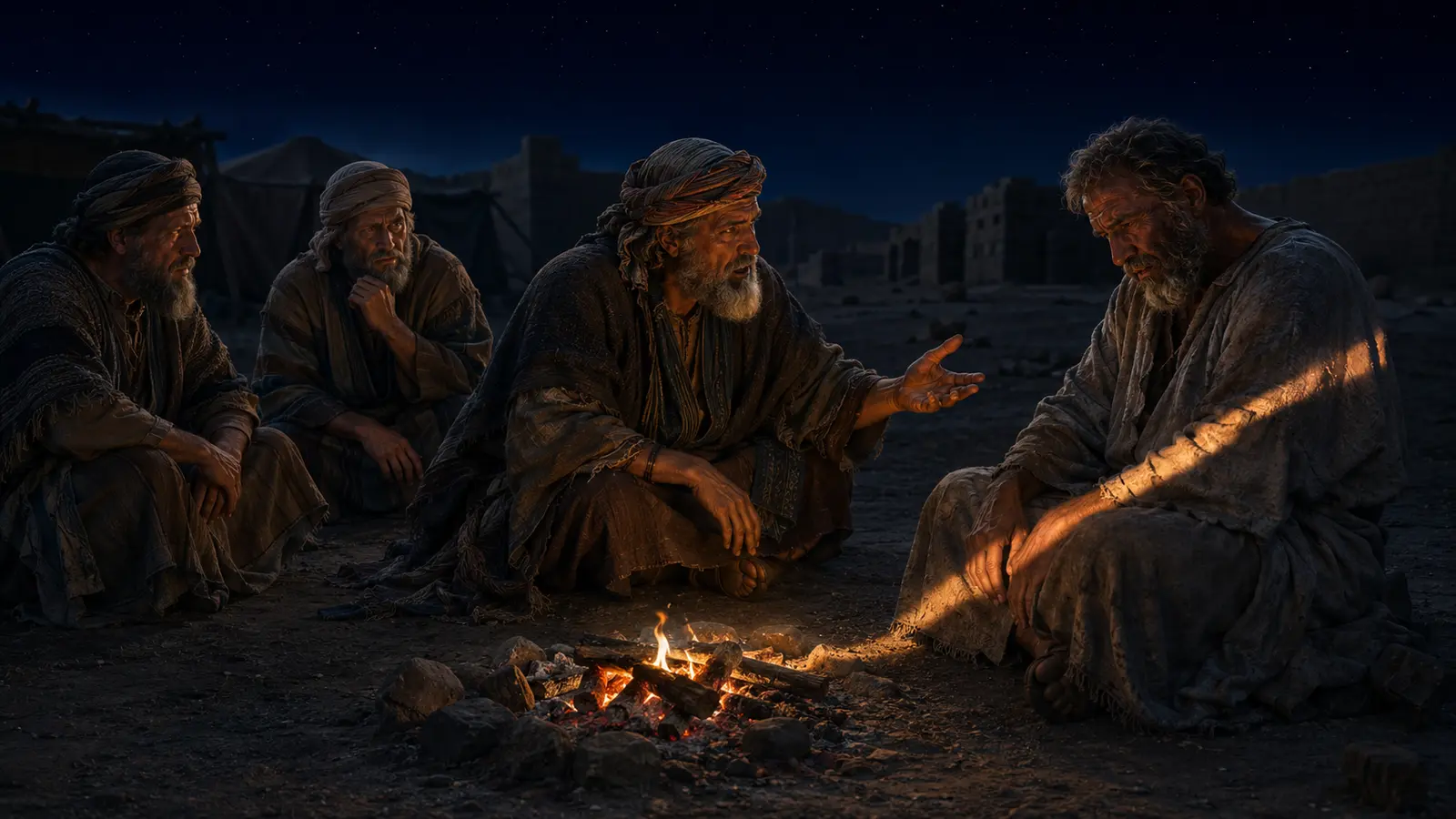
There are words spoken under the guise of wisdom, but their effects on the heart are like the blows of stones. Chapter 11 of the Book of Job represents one of the most painful passages in the Holy Scriptures; a place where theology dominates the stage, but the voice of compassion is completely muted.
01
Sofari, High Soundtrack of Simple Answers, and A Wounded Man in Need of Mercy
There are words spoken under the guise of wisdom, but their effects on the heart are like the blows of stones. Chapter 11 of the Book of Job represents one of the most painful passages in the Holy Scriptures; a place where theology dominates the stage, but the voice of compassion is completely muted.
Sofari presents arguments that, in themselves as general principles, seem to have solid truths: the greatness and wisdom of God, His ability to see the hidden, the call to repentance for sinners, and the promise of hope for the righteous. However, when he directs these arguments to Job who is full of ashes and grief, the harsh truth turns into a false testimony. This teaches us a great lesson: even theologically correct words can be serious mistakes when uttered without regard to the context of the listener's injury.
02
1.0 Introduction: When a Friend Turns into a Prosecutor
Job has just finished one of his courageous cries of pain. In chapter 10, he turned to God as Creator and asked why the hands that created him now seemed to be destroying him. He remembered the womb, the body joined together, the life and steadfast love that God had given him before. However, all that memory had become painful, because the Creator now felt like an enemy watching every step, counting every failure, and pushing him into darkness.
Now Sofari is speaking.
He is the third friend to answer Job, after Eliphaz and Bildad. By the time he opens his mouth, the conversation has become difficult. Silence has become theology. Comfort has turned into a fix. Friends came to comfort Job, but their speeches are increasingly sounding like arguments in the courtroom. They no longer sit with the suffering person; they interrogate the accused.
Sofari's speech is the strongest in the first round. Eliphaz had spoken with the calmness and confidence of a secret spiritual experience. Bildad had inherited the traditions of his ancestors. Sofari arrives with unfiltered certainty. He does not write for comfort. He begins with accusations. To him, Job's rage sounds like arrogance, his cry of pain sounds like gossip, and his insistence on innocence sounds like rebellion.
The tragedy of Job 11 is not that Zophar knows nothing of the truth. The tragedy is that he takes the facts and uses them without wisdom. He talks about God's unfathomable wisdom while acting as if he has already discovered the details of Job's case. He says God knows hidden sin while assuming that Job must have hidden sin. He calls Job to repentance, not because Job has been found guilty, but because the Zophari system cannot imagine the suffering of an innocent man.
This door asks a deep-searching question for every teacher, pastor, counselor, parent, friend, and believer: What happens when our theology becomes more interested in explaining pain than accompanying the person in pain?
03
2.0 Historical and Literary Context: Sofari in the First Cycle of Speech
Job 11 is part of the first round of dialogue between Job and his three friends (Job 4–14). The trend has been developing step by step:
Eliphaz speaks first (Job 4–5): encouraging Job to accept divine discipline and seek God. Job responds in chapters 6-7, insisting that his pain is more serious than his friends understand and crying out to God about the misery of human life.
Bildad speaks second (Job 8): defending God's justice through inherited wisdom. Job responds in chapters 9–10, admitting that God is too powerful to stand trial, but weeping because divine power seems to be turning against him.
Now Zophar speaks in Job 11: His speech has three main movements: Accusations against Job (11:1-4) Attributes of God's hidden wisdom and penetrating knowledge (11:5-12) Call to repentance with promises and warnings (11:13-20)
Sofari's logic is simple: God is wise; Job suffers; therefore Job must be guilty in ways he does not understand. If Job would repent and remove evil from his life, God would give him courage, light, security, and honor.
This is retribution theology in a very complex system. It assumes that suffering is always the visible smoke of a hidden moral fire. Friends are not entirely wrong to believe that sin has consequences. The Scriptures themselves teach that human actions matter, that wickedness bears bitter fruit, and that wisdom often brings life while folly brings destruction (Proverbs 10:27–30; Galatians 6:7–8). But Job exposes the danger of turning a general model of morality into an unchanging absolute law. Life under God's guidance makes moral sense, but it is not as technically predictable as a machine.
The introduction of this book (prologue) has already told the reader what his friends did not know: Job's suffering is not a punishment for secret evil (Job 1:1, 8; 2:3). That knowledge creates a situation where the reader knows the truth better than the characters (dramatic irony). Every time the friends accuse Job, the reader knows they are defending God using false concepts. They speak boldly about the case, but they are not invited to the council of heaven. They do not know the hidden conversation behind the visible tragedy.
That means a lot. Job 11 is not just about a bad friend. It's about the limits of human interpretation. It warns us that when we stand before the suffering of another, we stand on holy ground with only partial vision. We can know the teachings. We can figure out patterns. We can know the scriptures. But we do not know everything that God knows.
04
3.1 "Should Many Words Be Answered?" — Zophar Accuses Job (11:1–4)
Sofari begins indignantly: "Should not these many words be answered?" (11:2). Job has spoken a lot, from Sofar's point of view. His cry of pain does not sound like grief but like noise. His language is called nonsense, mockery, and empty words.
This is the first mistake of Sofari's advice: he fails to recognize the real cry of pain.
Job's discourses are not refined theological lectures. It is a cry from the edge of the life line. They are caused by loss, illness, shame, loneliness, and spiritual confusion. However, Sofari only hears pride. You don't ask, "What wound speaks through my brother?" He asks, "Who will silence this man?"
That is a dangerous trend. When we minimize the cry of pain and see it as just a complaint, when we act as if suffering is rebellion, we may be suffering from the same sincerity that God is ready to receive.
Then Sofar puts the words in Job's mouth: "Since you have said, My knowledge is pure, and I am pure in your eyes" (11:4). But this is a distorted reality (caricature). Job has emphasized his righteousness, yes, but he has not claimed flawless perfection. His point is not that, "I have never sinned." His argument is, "I have done no evil that can explain this great destruction."
That distinction is very important. Job does not claim to be sinless; what he rejects is the false formula that says: "If you suffer a lot, then you have a lot of sins or you are guilty."
Sofari cannot understand the difference. His system has only two boxes: godly people who repent and evil people who are proud. Because Job refuses to confess his secret guilt, Sofari puts him in the second box.
Here we see how bad theology often works. It starts by making it very easy for the person in front of us. It turns complex grief into a simple group. It edits the victim's words until they match the accusations we had planned to make from the beginning.
A friend who cannot listen carefully will eventually give false testimony, even when he is trying to defend the truth.
05
3.2 "If only God would speak" — Sofar Seeks Hidden Wisdom (11:5–12)
Zophar wishes that God would speak and reveal the secrets of wisdom (11:5–6). This is one of the great ironies of this book. God will speak later. But when God speaks out of the whirlwind, He will not confirm Zophar's accusations. He will reprimand those friends for failing to speak the right things about him (Job 42:7).
Sofari is right that God's wisdom surpasses man's ability. He describes the dimensions of the world: higher than heaven, lower than Hell (Sheol), longer than the earth, and wider than the sea (11:7–9). This is a very beautiful language. It sounds like a cult. It has the fragrance of songs and traditions of wisdom. In other circumstances, these verses could lead the heart to humility and humility.
But here, that beauty is turned towards accusations.
Sofari says that God's wisdom is beyond the scope of man, but he speaks as if he himself has examined it enough to give Job a measure. He says divine knowledge is immeasurable, but he measures Job's suffering with self-confidence. He proclaims the presence of mystery, but uses that mystery as a weapon.
This is the second mistake of Sofari's advice: he seeks mystery while pretending to possess absolute certainty.
He tells Job, in fact, "God knows what you do not know about yourself. If God revealed the whole truth, you would realize that your punishment is less than you deserve" (11:6). That is perhaps the most brutal sentence in his speech. Zophar calls it mercy: that God has not fully punished Job. But to Job, who has buried children, lost his livelihood, is covered with boils, has lost his honor, and is surrounded by suspicious friends, this "mercy" sounds like rainless thunder.
Sofari's view shuts out the cry of the innocent; you don't even leave him a little room to breathe. As suffering reaches its peak and engulfs life, he seeks the hidden mystery of sin to justify his judgment. In doing so, he builds a strong wall to protect his cold theory, while shattering and crushing the soul of the one wallowing in the ashes of pain.
Verse 11 emphasizes the point: God knows deceitful people; he sees evil. That is true. God sees the truth. Nothing is hidden from him (Psalm 139:1-12; Hebrews 4:13). But Sofari does not use all of God's knowledge to comfort Job with the hope that God sees his innocence, but uses it to threaten him with doubts that God sees his guilt.
Then comes the proverb in verse 12, a difficult verse about a foolish man gaining understanding and a wild ass being born as a man. No matter how one interprets the image, the result is painful. Zophar pushes Job toward humility, but he does so through insults. He points out that Job is stupid, stubborn, stubborn, and lacking in understanding.
However, the irony is getting serious. The one who calls Job a fool is the one who has failed to understand the whole story.
Sofari speaks of the wisdom above the heavens, but he cannot see the suffering man before his eyes.
06
3.3 "Set Your Heart Right" — Repentance, Light, and Shadow of Threats (11:13–20)
In the last part, Zophar calls Job to repent. He encourages him to keep his heart straight, stretch out his hands to God, remove evil, and not allow injustice to dwell in his tents (11:13-14).
This language is strong and, by itself, has great spiritual meaning. The scriptures repeatedly call people to seek God with all their hearts, to raise their hands in prayer, to turn from evil, and to purify their ways (Psalm 24:3-4; Isaiah 1:15-18; James 4:8). Sofar's words would have been perfect if Job had been hiding injustice. But because Sofari has not proven that Job is guilty, the call becomes like a medicine given by mistake.
A doctor may have the right medicine but still harm the patient by giving him the medicine for an unrelated disease.
Then Sofari paints a beautiful picture of being restored to the original state. Job will lift up his face without blemish. He will be safe and without fear. He will forget his trouble like water that has passed. His life will be brighter than noon. Darkness will be like morning. He will sleep without fear, and many will seek his virtues (11:15–19).
These pictures are gentle and light. They sound almost like gospel. Fear is removed. Shame is lifted. Darkness has turned to morning. Security is restored. Respect has returned. These are very good promises.
But in Sofar's mouth, they come with a condition based on false diagnosis: "Confess what I consider to be true, and you will be healed."
This is the third mistake of Sofari's advice: he gives hope without truth.
Hope built on false accusations is not hope. It's pressure. It requires the injured person to surrender his integrity just to get better. Job could find peace with his friends by confessing to a crime he does not believe he has committed. But that would mean losing one's self in order to gain social comfort.
The last verse goes back to the warning: the eyes of the wicked will be darkened, their refuge will disappear, and their hope will be like dying (11:20). Sofari cannot end with mercy. He must leave the threat hanging in the air. If Job does not accept that realization, he chooses the path of the wicked.
Thus the speech ends where it began: not with the presence of gentleness, but pressure; not with tears, but with threats; not by laying a hand on Job's shoulder, but with a finger stretched out to his face.
07
4.0 Theological Reflection: The Danger of True Words in the Hands of the Wrong People
Job 11 teaches that theology may be true in its statements but false in its application.
Sofari says God is wise. True.
Sofari says God sees hidden things. True.
Zophar says sinners should repent. True.
Sofari says justice brings hope. True.
However, Sofari is wrong.
He is wrong because he speaks the truth without knowledge of the reality. He is wrong because he is turning a mystery into an accusation. He is wrong because he defends God by judging a person whom God himself has called blameless. He is wrong because he thinks God's honor requires Job's humiliation.
This is one of the great theological lessons of this book: God does not need lies to defend His justice.
Friends assume that if Job is innocent, then God's moral government is in jeopardy. So they protect God by accusing Job. But in the end the book will show that God is not protected by false testimony. In the end, God will say that his friends did not speak the right things about him (Job 42:7). Their theology was too neat, too fast, eager to explain everything, and unwilling to dwell in the ash heap where answers do not come at the command of man.
This does not mean that Job is always right in everything he says. Job will also be humbled. He will be confronted with the immensity of creation, the mysteries of the universe, and the limits of human knowledge (Job 38–41). But there is a difference between Job's honest struggle and Zophar's confident false diagnosis. Job brings his distress to God. Sofar brings his system to Job.
In the great story of the Bible, Job 11 prepares us to recognize another innocent sufferer who will be misread by those who believe in religion. Jesus will be judged as cursed, mocked as abandoned, and burdened as guilty by those who believed they were defending God (Matthew 27:39-43; Galatians 3:13). On the cross, Zophar's logic regroups: suffering must mean rejection by God. But Easter reveals what the story of Job already whispers: the righteous can suffer without being wicked, and God's wisdom can be at work where human formulas have failed.
The cross does not destroy the moral order of the world. You spread it in more detail. You reveal that God's justice is not a coin-operated machine that produces immediate results, but rather a covenantal faithfulness that travels through suffering toward a new creation. It shows that God does not stand aside from the pain of an innocent person; in Christ, he enters into it, carries it, and breaks its last strength.
Sofari's speech also warns the church about pastoral care and ministry. A suffering person does not need a courtroom when he is sitting in ashes. He needs witnesses who can speak the truth gently. He needs people who know when to speak and when to be silent. He needs friends who can say, "I don't know why this happened, but I won't leave you."
There is a time to call people to repentance. Scripture would be unreliable without that call. But repentance must be called with truth, not doubt; and the Spirit, not worry; and conscious awareness, not the need to protect our thought systems.
God's wisdom is not just knowing what to say. It is to know if love has given us permission to say that.
08
5.0 Application in Life: How Not to Be Like a Sofa
Job 11 was not given for us to stand on Sofari and judge him from a safe distance.
It is given because there is a "Sofari" inside most of us. We want the world to understand quickly. We want pain to have a clear cause. We want suffering to be explained, because unspeakable suffering scares us. If Job can suffer innocently, then the world has a bigger mystery than we like.
So we must learn another way:
First, listen before explaining. The first duty of love is not explanation but listening. Before asking what lesson a person should learn from suffering, ask what he has lost. Ask what he is afraid of. Ask what he needs. Sit low enough to hear the vibration beneath his words.
Second, do not confuse the cry of pain with disbelief. Many faithful prayers in Scripture sound like pain speaking loudly (Psalms 13, 22, 88; Lamentations 3). God is not honored when we force the suffering to speak in neat, straightforward sentences. Sometimes faith looks like refusing to let go of God while telling him the truth about the darkness that exists.
Third, be careful with the description of "hidden sin." There are times when sin and suffering are intertwined, and love must speak honestly. But Job teaches us that we should not always take that convergence for granted. Doubt is not spiritual discernment. Accusations are not prophecies. The burden of proof is very important, especially when someone has already been crushed.
Fourth, allow God to be wiser than your system. Sofari believes in the mystery of God, but only in a way that protects his own conclusions. True humility allows God to surprise us. You give us a chance to say, "My teaching is not large enough to map every wound."
Fifth, offer hope that does not require dishonesty. Sofari's hope required Job to admit what was not true. Christian hope never asks people to lie about their pain, their questions, or their righteousness. True hope says, "God can meet you here, even before we understand why this place exists."
For pastors and teachers, Job 11 is a holy warning: The pulpit should never turn into the judicial bench of Sofari. We must not preach in a way that makes every sufferer feel secretly accused. We should not turn every tragedy into a lesson too quickly. We must proclaim God's wisdom, yes, but with the gentleness of Christ, who does not break a bruised reed or quench a smoldering wick (Isaiah 42:3; Matthew 12:20).
For those who are suffering, Job 11 gives permission to reject false comfort. You do not have to accept every explanation that is spoken in the name of God. You don't have to confess the sins that other people invent just to make your pain fit their theology. Bring your heart to God. Hold your integrity with humility. Let the Lord, and not worried friends, have the last word.
09
6.0 Reflection Questions
1. When have you ever seen true words used in a way that hurt instead of healing?
2. Why is it easy to be tempted to think that suffering must always have a clear moral explanation?
3. What is the difference between calling someone to repentance and accusing them because of your doubts?
4. How can believers make room for cries of pain (lament) without considering them as rebellion?
5. In your ministry or your friendship, where do you need to practice listening gently and speaking more calmly?
6. What does Job 11 teach us about the danger of defending God in ways that God Himself may later rebuke?
10
7.0 Responding Requests
Lord of wisdom that is higher than heaven, and mercy that is lower than Hell, teach us to speak with clean hands and gentle hearts.
Forgive us for the times we expressed pain too quickly, judged wounds too easily, and used truth without love. Sit with us in the ash heap.
Teach us the patience of holy silence, the courage of sincere prayer, and the humility to confess what we do not know.
For those who suffer under accusation, be their witness.
For those who cry in the dark, be their morning.
To those killed by careless theology, be a healer whose hands do not bruise.
And remove from us the attitude of Christ - truthful, gentle, faithful, and courageous - so that our words become lights, not knives; bread, not stones; water in the desert, not thunder on the broken hearted. Amen.
11
8.0 A Window to the Next Door: Job Answers the Teachers
In Job 12, Job turns to his friends with a very strong sarcasm. If Zophar accuses him of being an ignorant fool, Job replies that wisdom will not die with his friends. He knows the traditional claims about God's power. He knows God overturns nations, silences counselors, strips kings of their power, and rules over creation. But
Job will not allow his friends to use that fact as a weapon against him.
The next chapter begins Job's lengthy response in chapters 12–14. He will move from ridicule to a new legal confidence before God. He will distinguish his friends, then he will turn again to God, and fight against the weakness of human life. The ash heap will never be quieter. It will be more honest.
And in the sincerity of Job, the book continues to teach us: Faith is not the absence of questions. Sometimes faith is the wounded heart that refuses to stop talking to God.
12
9.0 Annotated Bibliography
Hartley, John E. The Book of Job. New International Commentary on the Old Testament. Grand Rapids: Eerdmans, 1988. Hartley's commentary on Job 11 is very helpful in seeing the structure of Zophar's speech: accusation, divine wisdom, and call to repentance. His reading shows Sofari's theoretical theology and how he misrepresents Job's claim to righteousness as a claim to absolute moral purity.
Clines, David J. A. Job 1–20. Word Biblical Commentary 17. Dallas: Word Books, 1989. Clines offers a very penetrating reading of Zophar's theology, especially the idea that Zophar acts as if God's mercy has already been cut off from the punishment that Job deserves. His discussion notes how Sofari can speak eloquently about the divine mystery while Bados demands to know the meaning of Job's suffering.
Alter, Robert. The Wisdom Books: Job, Proverbs, and Ecclesiastes: A Translation with Commentary. New York: W. W. Norton, 2010. Alter's literary sensitivity helps readers feel the poetic power of Job's speeches and the words of his friends. His translation work is important for discovering the compression, intensity, and artistry of the words in the dialogue.
Walton, John H., and Tremper Longman III. How to Read Job. Downers Grove: IVP Academic, 2015. Walton and Longman help position the book of Job as wisdom literature that challenges simplistic notions of reward for works and prompts readers to trust in God's wisdom without pretending to be experts in the hidden workings of the world.
BibleProject. The Book of Job Guide. BibleProject, 2026. This guide provides a clear overview of the larger movement of this book: Job and his friends discuss justice and suffering, but God's final answer pushes beyond narrow human concepts of equality toward the complexity and beauty of divine wisdom.

Be the first to leave a comment.