

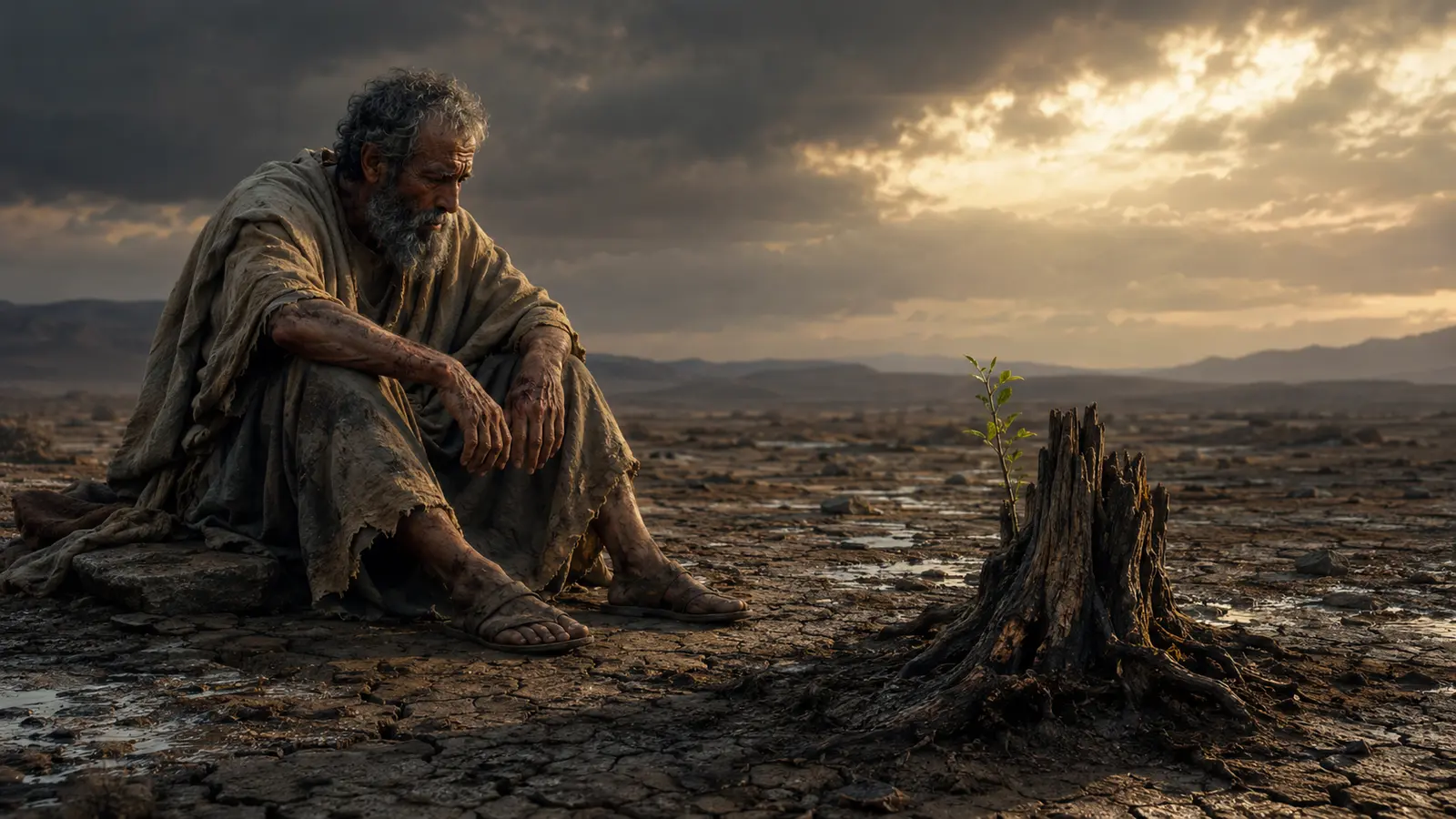
There are pages in the Holy Scriptures that make you feel as if you are standing on the edge of an open grave, with a gentle breeze blowing through the withered grass. Job 14 is one of those pages. Here, Job does not speak for himself alone; but he mourns the fate of every human being born into the beauty and brevity of life—every life that springs up like a flower and fades away like a shadow. However, in the middle of the dust, there is a strange passion that trembles: if a tree is cut down and can grow again, can a human being also live after death? If the grave is a prison, can it turn into a safe haven? If God is counting every step, will there ever be a day when He will call, and the dust will answer Him?
01
The Wilting Flower, the Budding Tree, and the Wound That Desires God's Remembrance
There are pages in the Holy Scriptures that make you feel as if you are standing on the edge of an open grave, with a gentle breeze blowing through the withered grass. Job 14 is one of those pages. Here, Job does not speak for himself alone; but he mourns the fate of every human being born into the beauty and brevity of life—every life that springs up like a flower and fades away like a shadow. However, in the middle of the dust, there is a strange passion that trembles: if a tree is cut down and can grow again, can a human being also live after death? If the grave is a prison, can it turn into a safe haven? If God is counting every step, will there ever be a day when He will call, and the dust will answer Him?
02
1.0 Introduction: When the Courtroom Becomes a Graveyard
Job 13 ended with the language of legal complaints. Job rejected his friends as "unfit healers" and "lying liars." He warned them not to speak lies on behalf of God. Then he turned to the Almighty and asked to be heard. He wanted his charges to be known. He wanted to understand why God seemed to hide His face and count him as an enemy.
But as chapter 13 closes, Job's legal courage begins to sink under the weight of death. Man, he said, decays like a decayed tree, like a moth-eaten garment. That picture opens the door to Job 14.
Now the courtroom is becoming a graveyard.
Job still speaks to God, but his voice is amplified. He no longer speaks like Job of the land of Uzi—a man who lost children, wealth, health, and honor. He speaks as a man: "a man born of a woman"—weak, of a few days, full of trouble, and looked upon by God.
This chapter is a meditation on death, but not a quiet meditation. Job is not writing a philosophical essay about death. He prays while inside the wound. He sees human life as a flower that blooms for a short time, a shadow that passes quickly, and a creature limited by God.
And that's when his question is heartbreaking: If human life is so short, why does God examine it so harshly?
In the midst of despair, Job thinks about something that seems impossible: if a tree that is cut down can sprout again with the smell of water, can man live again? If Hell is a dark place, can it also be a place to hide until the wrath passes? If God seems to count every step, can one day call, and the dust answers?
This is not yet the fulfillment of the resurrection hope. It is a seed under the frozen soil. Job does not have the future clarity of Daniel 12, Isaiah 26, John 11, or 1 Corinthians 15. But he is reaching out to something. He dreams an impossible dream—and in that dream, the Bible's long journey to resurrection begins to flash.
Job 14 asks the question that every grave asks itself: Can the God who created the dust also remember it, call it, and fill it with life again?
03
2.0 Historical and Literary Context: Job's Fourth Discourse Reaches Its Dark Center
Job 14 concludes Job's long speech in response to Zophar and all three of his friends in chapters 12–14.
Job 12 - Job rebukes the pride of his friends and explains God's authority over creation, rulers, nations, and wisdom. Job 13 - Job accuses his friends of lying on behalf of God, then he turns directly to God making a legal appeal. Job 14 — Job laments the weakness of man and struggles with death, Hell, memory, and the possibility of being restored to fellowship with God.
This chapter has four main movements:
1. Human life is short and full of trouble; Job asks God to look away (Job 14:1–6).
2. A tree may have hope after it is cut down, but man seems hopeless after death (Job 14:7-12).
3. Job wishes to be hidden in Hell until God's wrath passes, then God remembers him (Job 14:13-17).
4. Job returns to despair: God destroys human hope, and the dead are cut off from earthly life (Job 14:18-22).
This chapter is full of heavy images: a flower, a shadow, a hired servant, a tree stump, the smell of water, a dry sea, a vanished river, a hidden Hell, a sealed bag, an eroding mountain, a grinding stone, and a face changed by death.
These images don't just embellish Job's argument; they carry theology itself. Job does not think abstractly. He thinks of soil, water, roots, body, breath, grave, and the memory of God.
Job 14 is not the sunrise. But it is the place where darkness begins to hurt looking for morning.
04
3.1 "Born of a Woman" — Life as a Flower, Shadow, and Misery
Job 14:1–6
Job begins with one of the briefest and most powerful descriptions of human weakness:
"A man born of a woman does not have many days, and he is full of trouble." Job 14:1
The phrase "born of a woman" emphasizes our nature as creatures. We did not fall from heaven like fiery rocks. We have come in blood, travail, dependence, and weakness. Before we could speak, work, worship, argue, or suffer, we were received from another body. We are weak from the beginning.
Then Job says our days are few and full of trouble. Life is short, and within that shortness, it is full of problems. Job does not reject beauty, love, work, or happiness. But from the top of the ash heap, he sees this truth: human life blossoms under the shadow.
"He blooms like a flower, then withers; he runs like a shadow, and does not stay." Job 14:2
The flower is beautiful, but it is short-lived. The shadow is real, but it cannot be grasped. Job connects these two images to say: human life is beautiful, but it cannot last.
Then he turns that reflection into a question to God:
"Do you open your eyes to look at a man like this, and bring me to judgment with you?" Job 14:3
The issue is not only that man is weak. The problem is that God seems to review that weakness as if it is strong enough to stand in court.
Job asks: Why does the eternal God bring a wilting flower to court?
Job also recognizes the limits of human purity:
"Who can bring something clean out of something unclean? Not one." Job 14:4
He does not claim that man is spotless. He knows our lives are morally messed up. But this realization does not make him accept the accusations of his friends. Instead, he asks why God would expect unbearable greatness from a creature born in weakness.
So Job pleads:
"Stop looking at him, get him to rest, until he ends his day as a hired man." Job 14:6
This is a prayer of pain. Job does not ask God for closeness—yet. He is asking for relief. If life is short and limited, then let the worker finish his day. Let this weak creature breathe.
This is not the prayer of Eden, where God's presence is joy. It is the prayer of a person for whom divine closeness has become a threat. And yet, even this prayer is addressed to God.
05
3.2 "There's Hope for a Tree" — A Stump Embarrassing the Death of Man
Job 14:7–12
Job turns to one very memorable image:
"Because there is hope for a tree, if it is cut down, it will grow again." Job 14:7
A tree can be cut, grow old, dry, and remain a stump. Its root may grow old in the ground, and its stump may appear dead. But with the smell of water, you can sprout again and put forth branches like a young plant (Job 14:8-9).
The term "smell of water" is very strange. A tree doesn't need a whole river first. You shudder at the mere hint of life. The slightest smell of water can wake up a forgotten stump.
But Job does not offer easy hope. He does not say, "Men are like trees; therefore we shall rise again." He says something more painful: the tree seems to have more hope than man.
"But man dies, and disappears; man gives up the spirit, and where is he?" Job 14:10
The question falls like a stone in the grave: Where is he?
The body is laid on the ground. The breath leaves. The person disappears from the world of the living.
Job compares the death of man to the water that recedes in a lake, or a river that dries up completely (Job 14:11). Then he says:
"That is why man lies down, and does not get up; even when the heavens are no more, they will not wake up, nor will they be awakened from their sleep." Job 14:12
The language of sleep and later awakening will be very important in the biblical hope of the resurrection. But here Job still uses it sadly. As far as he sees it, death is a sleep without morning.
And yet the image of the tree has already done something in the poem. Raised a question. If a seemingly dead tree can live by the smell of water, why should a human being created by God's hands disappear without being renewed?
Job has no answer. But the question itself becomes a seed.
06
3.3 "I Wish You'd Hide Me In Hell" — Death Considered As A Refuge
Job 14:13–17
In the middle of this chapter, Job wishes for the impossible:
"I wish you would hide me in hell, and hide me in secret, until your wrath passes, and write for me the appointed time, and remember me!" Job 14:13
This is one of the most frightening and interesting prayers in this book.
Early on, Hell was seen as dark, silent, and a place of no return. But now Job thinks about it in a different way. Could Hell be a hiding place? Can death be a refuge from God's wrath? Could God keep him there for a while, then remember him?
The word "remember" is a covenant word. When God remembers, He doesn't just remember information. He acts honestly. God remembered Noah in the flood (Genesis 8:1). God remembered His covenant with Israel in slavery (Exodus 2:24). To be remembered by God is to be brought back under His mercy.
Then Job asks the main question:
"If a man dies, will he live again?" Job 14:14
Job does not answer with certainty. But he wonders what he would do if the answer was yes:
"All the days of my war I would wait, until my release would come." Job 14:14
Then comes the very gentle lines:
"You would call, and I would answer you; you would be interested in the work of your hands." Job 14:15
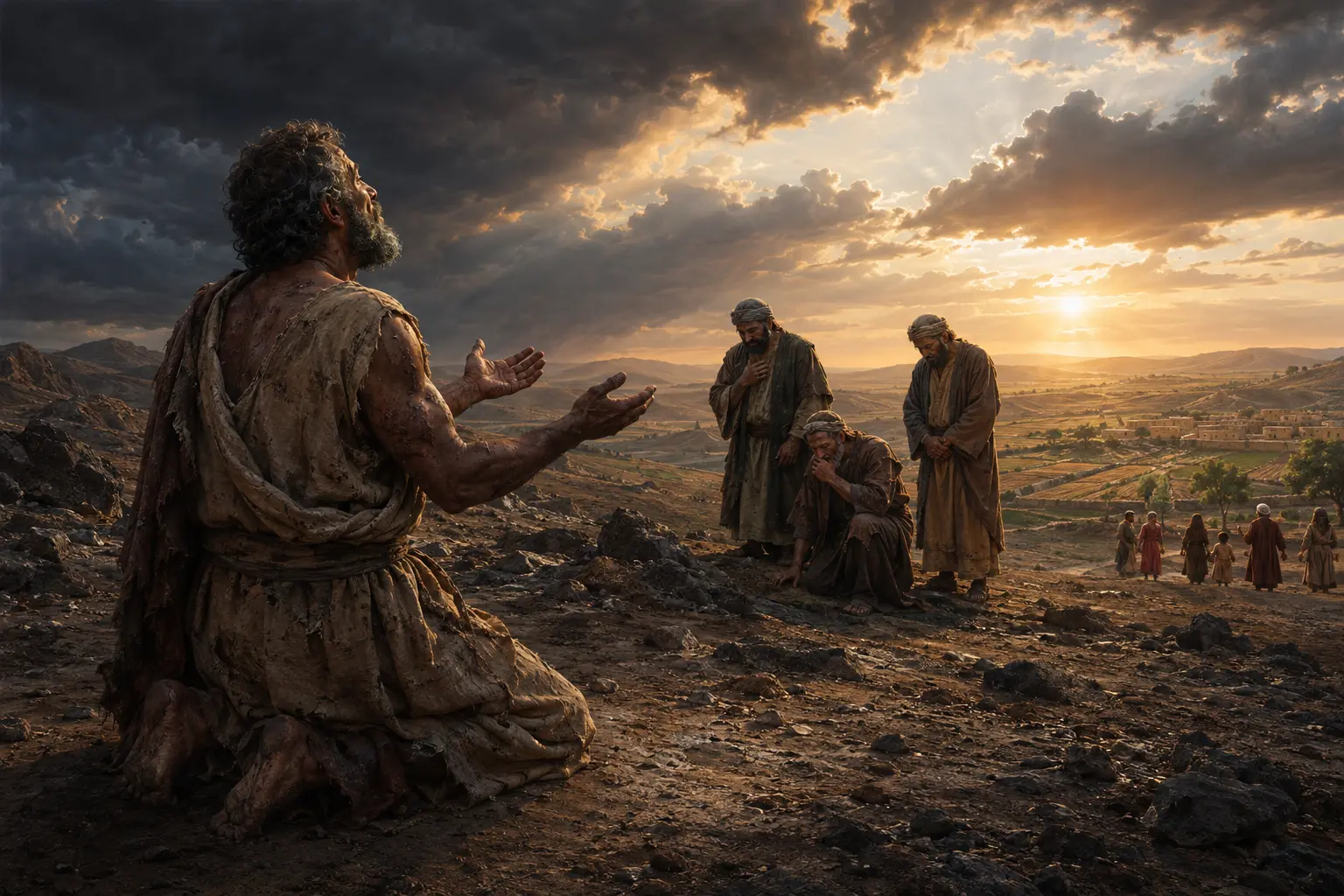
Here the environment changes. In chapter 13, Job felt watched, accused, and trapped. Here he imagines God calling, and the dead answering. He imagines the Creator longing for the work of His hands. The God who seemed to count mistakes may one day call the dust by name.
Verses 16–17 continue the dream. God would count Job's steps without looking at his sin; mistakes would be tied in a bag; evils would be covered.
Instead of accusations being opened, sins are sealed. Instead of condemnation, there is covering. Instead of wrathful inspection, there is reconciliation.
In the deepest darkness, Job dreams of a God whose last word can be a passion of love, not wrath.
07
3.4 "You Ruin the Hope of Man" — The Dream Returns to Dust
Job 14:18–22
That dream doesn't last. Job returns to the world as he sees it.
Mountains fall and erode. Stones are removed from their place. Water grinds stones. Floods wash away the earth's soil.
"That's how you destroy the hope of man." Job 14:19
These images are slow and continuous. It is not just a sudden storm; it is erosion. Time itself becomes an instrument of destruction. If mountains fall, what hope does man have in his body?
Job sees God as the one who defeats man, who changes his face, and drives him out of the land of the living (Job 14:20). The face—the symbol of personality and identity—is replaced by death.
Then comes the final sadness:
"If his sons are honored, he does not know; and if they are brought down, he does not see." Job 14:21
Death doesn't just bring fear; it leads to a break in the relationship. A parent no longer knows what happens to his children. The world of the living continues, but the dead cannot participate.
The chapter ends in pain:
"But his flesh that is in his body is in pain, and his soul within him mourns." Job 14:22
Job has a dream, but he still cannot live in that dream. Hope flickered, then the wind blew it back down.
But the Scriptures have heard that little light. Job 14 ends in the dust, but not before the dust asks to be remembered.
08
4.0 Theological Reflection: The Seed of Resurrection in the Soil of Mourning
Job 14 must be read with patience. It is not a complete doctrine of the resurrection. Job does not speak like Paul in 1 Corinthians 15, nor like Jesus before the grave of Lazarus. He speaks as a sufferer under the old horizon of death, where Hell looks like a land of no return.
And yet, in that context, Job contemplates greater things than his world can bear.
He imagines God keeping him in Hell until His anger passes.
He thinks about the appointed time.
He thinks about the memory of God.
He thinks about the call and response communication between the Creator and the creature.
He thinks that God really wants to see the creation of His hands.
He is thinking about sins that are sealed and completely covered.
Biblical hope often begins as a question before it becomes a confession. "If a man dies, will he live again?" not yet "I am the resurrection and the life." But that question paves the way.
In the larger narrative of the Bible, death comes as a result of man's separation from God (Genesis 3). Man created from dust and filled with the breath of God returns to dust. Job feels that ancient judgment in his bones.
But the God of the Bible is a God who remembers. He remembers His covenant. He hears the cries. He gives slaves to Egypt. He brings back the exiles. He gives water in the rock and bread in the desert. Again and again, God acts where human possibility ends.
So when Job asks if the dead can live again, that question is not new to the God of the Bible. It is a question that pushes to the core of who God will reveal himself to be.
The answer comes fully in Jesus Christ. He enters into the state of "a man born of a woman" (Galatians 4:4). He shares the weakness, pain, tears, and death of human life. He becomes a flower withering under royal violence, a shadow engulfed in darkness, a righteous sufferer brought to judgment.
And on the third day, God calls.
The resurrection of Jesus is the answer that Job could not yet see. You do not make Job's mourning small; you respect them. You say his question was deeper than he could have known. The Creator truly desires the work of His hands. God remembers dust. The grave may not be the last prison, but the place where the voice of the Son calls for life to return.
Christian hope is not to deny Job 14.
It is its fulfillment.
We still live in bodies that blossom and wither. We still bury the dead. We still feel the erosion of time. But we do so knowing that the resurrected Christ has become the firstfruits of those who fell asleep (1 Corinthians 15:20).
A cut stump can be a branch.
Dry bones can breathe.
The crucified can rise.
And those in Him will be called by their names.
The hope of resurrection is not a color painted on sorrow. It is God's answer from within the grave itself.
09
5.0 Application to Life: Living Faithfully in the Shadow, Waiting for the Voice
Job 14 gives us practical wisdom for those who suffer, mourn, teach, counsel, and hope.
First, tell the truth about human weakness. The Christian faith does not need to pretend that life is longer or easier than it is. Our days are few and full of trouble. We bloom and wither. We pass like a shadow. That trust does not weaken faith; you lay the foundation of true hope.
Second, don't put people off quickly on pain of death. When a person mourns, the hope of the resurrection should not be used to silence his sorrow. Jesus Himself wept at the tomb of Lazarus before calling him out (John 11:35, 43). Hope that cannot cry is still immature.
Third, remember that God knows our limits. Job asks why God brings a withering man to judgment. Later Scripture reveals that God remembers that we are dust (Psalm 103:14). In Christ, God knows our weakness not only from above, but from within as well.
Fourth, let creation teach you sorrow and hope. Flowers wither. The shadow passes. The water dries up. Mountains erode. But the stumps can sprout from the smell of water. Seeds can lie underground. Morning may come after a long night.
Fifth, ask to be remembered. Job's cry, "remember me," is a prayer that sufferers can pray today: "Lord, don't let my story be lost. Don't let my pain be the last word. Remember me in Your mercy." The thief on the cross also prayed: "Jesus, remember me when you enter your kingdom" (Luke 23:42).
Sixth, hold the hope of the resurrection as a promise, not as a pressure. We don't want mourners to feel like they have to be winners right away. We bear witness gently: Christ is risen. Because He lives, the dead in Him are not forgotten. The voice will come. Dust will respond.
Seventh, live now as one who will be called by name. If God is interested in the work of His hands, then the body is important. Tears are important. Justice is important. Creativity is important. The future resurrection does not make the present life disposable; you make them holy.
For pastors and teachers, Job 14 is a scripture for funerals, hospital rooms, prison visits, and long seasons of grief. It teaches us to speak of the resurrection without diluting the mourning.
For those suffering, Job 14 gives you permission to pray when you are on the verge of despair. Even when hope seems far away, you can still ask God to remember you. You can still whisper a question that the resurrection will come to answer.
10
6.0 Reflection Questions
1. What does Job mean when he says man "his days are not long, and he is full of trouble" (Job 14:1)?
2. Why does Job ask God to "leave" the weak man in Job 14:3-6?
3. What combination of sadness and desire for life does the image of the tree in Job 14:7–9 convey?
4. Why don't we read the full doctrine of the resurrection very quickly in Job 14, but still recognize his desire towards that hope?
5. What does the prayer "remember me" mean in the great story of Scripture?
6. How does Jesus' resurrection answer Job's question without ignoring his pain?
7. How can Christian communities speak honestly about death while holding onto the hope of resurrection?
11
7.0 Answered Prayer
God who remembers the dust,
You know our shape.
You see the flower before it withers,
before the shadow passes,
before the tears fall.
Our days are few,
and our hearts are full of questions.
Don't let our grief go unheard.
Don't let our names sink into darkness.
Hide us in Your mercy
until the wrath passes.
Set the appointed time,
and remember us.
When we are cut down,
be the fragrance of water to us.
When we lie in the dust,
be the voice that calls us.
When we can't hold on to hope,
let us hold fast in the risen Christ.
Teach us to mourn faithfully,
wait faithfully,
and live like the work of Your hands—
loved, remembered,
and we are scheduled to have a good morning.
Amen.
12
8.0 Window to the Next Chapter: Eliphaz Returns with Stronger Charges
Job 14 closes the first major cycle of Job's responses to death, longing, and unresolved grief. He has scolded his friends. He has complained to God. He has accused them of lying on behalf of God. He has brought his case before the Almighty. And now he has cried over the great question of life after death.
Now the second cycle begins.
In Job 15, Eliphaz returns. His first voice had a certain gentleness, almost pastoral. But now his words are becoming harsher. He accuses Job of empty words, of lack of piety, and of self-judgment.
The debate becomes more complicated. Compassion is waning. Friends are becoming more protective. When sufferers reject false explanations, comforters are often faced with a choice: be more humble or be more aggressive.
Eliphaz will choose the second way. And Job, still sitting on the ashes, will have to continue talking.
13
9.0 Annotated Bibliography
Hartley, John E. The Book of Job. New International Commentary on the Old Testament. Grand Rapids: Eerdmans, 1988. Hartley helps show how Job 14 moves from the weakness of "man born of woman," to the contrast between the hope of the tree and the silence of human death. His explanation of the lack of a developed vocabulary of resurrection in the book of Job helps to read Job's hope as a budding desire, not a finished doctrine.
Clines, David J. A. Job 1–20. Word Biblical Commentary 17. Dallas: Word Books, 1989. Clines reads Job 14 as Job's broader reflection on the human condition, not just his personal suffering. His discussion of the tree's hope, Hell as an imagined hiding place, and Job's impossible dream help trace this chapter's movement from despair, to desire, and back to dust.
Alter, Robert. The Wisdom Books: Job, Proverbs, and Ecclesiastes: A Translation with Commentary. New York: W. W. Norton, 2010. Alter's literary approach helps the reader feel the poetic power of Job's images: flower, shadow, stump, water, sleep, and eroding stone. His translation work is valuable for preserving the beauty and poignancy of Job's meditation on death.
Walton, John H., and Tremper Longman III. How to Read Job. Downers Grove: IVP Academic, 2015. Walton and Longman help situate the reflection on Job's death within the wisdom literature's broader emphasis on human limitations, God's wisdom, and the danger of forcing suffering into simple human patterns.
BibleProject. The Book of Job Guide. BibleProject, 2026. The BibleProject summary is useful for placing the discussion of Job within the broader movement of the book, in which human thought about justice, suffering, and God's wisdom is pushed beyond simple responses toward deeper faithfulness.

Be the first to leave a comment.