


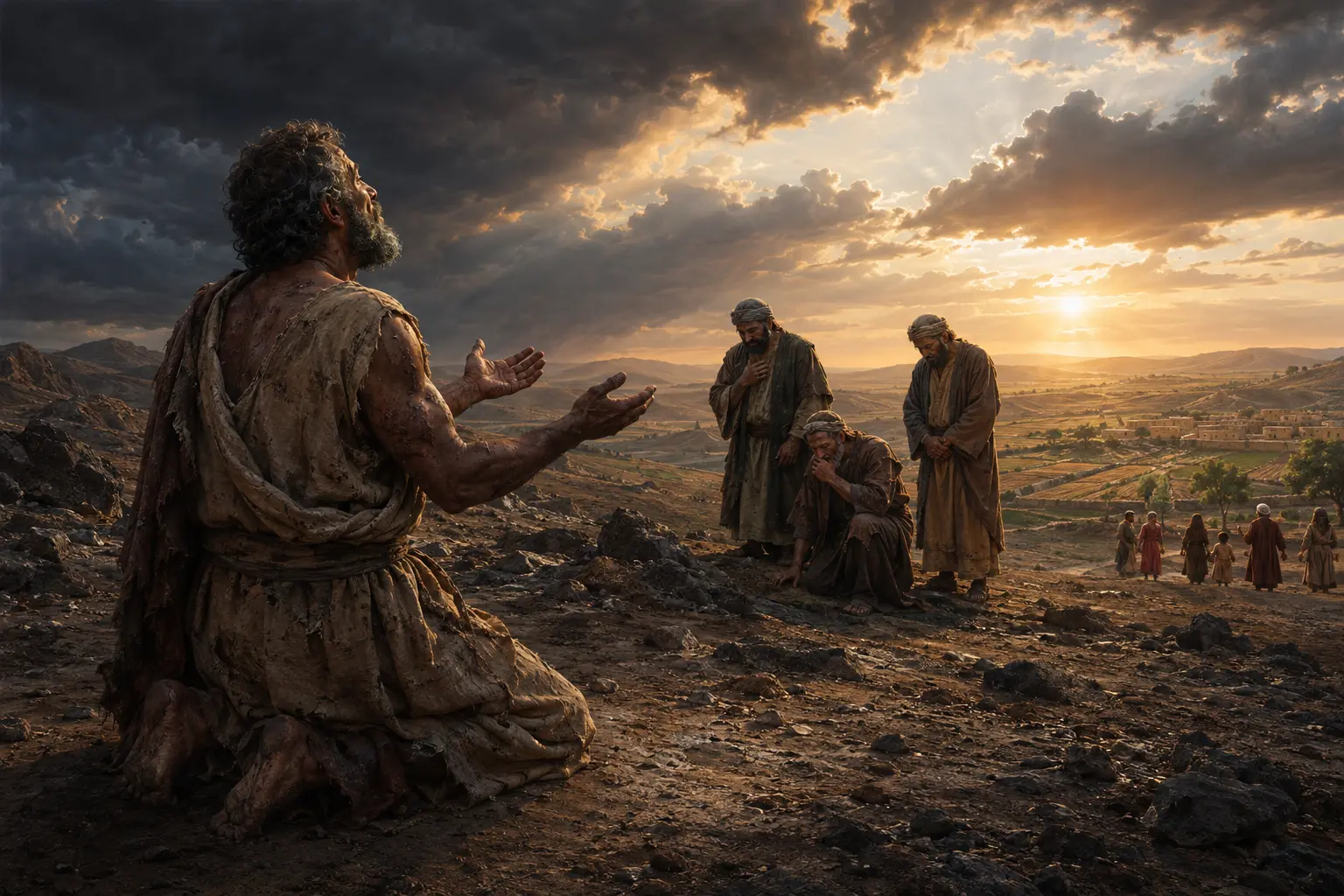
There is a wind that brings rain, and there is a wind that dries the throat. In Job 15, Eliphaz hears Job's deep pain and calls it "the knowledge of the wind." He sees a person who is looking for God in the midst of sorrow and calls that search as rebellion. He gathers the weight of tradition, the gray hairs of the aged, the proverbs of the wise, and the terrible image of the wicked—and places them before Job like a mirror. But the glass is broken. It reflects the thought system of Eliphaz more clearly than it reflects the soul of Job.
01
The Second Discourse of Eliphaz, The Fear of Angry Wailing, and the Unbearable Wisdom of a Wounded Voice
There is a wind that brings rain, and there is a wind that dries the throat. In Job 15, Eliphaz hears Job's deep pain and calls it "the knowledge of the wind." He sees a person who is looking for God in the midst of sorrow and calls that search as rebellion. He gathers the weight of tradition, the gray hairs of the aged, the proverbs of the wise, and the terrible image of the wicked—and places them before Job like a mirror. But the glass is broken. It reflects the thought system of Eliphaz more clearly than it reflects the soul of Job.
02
1.0 Intro: Round Two Begins With Little Mercy
Job 14 ended up by the grave. Job had spoken of human life as a wilting flower, a fleeing shadow, or a tree stump that can sprout again if it smells water. He had dared to think of being hidden in Hell until God's wrath passed, until God remembered him—when the Creator calls and the dust settles.
The speech was weak, painful, but with a deep meaning. It carried great sadness and passion at the same time in trembling hands.
Now Eliphaz speaks again.
This is where you begin the second round of speeches in this debate. The first round was already painful, but there were still sparks of pastoral interest. Eliphaz's first speech, though inadequate, began with a kind of politeness and hesitation. He had reminded Job of his past strength and encouraged him to seek God. Bildad touched on tradition. Zophar attacked more fiercely, but even he ended with a vision of restoration of light if Job would repent.
But in Job 15, the weather changes.
Eliphaz doesn't hesitate anymore. He is angry. Job's words have disturbed him. Job questioned his friends, accused them of lying on behalf of God, and announced his intention to defend his arguments before God. Now Eliphaz hears Job's words not as a lamentation, not as a search for justice for an injured person, but as a dangerous conversation. Job's mouth has been found to be evidence against himself.
This chapter shows how religious communities can respond when suffering people reject simplistic and superficial explanations. If the victim agrees to their system, society can call it humility. But if he continues to speak, continues to question, and refuses to bear the guilt of lies, society may begin to call that speech arrogant, impolite, and rebellious.
Eliphaz's second speech raises a serious question: What happens when traditional wisdom is afraid of mourning to the extent that it assumes sincere pain is a lack of fear of God?
03
2.0 Historical and Literary Context: Eliphaz Responds to Job's Legal Courage
Job 15 is Eliphaz's second speech and it opens the second cycle of dialogue.
Its structure is quite clear:
15:1–6: Eliphaz rejects Job's words, calling them empty, dangerous, and condemning himself.
15:7–16: Eliphaz questions Job's claim to be wise by referring to age, tradition, and human defilement before God.
15:17–19: Eliphaz gives teachings from the wise and the traditions of the ancestors.
15:20–35: Eliphaz describes the lifelong suffering and inevitable fall of the wicked.
This discourse directly responds to the themes found in Job 12–14. Job had said, "What you know, I also know; I am not inferior to you" (13:2). Eliphaz answers him: "What do you know that we don't know?" (15:9). Job had accused his friends of lying and speaking deceitfully on behalf of God. Eliphaz responds by accusing Job's own mouth of stripping him of his clothes and condemning him (15:5–6). Job had asked to be questioned before God; Eliphaz regards the desire as a rude anger against heaven.
The main issue here is words. For Eliphaz, Job's words are not just mistakes; it is spiritually dangerous. He says Job fills his stomach with the east wind, arguing with inappropriate words, destroying fear (fear of God), choosing the tongue of the deceitful, and directing his anger against God.
The image of the "east wind" is very important. In the Ancient Near East, the east wind was hot, dry, and highly destructive. You dried up the plants and caused discomfort. Eliphaz uses it to mock Job's words as mere heat—words that dry instead of water.
However, the reader knows something that Eliphaz doesn't quite understand. Job's words may be painful, exaggerated, and at times theologically confusing, but they are not empty. They come from a man whom God himself has called perfect and righteous.
They arise from the conflict between true faith and unrelieved suffering.
The second half of this chapter describes the fate of the wicked man. This is a familiar literary system of wisdom: the wicked are restless, anxious, threatened, lost, barren, and self-deceived. But the literary context changes its focus here. Eliphaz doesn't just teach about evil in theory. He warns Job: if you continue with these rebellious words, this is the way you are walking.
The sad thing is that Eliphaz's tradition is not completely false. Scripture teaches that evil breeds fear, chaos, barrenness, and falling (Ps. 1; Prov. 10:27-30; Isa. 59:4). But Eliphaz uses that truth without wisdom or discernment. He cannot imagine that Job's current pain is not the inner fear of a wicked man, but the anguished cry of a righteous sufferer.
Thus, Job 15 becomes a clear example of misused wisdom.
04
3.1 "Knowledge of the Wind" — Eliphaz Judges Job's Words (15:1-6)
Eliphaz begins with ironic questions: "Should a wise man answer with the knowledge of the wind, and fill his belly with the east wind?" (15:2). He does not begin by responding to Job's pain.
He begins by judging Job's words.
This is Eliphaz's first mistake in this chapter: he treats excruciating pain as empty rhetoric.
Job is not talking for the game. He has buried his children. His body is damaged. His dignity has collapsed. His friends have turned into his accusers. He feels God as if he does not exist and has become his enemy. Job's words are not just hypothetical; it is blood that comes from a raw wound.
But Eliphaz only hears hot air.
He questions whether Job should compete with useless words and useless talk (15:3). Then he makes serious accusations: "Yes, you destroy the fear, and prevent worship before God" (15:4). In Eliphaz's thinking, Job's mourning is not only unwise; they threaten piety itself. If people speak like Job, fear will disappear. Devotional worship and meditation will decrease. The holy system will be shaken.
There is a real concern here. Words build or tear down society. Hurtful words can spread poison. Careless theology can hurt. Not all laments are sincere just because they are emotional. But Eliphaz cannot distinguish between the scorn of destruction and the earnest cry of the covenant. He assumes that piety must always have a calm and gentle tone.
That assumption is not true.
The Psalms teach us that godliness can cry, "O LORD, how long?" (Ps. 13:1). You may ask why God has left it (Ps. 22:1). You can complain, cry, plead, and even question. Biblical faith has a wider range of voices than Eliphaz allows.
Then Eliphaz says that Job's wickedness teaches his mouth and that he chooses the tongue of the cunning (15:5). Finally: "Your own mouth condemns you, and not I; yes, your own lips testify against you" (15:6).
This is court language. Job wanted to be heard before God. Now Eliphaz says the evidence has been found: Job's words prove his guilt.
But this distorts the truth. Job's mouth actually shows something, but not what Eliphaz thinks. It shows pain, confusion, courage, grievance, and a steadfast refusal to surrender his loyalty. It shows a man who wrestles with God, not a hypocrite exposed by his own cunning.
When comforters fail to understand mourning, they immediately turn into prosecutors of those words that should have taught them how deep the wound is.
05
3.2 "Are You the First Born?" — Tradition Challenges the Hurt Voice (15:7–13)
Eliphaz now attacks Job's claims of understanding. "Are you the first born? Or were you born before the hills?" (15:7). These questions mock Job as if he claims to have eternal wisdom, as if he existed before creation or sat in God's secret council.
"Have you heard the secret counsels of God? And you withhold wisdom to be only yours?" (15:8). Here Eliphaz imitates Job's own language about divine wisdom and counsel, but turns it against him. Job never claimed to possess all wisdom. He has only been claiming that even his friends do not have all that wisdom.
Eliphaz cannot see the difference.
"What do you know that we don't know?" (15:9). This directly answers Job's earlier claim: "What you know, I also know" (13:2). This debate has become a contest of who can speak wisely. Eliphaz puts himself and his friends in the river of elders. "With us there are gray-haired and very old, older than your father" (15:10).
Tradition has its importance. The scriptures honor the elders and the wisdom of those who have walked the long road (Lev. 19:32; Prov. 16:31). Eliphaz is not wrong in appreciating the wisdom of inheritance. The problem is not that he listens to the elders; the problem is that he uses that tradition to silence the new wound.
Tradition should be a deep well to draw water from, not a locked gate.
Then comes a question that sounds gentle but has a secret edge: "Are the refreshments of God too small for you, and the word spoken to you gently?" (15:11). Eliphaz believes the words of those friends are refreshments (comforts) from God. He believes they have spoken softly. Job, of course, felt them as tiresome comforters and useless healers.
This is a very difficult pastoral lesson. Speakers may think they are polite just because their voice is calm or their style is polite. But gentleness is not measured only by the level of voice or behavior. You are measured by checking whether the truth is sitting correctly in the existing wound.
Eliphaz questions why Job's heart turns away from him and why his eyes sparkle, so that he turned his spirit against God and let such words come out of his mouth (15:12-13). He sees Job's feelings as the problem. Sparkling eyes, passionate words, refusal to bow quietly—these prove to Eliphaz that Job has fallen.
But sometimes feelings are not the enemy of truth. Sometimes grief sees what calm mental systems can't. Sometimes a wounded heart, though unstable, is more honest than a calm and well-organized counselor.
Traditions become dangerous when they fail to allow tears to rearrange things.
06
3.3 "What is Man even if he became Clean?" — Human Weakness Used as an Indictment (15:14–16)
Now Eliphaz returns to the subject of his first speech: the defilement of man before God. "What is man, that he should be pure? And he that was born of a woman, that he should be righteous?" (15:14). Job himself had just spoken of man as "born of a woman" (14:1). But Eliphaz uses this phrase in a different way.
Job used human weakness to ask why God examines such a weak creature with such severity. Eliphaz attacks human weakness to undermine Job's claims of integrity.
He continues: Behold, God does not believe his saints; yes, the heavens are also not clean in his eyes (15:15). A man who is hateful and perverse is not inferior, anyway injustice is like water (15:16).
There is a theological truth here. No creature stands before God as equal to Him. Man's right is not independent, it is not completely perfect, nor does it come from him. The scriptures are clear that all have sinned and fall short of the glory of God (Rom. 3:23). However, Eliphaz again distorts the use of this truth.
Job does not claim to be completely morally blameless in the face of God's infinite holiness. He only claims that he has not committed sins commensurate with the great tragedy that befell him. Eliphaz breaks down the distinction between the defilement of the creature and the specific guilt of certain sins. Because no human being is pure before God, then Job has no right to complain about the way he is treated.
That logic is very dangerous pastorally. It can make every victim without a defender. If the universal sin of mankind explains every kind of tragedy, then no injustice can be named, no inequality can be challenged, and no wound can ask, "Why?"
The Gospel gives the best answer. Yes, man is a sinner. Yes, no one stands before God in his own right. But the God of Scripture still hears Abel's blood crying from the ground. He still hears the cry of Israel in Egypt. He still judges bullying. He still defends the innocent victim. The general sin of mankind does not erase the specific injustice that befalls a person.
Saying "all are sinners" should never turn into a way of refusing to hear the special cry of a hurt person.
07
3.4 "I will show you; listen to me" — The Authority of the Wisdom of the Ancestors (15:17–19)
Here Eliphaz turns to the voice of a wise teacher: "I will show you, listen to me, and what I have seen I will preach" (15:17). As in the beginning, he relies on observation and tradition.
He does not invent new doctrines. He says it is what the wise men have explained, and their fathers did not keep it secret, to whom the land was given to them alone, without a stranger passing between them (15:18-19).
The goal here is the purity of tradition. Eliphaz presents his teachings as ancient, solid, untainted, and trustworthy. They come from their fathers. They are protected by the wise. It carries the authority of ancient ways.
Again, this is not without value. Biblical faith values memory. Israel is often told to remember, teach their children, recount God's great deeds, and listen to warnings (Deut. 6:4-9; Ps. 78:1-8). Faith without memory becomes shallow and rootless.
But the memory must remain alive. When conventional wisdom fails to recognize the new complexities of life, it becomes closed and rigid. Eliphaz's tradition has room for a wicked man who suffers and a righteous man who prospers. But they do not have enough room for a righteous person who suffers without explanation. Therefore, instead of allowing Job's situation to broaden the understanding of the tradition, Eliphaz forces Job to enter the same old group of wicked people.
This is one of the main tensions in the book of Job. Job does not reject wisdom; he pushes the wisdom to be deeper. His friends do not defend the Scriptures that much, but they defend a narrow view of the moral order system.
Ancestors can guide us, but they should not be used to silence the cries that the heavenly Father is still pleased to hear.
08
3.5 "The Wicked Man Bends in Pain" — A Terrible Picture (15:20–24)
Eliphaz now describes the life of a wicked man. "A wicked man is in pain all his days" (15:20). The image of these words is very strong. Evil produces inner suffering of the soul. A violent person lives under the shadow of great fear.
The voice of threats is in his ears; at the time of success the destroyer will descend upon him (15:21). He does not believe that he will return from darkness, and he is prepared for the sword (15:22). He wanders around looking for food, saying, Where is it? He knows that the day of darkness is near in his hand (15:23).
Distress and trouble frighten him; they defeat him as a king prepared for battle (15:24).
This is very powerful psychologically. Eliphaz understands that evil eats away at a person's inner life. The wicked may appear strong on the outside, but on the inside they are being hunted. Violence does not bring peace. Violence does not create stability. A mighty ruler may live in a strong fortress, but his soul hears footsteps in the night.
Scripture agrees with much of this. "The wicked flee when no one follows them, but the righteous are as bold as lions" (Prov. 28:1). Sin breeds fear. Deception breeds anxiety. A life built against God becomes a house of terrible echoes.
But here is the problem: Job is also suffering from pain, he is surrounded by threats, he is facing darkness, and he feels he is being hunted. Eliphaz's image of a wicked man is painfully similar to Job's reality. The parable is meant as a warning. Eliphaz means, "Look at this picture, Job. Do you recognize yourself in it?"
Job would reply: "Yes, I recognize the pain—but not the guilt."
That is where there is great sadness. Eliphaz cannot separate the symptoms of suffering from the moral category of evil. Because the wicked suffer from great fear, then anyone who is in great fear must be evil. But trauma can resemble guilt without having the risk of guilt itself. The innocent may tremble. The righteous may be afraid. The faithful can feel the darkness close at hand.
Pain can look like judgment when viewed from the outside, but inside it is just pain.
09
3.6 "He stretched out His hand to God" — Rebellion and His Fall (15:25–30)
Now Eliphaz explains why the wicked suffer: "Because he stretched out his hand to God, and strengthened himself against the Almighty" (15:25). The wicked man is proud, armed with stubbornness, running stiff-necked against God (15:26). He has grown fat because of his pleasures, dwelling in slain cities, in houses set as ruins (15:27–28).
This is a picture of a cruel ruler. He is not only morally weak. He commits deliberate rebellion. He has put his life as a weapon against God. His success is bloated, but not insecure.
His house is already stalked by vandalism.
Then Eliphaz announces his downfall: he will not be rich, nor will his possessions last, nor will his crops bow to the ground (15:29). He will not come out of darkness; the flame will dry up its branches, and with the breath of God's mouth it will depart (15:30).
The imagery here is agricultural and apocalyptic: branches dried by fire, riches disappearing, darkness surrounding him, and the breath of God wiping out his life. This is the exact opposite of the hope of the tree that Job envisioned in chapter 14. Job talked about a tree that was cut down and sprouted again because of the smell of water. Eliphaz speaks of the wicked tree being dried up in the flame.
This distinction is important. Job desired to be renewed from death. Eliphaz warns of destruction due to rebellion. Both pictures are found in Scripture. There is renewal for those who are remembered by God, and there is destruction for the evil that rejects God.
But the story of Eliphaz remains the same in the way he uses that truth. He puts Job under the wrong tree.
In a great biblical story, another righteous sufferer will be treated as if he had stretched out his hand to God. Jesus will be accused of blasphemy, mocked as cursed, and killed outside the city. However, the cross will show that the truly righteous can be seen, in the eyes of men, as hanged and condemned.
Eliphaz knows that pride falls; he does not know that purity can be crushed without guilt.
The outward appearance of judgment does not always reflect the moral truth of the sufferer.
10
3.7 "He Conceives Unrighteousness" — Barren Harvest of Evil (15:31–35)
This speech closes with a series of images about self-deception, early loss, infertility, and birth defects.
Eliphaz warns the wicked man not to use vanity, deceiving himself, for vanity will be his reward (15:31). Before his day it will be fulfilled, and his branch will not be green (15:32). Like a vine, he will shed its unripe grapes; like an olive tree, he will throw off his flowers (15:33). For the assembly of the hypocrites will be barren, and fire will consume the palaces of accepting bribes (15:34). Finally, "They conceive iniquity, and give birth to evil, and their stomachs prepare deceit" (15:35).
This last image is very powerful. Evil has the ability to reproduce. You are conceived, you grow, and you are born. But what you give birth to is not life; it is injustice, harm, and destruction. Sin creates the future, but it is a future full of poisonous children.
Again, this is as solid a truth as wisdom. Evil is not sterile for a short time. You are exacerbating its effects. Violence begets violence. Lies beget more lies. Oppression creates systems that later swallow up its own builders.
But as a word addressed to Job, this image becomes too cruel. Job has lost his children. To speak of a vine that sheds its unripe grapes, loses its flowers, and becomes barren is to speak almost entirely of the freshest wound in Job's life.
Eliphaz may have intended to warn, or even to encourage by comparison. But those words land on a pile of ashes, where Job's family will be taken out by force.
This is one of the most painful lessons of this chapter: even true warnings can be very harmful when they are spoken without regard for the other person's hurt.
Eliphaz ends by showing the moral reward system. The wicked conceive iniquity, and iniquity returns to them. His world is still understandable, still explainable, and still protected by tradition. But Job's world is completely torn apart.
The ancient formula cannot bear the weight of what happened.
And so the speech ends, not with comfort, but with a heavy shadow cast over Job.
11
4.0 Theological Reflection: Wisdom That Can't Give Way to the Cross
Job 15 is a chapter about not realizing the real truth. Eliphaz misunderstands Job's words, Job's suffering, Job's honesty, and even the nature of honest mourning.
He believes that he is advocating godly piety. But he interprets that reverence in a very narrow way. For Eliphaz, piety is stability, orderly measurements, tradition, and obedience to ancient inherited groups. Job's fiery tongue appears to him as rebellion. But the Scriptures themselves have strong fiery tongues of faith in them. Psalms, Jeremiah, Habakkuk, Lamentations, and even the cry of Jesus for being abandoned on the cross show that the faith of the covenant can speak from severe pain without turning into a lack of fear of God.
Eliphaz also believes that he is defending wisdom. But the wisdom in the Scriptures is not just repeating the old truth every time. True wisdom begins with the fear of the LORD—not fear that runs away from Him, but humble loyalty that bows before His holiness, His goodness, and His great secrets. Then it becomes discernment: the ability to apply God's truth carefully, compassionately, and faithfully to the specific wounds and difficulties of real life. It knows when a proverb is appropriate and when it is not. Proverbs 26:4–5 already teaches that words of wisdom need timing and right decisions: sometimes answer a fool, sometimes don't. A wise man must know the difference.
Eliphaz does not know.
He is telling the truth about the wicked man, but Job is not the wicked man he describes. He is telling the truth about human defilement, but Job's question is about unequal suffering, not absolute sinlessness. He is telling the truth about tradition, but tradition has turned into a shield to protect himself from the reality of things.
In a big biblical message, Job 15 helps us prepare for the cross. The cross is where Job's group of friends fail the most. There, he who is righteous suffers like a wicked man. The innocent is counted with the guilty. The beloved son is mocked as forsaken by God. Visual evidence says he is cursed; but the deeper truth says it is covenant love.
Eliphaz's theology cannot make room for the cross because it cannot make room for Job. It is inconceivable that the purposes of God can pass through the suffering of an innocent man without that suffering being a punishment for secret evil.
The Gospel does not reject the moral reward system. Evil still bears bitter fruit. The wicked cannot yet build a permanent house against God. But the Gospel reveals that God's wisdom is deeper than immediate reward. God can bring redemption through the suffering of the righteous. God can defend what the world condemns. God can make a rejected stone a cornerstone.
Therefore, Christians must read Job 15 with humility. Let us not be like Eliphaz with a cross around our neck. Let us not condemn those who suffer because our theology cannot bear the great secrets of God. Let's not call every sound of pain an "east wind." Some words from the ash heap are not just wind. It's a prayer before it even knows how to be a formal prayer.
The wisdom that cannot kneel beside the cross, will eventually come to condemn the crucified one.
12
5.0 Applications in Life: Measuring Traditions, Listening to Mourning
Job 15 offers practical wisdom for ministry, friendship, counseling, teaching, and personal suffering.
First, do not confuse emotional intensity with spiritual rebellion. Job's eyes sparkle and his words sting, but that does not mean that he has abandoned God. Some people speak harshly because pain has removed polite and flattering language. Listen to the faith that is under the fire of words.
Second, use tradition as a lamp, not as a hammer. The wisdom of the elders is very important. The ancient truth confirms us. But tradition must light the way, not beat the injured to silence them. When the groups we inherited fail to explain someone's suffering, we should not force those people to shrink just to be like our group.
Third, distinguish the general truth from the specific realization of the matter. It is true that evil breeds fear and fall. But it does not mean that everyone who fears and falls is evil. This distinction can save us from giving cruel advice.
Fourth, be careful with the language of "your words judge you." People in deep depression can say things that are incomplete, raw, and theologically heavy. Corrections may be necessary at times, but judgment is dangerous. God may have more patience with hurtful words than we do.
Fifth, discover the wounds that your words can touch. Eliphaz speaks of withered branches, lost flowers, and burned tents of a man who lost his children and his home. Before you speak, ask yourself: What loss might this image evoke? What grief can this doctrine suppress?
Sixth, let Christ reinterpret wisdom. The cross teaches that God's wisdom can be seen as foolishness, and God's victory can pass through suffering. This should make believers to be gentle and not quick to judge external things.
Seventh, when you are accused and disloyal, continue to bring your soul before God. Job will respond in chapter 16 with a deeper lament. He does not agree with Eliphaz's picture of him. In the same way, those who suffer should not accept every religious accusation directed at them. Let God examine you, but don't let fearful people invent your false guilt.
For pastors and teachers, Job 15 is a strong warning against turning into guardians of the religion of superficial tranquility instead of being God's servants of those who are hurt. We must make room in the church for mourning that has not yet settled in a clean order. We must teach people how to bring great pain to God without shaming them just because they have that pain.
For those who are suffering, Job 15 reminds you that being misunderstood does not mean you are doomed. Some people will feel your pain like the wind. God hears more deeply. Keep talking to Him.
13
6.0 Reflection Questions
1. Why does Eliphaz interpret Job's words as dangerous rebellion instead of mourning?
2. How can we distinguish between serious pain and destructive words from the mouth?
3. What role should the traditions and wisdom of the elders play when we encounter new or very difficult sufferings?
4. Why is it dangerous to say, "All men are sinners," as a way of describing the special suffering of someone?
5. How does Eliphaz's image of a wicked man resemble Job's reality, and why does this create a pastoral problem?
6. Where can today's churches assume that the complaints that hurt are a lack of faith?
7. How does the cross of Christ challenge Eliphaz's assumptions about suffering and the guilt of sin?
14
7.0 Response Requests
God of truth and mercy,
You hear what others hear wrongly.
You know the difference between rebellion and mourning,
then with great pain of the soul,
between empty wind and hurt prayers.
Save us from words that dry like the east wind.
Save us from using tradition without love,
and truth without distinction and wisdom.
Teach us to respect the wisdom of our elders
without silencing the cries of those who suffer.
Teach us to weigh words carefully,
but also listen with a lot of patience.
When we are tempted to accuse and judge,
give us humility.
When we are misunderstood by people,
give us endurance and patience.
When our pain burns hotter than our tongue can bear,
receive our groaning through Christ.
Lead us to the cross,
where the innocent suffered,
where wisdom wore sores on the body,
and where is Your answer to all accusations
it was a resurrection.
Amen.
15
8.0 A Window to the Next Chapter: Job Responds to Sad Comforters
Eliphaz has called Job's words a wind, his anger as a lack of fear, and his suffering as the shadow of a wicked man's warning. Job will not remain silent.
In Job 16, he will respond with one of the most poignant phrases in the book: "All of you weary comforters." He will say that if their positions were reversed, he too could speak as they do—but he would strengthen them with his mouth and comfort them with his lips. Then his mourning will turn again towards God, who feels him as the one who tore him, crushed him, broke him into pieces, and set him as the target of His arrows.
However, in the middle of the darkness, Job will speak about the witness who is in heaven.
The second round is now going lower and heavier. Friends are getting tougher. Job is getting hurt and getting sores. But his desire to be defended and justified will not die.
The ash heap becomes a courtroom, a sacred place of worship, and a battlefield of hope.
16
9.0 Annotated Reference List
Hartley, John E. The Book of Job. New International Commentary on the Old Testament. Grand Rapids: Eerdmans, 1988. Hartley's analysis of Job 15 is very helpful in seeing the structure of Eliphaz's second speech: first an argument rejecting Job's claim to wisdom, then a wise teacher's explanation of the fate of the wicked. He emphasizes Eliphaz's position that Job's own words prove his guilt and that the laws of nature ensure the downfall of the wicked.
Clines, David J. A. Job 1–20. Word Biblical Commentary 17. Dallas: Word Books, 1989. Clines provides an excellent view of Eliphaz's second speech, arguing that the image of the wicked man in verses 20–35 can function as a description of what Job is not, while still warning Job about his words and his current position. His discussion is invaluable in tracing Eliphaz's steadfastness, his concern for calm wisdom, and his failure to understand Job's anguished cry.
Alter, Robert. The Wisdom Books: Job, Proverbs, and Ecclesiastes: A Translation with Commentary. New York: W. W. Norton, 2010. Alter's literary sensibility helps the reader feel the power of the imagery of the east wind, Eliphaz's sarcastic questions, and the poetic power of the wicked man's fall.
Walton, John H., and Tremper Longman III. How to Read Job. Downers Grove: IVP Academic, 2015. Walton and Longman help situate the book of Job within a wisdom literature that challenges the simplistic moral reward system and challenges readers to hold divine wisdom with humility rather than mechanical certainty.
BibleProject. The Book of Job Guide. BibleProject, 2026. The BibleProject guide is very useful in placing Job 15 within a broader discussion between Job and his friends, especially the common assumption of those friends that suffering must be explained through retributive justice.

Be the first to leave a comment.