


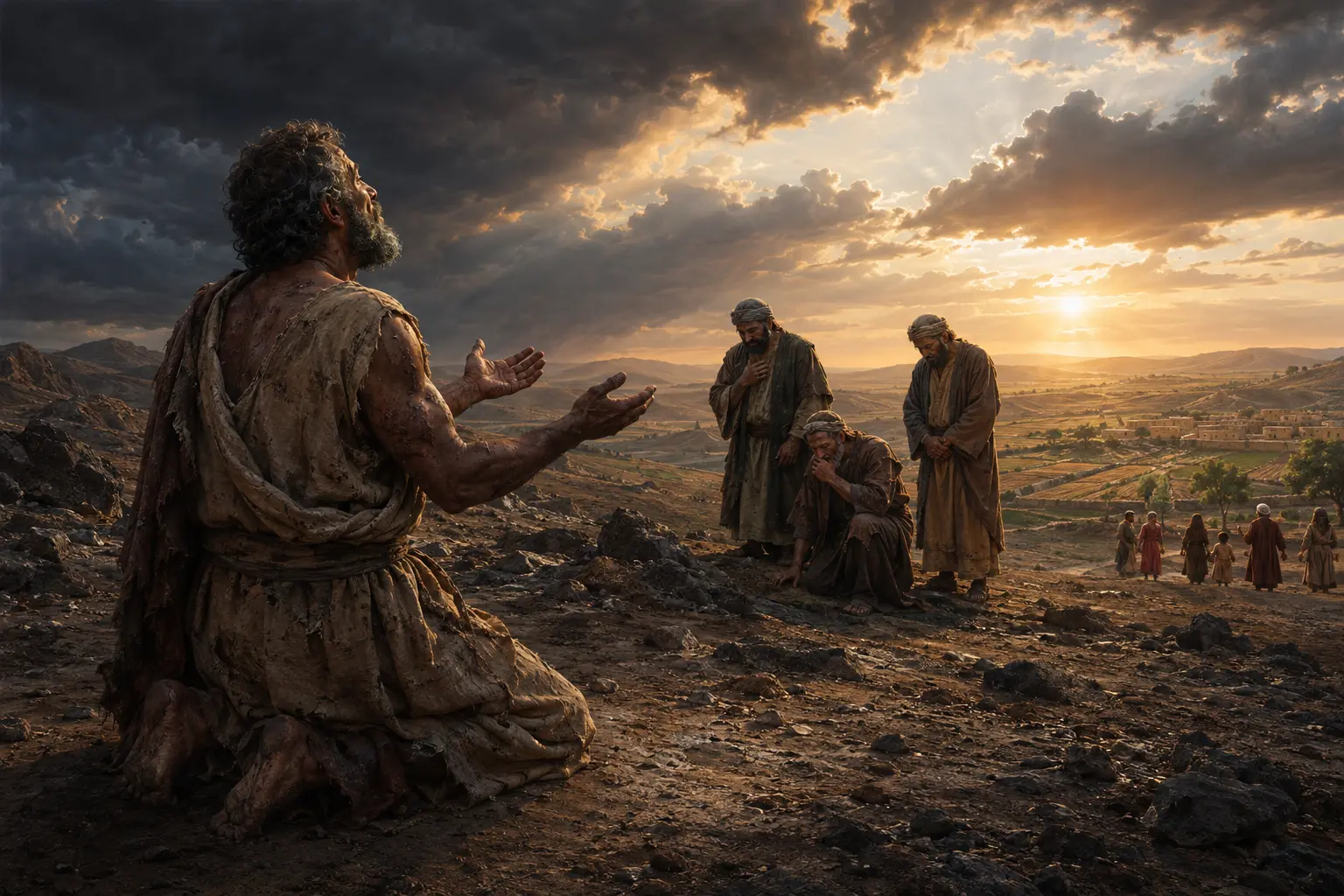
There are sorrows that no human answer can withstand. Job has listened to their speeches, weighed their proverbs, and tasted the medicine of his friends—then he found it bitter. In Job 16, this troubled man turns his back on the comforters of the afflicted, hurling bitter complaints against God, and then, in great surprise, turns to the heavenly witness. The ground should not cover his blood! His cry should not be buried! Somewhere on the ash heap, Job dares to believe that there is One who will testify against him, even when God Himself is perceived as his enemy.
01
Troubled Comforters, God Appearing as an Enemy, and a Witness Who Should Speak from Above
There are sorrows that no human answer can withstand. Job has listened to their speeches, weighed their proverbs, and tasted the medicine of his friends—then he found it bitter. In Job 16, this troubled man turns his back on the comforters of the afflicted, hurling bitter complaints against God, and then, in great surprise, turns to the heavenly witness. The ground should not cover his blood! His cry should not be buried! Somewhere on the ash heap, Job dares to believe that there is One who will testify against him, even when God Himself is perceived as his enemy.
02
1.0 Introduction: When Comforters Are Another Injury
Eliphaz just spoke again. His second speech was stronger and more intense than the first. He accused Job of having knowledge of the wind, of dangerous words, of destroying godliness, and of turning his spirit against God. He gathered the wisdom of the elders and painted a terrifying picture of the restless destruction of the evil man.
Now Job answers.
Job 16 begins with one of the book's most memorable snorts: "You are all comforting comforters" (16:2). His friends came to comfort him, but their comfort has become another torture. Their words have not lifted his burden; they have pressed you deeper into his bones. Those people who remained silent for seven days have now become people whose words hurt more than silence could ever hurt.
But Job's speech does not end with his friends. Pain moves quickly from human disappointment to accusation against God. Job says that God has tired him, he has squeezed him, he has torn him in anger, he has gnashed his teeth, he has handed him over to the ungodly, he has crushed him, he has grabbed him by the neck, and made him his target. These are not quiet words. This is a cry from the brink of great fear.
However, in this very chapter, Job reaches one great peak of faith. After describing God as an attacker, he cries: "O earth, do not touch my blood, and let not my cry find a place to rest. Even now, look, my witness is in heaven, and he who testifies to me is on high" (16:18–19).
This is the wonderful beauty of Job 16. The God whom Job sees as an enemy is also the only place from which proof of his innocence can come. Job cannot find justice among his friends. He cannot recover from his body. He cannot find clarity in the world. So, he appeals to the top.
This chapter asks a heart-wrenching question: What kind of faith increasingly looks to heaven for a witness when heaven itself feels silent, hostile, and closed?
03
2.0 Historical and Literary Context: Job's Fifth Discourse Begins
Job 16 begins Job's response to Eliphaz's second speech. The whole speech continues until
Job 17, but chapter 16 has its own powerful flow:
Job scolds his friends as troublesome comforters (16:1–6).
Job laments that God has tired and attacked him (16:7-14).
A yubu describes his mourning and emphasizes his innocence (16:15-17).
Job appeals to earth and heaven to prove his innocence (16:18-22).
This speech is woven into two threads: mourning and legal appeal. Job speaks as a struggling man who weeps under oppression, and he speaks as a claimant whose blood must bear witness. The language of physical pain, social shame, divine hostility, and court testimony all flow together.
This is important because, in a theological context, Job has a deep understanding and does not look at things superficially. He doesn't just say, "God is against me," and stop there. And he doesn't just say, "God will defend me," and jump into peace. He says both—God has crushed me, and my witness is in heaven. The tension is not a contradiction to be resolved quickly. It is the real tension of the life of faith under unrelenting suffering.
This chapter also builds on a theme that has been developing since Job 9 and 13: Job needs an intercessor, a witness, an advocate, or legal helper. In Job 9 he desired an arbitrator between himself and God. In Job 13 he prepared his case and asked God to answer. Now in Job 16 he looks to heaven looking for a witness who can testify on his behalf.
Later, in Job 19, this thirst will become more prominent: "I know that my Redeemer lives" (Job 19:25). But Job 16 is already moving towards that hope. It is a fragile, costly, and tension-filled hope. Job does not yet have a neat doctrine of mediation.
He has a desperate cry looking for someone in heaven to tell the truth about him.
04
3.1 “You Are All Wearisome Comforters” — Tired of Bad Counsel (16:1–6)
Job begins by answering Eliphaz and his other friends together: "I have heard many such things; you are all troublesome comforters" (16:2).
This verse is an accusation and also a lamentation. Job has seen speeches like this before. His friends continue to revolve around the same ideas: suffering means you have sin, repentance will restore wealth, God's justice must be protected for Job to confess his sins. Their words are different, but the wound they create is the same.
The phrase "troublesome comforters" has a deep, painful irony. Comfort should reduce misery. Their comfort produces misery. They have been the complete opposite of their calling.
Then Job throws his own accusation at Eliphaz: "Shall there be an end to the words of the wind?" (16:3). Eliphaz had accused Job of having knowledge of the wind in chapter 15. Now Job says his friends are the ones who talk about the wind. Their speech is not rain for a thirsty person. They are wind storms in the desert.
Job asks, "What prompts you to answer?" He cannot understand why they have to continue to defend their system of thought. Why do you have to answer every cry? Why can't they let the mourning breathe? Why does his pain itch them until they fix him?
Then Job thinks of a change of position: "I too could speak like you, if your spirit were in the place of my spirit" (16:4). This is one of the main pastoral views in this chapter. It is easy to talk like these friends when one is not sitting in the ashes of Job. Everyone can create a good speech while sitting in a safe chair.
But Job says that if their positions had changed, he would not have used the eloquence of words to crush them. He would strengthen them with his mouth. He would move his lips to ease their pain (16:5). The difference is great: his friends use accusing words; Job says he would use words to give strength.
Then comes the trap of suffering: "If I speak, my grief is not relieved; and if I keep silent, how much less is it?" (16:6). Talking doesn't heal him. Silence does not heal him. The sufferer is caught between expressing feelings that do not bring healing and silence that does not bring comfort.
Many injured people know this place. Talking doesn't make the noise go away. Not talking about it doesn't make it go away. The pain remains, whether it is spoken or not.
The failure of comfort is not only because it lacks answers; it is because it forgets that the victim needs to be strengthened rather than given an explanation.
05
3.2 "He has tired me" — Job Names God as Attacking Him (16:7-11)
Now Job turns from his friends and turns to God: "But now, indeed, God has tired me; you have made him all my congregation" (16:7).
This sadness is universal. Job's body is completely exhausted. His household is gone. His society has become desolate. He doesn't just get tired normally; he has been torn apart.
He says God has taken him down (he has treated me badly), and this has become a testimony against him (16:8). Job's emaciated body is taken by others as evidence of his guilt. His sufferings became a public testimony against his faithfulness. His friends look at his shriveled body and see evidence of sin. Job looks at the same body and sees injustice.
Then the picture becomes more intense: "He has torn me apart in his anger, and hates me; he has gnashed his teeth on me; my oppressor sets his eyes on me" (16:9). Job shows God by using the language of a carnivorous animal or a warrior. The divine face is no longer blessed; it is teeth, fierceness, and wrath.
This is a difficult language. It may confuse readers who want Job to speak more carefully. But the book does not erase his words. It gives it space. The Holy Spirit has protected this pain in the Scriptures, teaching us that the prayer language of the Bible is broad enough to include fear before God.
Then Job describes the public shame: people stare at him, they slap him on the cheek, they gather together against him (16:10). The cruelty of God seems to be reflected in the cruelty of people. When heaven appears hostile, society becomes bold with contempt.
Verse 11 says God has delivered him from the unjust people, and thrown him into the hands of the oppressors. Job not only sees God's attacks but he sees and is taken captive by God.
He feels abandoned in the hands of those who despise him.
This language will be very popular later in the great story of the Bible. Jesus will also be delivered—to sinners, to authorities, to scoffers, and to death. The righteous sufferer will know what the meaning of human cruelty and divine purposes meet in a mystery so long in simple words.
Job's lamentation is terrible because he refuses to protect God due to the way suffering is felt in his heart.
06
3.3 "He entwined me" — The body as a target (16:12-14)
Job continues: "I was sitting comfortably, and he stung me; yes, he grabbed my neck and broke me; and he has made me his target" (16:12).
The words "I was sitting comfortably" look back to Job's past life. He had stability, family, honor, work, worship, and community. Then everything fell apart. The transition from peace to crushing is part of a great psychological pain (trauma). Tragedy is not just pain; it's a brutality of great contrast—how morning can turn into night so quickly.
God is now pictured as the attacker who grabs Job by the neck, breaks him, and makes him his target. The image of the divine archers follows: "His archers surround me on all sides; he splits my kidneys, and has no mercy; he pours out my gall on the ground" (16:13).
In Hebrew thought, the internal organs are the center of deep emotion and life. Job feels attacked to his core. His suffering is not only superficial. It is as if the secret core of his existence has been torn apart and poured out.
Then Job describes how God tears him down with successive blows—causing him to crack upon crack—like a soldier on the front line of battle (16:14). Compare his description with the image of a city wall being battered over and over again until the attacker breaks through. Job was the city that was attacked. God is the warrior of war.
This is perhaps one of the strongest complaints against God recorded in all of Scripture. They show the reality of Job's suffering: it was not just ordinary grief or theoretical confusion, but it was a real situation of being overwhelmed and tortured by the One who trusted him before.
However, this chapter does not end here. That's the bottom line. Job's speech moves from this accusation to an appeal. He does not vomit the cruelty he feels, but also he does not stop talking to heaven.
Job's body has become a battlefield, but his voice still seeks a court.
07
3.4 "My Prayer is Pure" — Mourning and Loyalty (16:15–17)
Now Job describes his mourning: "I have sewn sackcloth over my skin, and I have wasted my strength in the dust" (16:15). The sackcloth is the garment of sorrow. Dust is a place of contempt and death. Job's very body is clothed in mourning.
"My face is pale with weeping, and there is darkness above my eyelids" (16:16). His tears have marked him. His eyes carry the shadow of death. This language makes grief visible. Job's hymn is not just an idea; it's written on his face.
Then comes his emphasis: "Though there is no cruelty in my hand, and my prayer is pure" (16:17).
This line is very important. Job does not claim that he is completely sinless before God in every possible way. He rejects the brutality and hidden evil that his friends imply he is. His hands have no crime stains that would explain this level of torture.
His prayers are not hypocritical. He has not used religion as a mask for cruelty.
The difference with the theology of his friends is very great. Eliphaz described the wicked man as cruel, stubborn, inwardly corrupt, and cursed. Job says: that is not me. My hands are not cruel. My prayers are pure.
This is not self-promotion. It is moral testimony under prosecution. Sometimes humility requires repentance. Sometimes humility requires refusing to admit a lie.
There is also a priestly attribute in this verse. Clean hands and sincere prayers go together (Ps. 24:3-4; 1 Tim. 2:8). Job says that his worship is faithful. His lamentation may be harsh, but it is not sarcastic.
Tears do not make prayers impure; sometimes tears are the proof that prayers are telling the truth.
08
3.5 "O Country, Don't Hide My Blood" — A Cry That Shouldn't Be Buried (16:18)
Suddenly Job warns the world: "O land, do not touch my blood, and let my cry not find a place to rest" (16:18).
This is a completely legal and Biblical picture. Blood cries where injustice has been done. In Genesis 4, Abel's blood pours from the ground after Cain kills him. Now Job puts himself in the same line. He is not a murderer; he is the one whose blood must bear witness.
He wants the country not to hide the evidence.
These words also oppose silence. Job fears that his suffering will be buried under the accusations of his friends, under death, under time, and under dust. He denies that. Let the blood remain exposed and uncovered. May the cry continue to move forward. Injustice should not be covered by the land.
This is powerful witnessing theology. Some cries should not be silenced so quickly. Some wounds must remain visible until the truth is told. Some blood must continue to cry until God answers.
In pastoral matters, Job 16:18 warns against ending things locally and prematurely. Society often wants the suffering to stop so that life can return to normal. But Job says: do not cover it. Don't bury that cry. Don't let the wound disappear before justice speaks.
The cross brings more depth to this. Jesus' blood speaks better words than Abel's - not because it denies injustice, but because it carries injustice to forgiveness and new creation (Heb. 12:24). However, even the blood of Jesus was not covered as if the atrocity never happened. The resurrected Christ still has his wounds.
Faith does not always ask the country to forget; sometimes faith commands the country to remember.
09
3.6 "My Witness is in Heaven" — Hope on the Ash Heap (16:19–22)
Now comes a surprising twist: "Even now, behold, my witness is in heaven, and he who testifies to me is on high" (16:19).
Job has just accused God of attacking him. However, he is now looking to heaven for a witness. This creates one of the great tensions of this book. Who is this witness? Does Job imagine a defender of heaven that is different from God? Is he appealing to God against God? Is this a poetic way of saying that somewhere in the heavenly world the truth is preserved even when the friends of the earth lie?
The scriptures do not fully explain this matter. That is part of its power. Job does not have a neat and clear teaching. He has a strong pessimistic influence: someone up there must know the truth. Someone must testify that Job's blood should not be covered. Someone has to speak up when a friend fails.
"My friends despise me; but my eye sheds tears before God" (16:20).
The horizontal relationship (with humans) is broken; the vertical cry (to God) remains. Man's contempt does not stop Job's tears from flowing towards God.
Then he wishes for reconciliation: "If only one would speak to God for man, as a man speaks to his neighbor!" (16:21). Job wants someone to defend him before God with the normal equality that one human can ask of another. He wants divine justice to be negotiable, accessible, and relational.
Verse 22 closes with urgency: "For after a few years, I will go the way that I will not return." Death is near. Time is short. If proof comes, don't wait forever.
This hope is not restful. It is fast, wet with tears, and surrounded by death. But it is hope. Job's witness in heaven becomes a bridge between mourning and future vindication.
In the whole context of the Bible, Christians cannot read this verse without hearing an echo that Job himself was not yet fully aware of. The New Testament speaks of Jesus Christ as mediator, advocate, faithful witness, and intercessor (Rom. 8:34; 1 Tim. 2:5; Heb. 7:25; 1 John 2:1; Rev. 1:5). Christ is not just someone who describes suffering; He enters into it, bears false accusations, sheds innocent blood, rises, and prays for the people.
Job's cry does not turn out to be direct prophecy in the simplest sense. It's more than that. It is the longing of the wounded man that the gospel evokes by giving him the Face of a real man.
Job asks for a witness in heaven; the gospel reveals a wounded Witness who has also stood in the dust.
10
4.0 Theological Reflection: High Witness and Low Wounds
Job 16 teaches us that faith can hold both condemnation and hope in the same breath.
Job accuses God of tearing him to pieces. He then appeals to heaven looking for a witness. This is not neat theology, but it has a strong Biblical basis. Suffering human beings often see God in conflicting ways: as absent but needed, terrifying but desired, admonishing but the only one worth talking about.
His friends cannot understand this. Their theology requires simple ideological groups. God is just; therefore Job must be wrong. Job's experience is more complicated. God is just; therefore these sufferings must be brought before God Himself. Job does not abandon divine justice.
He sneezes at it and wants it to appear.
This chapter also teaches us that encouragement must be empowering, not just classroom instruction. Job says that if the circumstances were reversed, he would strengthen his friends with his mouth.
That is a unique word of inquiry for every pastor, teacher, counselor, and friend. The question is not simply, "Are my words true?" but also, "Do they strengthen this man who is falling apart?"
Job's call that the land should not touch his blood is very important for theology and justice. Scripture does not teach us to forget as the first response to suffering. They teach us a reminder of the truth. Abel's blood cries out. Israel's groaning goes up. The witnesses under the altar cry, "How long?" Christ's wounds remain visible after the resurrection. God's redemption does not require the removal of injury; you need the wound to be answered with justice, mercy, and new creation.
In Christ, Job's thirst to find a witness in heaven finds its full light. Jesus is an innocent sufferer and also a defender of heaven. He knows what it means to be mocked by troublesome comforters, accused by religious certainty, handed over to cruel people, and made a target. He also becomes the one who witnesses, who prays, and who brings the cry of those who suffer before God.
This does not make the suffering any easier. It doesn't answer every "why" in the way Job wants it to. But it means that the victim is not without a witness. Lower injuries are known up there. The blood is not covered. The cry has not stopped.
The Gospel does not silence Job's cry; it carries it within the wounds of the resurrected Defender.
11
5.0 Life Application: Being Empowering Comforters
Job 16 offers practical wisdom for those who suffer and those who walk with those who suffer.
1. Ask if your comfort is energizing or boring. His friends say many words, but Job feels worse. Good advice does not always remove the pain, but it should not add unnecessary burden. Before you speak, ask: Will this strengthen weak hands? Will this help this person breathe?
2. Don't respond to every cry. Job asks why his friends feel compelled to keep answering. Sometimes the best answer to grief is not another explanation but an honest presence around them. Silence can be sacred when words would only be to defend our own discomfort.
3. Do not confuse physical or emotional weakness with guilt of sin. Job's shriveled body becomes a testimony against him in the eyes of others. We should not read suffering bodies as moral evidence. Sickness, tears, depression, psychological wounds (trauma), poverty, and exhaustion are not automatic signs of God's displeasure.
4. Make room for difficult words for God. Job says things that sound shocking. However, the Scriptures protect it. Churches should teach believers how to grieve honestly without shame, while continuing to hold them in worship, prayer, and community.
5. Do not cover the blood too quickly. When the harm is done, the truth is very important. Whether in personal relationships, churches, families, or communities, healing does not come by burying the dead. It comes when the truth is heard and brought before God.
6. See Christ as a witness and advocate. When friends misunderstand you, when accusations increase, and when the pain is indescribable, remember that Christ knows the truth of His people. He prays for them. He carries injuries. He is not ashamed because of your tears.
7. Learn to speak words of encouragement. Job says he would strengthen his friends with his mouth. Words of encouragement can sound like: "I'm here." "I don't understand, but I won't sue you." "Your pain is important." "God has not forgotten you." "Let us bring this cry to Him together."
For pastors and teachers, Job 16 is a warning that ministry can be a wind if separated from sincere compassion. Sermons, advice, and theological explanations must be shaped by the crucified Christ, whose truth comes with tears.
For those who suffer, Job 16 says: your cry does not have to be buried. If earthly comforters fail, there is still a witness in heaven. Your tears can still be shed before God.
12
6.0 Reflection Questions
1. Why does Job call his friends "troublesome comforters"? What makes comfort miserable?
2. What can we learn from Job's statement that if their positions were to change, he would strengthen them with his mouth?
3. How should believers respond to Job's strong language about God attacking him?
4. How do people today misread suffering bodies or broken lives as evidence of guilt?
5. What does it mean for the land not to cover Job's blood and for his cry not to find a place to rest?
6. Who or what is Job's witness "in heaven", and how does this thirst prepare Christian readers to think of Christ as an advocate?
7. How can churches be communities where cries are heard instead of buried?
13
7.0 Answered Prayer
God who hears blood from the ground,
and tears falling in silence,
do not let our cries be buried.
Forgive us for tedious comforts,
with words that blow like the wind,
with details that tire the wounded,
in silence when the truth should speak,
and in words where love should wait.
Teach us to strengthen our mouths.
Teach us to stay close to the broken without accusation.
Teach us to carry mourning to prayer.
When you feel far away,
be close in ways deeper than our senses.
When the sky seems closed,
let us show Christ our witness.
When our tears are speechless,
let the Spirit pray for us with groanings that cannot be uttered.
Do not cover the blood.
Do not forget this cry.
Let the truth stand,
let mercy answer,
and leave the wounded hands of Jesus
hold on to every sorrow until the morning comes.
Amen.
14
8.0 A Window to the Next Chapter: Hope Sinks to Hell, but Still Speaks
Job 16 ends quickly: only a few years remain before Job goes down the road from which he will never return. In Job 17, the darkness deepens. Job will say that his spirit is broken, his days are ended, and the grave is ready for him. He will ask God to give him a deposit (guarantee) for him, because no one else will stand as his guarantor.
The legal thirst continues, but the environment is getting colder. Mockers surround him. His eyes grow dim. His plans have been disrupted. Hope seems to descend to the depths of Hell (Sheol).
And yet Job continues to speak.
That is the fragile miracle of these chapters. A person who suffers has no solution, but still has an address to direct his words. He still brings his despair before God. His faith does not shine like the noonday sun. It is like a fire under the ashes—but it is not completely extinguished.
15
9.0 Annotated Bibliography
Hartley, John E. The Book of Job. New International Commentary on the Old Testament. Grand Rapids: Eerdmans, 1988. Hartley is helpful in dividing Job's fifth response into the argument with the comforters, the human lamentation against God, the appeal to the heavenly witness, and the continued lamentation of chapter 17. His discussion of "troublesome comforters" as an antithetical word strongly characterizes Job's view of their speech as pain rather than comfort.
Clines, David J. A. Job 1–20. Word Biblical Commentary 17. Dallas: Word Books, 1989. Clines provides a careful analysis of the structure of Job 16–17 and highlights the flow from despair to hope and back again, with Job's vindication being the focus of both. His reading helps preserve the tension of this chapter: Job accuses God of attacking him while still looking to heaven for testimony.
Alter, Robert. The Wisdom Books: Job, Proverbs, and Ecclesiastes: A Translation with Commentary. New York: W. W. Norton, 2010. Alter's literary sensibility helps readers feel the power of Job's images of brutality—teeth, targets, archers, crushed walls—as well as a surprising turn toward the witness in heaven.
Walton, John H., and Tremper Longman III. How to Read Job. Downers Grove: IVP Academic, 2015. Walton and Longman help place Job's speeches within the great wisdom challenge of this book against the simple payment of what you sow is what you reap (retribution) and his call to trust God's wisdom in the midst of unspeakable suffering.
BibleProject. The Book of Job Guide. BibleProject, 2026. The BibleProject summary is important for placing Job 16 within a larger conversation, where Job's sincere prayers and accusations push toward God's final answer and reveal the limits of his friends' thinking.

Be the first to leave a comment.