

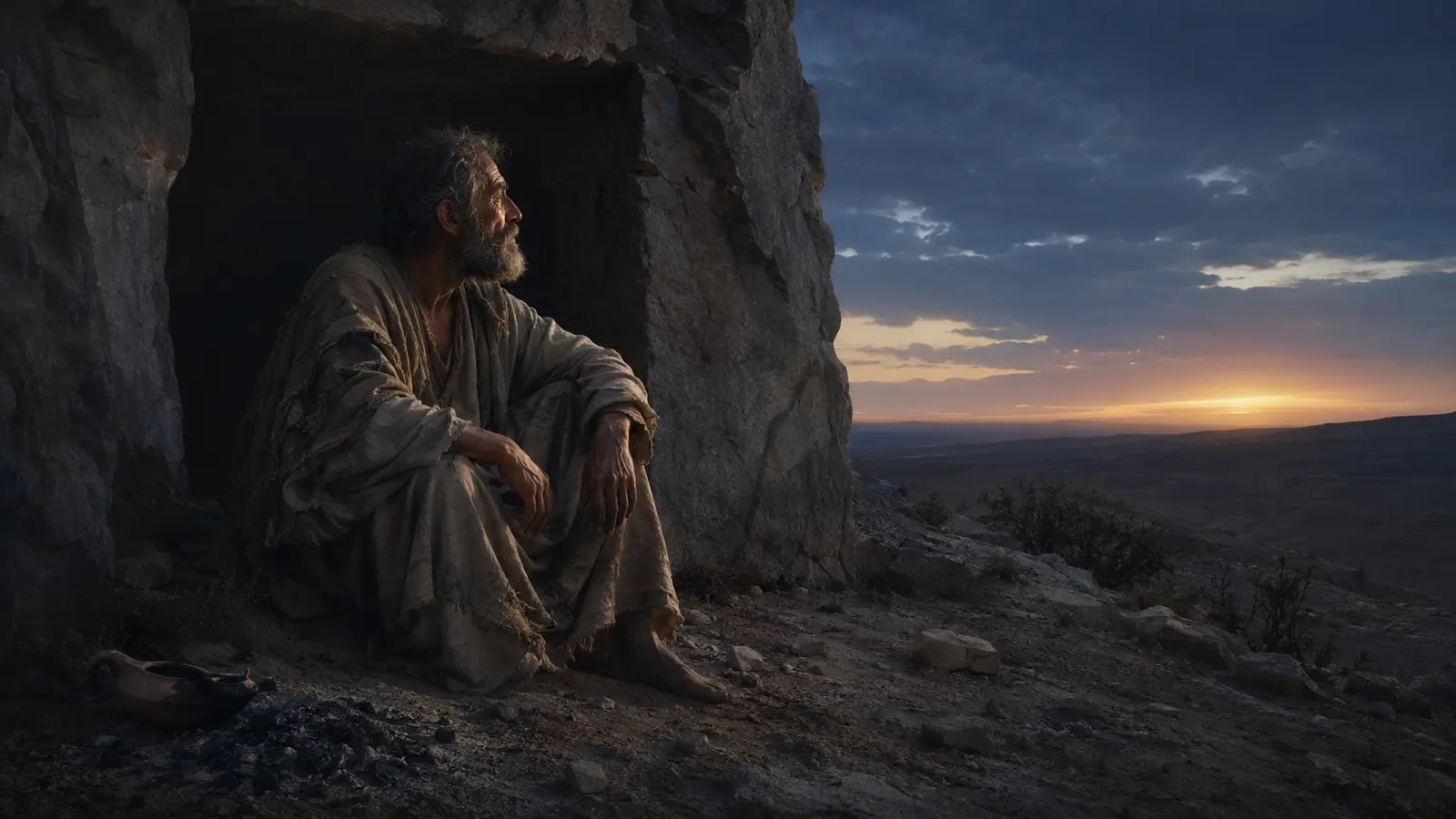
There are times when hope doesn't seem like a sunrise. He looks like a wounded man who is still talking when the grave is ready to swallow him. Job 17 is one of the coolest chapters in Scripture. Job's spirit is broken, his days are ended, scoffers are around him, and Hell (Sheol) seems to be the only home left for him. Even so, even under the weight of death, Job asks for a deposit. He needs someone to stand up for him when no earthly friend can do that. This chapter ends at the mouth of Hell, but it does not end in silence.
01
A Broken Spirit, A Needed Surety, and The Night Where Faith Rejects False Wisdom
There are times when hope doesn't seem like a sunrise. He looks like a wounded man who is still talking when the grave is ready to swallow him. Job 17 is one of the coolest chapters in Scripture. Job's spirit is broken, his days are ended, scoffers are around him, and Hell (Sheol) seems to be the only home left for him. Even so, even under the weight of death, Job asks for a deposit. He needs someone to stand up for him when no earthly friend can do that. This chapter ends at the mouth of Hell, but it does not end in silence.
02
1.0 Introduction: When the Tomb Is Ready
Job 16 raised his cry to heaven. Job had called his friends "troublesome comforters." He had described God as the one who broke him, who took him by the neck, and set him as the target of His arrows. However, in the midst of the blood, tears, and accusations, Job reached out to look for a witness in heaven: "Even now, look, my witness is in heaven, and he who testifies to me is on high" (Job 16:19).
Job 17 continues the discourse, but the light is fading.
If Job 16 looked up to find a witness, Job 17 looks down to the grave. "My spirit is broken, my days are spent, the grave is ready for me" (17:1). These words do not mean that Job expects to die in a few minutes. They mean that death has already entered into his emotional and spiritual life. His breath, his courage, his social world, and his future are all crushed. He is alive, but surrounded by the furniture of death.
His friends are close to him, but they are of no help. Now they have become mockers, no longer comforters. Their presence did not protect him from despair; rather it sharpens its pain. Therefore, Job asks God for something unusual: "Make a deposit for me with yourself; who will make a deposit for me?" (17:3). He needs a guarantor. He needs someone to stand up for his righteousness, because no one on earth will.
This chapter holds together several serious themes: psychological death, social shame, the failure of friends, the need for an advocate, the perseverance of the righteous, and the collapse of human hope. Job does not rise in victory. He descends towards Hell. But even as hope fades, his words stubbornly remain alive.
Job 17 asks a difficult and sacred question: What remains in faith when the grave seems more ready than the afterlife?
03
2.0 Historical and Architectural Context: The Conclusion of Job's Fifth Discourse
Job 17 concludes Job's fifth speech, which began in chapter 16. Together, Job 16–17 responds to Eliphaz's second speech in Job 15. Eliphaz had accused Job of having "knowledge of the wind," dangerous words, intemperance, and hidden wickedness. Job responds by saying that his friends are windy words, tiresome comforters who multiply words without strengthening the sufferer.
The flow of Job 16–17 can be seen as follows:
Job rebukes his friends as troublesome comforters (16:1–6).
Job cries out to God for the brutal attacks against him (16:7-14).
Job emphasizes his righteousness and appeals to the heavenly witness (16:15-22).
Job declares that death has taken over his inner life (17:1–2).
Job asks God for a deposit or guarantor (17:3-5).
Job describes his public shame and the weakening of his body (17:6-7).
Job confirms that the righteous will still keep his way (17:8-9).
Job rejects the wisdom of his friends and descends into the hopeless image of Hell (17:10–16).
Legal language is still very important here. In the ancient world, a trust or bond was a guarantee given in a legal or financial context. Job takes that social custom and turns it into theology. Since no friend will stand up for him, he asks God to give the deposit. This problem is very painful: Job has seen God as his attacker, but the same God is the only one who can guarantee that the truth will finally be heard.
This is the conflict at the heart of Job's faith. He needs God against God. He needs a righteous God to answer the God who seems to hurt him. He needs a witness in heaven because earthly witnesses have failed him.
This chapter ends with the language of Hell: darkness like a bed, pit like father, larvae like mother and sister, and hope descending into the abyss of the underworld. This is not just abstract poetry. It is the vocabulary of a person whose future has collapsed. The only proximity left to think about is that of decay and decay.
And yet, Job is still speaking. Speech itself is a form of struggle. He cannot see hope, but he rejects the false hopes of his friends. He cannot find a guarantor, but he asks for one. He cannot run away from the shadow of Hell, but he mentions it before God.
04
3.1 "My Spirit is Broken" — Being Alive But Actually Dead (17:1–2)
Job begins with a very sad sentence: "My spirit is broken, my days are spent, the grave is ready for me" (17:1).
The word "spirit" here is not just a decorative word. It speaks of breath, power, inner energy, and life. Job never had just ordinary sadness. He feels as if the light inside him has been turned off by being stepped on. His body may still be breathing, but his inner strength has collapsed.
This is an important pastoral insight. There is a kind of death that comes before the funeral. People can continue to walk, talk, work, and hang out with friends while inside feeling completely shut down. Grief can break the spirit before the body dies. Serious emotional wounds can make the future feel closed already.
"My days are ended." The future has lost its focus. The days of work, family, worship, and expectations are now felt to be over. Job does not count the possibilities of new things; he counts the endings.
"The grave is ready for me." Job does not see death as a distant theory, but as a prepared opportunity. The grave feels planned, waiting, close at hand. Psychologically, he lives with death as his neighbor.
Then he says, "Surely there are scoffers with me, and my eye rests on their aggression" (17:2). He cannot escape the presence of his friends. They sit around him, not as healers, but as mockers. Their accusations surround his fading hope like wolves surrounding a wounded animal.
Job's eye "rests" on their aggression. He can't avoid seeing it. Pain has a tendency to freeze one's attention to every look, every sound, and every rude word of other people. When the spirit is broken, even the presence of unsympathetic people becomes another wound.
A broken spirit needs shelter, not spectators.
05
3.2 "Deposit for Me" — Cry for a Guarantor (17:3–5)
Now Job makes one very amazing request in this book: "Make a deposit for me with yourself; who will make a deposit for me?" (17:3).
The deposit was a guarantee. In human legal and economic life, a person could give property—or even become surety—to ensure that a debt or obligation is fulfilled. Job uses this language because he feels he is caught in a legal dispute. His suffering seems to be evidence against him. His friends interpret his condition as proof of guilt.
He needs someone to stand up for his integrity.
But who will do that?
Not Eliphaz. Not Bildad. Not Zophar. Neither does the society that watches him. No one in the world will put his hand as a deposit for him.
So Job prays to God.
This is surprising because Job has just accused God of attacking him. With that, he asks the same God to guarantee him. He appeals to the same God who seems to be his opponent. This request seems impossible, but the impossibility turns out to be the only option left for Job.
Verse 4 describes part of his situation: "Because you have shut up their hearts from understanding, therefore you will not glorify them." Job believes God has prevented his friends from understanding him.
They are not just wrong by accident; their hearts are closed. However, Job also believes that God will ultimately not let them win. Their false judgment cannot be the last word.
Then comes a difficult saying similar to proverbs: "He who seduces his friends to become a prey, Even the eyes of his children, the eyes of his children will go into the kiwi [will faint]" (17:5). The exact meaning has been debated, but its force in this context is clear: betraying friends for some gain or interest brings judgment. Job may be warning that those who turn against a friend should fear the consequences.
Friends have not only failed to comfort; they have been witnesses against him. Their loyalty has turned into an accusation. Their friendship has become a legal hazard.
Job's request for a deposit becomes more than just legal language. It is the cry of the need for sincere solidarity. He needs someone who won't profit from his downfall, someone who won't interpret his suffering as an opportunity to oppress him, someone who will stand by him when every visible sign points to him.
For Christian readers, this passion points forward to Christ as our advocate and judge. Jesus is the one who does not leave the accused, who stands with sinners and those who suffer, who bears the blame, and who gives Himself as a guarantee for His people. But in Job 17, that hope is not yet clear. It is a cry in the dark: "Who will stand for me?"
When every human hand withdraws, Job asks for a hand from heaven that will not let him fall.
06
3.3 "He Has Made Me a Parable" — Public Humiliation and Weakening of the Body (17:6–7)
Now Job describes how he appears in the eyes of others: "He has made me a proverb of the people, and I have become a person to be spit in the face" (17:6).
The word "He made me" most likely refers to God. Job believes God has made him a public proverb, a terrible example, a name that people use when they want to talk about shame and humiliation. His life has been exemplary—but not honest. In people's minds, he has become a symbol of judgment.
This is social death.
To be a proverb is to lose control of your own life story. People stop seeing you as a human being and start using you as a lesson. Job is no longer "Job, the man, the father, the worshiper, the sufferer" anymore. He just becomes "Job, the lesson." His pain is turned into a public conversation.
Then he says that he has been spit in the face. Spitting is a sign of great contempt, ridicule, and exclusion. Job's suffering has put him outside the circle of honor. He is treated like a defiled person.
Verse 7 returns to the physical state: "My eye also has become dim because of sorrow, and all my limbs have become like a shadow." The eye, which is often associated with life, perception, and existence, has become weak. The body itself feels like a shadow. Job is disappearing more and more, he is losing his reality, he is no longer alive.
This is not just weakening of the body due to illness. It is an experience of social and physical devaluation. Sorrow blinds the eyes. Shame makes the body fat. Accusations fill a person and make him just a shadow.
The great story of the Bible will be heard again in this style through the suffering servant, who was assumed, rejected, and counted as smitten by God (Isa. 53:3-4). Jesus Himself will be mocked, spat on, beaten, and made a public spectacle (Mt. 26:67; 27:27-31).
An innocent wretch can become the epitome of contempt before his truth emerges and cleanses him.
07
3.4 "The Righteous One Keeps His Way" — The Amazing Power of Loyalty (17:8–9)
In the midst of this darkness, Job says something with unexpected power: "The righteous will be sad because of this, and the innocent will wake up to the hypocrite" (17:8). Then: "But the righteous will keep his way, and he who has clean hands will gain strength" (17:9).
This is a very strange time.
Job said his spirit is broken. He said the grave is ready. He has said that he has become proverbial and a shadow. Despite that, he still believes that justice has its endurance. Honest people will be saddened by the way he is treated badly. The innocent will wake up against hypocrisy. The righteous will keep his way. Clean hands will gain strength.
How can Job say this while feeling hopeless?
It's because giving up on your environment is not the same as surrendering your integrity. Job cannot see his future, but he can still hold on to his moral principles. He cannot find comfort, but he can deny false guilt. He cannot force God to answer, but he can keep his hands clean.
This line also pushes back his friends. They claim to be defending justice, but their charges against Job are unjust. Job says that those with true morals will be sad—not because of Job's complaint, but because of the injustice he was treated. The innocent will realize that something is wrong when the victim is judged without the truth.
Verse 9 becomes like a lamp within this chapter. You don't remove the darkness, but you shine in it. A righteous man is not always stable by receiving answers to his questions. Strength is always gained by refusing to leave the right path even when answers fail to come.
This is not a quick victory. It is patience.
James will later talk about Job's patience (James 5:11). That patience is not just a gentle calmness that accepts everything. It is the severity of refusing to allow persecution, accusations, and silence to destroy one's honesty and integrity.
The righteous may walk in darkness, but they are under no obligation to let darkness choose their path.
08
3.5 "I will not find a wise man among you" — Job Rejects His Friends (17:10)
Now Job turns to his friends again: "But all of you, return, come now, for I will not find a wise man among you" (17:10).
This sentence is full of pain and exhaustion. Job invites them to continue talking, but he already knows the consequences. Much talk will not bring wisdom. Many proverbs will not heal. Most accusations will not reveal the truth.
This is a very sad step in this conversation. Communication is collapsing. Friends do not persuade Job; and Job does not persuade his friends. Each speech increases the distance between them. The conversation has now ceased to be about giving advice and has become like a war of words.
This rejection of Job is not against wisdom. It is against false wisdom. He is not saying that wisdom does not exist in the world. He says he cannot find it among these people, at this time, and through the way they treat him.
Here is a very important lesson in ministry and formation. People may have read a lot about religion and still not have the wisdom to meet someone who is going through a certain challenge.
They can quote ancient truths and are completely afraid of a living human being in front of them. Wisdom is not just information stored in the head; it is the truth given at the right time, guided by loving God and loving the neighbor.
The speech may have been full of religious teachings but it was still completely empty without wisdom in it.
09
3.6 "My Plans Are Ruined" — Disruption of Future Expectations (17:11–12)
Job now returns to the internal destruction of his soul: "My days are past, my plans are broken, even the things that were in my heart" (17:11).
This is one of the deepest wounds of great grief: losing not only what was, but also what could have been. Job has lost his family, wealth, health, and honor. But he has also lost his plans. The future life he envisioned has been completely cut off. The desires of his heart—perhaps to grow old with dignity, to see his grandchildren clear his name, to continue in worship and service, to die in peace—are all ruined.
Suffering often breaks the calendar of a person's life before it breaks his body. They cancel future lives, disrupt callings, and make once-common dreams seem unattainable. People grieve not only for past memories but also for lost future opportunities.
Verse 12 is difficult: "They turn the night into day; 'The light,' they say, 'is near darkness.'" Job may be accusing his friends of overturning the reality of things. They call darkness light. They insist that hope is near when Job is only going through a thick night.
Their hasty optimism feels like a refusal to face reality.
This is another pastoral warning. It is possible to talk about light too early in a hurtful way. There is a kind of encouragement that is cruel because it refuses to respect the real darkness that a person is going through. "It will be all right," "God will fix it soon," "Your victory is near"—such words may sound hopeful, but if they are not grounded in truth, timing, and gentleness, they can make the sufferer feel invisible and misunderstood.
Job does not oppose the light. He longs for it. But he doesn't want to pretend it's day when it's actually night.
Hopes that cannot recognize seasons and times can turn into another form of lies.
10
3.7 "Looking for Hell to Be My Home" — Hope Descends to the Underworld (17:13–16)
This chapter ends with the heavy language of Hell (Sheol).
"If I look to Hell for my home; if I make my bed in darkness; if I say to the pit, 'You are my father;' and the worm, 'You are my mother and my womb;' Where, then, is my hope? And my hopes, who will see them?" (17:13–15).
These images are very scary. Hell becomes his home. Darkness becomes his bed. Pit becomes his father. The larvae become his mother and sisters. Job does not think of death as the end of the journey, but as his new family. All normal human bonds are broken. His children are gone. His friends have become his accusers. His community spits on him. His body is rotting. Therefore, the only brotherhood he can imagine is that of destruction and decay.
This is despair at the level of relationships and identity. Job is not only afraid of death; he feels that death is the only household left to receive him.
Then he asks, "Where, then, is my hope? And my hope, who will see it?" (17:15). Hope has become something completely invisible. If his future is only Hell, hope cannot be seen by anyone—not friends, not society, not Job himself.
The last verse asks if hope will go down with him to the depths of Hell, if they will go down together in the dust (17:16). The "mouths" of Hell imply the presence of imprisonment. Death here is not just a break; it is restricted and locked in. Hope itself seems to go down with Job.
This is one of the saddest and darkest endings in this book. There are no miraculous rescues, no clear answers, and no comforting confessions. The chapter ends with hope standing at the gates of death.
However, it is worth noting that when Job questions where his hopes are, the question itself becomes a fortress that prevents those hopes from disappearing completely. Faded and completely dead hope has no voice to ask questions. Job's hopes may not be visible; maybe they're falling to the ground, maybe they're buried in the dust—but they still have breath, they still have a name.
In the main narrative of the Holy Scriptures, this decline in hope will find an answer in a way that Job could not even remotely see. Christ will descend to the depths of death; he will enter that abode of darkness. He will be locked behind a sealed tombstone. But the jaws of death will have no power to stop him. In Him, hope doesn't just stand staring at the gates of Hell; instead, hope breaks it completely to pieces.
Job does not know that fulfillment yet. But Christian readers hear this cry pointing to Easter morning.
Job 17 ends with hope falling into the dust, but the Gospel reveals the fallen Hope so that it can rise again.
11
4.0 Theological Reflection: The Need for a Trustee
Job 17 presents one of the most profound pictures in Scripture about the human need to have a representative or advocate. Job cannot stand alone. His friends don't want to stand with him. His body seems to testify against him. Society has made him a proverb of contempt. Your death is near. He needs a guarantor to make a deposit on his behalf, to ensure that his life and integrity are not lost or swallowed by fraudulent decisions.
This passion is not accidental. It is part of the larger story of the Bible.
Humans need someone who can stand before God on their behalf and with them.
The priests of Israel carried the names of the tribes of Israel on their chests before the Lord. The prophets stood in the gap. The Suffering Servant bears the sins of many people and prays for sinners. The New Testament presents Jesus as our judge, advocate, guarantor of a better covenant, and faithful high priest.
Job's cry, "Who will be surety for me?" it finds its deepest answer in the Person of Christ. Jesus does not give a guarantee that is outside of His Person; but He gives Himself as a perfect deposit. He stands with the accused. He carries shame. He is made a proverb of contempt. He is spat in the face. He descends to death. But through his resurrection, He becomes a living guarantee that proves that God's final decision was not left in the hands of mockers, destruction, or the powers of the grave.
Along with that, Job 17 also warns us not to enter too quickly into the language of resurrection in a way that erases and ignores the darkness of this real chapter. Christian hope does not deny the reality of a broken spirit. It does not mock psychological and emotional death. They do not criticize those whose plans are completely disrupted. They don't tell you at night to pretend it's day.
Resurrection is not empty words thrown in the dark to bring only superficial comfort. Rather, it is a firm act of God that springs forth and roars from within the depths of darkness itself.
Job's statement that the righteous will keep his way is also very important.
This chapter is not just about despair; it is about integrity maintained in the midst of despair. Job's circumstances do not turn out to be good. His friends don't change. God has not answered yet. But Job still distinguishes righteousness from lies. He still refuses to surrender the cleanliness of his hands. He still believes that honest people will be saddened by this injustice.
Here we should learn that loyalty is not measured only by being happy or emotionally excited all the time. Sometimes honesty is just refusing to lie when hope is not visible in your eyes.
Job 17 shows us hope at its lowest point: if it has not yet begun to sing, if it has not yet begun to shine, but it is still asking for someone to stand in the gap.
12
5.0 Decisions in Life: Caring for a Broken Spirit
Job 17 is a holy text for those whose inner life feels completely extinguished.
1. Realize the reality of a broken spirit. Some aches and pains don't appear as sores on the outside of the skin. A person may be alive physically but inside he is completely crushed. Do not take this lightly. Don't say, "At least you're alive," as if just being physically alive erases the psychological and emotional damage you're going through.
2. Don't be a spectator at other people's graves. Job is surrounded by mockers while the grave is ready to swallow him. Those who are wounded need a presence that protects their dignity. They don't need tabloid audiences, spiritual critics, or people who use their pain as an example to teach others.
3. Stand as a guarantee of trust where you can. We cannot be Christ to others in the ultimate spiritual sense, but we can be witnesses of their truth. We can say, "I will not join these false accusations against you." "I will stand with you when the truth is sought." "I will not let the story of your life be turned into nothing but shame."
4. Treat broken plans like a real tragedy. Job's plans and the desires of his heart are broken. When people suffer, they grieve for their future as much as they grieve for the things they have already lost. Ministry must make room to shed tears for broken dreams, disrupted vocations, missing children, lost years, broken marriages, closed doors, and awaited lives that will never come again.
5. Don't call night into day too soon. Encouragement must be genuine and honest. There is a time to speak of light, but not in a way that denies the real darkness that one is experiencing at that time. Hope must be patient enough to wait humbly at the edge of the night.
6. Hold on to your integrity when hope is hard to see. Job 17:9 teaches that the righteous can keep his way even when comfort is gone. Clean hands can gain strength not through simple things, but through endurance in the midst of struggle.
7. Look at Christ as a surety who entered the dust. When no human being can fully stand up for you, Christ can. He knows shame, ridicule, being spat upon, being left alone, death, and the grave. He has passed through those traps and came out alive.
For pastors, leaders and teachers, Job 17 calls them to be very gentle in the face of stress, deep sadness, emotional wounds, and despair. Do not demand a sudden change of happiness from those whose hopes rest in the mouths of Hell. Bring the presence of Christ to them slowly, faithfully, and very gently.
For those who are suffering, Job 17 gives you the right language for that place where the future seems to disappear completely. You can tell God that your spirit is broken. You can ask for a deposit. You can tell that hope is hard to see in your eyes. The Bible has a lot of space for such prayers.
13
6.0 Reflection Questions
1. What does Job mean when he says his spirit is broken and the grave is ready for him?
2. How can friends turn into "mockers" even when they think they are defending God's truth?
3. Why does Job ask for a deposit or guarantor, and what does this reveal about his need to defend and clear his name?
4. What does it mean to be a "parable" of contempt in other people's eyes?
5. How can a righteous person keep his way even when hope is almost invisible?
6. What are the examples of calling the night the day too early in pastoral services or Christian encouragement?
7. How does Christ respond to Job's desire to want someone to stand up for him without completely erasing the pain and weight of this dark image?
14
7.0 Requests for Responses
God of the broken spirit,
You see a life that feels completely extinguished
even when the breath of the body is still present.
Don't let scoffers have the last word in our lives.
Don't let shame define Your servant.
Do not let the grave speak louder than Your mercy.
Stand up for us when no one else will.
Be our witness when our stories are twisted by people.
Be our guarantor when our strength is completely exhausted.
Teach us not to call night as day too soon.
Teach us to sit faithfully with those whose plans are broken.
Teach us to strengthen clean hands
and protect badly wounded hearts.
Lord Jesus,
You were mocked, spat in the face, made a mockery of,
and you were kept in a dark house.
You passed through the jaws of death
and you arose with a victorious morning in Your hand.
Hold on to our hope when we can't see it.
Hold our way when we walk with difficulty.
Hold all our dust until you call each one of us by name.
Amen.
15
8.0 Window to the Next Chapter: Bildad Turns the Lamp of the Wicked Against Job
Job 17 ends with hope descending towards Hell. Job's spirit is broken, his plans are broken, and the grave feels like the only home left for him. Despite that, he still insists that the righteous will keep his way.
In Job 18, Bildad responds. His speech will not comfort a broken spirit at all. Instead, he will describe the fate of the wicked with terrible severity: the lamp of the wicked will be extinguished, snares surround him on every side, fear terrifies him, his memory is lost on earth, and he is driven from the light into darkness.
Like Eliphaz, Bildad will speak truths that are usually found in wisdom traditions. Evil indeed brings destruction. But in this conversation, those truths become arrows pointed directly at Job's chest. Bildad will take the same darkness that Job is already afraid of and tell him that this darkness is the proof of the darkness of the wicked man.
The second round of negotiations is getting colder and more brutal. Friends aren't just accidentally wrong now; they are becoming more dangerous. And Job's hopes, although they are almost completely buried, will have to fight for another breath in the following chapters.
16
9.0 List of Analyzed Books
Hartley, John E. The Book of Job. New International Commentary on the Old Testament. Grand Rapids: Eerdmans, 1988. Hartley's analysis of Job 17 helps explain how this chapter continues Job's cry for the clearing of his name as he delves into images of death and humiliation. His focus on Job's public shame, the failure of friends, and the continuation of legal language is crucial to reading this chapter as part of Job's larger search for a witness.
Clines, David J. A. Job 1–20. Word Biblical Commentary 17. Dallas: Word Books, 1989. Clines is very helpful in explaining Job's "broken spirit", noting that Job is not demanding a quick physical death but psychologically he is in the firm grip of death. His discussion of the trust or guarantee in 17:3 also explains that Job is seeking assurance of his integrity when no one else on earth is willing to stand by him.
Alter, Robert. The Wisdom Books: Job, Proverbs, and Ecclesiastes: A Translation with Commentary. New York: W. W. Norton, 2010. Alter's literary sensibility helps bring out the poetic power of Job's images: the ready grave, faded eyes, broken plans, Hell as a house, darkness as a bed, and larvae as new family members.
Walton, John H., and Tremper Longman III. How to Read Job. Downers Grove: IVP Academic, 2015. Walton and Longman help situate Job's speeches within the larger challenge of the book's wisdom, where simple religious explanations fail miserably and the righteousness of the sufferer remains central to the entire theological play.
BibleProject. The Book of Job Guide. BibleProject, 2026. The BibleProject summary is important for placing Job 17 within a larger discussion, where Job's honest complaints and demands for justice reveal the limits of his friends' simplistic ideas about justice, reward, and human suffering.

Be the first to leave a comment.