

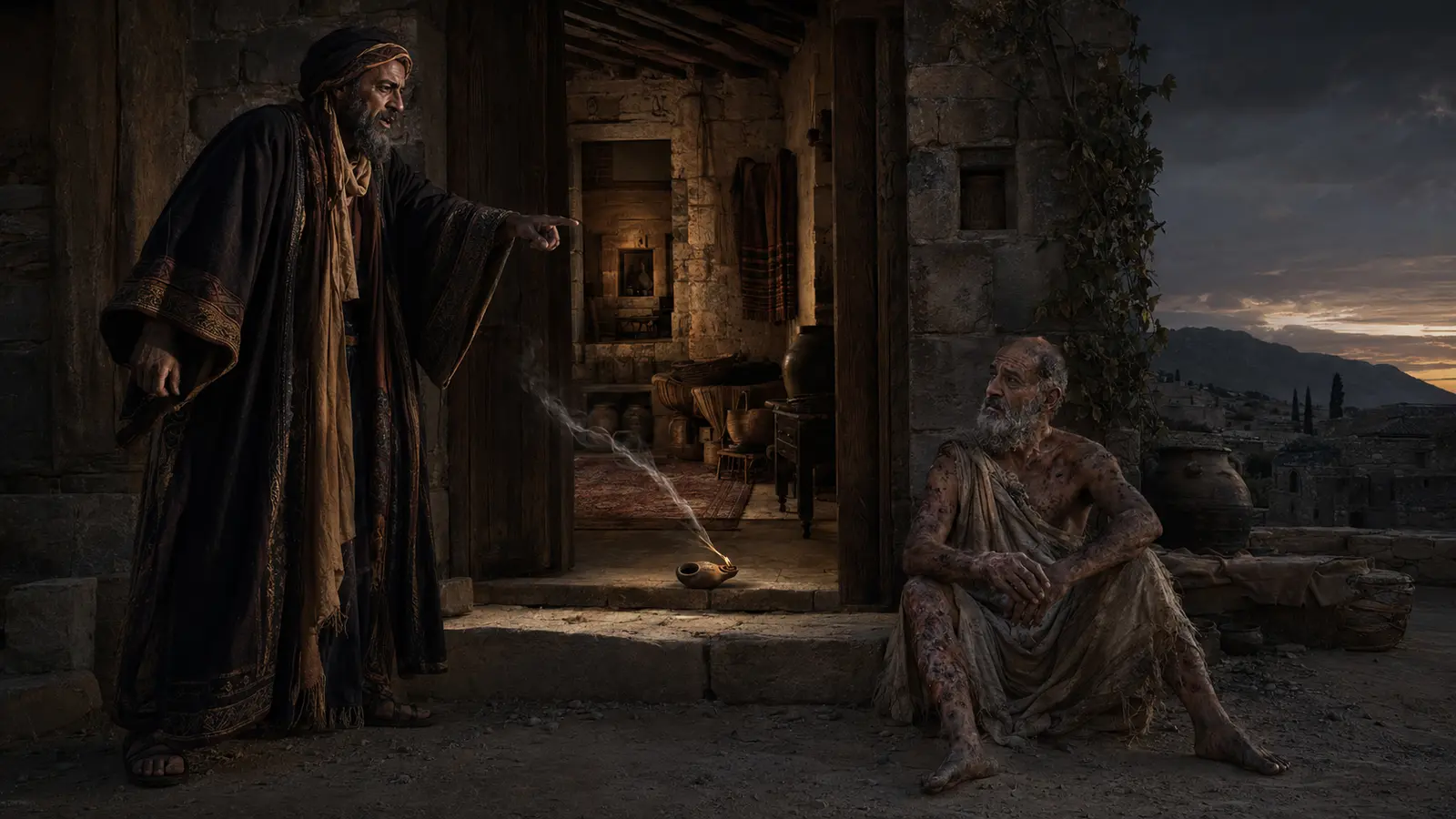
There is a light that welcomes the weary home, and there is a light that burns like a torch that is shone on a bleeding wound. In the pages of Job 18, Bildad paints a picture of complete darkness: the lamp of the wicked is extinguished, secret traps, threats surround a person at every corner, and his name is completely forgotten as if he never lived. This is wisdom that has lost the character of humanity.
01
Bildad's Second Discourse, The Traps of Vengeance, and the Darkness Calling the Persecutor a Misnomer
There is a light that welcomes the weary home, and there is a light that burns like a torch that is shone on a bleeding wound. In the pages of Job 18, Bildad paints a picture of complete darkness: the lamp of the wicked is extinguished, secret traps, threats surround a person at every corner, and his name is completely forgotten as if he never lived. This is wisdom that has lost the character of humanity.
On the ash heap of Job's life, these words become a heavy cloud covering the sky of hope. The great tragedy here is not that Bildad is lying about the nature of darkness and suffering. The tragedy is that this darkness comes with a wrong name—it brings the judgment of the wrongdoer to the house of the righteous who cries for comfort.
02
1.0 Introduction: When Friends Stop Listening
The 17th chapter of Job ended in the depths of Hades (Sheol). Job's spirit was broken. His days seemed to end. His plans had been disrupted. His hopes seemed to fall into the dust. Despite all this, Job did not surrender his loyalty. He asked for a surety, a guarantor, someone to stand on his behalf when no earthly friend would lay a hand to help him. He also dared to say that the righteous will hold his way and that those with clean hands will gain strength.
Now Bildad speaks again.
This is Bildad's second speech. His first speech in Job 8 was based on the traditions of the ancestors and encouraged Job to seek God so that his future days would be restored. But here, like Eliphaz before him, Bildad has become more aggressive. The second round of speech is cooler and drier than the first. The friends no longer try to persuade Job; instead they defend themselves against Job's accusations. Their advice turns into a fight.
Bildad begins by rebuking Job's words. Job has called his friends comforters in trouble and has said that he cannot find a wise man among them. Bildad feels insulted. He asks why Job treats them like animals, like irrational creatures.
He then accuses Job of tearing himself apart in anger. From Bildad's point of view, Job is not destroyed by God, as Job claimed in 16:9. Job tears himself apart by rebelling against moral truth.
Then Bildad asks a question that reveals the basis of his theology: "Will the land be forsaken for you? Or will the rock be removed from its place?" (18:4). In other words: Does Job expect the entire moral system of creation to be changed just to accommodate his claims of innocence? For Bildad, the world is fixed and unchanging. The righteous prosper. The wicked fall. If Job falls, then he must stop thinking that the rock will move.
After that, Bildad stops talking to Job directly and begins to describe one of the most terrifying images of the wicked in this book. The light of the wicked is extinguished. His steps are taken. Threats scare him. Tragedy is hungry to devour him. Death eats him. His memory is fading. He has no offspring, no survivors, no name, and no place among the living.
This speech is powerful. It is also dangerous.
Job 18 presents us with a difficult pastoral and theological question: What happens when true warnings about evil are spoken in such a way that an innocent sufferer hears them as a judgment to destroy him?
03
2.0 Historical and Literary Context: Bildad's Second Speech in an Intensifying Conversation
Job 18 is part of the second cycle of discourses in this dialogue (Job 15–21). The system so far has been like this:
Eliphaz's second speech (Job 15): Job's words are windy, dangerous, and self-judgmental; the wicked live in fear and perish.
Job's response (Job 16–17): Friends are comforters in trouble; God seems to attack Job; but Job asks for a witness in heaven and is looking for a guarantor.
Bildad's second speech (Job 18): Job is reprimanded for anger and pride; the fate of the wicked is described through images of extinguished light, traps, fear, death, and erased memory.
The structure of Job 18 is simple:
1. The complaint against Job (18:1-4).
2. Trapped by the wicked (18:5-10).
3. The death and complete destruction of the wicked (18:11–21).
The first four lines show Bildad's emotional state. He is angry, anxious, and defensive. He hears Job's speeches as a mess of pride. Job has questioned the wisdom of the friends, accused them of failing to comfort, and insists that his case does not match their teachings. Bildad responds as if Job's complaint threatens the entire world system.
The rest of this chapter presents the conventional wisdom about the fate of the wicked. Much of it has scriptural echoes. The scriptures speak of the lamp of the wicked being extinguished (Acts 13:9; 24:20). It says about evildoers falling into traps they made for themselves (Ps. 7:14-16; Nets 26:27). It says about the memory of the wicked being lost (Ps. 34:16). These pictures are not fake in themselves.
But Job has shown that the question is not whether evil brings destruction. The question is whether Job is evil. Bildad's speech does not prove that. It simply assumes that the moral system is so stable and immediate that Job's situation must reveal its identity.
However, the reader knows what Bildad does not know: God has already called Job to be perfect and upright (Job 1:8; 2:3). Therefore, Bildad's theology has lost its direction in a sad way. He's giving a real warning, but he's directing it at someone who doesn't belong.
This chapter also prepares us for Job 19. Bildad says the wicked will be cut off from memory and will have no name in the way. In his response, Job will wish his words to be written in a book, engraved on a rock forever. Bildad says the wicked has no survivor or defense. Job will answer with one of the main confessions of this book: "I know that my Creator (my Redeemer) lives."
Therefore, Job 18 is not the last word. Its darkness becomes the backdrop against which Job's future cry for protection will shine.
04
3.1 "How Long Will You Find the End of Words?" — Bildad Rebukes Job (18:1–2)
Bildad begins with annoyance: "How long will you find the end of the words?" He wants Job to be silent. This statement is reminiscent of earlier complaints from friends that Job talks too much, speaks without wisdom, and refuses to be corrected.
This is the first failure of Bildad's speech: he wants Job's words to live completely before Job's wound is heard.
Job's speeches have been long because his pain is heavy. He tries to explain the inexplicable. He tries to protect his credibility under the charges. He tries to talk to God when God seems to be silent. But Bildad hears the length of Job's speech as evidence of chaos and lack of order.
Then he says, "Think, after that we will talk." The meaning is that Job is not intelligent or does not think straight. Only when Job becomes sane—meaning, only when he accepts the views of his friends—can the conversation continue.
This is not a real conversation. It is a controlled conversation. Bildad says, "We will talk when you return to the terms we recognize." But Job's suffering has revealed that those conditions are too small.
Many communities do this without realizing it. They allow cries of pain only when they remain within acceptable limits. They allow questions only when the expected answer has already been decided. They invite testimony only when it ends quickly with victory. But Job refuses to confine his great pain to a safe religious drama.
Many words of a suffering person may not be rebellion; they may be souls struggling to breathe under the rubble of disasters.
05
3.2 "Why Are We Considered Like Animals?" — A Friend Who Feels Insulted (18:3)
Bildad asks, "Why are we considered like animals? And unclean in your eyes?" Job has questioned the wisdom of his friends, and Bildad feels humiliated. He believes Job is treating them like irrational creatures.
There is a sickening irony here. Job is thought of by his friends as morally blind, spiritually deficient, and with a secret guilt under his skin. Despite this, when Job pushes the opposition back to them, Bildad feels insulted.
This reveals something important about the psychology of bad counselors. Prosecutors often become angry when the injured party denies their charges. They may feel that their authority is under attack. They may interpret resistance as indiscipline. Instead of wondering if the victim has a valid point, they are concerned with protecting their own dignity.
Bildad's grief at having his pride wounded is understandable, but not believable. Right now he is letting his inflated ego guide his theology. He has given up on helping Job—his new priority is to protect his honor and that of his friends.
That is dangerous. When counselors need to appear wise, they can stop being wise. When teachers need to win an argument, they can stop listening. When comforters feel mocked, they can be cruel.
Bildad is sorry that Job has likened them to animals and stripped them of their humanity. However, in the next breath, he himself accuses Job of being a riotous creature tearing himself to pieces. This proves that harsh and slanderous words are not the only weapon of the loser—even embittered comforters can use them.
Once the injured comforter's pride has taken over the altar, mercy drops her feet and leaves the room without saying goodbye.
06
3.3 "You Who Tear Your Soul in Your Anger" — Bildad Turns Job's Cry (18:4)
Now Bildad turns directly to Job: "You who tear your own soul in your anger." This statement is a direct response to Job's earlier complaint that God has torn him apart in His wrath (16:9). Job said, "God has torn me." Bildad says, "No, Job, you are tearing yourself apart."
This is the second failure of Bildad's speech: he turns Job's experience of being wounded into an accusation of self-destruction.
There may be times when anger exacerbates suffering. Pain can aggravate ulcers. Denying the truth can bring additional pain. But Bildad assumes that this is what happened to Job without any evidence. He interprets Job's great pain as something he wished for himself because his theology cannot allow Job's claim that God has hurt him without a just cause.
Then Bildad asks: "Will the land be left for you? Or will the rock be moved from its place?" These questions reveal his deepest fears. Bildad believes Job's claim to justice will require the world to be destroyed and recreated. A moral system is like the earth and the rock—solid, firm, unshakeable. If Job is innocent and suffers like this, then Bildad's world is torn apart.
So Bildad protects the rock of his theology by blaming Job.
Here we find a mixture of truth and delusion. We cannot argue that God's creation is based on moral laws; wisdom has value, but the end of evil is destruction. But Bildad's blindness comes when he tries to lock God's justice into a box of rigid human rules and immediate results that can be measured with the eyes. His thinking has no room to accept that the Rock of Times has a greater and deeper secret than his traditional teachings.
Later, God will speak about creation in a way that makes Job and Bildad look very small. The world is orderly, yes, but it also has a wild and unruly side to human minds. It includes the wild goat, wild donkey, ostrich, war horse, hawk, Behemoth, and Leviathan. God's wisdom is not less than moral order; is much larger than Bildad's narrow interpretation.
Bildad thinks Job is a fool asking for the rock to be moved for him. But it will show that Bildad has failed to distinguish between his ideas about the truth and the actual truth of God.
07
3.4 "The Light of the Wicked One Will Be Extinguished" — The Extinguished Lamp (18:5–6)
Now Bildad stops reprimanding directly and turns to teaching: "Yes, the light of the wicked will be extinguished, and the flame of his fire will not shine." This image is very powerful. In an ancient tent or house, a lamp meant life, presence, safety, and continuity of the clan. To turn off the lights is to remove the vitality, leadership, and future of the household.
"The light will be dark in his tent, and his lamp above him will go out" (18:6). The house of the wicked becomes dark. The place that was supposed to provide shelter becomes the night room.
In the wisdom tradition, this image has great meaning. Evil ultimately does not give light. Evil may burn for a while, but its flame cannot last. The lamp of pride, violence, lust, and deceit will be extinguished.
The problem is not the image itself. The problem is the direction it is directed.
Job's life has already gone dark. His children are dead. His household has been destroyed. His body is perishing. His future feels off. When Bildad says the wicked man's lamp is extinguished, Job can't help but hear, "Your darkness proves your wickedness."
This is where theological discourse becomes very dangerous. A scriptural image can be a weapon when spoken regardless of the situation of the person in front of us. Bildad's lamp theology does not ask whether the darkness of Job might be the darkness of the suffering of the innocent rather than the fall of the wicked.
Today's writers and readers must read this carefully. The scriptures later show the righteous sufferer falling into deep darkness. At the cross, from six o'clock to nine o'clock, darkness covers the whole land. The true light of the world seems to have gone out. Even so, the darkness of Good Friday is not the lamp of the wicked being extinguished. It is the Righteous One entering the night to break the night from within.
Not every tent shrouded in darkness is the abode of the wicked; at times, even the righteous sit in darkness, resting in humility waiting for the voice of God to speak the light again.
08
3.5 "His own counsels will bring him down" — Nets, Traps, and Downfalls (18:7-10)
Bildad continues: the steps of the wicked will be shortened, and his own counsels will bring him down (18:7). The movement of confidence becomes a stumbling block. Plans that promised security become a source of collapse.
Then follows a rapid series of trap shots: he is thrown into a net by his own feet; he walks over a hidden trap; a snare catches his heel; the noose catches him; the rope is hidden in the ground; a trap is set in his path (18:8–10).
These are pictures of clear traps. For a wicked man, security becomes a dream, and every step becomes a mortal danger. The world itself turns into an ambush trap. Evil has a tendency to create dangerous environments where every corner hides dire consequences waiting at any moment to explode.
This is the indisputable truth of the wisdom of all ages: rebellion brings about the resolution of the soul. Because a lie demands another lie to stop, and injustice gives birth to the fear of revenge. Bad desire becomes a snare that ensnares the glutton, and pride blinds a person from seeing the pit in front of him. That is the main teaching of the Old Scriptures—that the wicked man falls into the same trap and pit he dug for the innocent.
But in the context of the story of Job, Bildad's traps have a very painful resonance.
Job has already explained how he feels trapped by God. He said God has surrounded his path with a wall, has put darkness in his paths, and made him a target for arrows. In Job 19, he will say God has put his net around him. Bildad says snares catch the wicked; Job says he is trapped by God.
Job's friends assume that every trap is the result of sin. They don't know that even an innocent person can get stuck. Suffering can ensnare anyone—even the righteous. Illness can trap you. Grief can trap you. Poverty, injustice, stress, and false accusations—all these are real life traps that can bind anyone at any time.
The difference is not always visible on the outside.
True wisdom must distinguish between a trap woven with the ropes of sin and the iron prison built by suffering.
09
3.6 "Terrors Will Frighten Him On All Sides" — Tragedy, Death, and Dismemberment (18:11–15)
Now Bildad gives personality to the forces of destruction. "Threats will frighten him on all sides, and drive him close to his heels" (18:11). Fear is not just an internal feeling here. It becomes an external monitor. Fear has legs to run.
"His strength will be weak with hunger, and calamity will be ready for his stumbling" (18:12). Destruction awaits like a beast of prey. An evil person may appear strong, but unseen forces hunger to devour him.
Then comes a picture that excites the body: "It will eat the parts of its skin, yes, the firstborn of death will eat its parts" (18:13). "Firstborn of death" most likely means the strongest representative of death, the most dangerous force in the house of death (such as a deadly disease that eats away at the body). Bildad does not picture death as a peaceful end, but as a tearing and consuming force.
The wicked is uprooted from his tent in which he trusted and sent to the king of threats (18:14). Home is no longer a refuge. The tent that promised safety cannot protect him. He is led to the royal court of Death.
"In his tent the inhabitant shall not dwell...brimstone shall be poured upon his dwelling" (18:15). Brimstone brings an image of judgment, desolation, and destruction that cannot inhabit people, reminiscent of the destruction of Sodom and Gomorrah (Gen. 19:24-25). The dwelling place of the wicked becomes a cursed land.
This is terrible poetry. You are telling the truth that evil is not just a person's secret moral fault; it is the road that leads to the realm of death. Evil does not make a house flourish forever. You invite the king of terror.
But again, the pastoral wound is very serious. Job's tent is left empty. Her children died in the collapsed house. His body is eaten by ulcers. Threats have surrounded him. Even if Bildad's speech is not directed directly at Job, it still focuses on Job's actual wounds.
This is why careless theology can be an unbearable burden. It describes the apparent condition of the sufferer as the fate of the wicked, then emphasizes that it only states general principles.
If the warning has an edge that can burn the victim's wound, that is when love must speak with great fear and caution, or else, stay silent.
10
3.7 "His Roots Shall Wither Down" — No Seed, No Memory, No Name (18:16–21)
Now Bildad moves from the flesh to the inheritance. "His roots will dry up on the ground, and his branches will be cut off on top" (18:16). This is a complete picture of a tree: roots and branches, root and fruit, ancestors and descendants. The wicked man is completely erased from the earth to the sky.
"His memory will disappear from the earth, and he will not have a name on the road" (18:17). In the ancient world, the loss of name and memory was the most terrible fate. The name carried identity, honor, and continued existence among the living. Not having a name on the street (in public squares) was to disappear completely from the society's recognition.
"He will be driven from the light into darkness, and driven out of the earth" (18:18). This movement is of exile. The wicked is banished from the world of life.
"He will have no son or grandson among his people, nor anyone to remain in his place of residence" (18:19). This verse would have pierced Job like a spear. Job has lost all his children.
Bildad speaks of the wicked having no descendants, no one left, no continuity. The reader cannot avoid seeing the brutality of the use of these words here.
Bildad concludes by saying that those who live in the west and the east will be sad because of his day (18:20). His downfall becomes public doctrine. People everywhere tremble because of the fate of the wicked.
Finally, he summarizes: "Indeed, this is the abode of the unjust, and this is the place of the one who does not know God" (18:21).
This last statement is devastating. "Knowing God" in the Scriptures is not just having information about him. It is a relational, covenantal, moral thing. Bildad says this is the fate of those who do not know God. But Job knows God. That is why he is suffering so much.
His main pain is not the absence of relationship; it is the pain of a relationship that has been difficult for his mind to understand.
The tragedy of Bildad's final statement is that it calls Job a name that does not belong to him at the deepest level. It says that Job's destruction is for those who do not know God, while Job's speeches are the real evidence that he refuses to let go of God.
Friends believe that Job's pain shows that he has no relationship with God. But this book shows a different truth: Job's inner struggle and his crying both prove that he has no intention of leaving his God.
11
4.0 Theological Reflection: The Danger of Misjudging
Job 18 teaches us that true doctrine can become false evidence when misused.
Bildad's basic claim is not silly. Evil brings darkness. Sin entangles people in traps. Evil leads to death. A life built against God has no secure future. These are scriptural truths. Psalms, Proverbs, Prophets, Jesus, and apostles all warn that rebellion against God ends in destruction.
But the book of Job absolutely refuses to allow that truth to be used as an automatic system and to provide short-cut answers.
The moral world is real, but not that simple. God is just, but His justice is not always immediately apparent in tangible results. The wicked do not always fall instantly. The righteous do not always prosper instantly. Innocents may suffer.
The guilty can succeed for a season. The lamp of the wicked one will be extinguished, but not every lamp that is extinguished belongs to the wicked one.
Bildad's fault does not lie in his firm belief in the judgment of justice. His mistake is to deceive himself that he can measure the purity of Job's heart by just looking at his economic situation, his health, and the disasters that befell him. He mixed external challenges with internal judgment.
This is a fundamental truth in the Christian faith. The cross is what protects us from making quick judgments on those who suffer. On the cross, Jesus is seen as a man cursed and abandoned by God. His light is extinguished, his body is brutally tortured, his name is publicly defamed, and his friends run away from him. If you look at it from the outside, Good Friday is one hundred percent similar to Bildad's cruel description of a person who has lost God's favor.
But Easter reveals the truth: the one who suffers is righteous. Visible darkness is where God overcomes darkness. The rejected is the chosen. The one crucified is the Lord.
Is it to say that there is no justice? No way! The cross itself is the ultimate revelation of God's wrath against sin, evil, violence, and all the forces of darkness. But in a surprising way, you confirm that God's judgments and mercies have a deep and deep mystery that goes beyond the horizon of the flesh. We cannot look at a person going through a storm and then easily conclude, 'This is the result of not knowing God.'
Job 18 also challenges the church's statements about the outcome of things. We must warn against evil, but not in a way that condemns the innocent. We must preach judgment, but not make it a weapon to crush the wounded. We must teach that sin has traps, while also realizing that suffering has iron holes that were not made by man himself.
A true theology of judgment must go through the cross before speaking of another person's pain.
The cross teaches us that the darkest house in the world can hold a beloved Son, not an ungodly fool.
12
5.0 Application of Life: Tearful Judgment and Recognition
Job 18 gives practical wisdom for preaching, counseling, friendship, and self-examination.
First, don't assume that darkness proves guilt. A person can be in darkness because of sin, but also because of grief, illness, injustice, emotional wounds (trauma), depression, and divine mysteries. External conditions are not enough to measure the health of the soul.
Second, separate the warning from the accusation. The scriptures warn the wicked so that people turn from death. But a warning becomes an accusation when we point it at someone without solid evidence. Bildad accurately describes the wicked in many ways, but Job is the wrong target.
Third, be careful when your words echo someone's wounds. Bildad talks about lights out, empty tents, bodies being eaten, lost children, names erased, and no survivors. Job has lived those losses. Before you speak, ask yourself if your images will heal, warn, or crush.
Fourth, do not protect your thought system by blaming the sufferer. Bildad cannot imagine the rock moving, so he concludes that Job is tearing himself apart. When the stories of people's lives challenge our theology, humility requires listening before we defend our structures.
Fifth, recognize the traps of sin without turning all suffering into a trap of sin. Sin is really confusing. But not every confusion is the result of that person's sin. Some people are trapped by bad systems, disease, violence, poverty, sadness, or false accusations. Wisdom recognizes the difference.
Sixth, remember the name of the sufferer. Bildad says the wicked loses his name along the way. Pastoral care must do the opposite: protect the honor and name of the person who is suffering. Don't let someone turn into a "case," "lesson," "warning," or "problem." He is a man before God.
Seventh, study all the sufferings through Christ before reaching conclusions. The crucified Jesus teaches us that the suffering of the innocent is real, that God can be present in what seems like abandonment, and that true defense can come after the world has passed its false judgment.
For pastors and teachers, Job 18 warns us to preach judgment with fear and trembling. Judgment is real, but careless use hurts the innocent and misrepresents God.
For those who are suffering, Job 18 gives you permission to reject the conclusions drawn too quickly from your pain. Your darkened tent does not prove that God has rejected you. Your losses do not erase your name before him. Your struggle can be a place where your knowledge of God, though painful, remains alive.
13
6.0 Reflection Questions
1. Why does Bildad feel rebuked and angered by Job's words, and how does this affect his advice?
2. What does Bildad mean when he asks if the land will be left or the rock will be moved for Job?
3. How can true statements about the fate of the wicked turn into false evidence when misused?
4. What is the significance of the images of the lamp, tent, trap, fear, and the deleted name in Job 18?
5. How might Job have taken Bildad's words about not having descendants or survivors?
6. Where are the churches today when they are in danger of assuming that darkness or suffering proves secret guilt?
7. How does the cross of Christ challenge Bildad's way of reading and interpreting suffering?
14
7.0 Answered Prayer
god of light,
You know every darkened tent,
every hidden trap,
every name about to be erased in shame.
Save us and pronounce judgment without tears.
Save us and direct real warnings to irrelevant lesions.
Save us and protect our thought systems
when love calls us to listen.
Teach us to recognize diversity
between the trap of sin and the pit of torment,
between rebellion and cries of pain,
among the deserved darkness
and darkness endured.
Lord Jesus,
Your lamp that seemed to go out,
Your name was mocked along the way,
Your body was delivered from death,
and yet You were Righteous.
Stand with all who are mistreated because of their suffering.
Put their names before the Father.
Turn on the lights in homes where hope has faded.
And make us servants of truth
with gentle hands for the wounded.
Amen.
15
8.0 Window to the Next Chapter: Job's Author Rises in Darkness
Bildad has spoken of the wicked man's lamp being extinguished, his memory being lost, his name disappearing from the way, and his descendants being cut off. Job has suffered many of these things already. This speech lands like a court verdict: darkness, no name, no future.
In Job 19, Job will answer from the same darkness.
He will say his friends have seen him ten times. He will describe God as the one who closed his way with a wall, stripped him of his glory, uprooted his hope, and separated him from his relatives, servants, wife, children, and close friends. This chapter will be one of the loneliest chapters in this book.
And then, suddenly, from that solitude, Job will shout: "I know that my Author (my Redeemer) is alive."
Bildad says Job's name will disappear. Job will ask that his words be written forever. Bildad says the wicked has no one left. Job will reach out to the living Redeemer. Bildad says darkness is the end. Job will see defense beyond the dust.
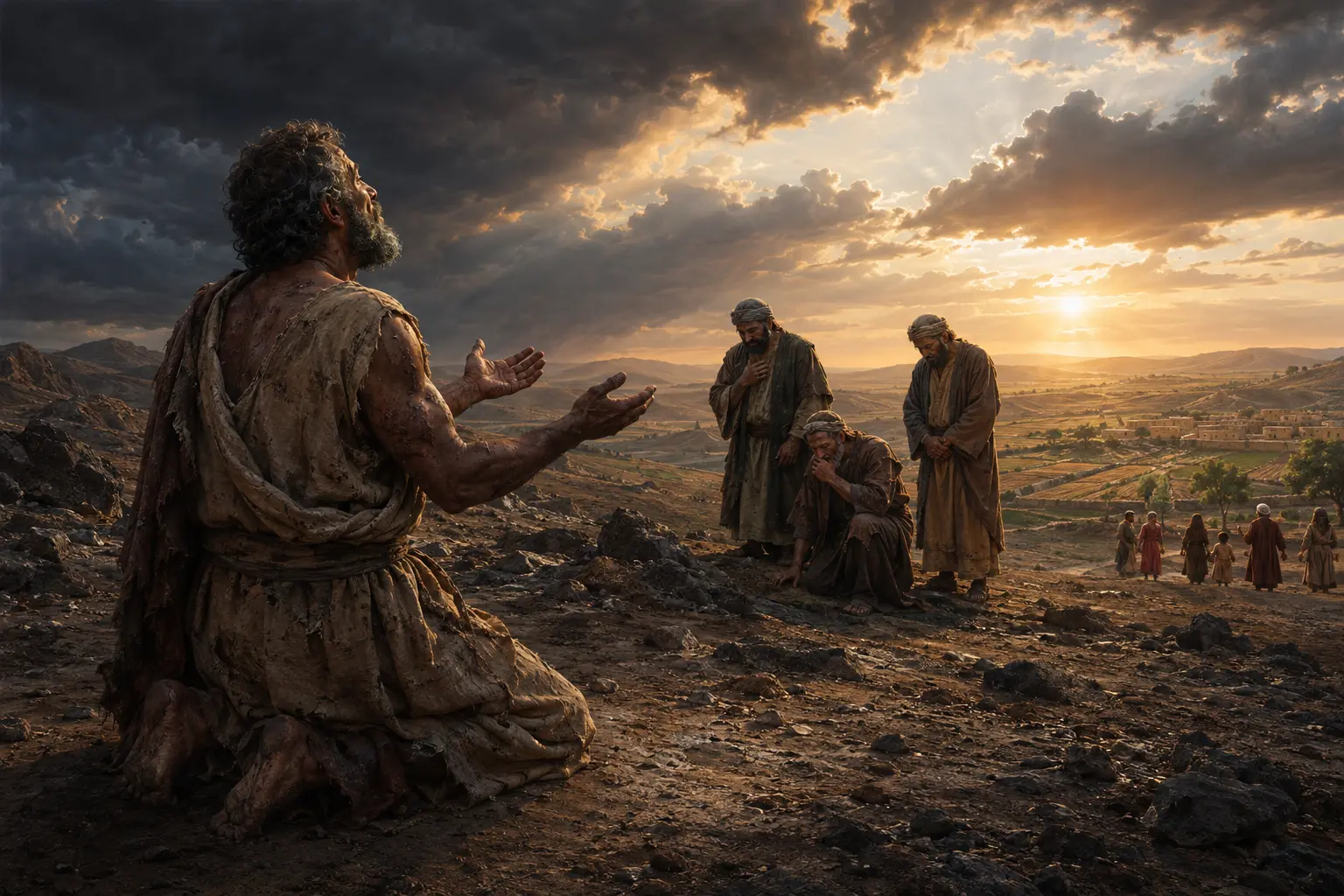
The night is about to get darker—but so is hope.

Be the first to leave a comment.