


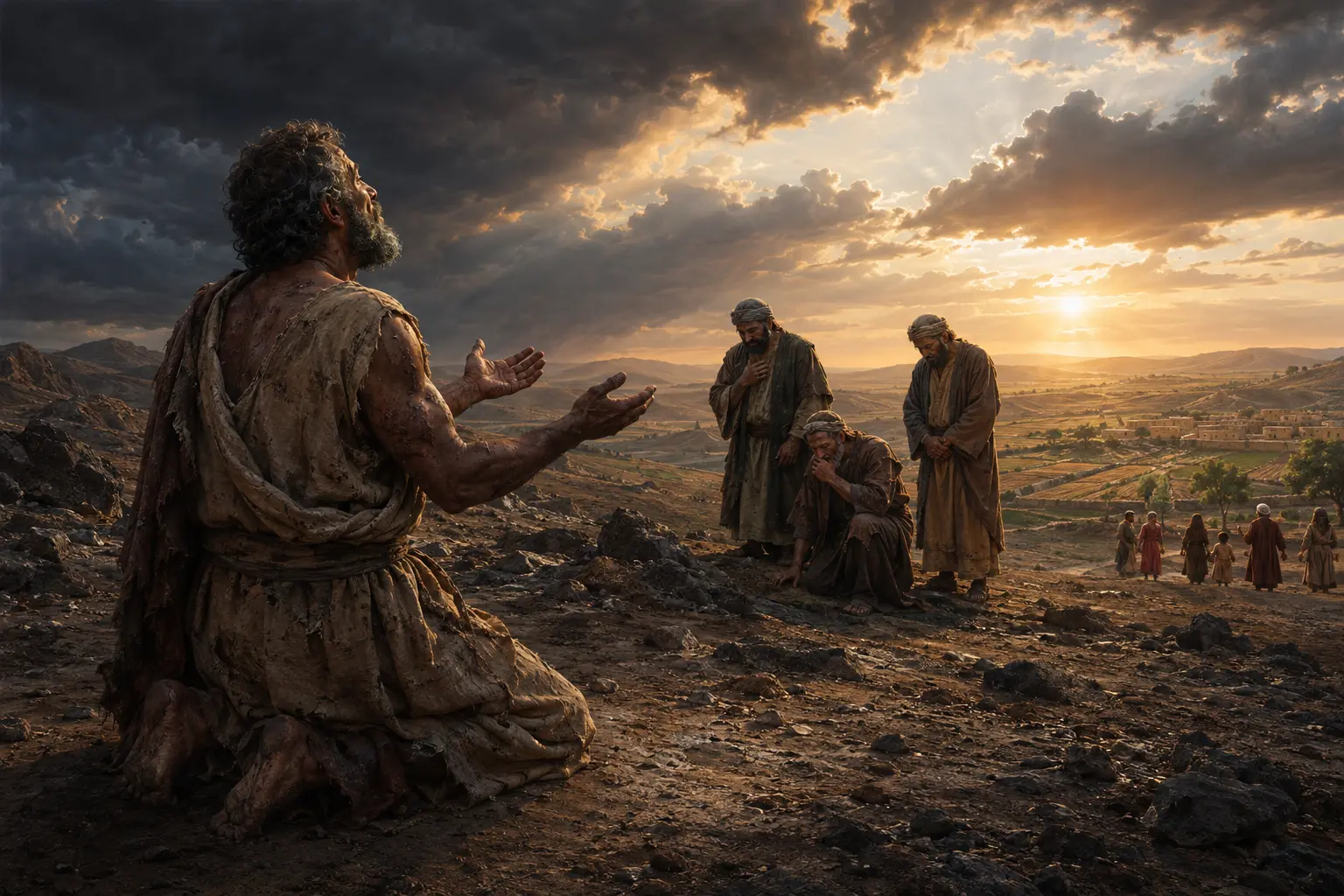
There are chapters in which the night gathers all its shadows in one room. Job 19 is such a chapter. His friends hurt him, God seems to put a fence on him, brothers disappear, servants ignore him, children make fun of him, and even his breath becomes an abomination to his wife. But at the bottom of the pit of abandonment, Job utters one of the greatest seemingly impossible sentences in Scripture: "I know that my Redeemer lives." The lamp that Bildad tried to turn off has not gone out. It hovers over the dust, waiting for the One who will stand up and speak the truth.
01
Abandoned by His Friends, Surrounded by God, and Crying for a Living Defender
There are chapters in which the night gathers all its shadows in one room. Job 19 is such a chapter. His friends hurt him, God seems to put a fence on him, brothers disappear, servants ignore him, children make fun of him, and even his breath becomes an abomination to his wife. But at the bottom of the pit of abandonment, Job utters one of the greatest seemingly impossible sentences in Scripture: "I know that my Redeemer lives." The lamp that Bildad tried to turn off has not gone out. It hovers over the dust, waiting for the One who will stand up and speak the truth.
02
1.0 Introduction: When the Nameless Man Calls for a Living Redeemer
Bildad has just finished a solemn speech about the end of the wicked. He spoke of the lamp being extinguished, steps being caught, threats surrounding, death devouring, memory being erased, name being lost, and offspring being cut off. His warning would have some place in the wisdom tradition, but on the ash heap it rested as judgment on Job's head.
Job answers in chapter 19.
This chapter is one of the most touching chapters in the entire book. It collects almost every thread of Job's suffering: the cruelty of a friend, the mystery of God who seems to be against him, the collapse of his honor before the community, the loss of family intimacy, the shame of a corrupting body, the thirst for pity, the desire for a lasting witness, the brave hope of being defended, and the warning that even his own friends may face judgment.
Job begins by explaining the pain caused to him by his friends: "How long will you torment my soul, and break me with words?" (19:2). Their speech is not only wrong anymore; have been brutal. Words can break the bones of the soul. He says they have accused him ten times, and they are not ashamed to treat him badly. He feels humiliated, not only because of the suffering, but also because of the way his friends interpret his suffering.
Then Job turns to God again. "Know then that God has twisted me, and wrapped his net around me" (19:6). These are serious words. Job sees God as the one who trapped him, who blocked his path, who stripped him of his honor, who uprooted his hope, who ignited anger against him, and who sent armies to attack him. The God that Job is still looking for is the one who seems to surround him.
Then comes the collapse of social relations. Brothers, relatives, close friends, strangers, servants, wife, children, and family members—they all separate from him. Job's pain is not only physical or theological. It is the pain of relationships. He tastes the death of being part of society.
After begging for mercy, Job suddenly wishes his words to be written down forever. If a friend will not preserve his integrity, then let the stone preserve it. If the present generation misunderstands him, let the testimony of the future speak. If his name is erased, then his cry should be recorded.
Then there is a glimmer of hope: "I know that my Redeemer is alive, and that he will finally stand on the dust" (19:25).
Job 19 asks the question that trembles under every event of abandonment: When every human witness disappears, and even when God seems to be against us, can there still be the One who will stand on the dust and speak the truth?
03
2.0 Historical and Literary Context: Job's Sixth Discourse in the Second Cycle
Job 19 is Job's sixth speech and his response to Bildad's second speech in Job 18. Bildad had announced the terrible end of the wicked: darkness, snares, death, no memory, loss of name, and no offspring. Now Job responds as someone whose life seems to match that description, rejecting the conclusion that he is evil.
This chapter goes through six main sections:
1. Job accuses his friends of torturing him and treating him badly (19:1-6).
2. Job complains that God has blocked his way, stripped him of honor, uprooted his hope, and surrounded him (19:7-12).
3. Job describes how he was completely isolated from his relatives, servants, wife, children, and friends (19:13-20).
4. Job asks his friends to have mercy on him (19:21-22).
5. Job wishes his words to be written permanently and to confess that his Redeemer is alive (19:23-27).
6. Job warns his friends that they may be judged for torturing him (19:28-29).
This chapter is well known because of verses 25–27. These verses have been interpreted in various ways throughout history. Many Christian readers have heard it as a direct confession about the resurrection of the body: "I know that my Redeemer lives." The translation has great spiritual power, especially because these words are often read at funerals and in the hope of Easter.
At the same time, the immediate context requires us to read carefully. Basically, Job wants to be defended and proven innocent. He wants someone to stand up to defend his integrity after friends, family, and society have failed to do so. The Hebrew word often translated as "Redeemer" is go'el—a close relative who was a deliverer and defender. In Israeli society, go'el was a close relative who stood up to protect the rights of the family, redeem property, pay for spilled blood, restore honor, or defend the case of a relative who was treated badly.
Therefore, Job's thirst is legal, relational, and profound. He needs a living advocate who will not allow his name to be buried under accusations.
However, the echo of this chapter throughout the narrative of Scripture reaches far beyond what Job himself can fully perceive. Job may not be giving a fully mature teaching about the resurrection as it is described later in the Bible. But his cry grows in the same soil that will later give birth to the hope of resurrection: God is just; the suffering of the innocent cannot be the last word; the truth must be proved; and dust must not be allowed to silence the voice of the righteous.
Therefore, Job 19 should be read with two types of scope: first, Job's cry to be defended within his own narrative; secondly, the broad biblical fulfillment in God who is the Redeemer, Defender, and the risen Lord in Jesus Christ.
04
3.1 "How long will you persecute me?" — Words That Break the Sufferer (19:1–6)
Job begins with a question: "How long will you torture my soul, and break me with words?" (19:2).
His friends did not touch Job's body. However, Job says their words break him. Words can be cruel. Advice can be a hammer. Theology can be heartbreaking when used without love.
This is the first step of this chapter: Ayub mentions the cruelty of religious words when they are used in the wrong place.
He says, "These ten times you have accused me" (19:3). The statement "ten times" is not an exact count; it is a way of saying something has happened again and again, until it is full. They have embarrassed him many times. They are not ashamed to treat him badly. Their repeated accusations have turned into a form of torture.
Then Job says, "Let it be true that I have sinned, my sin is left to myself" (19:4). He does not accept the argument of his friends; He says that even if there is some mistake in it, they have not confirmed it. They do not have the right to exalt themselves against him and use his humiliation as evidence of guilt (19:5).
Then the more detailed claims come: "Know then that God has twisted me, and wrapped his net around me" (19:6). Job does not blame his friends for everything. They treat him badly, but behind his suffering he sees the hand of God. God has turned the case against him. God has locked him in a net.
This verse is shocking. Job does not say, "You are right; God is punishing me because of sin." He says something different and more dangerous: "God has trapped me, and you are using that trap as evidence that I am guilty."
In other words, his friends see the net in the wrong way.
They see Job trapped, then they conclude that he is evil. Job says he is trapped because God has locked him in a mystery beyond their understanding.
A person caught in suffering is not necessarily caught in guilt.
05
3.2 "I cry, Violence! But I am not answered" — When God Appears to Block the Way (19:7-12)
Now Job describes God's actions against him with a series of pictures.
He cries, "Violence!" but he gets no answer. He asks for help, but he does not get justice (19:7). The court is silent. The wronged one cries, but no judge appears. This situation is the opposite of all that Job desires: to be heard, to find a witness, to have a savior, and to hear the judgment of justice.
Then Job says God has blocked his way so that he cannot pass, and has put darkness in his paths (19:8). The image is in motion-blocked. Job cannot go forward. Every road is closed. Every path is darkened. He's not just lost; he is blocked.
God has stripped him of his glory and removed the crown from his head (19:9). Once upon a time, Job was a dignified man. He was a respected elder, a father, a worshiper, and a person with a place in society. Now the crown is gone. Shame sits where honor once sat.
"He has torn me down on all sides, and I am finished; he has uprooted my hope like a tree" (19:10). The image of the tree reminds us of Job 14. There, Job said that a cut tree can grow again when it smells water. But here, his hope is not only cut off; it is uprooted. A cut tree can grow back from the root. The uprooted tree does not seem to have a future.
Then God's anger burns against him, and God counts him as an enemy (19:11). This is one of Job's deepest wounds. He doesn't just feel that he is being punished; he feels that his position has been changed. God who has feared and loved him now counts him as an enemy.
Finally, Job sees the armies of God gathering, building a way to attack the city, and encamping around his tent (19:12). Job is a besieged city. God is the army that attacks it.
These are serious words. However, the Scriptures have preserved it. Job teaches us that honest mourning can tell God how he feels about the sufferer, not how a quiet religious doctrine defines him. Job does not make a theological final statement; he gives a true testimony from inside the pain.
The Christian reader should approach this matter with care. Later the cross will show the righteous one who is suffering crying, "My God, my God, why have you forsaken me?" Jesus enters a place where the believer feels abandoned, blocked, stripped of honor, and counted among enemies. God's answer will not be a speech from afar, but a revival that occurs within the place of abandonment.
Job's accusation is not against faith; it is faith wounded enough to tell God the truth.
06
3.3 "My relatives have forsaken me" — The death of being part of society (19:13-20)
Now Job is moving from the attack he feels has come from God and towards being abandoned by humans. His list is very sad.
God has kept his brothers away from him; people he knows are isolated; relatives have left him; a close friend has been forgotten; the guests and maids regard him as a stranger; the servants do not respond when he calls them; his wife is disgusted by his breath; little children despise him; the locals hate him; and those whom he loved have turned against him (19:13-19).
His suffering is complete because it has touched every circle of his relationships.
Job is not just sick; he is excluded. He doesn't just mourn; he is dead in the eyes of society. His friends don't just accuse him; he is separated from the net of human relationships that once held him.
This passage is one of the clearest pictures in the Bible about relationship suffering. The pain is more severe when society isolates itself. Illness, grief, shame, poverty, disability, stress, and public wrongdoing can cause people to stay away. Often people do not know what to do in front of someone who is suffering, so they retreat. Sometimes they fear infection. Sometimes they are afraid to face a controversial situation. Sometimes they fear that showing compassion will force them to question their theology.
Job's servants ignore him because his status has fallen. His wife is disgusted by his breath because the disease has come close to home. The children make fun of him because the suffering has left him defenseless in front of society. Friends turn against him because they interpret his condition as a sign that God has humiliated him.
Then Job says, "My bones stick together with my skin and my flesh, and I am healed only by the skin of my teeth" (19:20). His body is almost skeletal. He has narrowly escaped death. This statement has become a proverb, but here it is physical and frightening. Job does not speak when he is bothered by a small matter. He speaks while on the verge of disintegration.
Bildad had said that the wicked loses name, place, and seed. Now Job says, "That's what my life looks like—but you're wrong about what it means."
In the wider narrative of the Bible, Jesus will also taste abandonment: a friend flees, one betrays him, another denies him, the crowd mocks him, the soldiers spit on him, and the leaders judge him. A righteous person who suffers is rejected by society before God defends him.
One of the sharpest knives of suffering is not the pain itself, but the hurt without having people to receive and hold you.
07
3.4 "Have mercy on me" — The Accused's Prayer (19:21–22)
Then a new voice is heard: "Have mercy on me, have mercy on me, my friends; for the hand of God has touched me!" (19:21).
This is surprising. Job has rebuked, accused, and challenged his friends. Now he pleads with them. They do not first ask them to agree with his theology. He asks them to have mercy on him.
The repetition of the words—"Have mercy on me, have mercy on me"—is the voice of a man deprived of all protection. Now he doesn't argue. He begs for mercy.
He says the hand of God has touched him. Whether his friends understand the mystery or not, they can definitely see that he is crushed. Of course human compassion can act before people agree theologically. Of course, feeling sorry for someone doesn't require first getting the full explanation.
Then he asks, "Why do you, like God, offend me? Are you not satisfied with my flesh?" (19:22). His friends imitate the same hostility that Job feels from God. God is with him; now they are also following him. God has wounded his body; they are not satisfied until their words chew up what is left.
This verse gives a strong warning. When people are suffering under the mysterious hand of God, friends should not join and become the tormentors of others. Mercy should not wait until the mystery is solved.
There are times when the holiest service of all is to simply say: "I see the hand of suffering is heavy on you. I will not be another hand to beat you."
Compassion is not weakness; it is the first duty of love in the face of inexplicable injury.
08
3.5 “Would My Words Were Written” — A Cry for a Lasting Testimony (19:23–24)
Now Job moves from seeking mercy to longing for something permanent: "If only my words were written! If only they were written in a book!" (19:23). He wants his testimony to live on even after his suffering.
He wishes his words to be engraved forever in the rock with an iron pen and lead (19:24). This picture is alive and big. Job does not want temporary mercy. He wants a testimony that will last. If the present generation refuses to hear him, let future generations read it. If his friends are misrepresenting his story, let the stone keep it. If his body rots, let his words remain.
This desire directly responds to Bildad's statement. Bildad said the memory of the wicked is lost and his name disappears from the streets. Job says, "Let my words be written forever." He refuses to be dismissed.
There is a deep irony here: Job's wish has come true. His words are written. They have lived longer than the accusations of his friends. Generations have heard his cry. The scriptures we read are the engraved testimony that he desired.
But within this narrative, Job still does not know that. He is still reaching out to find a witness who can outlive the dust.
This teaches us an important truth about mourning. Mourning calls for testimony. They are not just looking for cheap. They want the truth not to disappear. They want the world to know that the sufferer was more than a lesson, more than a warning, and more than an appearance of guilt.
Writing can be an act of resisting false memory. Testimony can preserve dignity when society gives the victim a name that does not belong to him.
When the injured ask that their words be remembered, they ask that they not be buried under someone else's description.
09
3.6 "I Know That My Redeemer Lives" — The Living Advocate Above the Dust (19:25–27)
Suddenly Job stands up and utters one of the greatest confessions in the Scriptures: "I know that my Redeemer lives, and that he will finally stand on the dust" (19:25).
The opening words, "I know," are firm. Job has gone from desire to reality. He wished his words were written down. But beneath that desire to be carved is the certainty that there is a living Defender.
The word "Mkombozi" translates the word go'el, i.e. a close relative who was a savior and defender. In the legal and social world of Israel, the go'el stood for the kinsman who was in danger: he freed him from slavery, restored the land, paid for the blood shed, preserved the family inheritance, and defended his rights. Go'el stood where brotherhood and justice met.
Job has lost his human kinship. Relatives have left him. Friends torment him. The servants ignore him. His community has separated from him. Therefore, his desire to have go'el is not a theological idea that does not touch life. It is a cry for brotherhood to be restored in a fair way.
Who is this redeemer?
This chapter does not provide an easy answer. Even Job himself may not fully know. He may be thinking of a heavenly witness, an advocate, or God himself performing a seemingly impossible role, because God also seems to be his enemy. This tension has been present in all of Job's speeches. He needs God to stand against God. He needs a righteous God to defend him before God who sees him as an attacker.
Then he says that after his skin is destroyed, he will see God while still in his body or outside his body (19:26). The Hebrew of this verse is difficult, and translators differ. Some hear it as a clear hope for the resurrection of the body. Others see the hope of salvation after death, perhaps without having a mature doctrine of the resurrection. Still others see Job desiring to see God in a way that will prove his righteousness, even if his body is corrupted.
We should not force this verse to be clearer than Job's own understanding. But we should not underestimate its power either. Job believes that death, decay, and dust will not erase the need for justice. He believes he will somehow see God—not as a stranger, but with his own eyes (19:27). His heart faints with desire.
The greatness of this confession resides in its tension. Job has just said that God considers him an enemy. However, he longs to see God as his Defender. He has said that his hope has been uprooted. But here hope rises from beneath the roots. He said his name is being deleted. However, he knows the living Redeemer will stand on the dust.
Christian readers have a right to hear these words in the light of Christ, but they should do so with reverent patience. Jesus is the true Brother Redeemer, the Word made flesh, the Brother who enters our dust, the Advocate who stands for us, the Righteous One who suffered and was confirmed by the resurrection, and the living Lord who will stand on the last day. The Lamentation of Job is not a fully opened Easter sermon; it is the seed that Easter blossoms into a full flower.
In Job 19, hope does not reject dust; it declares that a living Redeemer will stand upon it.
10
3.7 "Fear the Sword" — Job Warns His Friends (19:28-29)
After the confession, Job turns back to his friends with a warning. Because they have been saying, "The root of the matter itself is in it" (19:28). They believe Job's suffering is rooted in his guilt. They keep looking for the root of the problem in him.
Job warns them: "Fear the sword, for wrath brings the punishment of the sword, so that you may know that there is judgment" (19:29).
Here the situation is reversed. Friends had warned Job about judgment. Now Job is the one who warns them. Their accusations are not harmless words. Their theology carries moral responsibility. If they torture the innocent and lie in the name of God, they too stand under judgment.
This last warning precedes the end of the book, where God will rebuke those friends and ask Job to pray for them. Job's warning is not just anger. It is a prophetic light. Those who claim to speak on behalf of God will be responsible before God for the way they speak.
Therefore, this chapter ends with accountability. Comforters are not passive spectators. Teachers are not exempted under the judgment. Counselors who injure the innocent by false accusations should fear the sword.
Sufferers are responsible for their words, but comforters are also responsible.
11
4.0 Theological Reflection: A Redeemer Who Stands When Relatives Fail
Job 19 is one of the most detailed chapters in the Bible about abandonment and defense.
It shows that suffering can strip a person layer by layer: first the honor before the society, then the physical strength, then his position among the people, then the theological understanding, and finally even the sense of God's approval. Job loses almost every human witness. Friends misunderstand him, relatives reject him, servants ignore him, children despise him, and the closeness of the home is broken. His world becomes a desert of failed brotherhood.
The word go'el enters the desert.
The Redeemer is not a savior who exists only in the imagination. It is a relative who takes responsibility. He is the one who says, "Your case is not forsaken. Your name will not disappear. Your blood will not be covered. Your heritage will not be lost. The evil done will be answered."
Job's desire reveals a central biblical truth: humans need more than explanations. We need to be defended. We need someone righteous enough to speak the truth, close enough to accept us as his relatives, strong enough to stand, and alive enough to live longer than dust.
The wider narrative of the Bible reveals that God himself becomes this Redeemer. In the Old Testament, Yahweh is repeatedly called the Redeemer of Israel—the one who brought them out of slavery, who brought them back from exile, who defended the weak, and who acted as a close relative for his covenant people. In Jesus Christ, this redemption of God takes on flesh. God does not redeem from a distance. The Son becomes our Brother, enters into our sufferings, bears our shame, dies under false accusations, and rises as a living Advocate.
This means Christian hope is not just saying that "one day everything will be understood." Our hope is that Mkombozi is alive.
The living Redeemer changes the way we understand suffering. He doesn't make every injury immediately obvious. Job 19 remains a chapter of tears. But he assures us that the story of the righteous who suffers will not be written in the end by accusers, sickness, shame, or death.
The resurrection of Jesus is the main "I know" of the Christian faith. You declare that the righteous who has suffered has been vindicated. You declare that God's righteousness can stand on the dust. You declare that bodies broken by violence are not outside of God's future. You declare that the last witness is not a friend who misunderstands us, a society that abandons us, or a grave that receives us, but the living Christ.
When all other relatives fail, Mkombozi is still alive.
12
5.0 Life Application: Holding on to Hope When Relationships Break
Job 19 offers practical wisdom for sufferers, comforters, pastors, and communities.
First, realize that words can hurt. Friends have not beaten Job, but their speeches break him. Use theological language carefully when you are around the hurting. Words can be medicine, but they can also be stones.
Second, don't use someone's humiliation as evidence against him. Job's friends raise themselves against him and use his shame as evidence. We must not assume that public shame reveals secret guilt. The cross forbids that conclusion.
Third, recognize relational suffering as real suffering. Job's separation from his family and friend is not an isolated matter. Loneliness can hurt like a disease. Churches should learn to stay close to those who suffer, instead of withdrawing when the pain becomes difficult to understand.
Fourth, sympathy can precede explanation. Job prays, "Have mercy on me." Compassion does not need a complete theory. We can bring food, our presence, prayers, a listening ear, tears, and protection before we understand everything.
Fifth, help preserve the victim's testimony. Job wants his words to be written. People in pain often need their story to be heard correctly. Don't let others describe their life as failure, punishment, or scandal only. Help protect the true memory.
Sixth, hold carefully the hope of the Redeemer. "I know that my Redeemer lives" is not a slogan to stick on wounds. It is a confession born in abandonment. Say it gently, especially when you are sad. Let it stand on the dust without denying the dust.
Seventh, fear God when you talk about someone else's suffering. Job warns his friends about judgment. We are responsible for what we say in the name of God. Fear should make us quick to listen and heavy to condemn.
For pastors and teachers, Job 19 is a holy chapter for funerals, hospital rooms, broken family relationships, public shame, and spiritual confusion. It teaches us to preach Christ as the Redeemer, not as an easy way to escape mourning, but as the Living One who stands where every earthly hope has failed.
For those who suffer, Job 19 offers a catchphrase when all else fails: Your Redeemer lives. The fate of your name is not in the hands of those who misunderstand you. Your dust is not forgotten. Your tears are not the last testimony.
13
6.0 Reflection Questions
1. How do Job's friends "break him down with words", and what does that teach us about our speech?
2. Why does Job insist that God has caught him while refusing to accept the accusation of his friends that he is guilty?
3. Which circle of exclusion in Job 19:13–20 seems to be the most painful, and why?
4. What does Job's plea for mercy teach us about showing compassion before getting an explanation?
5. Why does Job want his words to be written or engraved permanently?
6. What does the word go'el, or a close relative who was a savior and defender, mean, and how does it help us understand Job's confession?
7. How does Jesus Christ fulfill and expand Job's desire to have a living Redeemer?
8. What warning does Job 19 give to those who talk about someone else's suffering?
14
7.0 Response Prayer
The living Redeemer,
stand on our dust.
When words break us,
be the Word that heals us.
When friends misunderstand us,
be a Witness who knows us.
When relatives leave us,
be the Brother who remains.
When shame takes our crown,
be the Lord who restores our name.
Have mercy on the wounded.
Have mercy on those whose breath is heavy with sorrow.
Have mercy on those whose story has been told in a false way.
Write the truth where you have lied.
Carve mercy where the charge has cut.
Save every honest cry
until the day you stand on the dust.
Lord Jesus Christ,
Our Brother-Redeemer,
you were abandoned, you were mocked, you were pierced, you were buried,
and resurrected in the glory that proved your right.
Hold us until our eyes see you,
not as a stranger,
but as the One for whom our hearts have longed.
Amen.
15
8.0 Window to the Next Chapter: Sofari Tries to Shorten the Song of the Wicked
Job 19 ends with one of the brightest flashes in the book: "I know that my Redeemer lives." But the conversation does not stop with fear. In Job 20, Zophar will respond with new emphasis.
He will emphasize that the victory of the wicked is short-lived, and the joy of the ungodly lasts only a little while. Evil may be sweet in the mouth, but it turns poison in the stomach. The wicked may swallow wealth, but God will force him to vomit it up. Heaven and earth will stand as witnesses against him.
Zophar's speech will be a powerful attempt to return Job to the same old principle. If Job claims to have a Redeemer, Zophar will respond with the destruction of the wicked. If Job speaks of being defended, Sofari will speak of exposure. If Job sees a living Witness, Sofari will insist that the moral order already explains everything.
The second round is not over yet. Friends will continue to push him. Job will continue to resist. And the question will become more intense: can wisdom give way to the suffering righteous whose Redeemer lives beyond the dust?
16
9.0 Annotated Bibliography
Hartley, John E. The Book of Job. New International Commentary on the Old Testament. Grand Rapids: Eerdmans, 1988. Hartley's interpretation of Job 19 is particularly helpful in understanding the word go'el as a close relative who was the redeemer, a role rooted in Israel's legal and familial obligation to protect the rights and honor of the wronged relative. He also highlights Job's desire to have a permanent record that will testify to his innocence, and reads Job's confession as a true belief that God will defend him publicly, even though Job now sees God as an enemy.
Clines, David J. A. Job 1–20. Word Biblical Commentary 17. Dallas: Word Books, 1989. Clines provides a careful and balanced commentary on Job 19:25–27. He distinguishes between what Job knows—his certainty that he is innocent and will be defended—and what he desires, including his thirst to see God. He warns against reading this passage too quickly as a fully mature doctrine of the resurrection; at the same time, he shows the irony that the end of the book fulfills Job's words in ways that Job himself could not yet see.
Alter, Robert. The Wisdom Books: Job, Proverbs, and Ecclesiastes: A Translation with Commentary. New York: W. W. Norton, 2010. Alter's attention to literary art helps readers feel the emotional intensity of Job's journey: from condemnation to abandonment, and from the desire for his words to be carved to the soaring confession that his Redeemer lives.
Walton, John H., and Tremper Longman III. How to Read Job. Downers Grove: IVP Academic, 2015. Walton and Longman help situate Job's speeches within the broader challenge of wisdom in this book. They highlight in particular the danger of a very simple principle of reward according to actions, and the importance of trusting God's wisdom without reducing suffering to a direct principle of moral cause and effect.
BibleProject. The Book of Job Guide. BibleProject, 2026. The BibleProject summary helps place Job 19 within a broader discussion between Job and his friends, where Job's genuine complaint and claim to be defended reveal the limits of his friends' thinking about justice and suffering.

Be the first to leave a comment.