

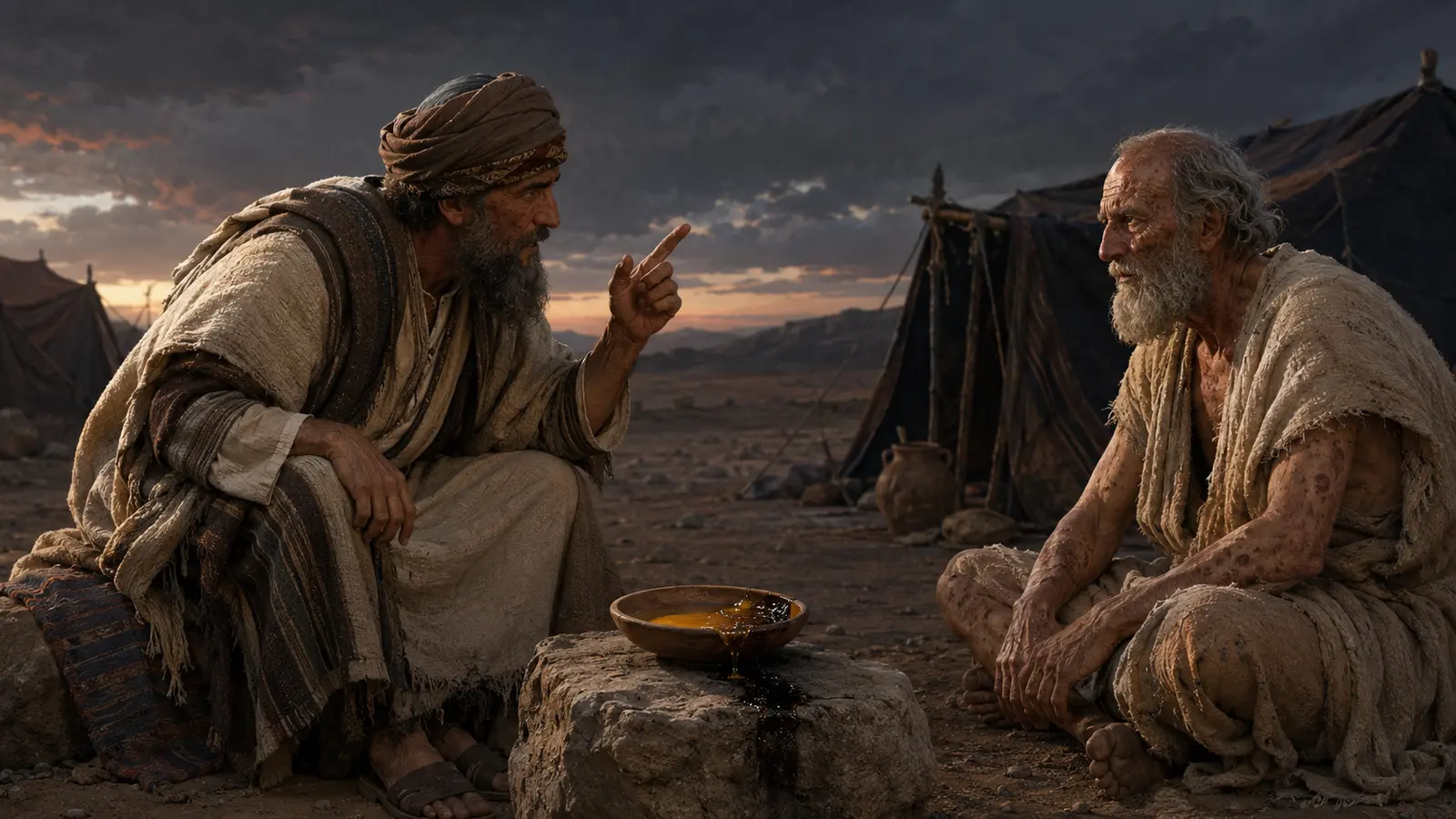
There is a deceptive sweetness—honey that entices the mouth but leaves the heart hungry. There are successes that carry the seed of pain from the beginning, starting to ache in the stomach before it is digested. In Job 20, Zophar uses powerful images: he makes evil seem like honey under the tongue, wealth swallowed up like stolen bread, and luxury turning into snake venom. His poetry has moral weight, and his warning has a grain of truth. However, this arrow of wisdom is fired at the wrong target against an innocent person. Sofari understands how sin poisons the soul, but he dismisses how false accusations destroy the very comfort meant to heal.
01
The Second Speech of the Sofari, the Short-Term Victory of the Wicked, and the Poison of Abused Certainty
There is a deceptive sweetness—honey that entices the mouth but leaves the heart hungry. There are successes that carry the seed of pain from the beginning, starting to ache in the stomach before it is digested. In Job 20, Zophar uses powerful images: he makes evil seem like honey under the tongue, wealth swallowed up like stolen bread, and luxury turning into snake venom. His poetry has moral weight, and his warning has a grain of truth. However, this arrow of wisdom is fired at the wrong target against an innocent person. Sofari understands how sin poisons the soul, but he dismisses how false accusations destroy the very comfort meant to heal.
02
1.0 Introduction: The Cry of the Redeemer Meets the Sermon of Doom
Job 19 ended by witnessing a single flame of Scripture rising high from one of his dark rooms: "I know that my Redeemer lives." Job was left by friends, relatives, servants, children, and close friends. God seemed to block his way, take away his honor, uproot his hope, and count him as an enemy. But when he was in the dust, Job opened his heart to the living go'el—the Redeemer, the Defender, and the relative who has the responsibility to finally stand up and speak the truth.
Now Sofari answers.
If we expected him to stand a little before the mystery of Job's confession, we are disappointed. Sofari is not concerned with Job's desire to find the Redeemer. You do not ask what suffering can produce such a cry. He doesn't wonder if Job's hope might reveal something deeper that his friends don't understand. Instead, he again speaks of the end of the wicked.
Job 20 is the second speech of Zophar. It is also his last open speech in this debate. Almost all speech is full of judgment. In his first speech, at least Zophar gave a call to repentance and a promise that Job's life could be brighter than noon if he returned to God (Job 11:13-19). But here there is no meaningful invitation, no sufficient mercy, and no open way of return. All that is left is destruction.
Sofari's argument is easy to understand: the victory of the wicked is short. Their happiness only lasts for a short time. Their height may reach heaven, but they disappear like excrement, like a dream, or like a vision of the night. Evil may be sweet in the mouth, but it turns into poison in the stomach. Stolen wealth must be cooked. The wicked cannot enjoy what he has swallowed. The wrath of God fills his belly, the heavens reveal his guilt, the earth rises against him, and his house is taken.
Here is a serious moral theology. Scripture teaches that evil destroys from within, stolen bread turns to gravel, lust turns to serpents, and injustice cannot build a lasting house. Sofari is not wrong when he warns that evil poisons itself.
But the problem with Job 20 is where this speech is aimed. Job is not the evil that Zophar describes. The reader knows that. God has already called Job a perfect and upright man. Therefore, Sofari's speech becomes another example of wisdom that sounds true but is addressed to a righteous person who is suffering.
This chapter asks us a heart-searching question:
How can we talk about the real poison of evil without poisoning the wounded by assuming that their suffering proves their guilt?
03
2.0 Historical and Literary Context: The Last Word of Annihilation from Sofari
Job 20 is part of the second cycle of discourse in the discussion. This cycle has intensified:
Eliphaz (Job 15): He accuses Job of having empty knowledge, then he paints a picture of the wicked as people who are full of inner fear and who have already been judged.
Job (Job 16–17): Calling his friends "comforters of trouble," he cries to his Heavenly Advocate/Witness, as his thoughts descend in sorrow to the gates of hell.
Bildad (Job 18): He describes the wicked as people caught in traps, covered in deep darkness, swallowed up by death, erased from memory, and cut off without any offspring.
Job (Job 19): He painfully describes how he was abandoned and isolated by everyone, but suddenly he makes a great confession that his Redeemer is alive.
Zophar (Job 20): He strongly emphasizes the same argument that the wicked - no matter how successful they are for a short time - will eventually be revealed and completely destroyed by God.
This chapter has a clear flow:
1. Zophar is touched by Job's rebuke and feels compelled to respond (20:1-3).
2. The victory of the wicked is short; disappears despite their rise (20:4-11).
3. The pleasure of evil is sweet in the mouth but poison in the stomach (20:12-16).
4. Stealing wealth is unpleasant; oppression brings loss (20:17–22).
5. God's wrath attacks the wicked and exposes him publicly (20:23-29).
Sofari resorts to ancient wisdom: "Don't you know that it has been since ancient times, since man was placed on earth?" (20:4). Like Bildad and Eliphaz, he oversees tradition. He thinks the world has always been governed by this moral order: the success of the wicked is short, God's punishment is certain, and the apparent fall of a man may reveal a hidden guilt.
But this is where the tension lies. After the opening of his speech, Sofari does not speak directly to Job. He begins to speak of the 'evil' in the third person—as if pointing at him from a distance. Does he want to say Job is one of them? Is he warning him lest he perish like them? Or is he showing diversity to give him hope? The truth is, this speech is not comforting at all; instead, it only ends up covering Job in a heavy shadow of condemnation.
This complexity is important. Sometimes people hide accusations within general statements. Words like, "I'm not saying you're like that, but..." can still come across as judgmental. Zophar's sermon on the wicked shows Job's wounds: lost children, lost property, public humiliation, physical illness, and a collapsed house. Even if Sofari does not mention Job by name, his speech is directed towards him.
Therefore, the second cycle reveals the state of friendship breakdown. Friends no longer sit with Job in his grief. They talk about him and pass him by, painting increasingly horrifying pictures of the wicked. Their theology increasingly abandons the pastoral spirit and turns into court accusations.
04
3.1 "My Understanding Answers Me" — The Prompted Sofari's Answer (20:1–3)
Sofari begins by explaining why he must answer: "Therefore my thoughts answer me, because of the haste that is in me" (20:2). He is disturbed, agitated, restless. Job's words have touched him. He can't keep quiet.
He says he has heard a reproach that humiliates him, and that "the spirit of my understanding answers me" (20:3). Sofari believes the answer comes from knowledge. He feels pushed from within, perhaps even inspired, to correct Job.
This beginning is very important because it shows how this discussion touched the inner feelings of the characters. Sofari does not teach wisdom calmly and from an impartial position; instead, he feels attacked. In the previous speech, Job had warned his friends to fear the sword of God's judgment (19:28-29). Sofari takes the warning as a personal attack, prompting him to respond with haste and anger.
This is where the first chapter warning appears:
Wounded pride often cloaks itself in spiritual conviction
One may feel a strong impulse to speak, but not every inner impulse comes from wisdom. Sometimes we respond because there is a sincere truth burning within us; but sometimes, we only respond because our ego is touched. Sofari may be sincerely believing that he is defending God's justice, but the turmoil of his soul makes his speech very dangerous.
Here the pastoral lesson seems obvious, but when looked at closely it penetrates even to explore the depths of the heart: when we feel obliged to correct someone who is suffering, let us first examine what has been stirred up in us. Is it motivated by love, fear, or pride? Are we trying to protect God and protect our belief systems? Or are we driven by the human desire to be right and win arguments?
Sofari Speech will have vivid and dynamic images. But power is not the same as trust.
Not every quick answer comes from wisdom; greed often cloaks itself in the cloak of spiritual fanaticism.
05
3.2 "The joy of the ungodly is short-lived" — The Wicked Vanishes (20:4-11)
Sofari resorts to ancient knowledge: "Don't you know that it has been since time immemorial, since man was placed on earth?" (20:4). The lesson he gives is as old as mankind itself: the victory of the wicked is short, and the joy of the ungodly lasts only a little while (20:5).
This is the main topic of his speech.
Sofari says that evil can arise, but it cannot last. Even if the stature of the wicked rises to heaven and his head touches the clouds, he will perish like his own excrement; those who saw him will ask, "Where is he?" (20:6–7). The contrast is stark: he ascends to heaven, then disappears into the dirt. Public fame turns into not being in public.
He flies away like a dream and is no longer seen; he is chased away like a night vision (20:8). The eye that saw him shall see him no more; his place will not continue to recognize him (20:9). His children will ask for mercy like the poor, and his hands will restore his wealth (20:10). His bones, full of youthful vigor, will lie with him in the dust (20:11).
These images emphasize disappearance, reversal, and humiliation. The villain appears strong, tall, distinguished, and powerful. But he becomes elusive. His place no longer knows him. His children bear the consequences. His youthful energy crumbles to dust.
There is a deep truth in this argument. Evil may seem stable and permanent, but it is already on its way. The proud may build tall towers, but eventually they all fall; A great empire is proud today, but tomorrow leaves grow on its stone ruins. The scriptures remind us repeatedly that although the wicked bloom like green leaves, they eventually wither and disappear completely (Ps. 37:1-2; 73:18-20).
But the biggest challenge comes when we look at the reality of things. Job is completely uprooted from his past life; he does not even know his home anymore. His children are lost, all his wealth is gone, and his body is burning with disease. When Zophar says all these words in front of his eyes, how will Job avoid feeling that he is being pointed at and counted among the wicked?
Therefore, this speech becomes another burden. The traditional truth of Sofari does not help Job to realize the truth of his situation. Instead, you push him into a false identity.
The Christian reader must hold to both truths: the victory of the wicked is temporary, and the suffering of the innocent may resemble the fall of the wicked. The cross is the greatest witness. Jesus was lifted up, mocked, stripped, humiliated, and laid in the dust; but he was not a godless man whose happiness lasts for a while. He is the Righteous One whose humiliation was the way to resurrection.
The wicked may disappear because judgment has found them; the righteous may disappear because the world still does not know how God will defend them.
06
3.3 "Sweetness in His Mouth" — Evil Like Honey Turns to Poison (20:12–16)
Sofari now moves into the most powerful metaphor of this chapter: taste and digestion.
"When evil is sweet in his mouth, when he hides it under his tongue, when he feels sorry for it, he does not let it go and holds it in his mouth, his food changes in his stomach; it becomes the poison of a snake in him" (20:12-14).
This is a living moral psychology. The wicked delights in wickedness like candy. He puts it under the tongue so that the pleasure lasts. You don't eat quickly because you want the sweetness to continue. But what tastes sweet turns into poison inside.
Sofari understands the truth about sin. Evil often appears first as sweetness. Lust for wealth tastes like security. Revenge tastes like justice. Carnal desire tastes like intimacy. Pride tastes like respect. Oppression tastes like control. Deception tastes like a way of life. But what the mouth calls sweet, later the soul can recognize it as poison.
This image is consistent with the wisdom tradition. Proverbs says that deceitful bread may be sweet, but later the mouth is full of gravel (Prov. 20:17). Sin changes its taste after it is swallowed.
Then Sofar says, "He has swallowed wealth, and he will vomit it up again; God will take it out of his stomach" (20:15). The picture continues. The wealth of theft is swallowed like food, but it cannot be digested. The body rejects it. God himself causes the wicked to regurgitate what he has swallowed.
"He will suck the poison of the snake; the tongue of the snake will kill him" (20:16). What seemed like sweet pleasure from the beginning was snake venom.
This is one of the most powerful insights of Sofari. Sin is not punished from the outside. It carries death within it. Evil poisons itself. Judgment is not arbitrary; the poison is already in the sweetness.
However, once again, Zophar's wisdom becomes dangerous when it is aimed at Job. Job's life has been painful, but not because he enjoyed evil. He has swallowed suffering, not the sweetness of theft. He has tasted ashes, not the honey of sin. His body is affected by misery, not a secret desire for wealth.
This distinction is important. We must preach clearly about the poison of sin. But let us not make every painful belly a proof that he himself once enjoyed a hidden sweetness.
Sin can turn sweetness into poison, but suffering can make life bitter without making the sufferer guilty.
07
3.4 “He will not look at the rivers” — Loss of Pleasure and Unveiling of Oppression (20:17–22)
Zophar continues: the wicked will not look at rivers, streams flowing with honey and frozen milk (20:17). This is plural language, almost like an inverted picture of the promised land. The wicked may desire to be satisfied, but he will not enjoy the abundance.
Then, Sofari continues to explain that the person 'will return the fruits of his work and will not swallow them; he will not enjoy the profit of his business' (20:18). Then, he begins to reveal more clearly the moral crime that causes the judgment: 'For he has oppressed them and left the poor; he has seized the house he did not build' (20:19)
Up to this point, the evil one has been described more as a general example than a person with specific actions. Now Sofari mentions oppression. The evil one has exploited the poor and seized wealth. His wealth is not a neutral achievement; you are built on the pain of others.
This is a serious biblical topic. The prophets repeatedly blame those who seize houses, oppress the poor, combine fields with fields, and build wealth on the backs of the weak (Isa. 5:8; Amos. 2:6-7; Mic. 2:1-2). The scriptures are not only concerned with private morality, but also with economic justice.
Sofari's moral sense is not bad here. Wealth obtained through oppression is toxic wealth. Homes stolen from the poor cannot be safe havens. Food taken from the hungry turns into judgment in the stomach.
But the problem remains: there is no evidence that Job was an oppressor. Later, in Job 31, he will clearly deny crimes against the poor, the widow, the orphan, servants, and strangers. His life was not marked by exploitation, but by caring for others.
Sofari continues: because the wicked did not know rest in his belly, he will not save anything he desired (20:20). Nothing remained after his gluttony; therefore his success will not last (20:21). In the midst of his abundance he will enter into distress; every hand of the afflicted will be lifted up to him (20:22).
This is a powerful rebuke against lust. A greedy person is never satisfied. His stomach is restless. The more he swallows, the less he can retain. His abundance turns to distress. Those he hurt rise up against him.
The church should hear this warning. In a world of exploitation, unlimited consumption, and economic brutality, Sofari's words still reveal the poison of profit that comes from oppression. But it should be preached against real injustice, not used to judge everyone who suffers.
The Bible's warning against stolen houses should not be directed at a person whose own house has fallen.
08
3.5 "God Will Send His Wrath Upon Him" — Wrath Offered as Food (20:23–25)
Sofari now brings God directly into the scene: "To fill his belly, God will send his burning anger and rain down on him in his body" (20:23).
The food metaphor reaches a terrifying climax. The evil one wanted to fill his stomach with sweetness and riches. God fills him with wrath. Judgment becomes his last meal.
"He will flee from an iron weapon, but a bronze arrow will pierce him" (20:24). The escape route fails. Avoiding one danger leads to another. The wicked dodges the iron sword, but is pierced by the bronze arrow.
"You are plucked out of his body; his shining tip comes out of his gall; threats come to him" (20:25). The picture is strong and scary. The arrow pierces the inner parts. The shiny tip comes from the painful area. Fear surrounds him.
Sofari paints God as a hero who pursues the wicked with inevitable judgment.
Once again, the moral argument is serious: evil cannot escape God. The oppressor can escape the courts of men, but he cannot escape the justice of God.
However, this language echoes Job's own experience. Job has already said that the arrows of the Almighty are in him (Job 6:4). He also said that God's archers surrounded him and pierced his kidneys mercilessly (16:13). Zophar describes the judgment of the wicked in terms very similar to Job's suffering.
This is very painful.
Job has seen himself as God's target. Sofari's speech suggests that such a situation is for the wicked. The friends continue to make the same mistake: they turn the language of Job's pain into evidence of guilt.
The cross again disrupts this logic. The Righteous One is pierced. The beloved son is beaten. God's judgment against sin and human cruelty against the innocent meet in one crucified body. Therefore, we should be careful when interpreting injuries. A pierced body may carry guilt; but you may also carry a testimony of faithfulness, intercessory love, or unspeakable suffering.
A wound can reveal judgment, but it can also reveal the mystery of the suffering of the righteous. Only God can fully read the wound.
09
3.6 "The Heavens Will Reveal His Wickedness" — As Creation Testifies Against the Wicked (20:26–29)
The last part introduces the speech in the language of the court. Great darkness is reserved for the treasuries of the wicked one. A fire that is not kindled by a man's breath consumes him along with what is left of his tent (20:26). The heavens reveal his wickedness, and the earth rises against him (20:27). The property of his house is taken, it is swept away in the day of God's wrath (20:28). Then Sofar concludes: "This is the portion of the wicked from God, and the inheritance commanded by God" (20:29).
This ending directly contradicts Job's hope.
In Job 16, Job cried, "O land, do not cover my blood." He wanted the world to preserve the evidence of his innocence. In Job 19, he asked for his words to be written in a book and engraved forever in a rock. He believed that his Redeemer would stand up and defend him. Now Sofari says heaven and earth will testify—not for the one who is suffering, but against the wicked.
There is tension on the court of creation. Job wants creation to bear witness to his innocence. Sofari emphasizes that creation will reveal the guilt of the sinner.
Once again, Sofari's theology is not empty. The scriptures show heaven and earth as witnesses in the case of the covenant (Deut. 30:19; 31:28; Isa. 1:2; Mic. 6:1-2). God's world sees what humans try to hide. Secret tyranny is never a complete secret.
But in this context, Sofari uses that fact to undermine Job's hope of being defended. Job has asked for a heavenly witness and a living Redeemer. Sofari answers: the heavens will testify against the guilty. His message is hard to miss: Job, beware of the court you ask for.
The last word, "portion" or "inheritance," makes the judgment appear to have been decided. The wicked get what they deserve. Destruction is their inheritance.
But the story of Job will not end there. At the end of the book, God will say that his friends did not say the right things about him. The creation court will not confirm Sofari's charges. Job's passion for defense will not be ridiculed forever.
Sofari says heaven and earth will reveal guilt; Job is waiting for the heavens to tell the truth.
10
4.0 Theological Reflection: The Poison of Sin and the Poison of Misapplied Wisdom
Job 20 teaches us two truths that we must hold together.
First, evil is poisonous. This great metaphor of Sofari has moral weight. Sin often begins as sweetness. It promises pleasure, safety, power, revenge, escape, or satiety. But underneath that sweetness is poison. A stolen house has no solid foundation. Swallowed wealth cannot remain in the stomach. Pleasure held under the tongue turns poison in the stomach. Oppression creates a world where the poor cry and heaven hears.
This fact should not be underestimated. The Bible is clear that evil destroys. The wages of sin is death. Lust swallows the greedy. Cruelty returns to the cruel. Injustice calls it God's judgment.
Second, misused wisdom is also poisonous. Sofari's speech is hurtful because it takes true moral systems and imposes them on Job without recognition. He describes the disappearance of the wicked before a man whose children and honor have disappeared. He expresses a poisonous sweetness in the presence of a person whose suffering is bitter but not caused by his wickedness. He describes stolen houses in front of a man whose own house has fallen. He explains God's arrows in front of a person who already feels pierced by God. He describes heaven and earth testifying against guilt before a man whose only hope is the witness of heaven.
The result is not comfort. It is an accusation disguised as wisdom.
The cross of Christ teaches us how to hold these two truths correctly. At the cross, the poison of sin is fully revealed. Human wickedness, religious jealousy, imperial cruelty, treachery, fear, mockery, and tyranny all show its poison. But in the same cross, the righteous one who suffers bears wounds that cannot be interpreted as the result of his personal guilt. Jesus is pierced, shamed, stripped, and killed—but he is still Righteous.
Therefore, the cross confirms the warning of Zophar and at the same time corrects its use. Sin brings death. But suffering is not always evidence of sin.
Christian theology must be able to preach judgment and mercy, the moral consequences and suffering of the innocent, the poison of evil and the defense of the righteous who suffers. A church that cannot do this will either be too soft on sin, or cruel to those who suffer.
Job 20 calls us into deeper wisdom: insightful truth, tearful warning, and instruction that looks closely at the real person in front of us.
Sin can poison the soul, but careless certainty can poison the room where healing should have begun.
11
5.0 Application in Life: To Warn Without Injuring the Innocent
Job 20 provides practical wisdom for preaching, teaching, pastoral counseling, and spiritual self-examination.
First, take seriously the sweetness of sin. Evil is often attractive because it offers something that seems desirable. If we describe sin as just something bad, we may fail to understand temptation. Sin may be sweet in the mouth before it becomes poison in the stomach.
Second, remember that the results may be hidden at first. Sofari is right that evil does not always reveal its true nature immediately. Desire can be seen as success. Revenge can feel righteous. Suppression may seem effective. But the poison is already in it.
Third, preach against actual oppression. Sofari mentions oppressing the poor and seizing houses. This is important. Biblical wisdom does not only speak to private feelings; it is about rights, wealth, power, and how we treat the weak.
Fourth, do not use general sentences about punishment to identify the source of specific suffering without evidence. This is where Sofari goes wrong. The warning about the wicked should not be turned into an accusation against everyone whose life has fallen.
Fifth, beware of speaking out of wounded pride. Sofari starts because he feels scolded. Before correcting someone, especially one in pain, ask yourself if your response is motivated by love or pride.
Sixth, do not destroy the only hope of the one who is suffering. Job has asked for a heavenly witness and a living Redeemer. Sofari responds by saying heaven and earth will testify against the wicked. Be careful not to take the language of judgment and use it to crush the weak hope that God may be keeping in a person.
Seventh, let Christ teach you how to read suffering. The crucified Lord shows that the pierced body can belong to the righteous, not just the guilty. Do not interpret wounds without first passing them under the shadow of the cross.
For pastors and teachers, Job 20 is a warning to preach judgment faithfully but with caution. The poison of sin must be mentioned. But the injured should not be forced to drink the charges intended for the oppressors.
For those who are suffering, Job 20 reminds you that not every doomsday sermon is God's judgment on your life. Let God search your heart, but don't let the certainty of men force you to wear a false identity. Your redeemer, not your accusers, will have the last word.
12
6.0 Reflection Questions
1. Why does Zophar feel compelled to answer Job, and what role might wounded pride play in his speech?
2. What does Sofari mean when he says the victory of the wicked is short?
3. How does the image of sweetness turning into poison help us understand the nature of sin?
4. Why is it important that Sofari specifically mentions oppressing the poor and seizing houses?
5. In what ways is Zophar's description of the wicked painfully similar to what happened to Job?
6. How can believers preach the truth of judgment without falsely accusing those who suffer?
7. How does the cross of Christ confirm Zophar's warning about sin, and at the same time how does it correct the way he interprets Job's suffering?
8. What area of your life needs you to examine if you are fixing others with love, fear, or wounded pride?
13
7.0 Response Prayer
Holy and merciful God,
You know the sweetness that hides the poison,
and the pain that comes from the wounds of the innocent.
Let's really look into it.
Reveal the evil we have hidden under the tongue.
Deliver us from lust for wealth, oppression, deception, revenge,
and every pleasure that leads the soul towards death.
But also protect us from careless judgment.
Prevent us from directing warnings to unconcerned hearts.
Prevent us from using truth without discernment,
and teachings without mercy.
Lord Jesus,
You were pierced though you were righteous,
you were convicted even though you were innocent,
and you were resurrected even though you were buried in the dust.
Teach us to read suffering through your cross.
Teach us to hate sin without hurting those who suffer.
Teach us to proclaim judgment with tears,
and hope indeed.
May our mouths no longer enjoy poison.
Let our words no longer turn into poison.
Instead, fill us with the bread of mercy,
water of wisdom,
and the life of the resurrected Redeemer.
Amen.
14
8.0 A Window to the Next Chapter: Job Answers the Riddle of the Success of the Wicked
Sofari has emphasized that the happiness of the wicked is short and that their success falls quickly. In Job 21, Job will respond by directly measuring the claims against what is seen on earth.
He will ask his friends to listen carefully. Then he will show the wicked living a long life, increasing in strength, seeing their children flourish, enjoying music and wealth, and dying in peace. They even tell God to leave them—yet they still seem to thrive.
Therefore, Job 21 will strike the doctrine of friends in the middle of his heart. Sofari says the wicked always fall fast. Job replies, "Look at your surroundings." The world is not as neat as their teaching system claims.
The second round will not end with the certainty of friends, but with the reality of Job. The pile of ashes will turn into the trial court of life. And the question will be more severe: if the wicked can prosper and the righteous can suffer, what kind of wisdom rules the world?
15
9.0 Annotated Bibliography
Hartley, John E. The Book of Job. New International Commentary on the Old Testament. Grand Rapids: Eerdmans, 1988.
Hartley's commentary on Job 20 is particularly helpful in seeing Zophar's discourse as centered on the negative side of the principle of retribution: the sure punishment of the wicked. He shows the course that starts from the short victory of the sinner, to the poison contained in the evil deeds, to the judgment of God who is likened to the hero and the heavenly court in which heaven and earth testify against the evildoer.
Clines, David J. A. Job 1–20. Word Biblical Commentary 17. Dallas: Word Books, 1989.
Clines provides a detailed reading of Sofari's language, especially how evil is depicted as sweet in the mouth but already poisoned within its sweetness. He also raises an important question of interpretation: does Zophar see Job as one of the wicked, or is he warning him not to go to their end? He also notes how Sofari's speech has very little comfort.
Alter, Robert. The Wisdom Books: Job, Proverbs, and Ecclesiastes: A Translation with Commentary. New York: W. W. Norton, 2010.
Alter's attention to literary art helps reveal the power of the emotive images in this chapter: sweetness under the tongue, poison in the stomach, riches being cooked, rivers of honey and frozen milk, arrows piercing the body, and witnesses of creation rising up against guilt.
Walton, John H., and Tremper Longman III. How to Read Job. Downers Grove: IVP Academic, 2015.
Walton and Longman help to see the book of Job as wisdom literature that challenges the simple principle of reward and reveals the danger of reducing suffering to a straightforward calculation of reward and punishment.
BibleProject. The Book of Job Guide. BibleProject, 2026.
The BibleProject summary helps place Job 20 within the broader discussion of the book, in which friends think that suffering must be explained by the justice of retribution, while Job's experience pushes toward a broader and deeper understanding of God's wisdom.

Be the first to leave a comment.