

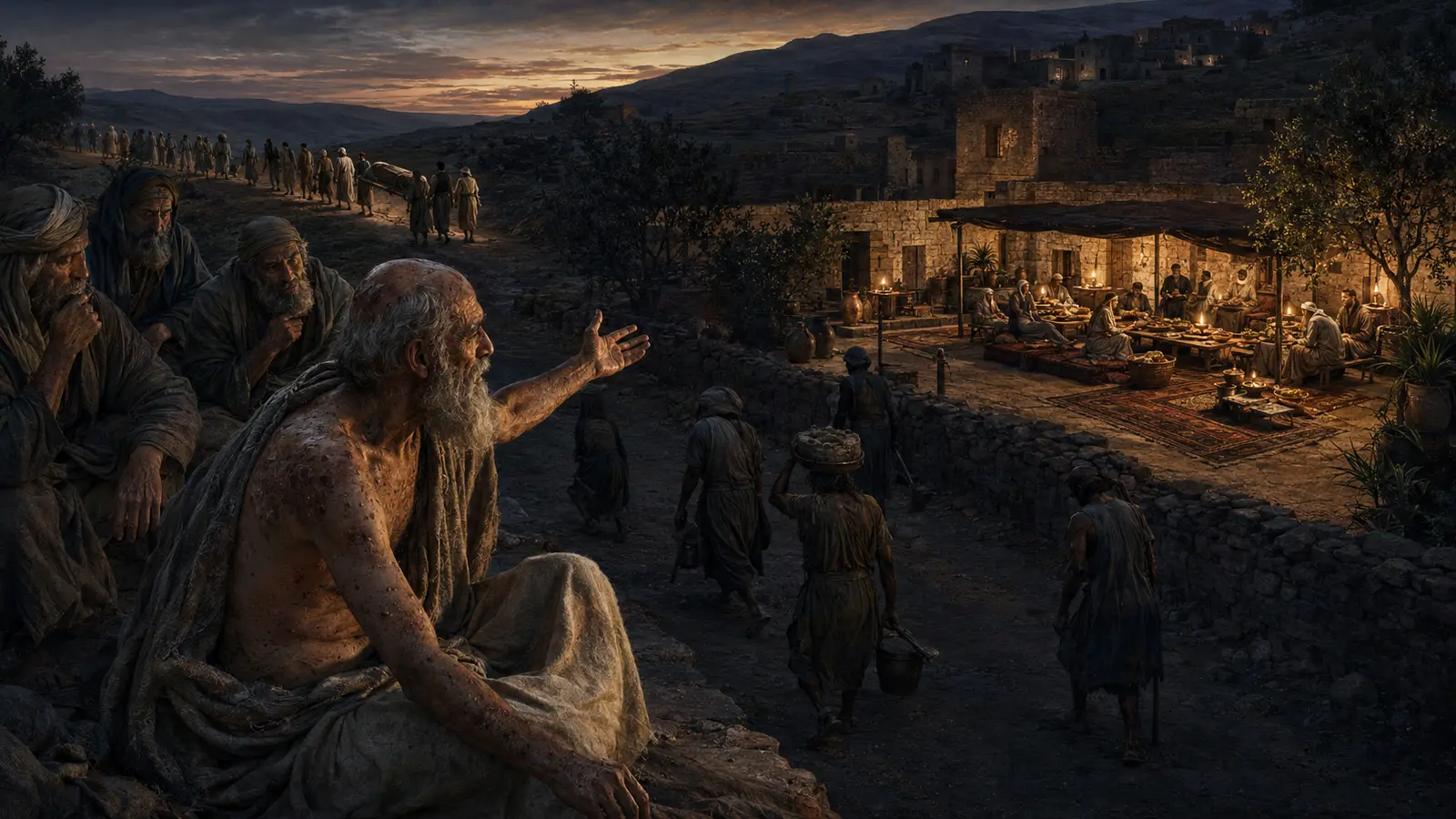
It is easy to give short and confident answers, until you face the real facts of life. Sofari said the prosperity of the wicked is short, their sweetness turns to poison, and judgment sweeps them away. Now Job opens the door to the real world. He shows the wicked living long, their children playing like lambs, their houses secure, and flutes sounding while drums are played. They say to God, "Depart us," but their days continue in prosperity; others go down to hell in peace, and even their graves are guarded with respect. Job does not defend evil. He rejects the map that says every road to sin ends in immediate judgment. This world is much darker and more complicated than the map of his friends—and the greatness of God cannot be measured by their narrow religious formulas.
01
Introduction
It is easy to give short and confident answers, until you face the real facts of life. Sofari said the prosperity of the wicked is short, their sweetness turns to poison, and judgment sweeps them away. Now Job opens the door to the real world. He shows the wicked living long, their children playing like lambs, their houses secure, and flutes sounding while drums are played. They say to God, "Depart us," but their days continue in prosperity; others go down to hell in peace, and even their graves are guarded with respect. Job does not defend evil. He rejects the map that says every road to sin ends in immediate judgment. This world is much darker and more complicated than the map of his friends—and the greatness of God cannot be measured by their narrow religious formulas.
02
1.0 Introduction: The Real World Breaks Down Well-Ordered Speech
Sofari has just downloaded a speech loaded with heavy examples about the fate of the wicked. In Job 20, evil is honey that is hidden under the tongue, the wealth of injustice that is swallowed, and pleasure that turns into the poison of a snake in the stomach. The wicked may rise to the clouds, but his fall comes quickly. The heavens reveal his guilt, the earth stands against him, and the wrath of God sweeps away his house.
Sofari is sure that he has explained the world as it is.
Job responds by saying, in another sense, "But look again."
He asks his friends to listen carefully. Their only listening can be the comfort they can give him (21:2). After that, he says, they can continue to mock him if they want. This request carries great pain. The people who came to comfort him now have only one gift left that they can still give him: silence to listen to him.
Then Job takes them out of the ash heap and shows them the world they reject. Why do the wicked live? Why do they reach old age and gain strength? Why do their children thrive in front of them? Why are their homes safe, their livestock giving birth, music fills the house, and their lives end without the tragedy that his friends say must happen to them? (21:7-13).
These questions are not for a person who loves evil. Job clearly says that the counsels of the wicked are far from him (21:16). But honesty forces him to admit what his eyes see: judgment often does not come on the schedule that simple theology expects.
That is where the power of Job 21 lies. This chapter does not deny that God is righteous. It refuses to use a person's present condition as God's final judgment on his life. A person's well-being does not prove that God has accepted him; A person's suffering does not prove that God has judged him.
Job 21 asks a question that shakes every belief that relies on quick answers:
What will we do when life shows that the wicked can prosper, the righteous suffer, and God's judgment refuses to follow our calendar?
03
2.0 Historical and Literary Context: Job Calls the World to Witness
Job 21 is Job's seventh speech. It is often considered to be the beginning of the third round of discussion, although in other arrangements it is read as the answer that completes Sofari's speech in the second round. Either way, this chapter is a milestone. Until now, his friends have continued to emphasize one point: God rules with justice; therefore the wicked fall, and those who suffer greatly must have done a great evil.
Job does not deny the first part—God is just. He rejects the bridge that his friends have built from God's justice to their conclusions about every sufferer.
Eliphaz relied on his experience. Bildad relied on the traditions of the elders. Zophar claimed that this fact has been known since ancient times: the joy of the wicked is short-lived (20:4–5). Now Job also gives evidence of experience. He tells them to ask travelers who pass by. People who have seen the wider world know that the wicked can be saved in the day of disaster, protected in the day of wrath, and buried with honor (21:29–33).
Therefore, this chapter is an argumentative speech. Job takes the claims of his friends and weighs them against life itself. His argument is organized into seven elements:
1. Job asks his friends to listen to him, because listening is the only comfort left (21:1-6).
2. The wicked live long, increase in strength, and see their children flourish (21:7-10).
3. Their families dance, music fills their homes, and some die in peace (21:11–13).
4. They openly reject God, but they do not receive immediate judgment (21:14-16).
5. Job asks how often the lamp of the wicked is really extinguished as his friends claim (21:17-22).
6. One person dies with strength and peace, another with pain, but they all sleep in the dust (21:23-26).
7. The testimony of travelers and funerals of the powerful show that even the wicked can die with honor (21:27-34).
Job does not offer another simple system to replace the system of his friends. He does not say that the wicked always prosper. He is not saying that justice is meaningless. He says that the human experience cannot be wrapped up in one sentence. Sometimes the wicked fall. Sometimes they thrive. Sometimes the righteous see redemption. Sometimes they die while they are still waiting.
True wisdom must be broad enough to accept all the truth before God.
04
3.1 “Listen Carefully” — Listening as the Last Comfort (21:1–6)
Job begins with a request: "Listen carefully to my words; and let this be your comfort to me" (21:2).
This statement is small, but it carries the sadness of the whole conversation. His friends came to comfort him. They sat with him in silence for seven days, and during that time their silence was wiser than the speeches that followed. Now Job tells them that if they just listen to him, without interrupting him or forcing him into their system, that listening can be counted as comfort.
There are times when a wounded person does not need a new answer. He needs a space in which his truth will not be judged before it is heard.
Job asks them to bear with him when he says; after that, they can mock him (21:3).
The sarcasm shows that he already knows this conversation is not safe. However, he is still talking. He puts the truth on the table even if those who hear it have already decided not to believe it.
Then he asks, "Is my complaint against man?" (21:4). His final case is not in front of his friends. He competes with God. That is why his soul is impatient. If his dispute was with another human being, he could seek a higher court. But who does one take the case to when God himself seems to be on the other side?
He tells them to look at him and put their hands over their mouths (21:5). His body is evidence of something that does not fit into their formulas. When he remembers his condition and the condition of the world, fear grips him and his body trembles (21:6).
Job is not a cold analyst of the problem of evil. His argument comes from a wounded body. His questions are shaky.
True listening begins when we acknowledge that someone's suffering can say something that our system has not been able to say.
05
3.2 "Why Do the Wicked Live?" — Long Life, Strength, and a Safe Home (21:7–10)
The main question comes directly: "Why do the wicked live, reach old age, yes, become strong in strength?" (21:7).
Sofari said the victory of the wicked is short. Job says there are wicked people who live a long time. They do not disappear like dreams before morning. They are getting old. Their power is increasing. They have time to build, gather, rule, and see the fruits of their lives.
Their children prosper before them, and their descendants grow in their sight (21:8). This touches Job's wound directly. His children are dead. His friends claim that the loss of the family is a sign of judgment on the wicked. But Job has seen the wicked whose children do not fall. Instead, their lineage lives on, their names endure, and their tables never remain empty.
Their houses are safe without fear, and the rod of God is not seen over them (21:9). The picture completely breaks the frequent claims of his friends. Eliphaz, Bildad, and Zophar describe the house of the wicked falling. Job shows a house that stands—its doors are securely shut, its sleep is undisturbed, and no thunderbolt of judgment strikes its roof.
Even their livestock is thriving. Their bulls give birth without failure; their cows give birth without destroying the pregnancy (21:10). In an ancient society based on livestock, that is the description of a successful economy. Prosperity is not only seen in coins, but in a living stable, a continuous generation, and an uninterrupted life.
Job does not want the readers to see wealth as evil. He wants them to stop seeing it as a certificate of God's approval.
A safe house is not necessarily a righteous house, and a stormy house is not necessarily a cursed house.
06
3.3 “Their Children Play Like Lambs” — Music in the House of the Wicked (21:11–13)
Now the picture gets sound and motion. The wicked let their children go forth like a flock of lambs; their children play (21:11). Drums and harps are heard, and they rejoice with the sound of flutes (21:12).
It is a vivid picture: children are running, feet are dancing, harp strings are vibrating, flutes are playing, and the family is celebrating. This is not the inner mystery of the heart of the wicked; it is a common occurrence of domestic happiness.
The weight of this image is seen when we remember Job's house. At the beginning of the book, his sons and daughters gathered for a party. Then a great wind struck the house, and they all died (1:13-19). Now Job sees the houses of the wicked filled with children playing, while his house is filled with silence.
His friends say the situation is impossible or unsustainable. Job says, "But it has happened. I have seen it."
"They end their days in prosperity, and they go down to hell in peace" (21:13). Here his argument reaches the most painful point. His friends may agree that the wicked flourish for a time, provided they add that his end must be sudden and terrible. Job refuses even that protection. Some of the wicked just don't live well; they die without a major disaster. They don't have a deadline written in thunderbolts. They descend into hell—the abode of the dead—in a slow calm, like a man going to sleep.
Does this mean that they have received God's final approval? No way! The truth is that a peaceful death is not sufficient evidence of a person's character, just as a painful death is not evidence of his guilt.
Sometimes music is heard in the house of the unjust, while the house of the righteous remains silent. Wisdom must acknowledge that without leaving God.
07
3.4 "Let us depart" — Those who reject God without losing their prosperity (21:14-16)
Now Job eliminates the possibility of saying that these people prosper because, secretly, they are godly. No. They say to God clearly, "Depart from us; we do not want to know your ways" (21:14).
Then they ask, "Who is the Lord that we should serve him? And what benefit will we get if we pray to him?" (21:15).
These are words of open rebellion. They do not want God, nor do they want to learn his ways. They measure worship by profit. If prayer does not increase their wealth, they see no reason to pray. If serving God does not bring benefits they can count on, they do not want to serve Him.
But here the chapter reveals an inner irony. The wicked and Job's friends may be on different sides, but they are all in danger of using the same business calculation. The wicked say, "Since we do not see the benefit of serving God, we will not serve him." Friends say, "If you serve God, you must get tangible benefits." They all keep profit in the middle. Job seeks a relationship with God that cannot be reduced to business.
However, Job does not agree with the wicked. He admits that their success is not in their hands in the sense of final authority; life is still a gift that they cannot create for themselves. Then he says, "Let the counsel of the wicked be far from me" (21:16). He can explain their prosperity without wishing for their rebellion.
That is moral maturity. We can admit that a bad way has been successful for a while without calling it good. We can refuse to lie about the truth while also refusing to love the evil we see.
Job is not on the side of the wicked; he is on the side of truth.
08
3.5 "How Often Do Their Lights Go Out?" — Judgment That Does Not Follow Our Schedule (21:17–22)
Job now throws a series of questions: How often is the lamp of the wicked put out? How often does tragedy come to you? How often does God distribute pain in his anger? How often are they like leaves before the wind or chaff blown by the storm? (21:17–18).
His friends have spoken as if the answer is, "Always." But the way Job asks suggests a different answer: not as often as they claim.
They may answer that God places the punishment of their father on the children of the wicked. Job rejects that answer as a solution to the problem. If the wicked one has done evil, then let him himself see the judgment; let his own eyes see his destruction, and let him himself drink the wrath of the Almighty (21:19-20). After he dies, what benefit or pain does he have regarding the house that will remain behind him? (21:21).
Job does not write a complete teaching about the relationship between the generations. He objects to the way his friends would transfer judgment from a prosperous villain to his children, just so their system would continue to appear correct. Delayed punishment and the landing of another person cannot easily be used to prove that the evildoer himself received a tangible reward.
Then he says, "Will a man teach knowledge to God, who judges even those who are on high?" (21:22). Job does not intend to teach God how to rule. But his friends have been doing it without knowing. They have drawn a mandatory map that even God must follow. Job warns them: God does not need our system to be just.
The problem is not that God is unjust. The problem is that his right cannot be ruled by our hours.
Delayed judgment is not the same as dead justice; but that delay prevents us from pretending we can read God's final judgment in today's situation.
09
3.6 "One Dies in the Fullness of His Power" — Two Deathbeds, The Same Dust (21:23–26)
Job takes us to two deathbeds.
A person dies with full strength, calm and safe (21:23). His body is nourished, his bones are filled with mucus; his life has not deprived him of visible goodness (21:24). He dies having tasted pleasure.
Another dies in agony of spirit, without tasting good (21:25). He may have lived honestly, he may not; A paragraph does not constitute a complete biography. It just shows us the vast diversity of human experience. One has drunk a cup of tranquility. Another has swallowed pain.
Then they all sleep together in the dust, and maggots cover them (21:26).
Death erases some of the distinctions that people thought defined the value of life. The strong body and the weakened body meet in the dust. The grave does not ask who died prosperous and who died brokenhearted.
But Job's point is not that they were all morally equal. It is that the way a person dies cannot be used as an accurate calculation of the way he lived before God. A quiet death does not make the wicked righteous. A painful death does not make the righteous wicked.
Chapter 3 already looked at hell as a place where prisoners and rulers, small and large, meet in silence. Here the idea returns with a new purpose: if all can end in dust, then death itself cannot be a simple pay table.
For the Christian reader, this makes the hope of the resurrection all the more necessary. If the grave balances without resolving, then the final justice must come from beyond the grave. Resurrection declares that God will not let the dust be the final judge.
The grave may cover them all, but it cannot give final judgment on all.
10
3.7 "Ask the Travelers" — The Wicked Honored Even After Death (21:27-34)
Now Job looks at his friends directly: "Look, I know your thoughts, and the advice you want to oppress me with" (21:27).
He knows what they are thinking. They say, "Where is the prince's house? Where is the tent where the wicked lived?" (21:28). They want to show the ruins and say, "Look, we have proved our point. The house of the wicked has fallen." And since Job's house has fallen, they want to put him in the story.
Job tells them to ask travelers who pass by (21:29). Travelers have seen more than one village, one house, and one story. Their testimony contradicts the words of his friends: the wicked can be left in the day of disaster and saved in the day of wrath (21:30).
Who scolds him to his face for his behavior? Who pays him for what he did? (21:31). This man has so much power that no one dares to tell him the truth. His evil is not protected by innocence, but by authority. The weak may know what he has done, but they have no voice before him.
When he dies, he is taken to the grave with honor, and his grave is guarded (21:32). The clods of valley soil are sweet to him; countless multitudes follow behind him, while many others go before (21:33). His funeral is not shameful. People are lining up. Public honors cover a history of injustice.
This image is still visible in our world. The powerful can hurt others and still be respected. Good speeches can be read over the coffin of a man whose victims were never heard. The tomb may be guarded, the name glorified, and the crowd followed—but the size of the procession cannot turn evil into righteousness.
Then Job concludes: "So, how do you comfort me in vain, since your answers remain false?" (21:34).
Their comfort is empty because it has denied the truth. They have tried to comfort him with a map that life itself opposes. And comfort that requires the sufferer to lie about the world is not comfort.
True comfort is not afraid of evidence. It can stay in front of the mystery without turning the wounded into a response to defend our system.
11
4.0 Theological Reflection: God's Justice in a Non-Mathematical World
Job 21 forces faith to grow beyond simple words.
First, this chapter teaches us that biblical wisdom is faithful to God and faithful to the real world. His friends see that protecting God's honor requires denying the evidence that bothers them. Job believes that the true God does not need to be defended by lies. If the wicked prosper, we must say they prosper. If the righteous one suffers, we must say he suffers. The truth of God cannot be saved by hiding the truth of life.
Second, prosperity is not a sure measure of God's approval. Wealth, health, children, security, longevity, and a dignified burial are gifts that can be good. But separated from righteousness, they cannot be used as a seal of holiness. The Bible itself rejects the gospel that says that everyone who prospers is blessed because of his righteousness, or everyone who suffers is cursed because of his sin.
Third, torture is not a judgment that can be read directly. The cross makes this clear more than anywhere else. Jesus is the Righteous One, but he dies a shameful death. The audience uses the logic of his friends Job: "He trusted in God; and God will save him now, if he wants him" (Matthew 27:43). To them, his suffering seems to prove that God has rejected him. The resurrection breaks their conclusion. God defends the Righteous One who suffered and reveals that the dark Friday was not the final judgment.
Fourth, Job 21 reveals the danger of business faith. The wicked ask, "What benefit will we get if we pray to him?" His friends also believe that serving God must bring visible rewards now. Both sides are tempted to make God a means to something else. But Job's faith, though wounded and deeply questioned, still seeks God himself. He doesn't just want his property back; he wants his case to be heard before the face of God.
Fifth, this chapter teaches us to hold together the final judgment and present humility. Job does not say that evil will go unanswered forever. The whole book still leads to God who will speak, judge the words of a friend, and defend Job. The broad narrative of the Bible leads to the day when God will judge the world with justice through the resurrected Christ (Acts 17:31). But that hope does not give us permission to pretend we already know God's judgment on each of our neighbors.
Psalm 73 grapples with the same mystery. The psalmist sees the peace of the wicked and his feet almost slip. The answer does not come by denying their welfare, but by entering the sanctuary and seeing life in the broad scope of God's presence and justice. Job 21 stands in tension before that horizon is fully opened. It teaches us not to rush the dawn when we are still in the night.
Therefore, Christian hope is not a promise that every wicked person will fall before our eyes, nor every righteous person will be exalted in this life. Our hope is Jesus Christ who was crucified and resurrected. The cross shows that the righteous can be crushed by the schemes of evil. Resurrection shows that evil cannot write the last sentence. And the new creation promises a world where justice will no longer be a stranger, tears will be wiped away, and death itself will have no final grave.
The wicked may go down to the grave in peace, but the grave is not the final judgment. The God of resurrection will still make the final decisions.
12
5.0 Life Application: Living Faithfully When Justice Seems Delayed
Job 21 gives wisdom to sufferers, comforters, leaders, and faith communities.
First, learn to listen as an act of comfort. Job does not call his friends to solve his riddle; he asks them to listen to him. Before giving an answer, give the injured person a chance to finish his sentence. Sometimes a loving ear is the first altar of comfort.
Second, don't consider prosperity a certificate of good behavior. One can have a safe home, thriving children, a growing business, and respect in society while living far from justice. Measure life with honesty, compassion, and godliness—not just by external light.
Third, do not consider torture as evidence of guilt. Loss, illness, poverty, family breakdown, or painful death do not give you permission to judge the sufferer. Stay close to the ash heap without turning injuries into charges.
Fourth, reject the belief that makes God a business. Ask yourself: Do I worship God because he is God, or because I expect him to pay me back with health, money, success, and protection? Faith that endures in darkness learns to love the Giver even when gifts are lacking.
Fifth, speak the truth about the evil of those in power. Job asks who rebukes the wicked to his face. God's community should not allow wealth, position, fame, or an honorable burial to cover the harm done to the poor. Justice needs a voice before the coffin is buried.
Sixth, do not create details to save your system. His friends are ready to transfer judgment to the children of the wicked or the invisible time, as long as they do not admit that their argument is limited. Spiritual humility can say, "I don't know why this thing happened, but I won't lie about you or about God."
Seventh, hold on to the hope of the final judgment without taking the Judge's seat today. God will make things right. That is the basis of hope, not permission to quickly judge others. Leave the final decision to God, and today do justice, love mercy, and walk humbly (Micah 6:8).
Eighth, don't let the delay of justice turn you into the wicked. Job says their advice is far from him. You can see the scams succeed without joining them. You can see the cost of loyalty without abandoning it. Faith does not measure goodness by today's profit, but by the beauty of God who will still make the world new.
13
6.0 Reflection Questions
1. Why does Job say that listening only to his friends can be a comfort to him?
2. What images in Job 21:7–13 show the prosperity of the wicked, and why are those images so painful when we remember what Job lost?
3. The statement of the wicked, "What benefit will we get if we pray to him?" How does it reveal business confidence, and how can we fall into that trap?
4. How do Job's questions in 21:17-21 oppose the argument of his friends that the wicked are always punished quickly?
5. What do the two deathbeds in 21:23-26 teach us about the limits of measuring a person's character by the way his life ended?
6. Why does Job tell his friends to ask the travelers, and what does their evidence add to his argument?
7. What does the dignified burial of the wicked in 21:31-33 have to do with how today's societies can cover up the wickedness of the powerful?
8. How do the cross and the resurrection of Jesus help us uphold God's justice without judging those who suffer?
14
7.0 Request for Response
O righteous God, whose times are deeper than ours,
teach us to speak the truth before You.
When the wicked prosper and the righteous mourn,
do not allow us to save our response by injuring the sufferer.
Teach us to listen before we speak,
sit close before explaining,
and sympathize before judging.
Save us from the faith of the business
asking you the benefit of the application,
that measures Your love for wealth,
and which translates every wound into a curse.
When we see the houses of tyranny safe,
their children playing,
and music is heard in it,
protect our hearts from envy or despair.
Keep the counsel of the wicked away from us.
When we die in pain or in peace,
let us remind you that dust is not the final judge.
The Redeemer is alive.
Christ is risen.
And Your righteousness will still stand above all graves.
Give us the courage to do justice when justice is delayed,
loving mercy when words have been harsh,
and walk in humility when we have no answers.
In the name of Jesus Christ,
The righteous one who suffered,
The resurrected king,
and the Judge who will make the world new.
Amen.
15
8.0 A Window into What's Next: Eliphaz Designs a Charge
Job has shaken the foundation of his friends. He has shown that the wicked can prosper, die in peace, and be buried with honor. Now their system has two options: you can submit to the evidence, or you can increase the charges.
In Job 22, Eliphaz chooses the second way.
For the first time, he begins to mention great sins as if he knows that Job has committed them: taking the bonds of brothers without reason, stripping the naked of their clothes, denying water to the tired, denying food to the hungry, driving away widows empty-handed, and crushing the hands of the orphans (22:6-9). The scriptures never say Job did those things. Eliphaz needs Job to be evil in order for his theology to stand; so the evidence gap is filled with suspicion.
Chapter 21 has shown that easy answers cannot carry the world. Chapter 22 will show something even more dangerous: when we love our system more than our neighbor, we can begin to invent sin to explain its wounds.
16
9.0 Annotated Bibliography
Alter, Robert. The Wisdom Books: Job, Proverbs, and Ecclesiastes—A Translation with Commentary. New York: W. W. Norton, 2010. His translation preserves the poetic power of Job 21 and shows the edge of Job's questions against the system of immediate payment.
Clines, David J. A. Job 21–37. Word Biblical Commentary 18A. Nashville: Thomas Nelson, 2006. Detailed analysis of speech structure, rhetorical questions, and Job's argument that life experience contradicts simple claims about the end of the wicked.
Crenshaw, James L. Old Testament Wisdom: An Introduction. Louisville: Westminster John Knox, 2010. Places the book of Job within a broader wisdom tradition and explains the tension between God's justice and unspeakable suffering.
Habel, Norman C. The Book of Job: A Commentary. Old Testament Library. Philadelphia: Westminster, 1985. Helps to see Job 21 as an argumentative speech challenging conventional wisdom with real-world evidence.
Hartley, John E. The Book of Job. New International Commentary on the Old Testament. Grand Rapids: Eerdmans, 1988. Provides a balanced literary and theological guide to the welfare of the wicked, death, and failure to comfort his friends.
Newsom, Carol A. The Book of Job: A Contest of Moral Imaginations. Oxford: Oxford University Press, 2003. Describes Job's discussion as a clash of moral perspectives—each voice trying to explain how justice, suffering, and God's rule meet.
Walton, John H., and Tremper Longman III. How to Read Job. Downers Grove, IL: IVP Academic, 2015. A guide that helps you read the parable of Job without turning the book into a simple formula to explain every scene of suffering.

Be the first to leave a comment.