

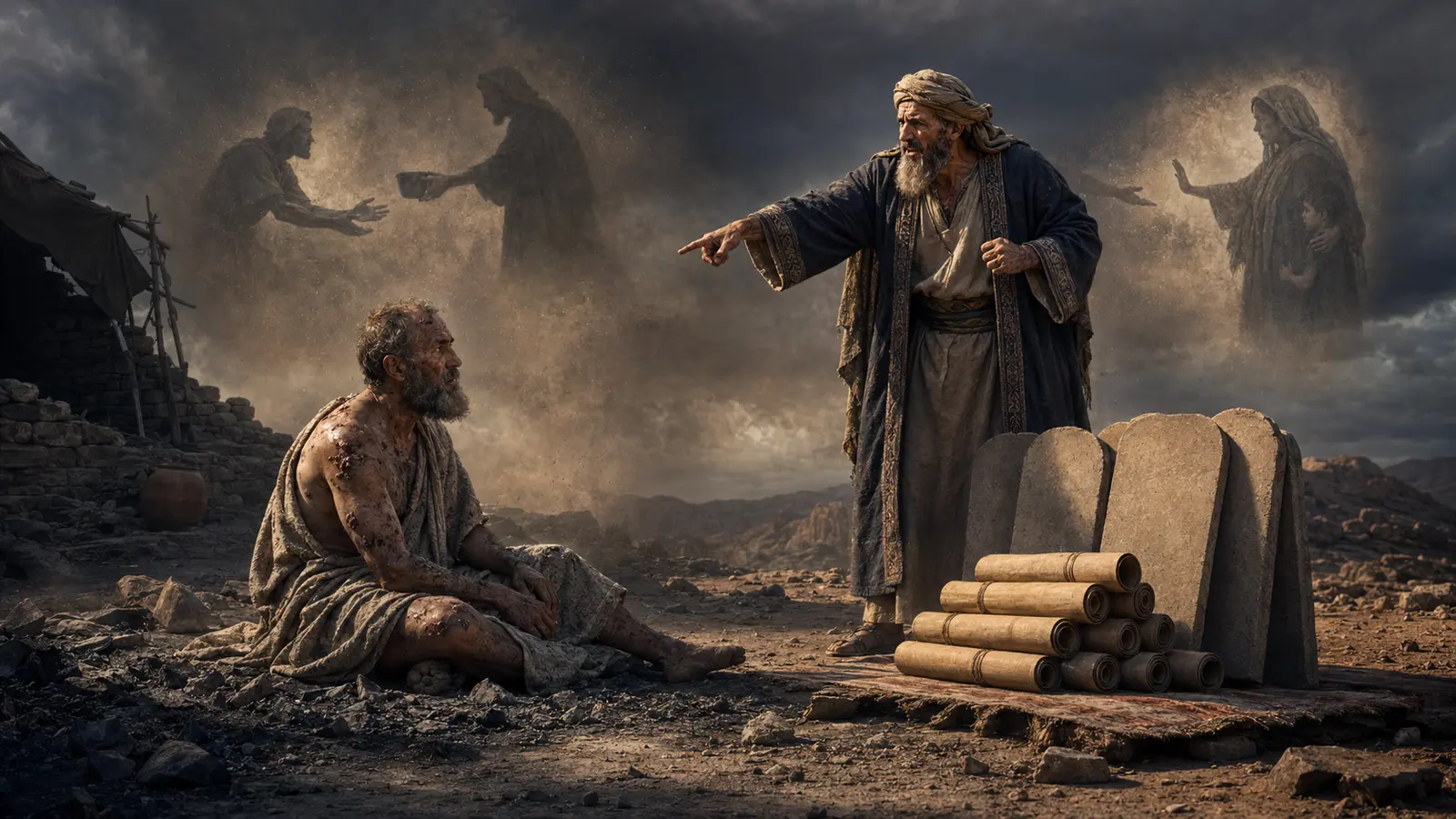
There is a time when the system is in danger, and the owner of the system starts looking for a sin that will save it. Eliphaz has failed to prove that the wicked always fall and the righteous always prosper. Job shows a world with safe houses of the wicked, children playing, and graves honored. Now Eliphaz does not open his heart to that evidence; he opens an indictment. He says that Job has stripped the poor of his clothes, denied water to the weary, chased away the widow empty-handed, and crushed the hands of the orphan. The text has not provided any evidence of such things. When the system fails to explain the wound, Eliphaz turns the wound into evidence of sin. However, in his strong speech there are beautiful words: "Be reconciled with God, be at peace." The problem is not that every word of his is a lie. The problem is that the real medicine has been given to a person who does not have the disease he is accused of having.
01
When Eliphaz Turns From Comforter To Prosecutor, And When True Words Land In The Wrong Place
There is a time when the system is in danger, and the owner of the system starts looking for a sin that will save it. Eliphaz has failed to prove that the wicked always fall and the righteous always prosper. Job shows a world with safe houses of the wicked, children playing, and graves honored. Now Eliphaz does not open his heart to that evidence; he opens an indictment. He says that Job has stripped the poor of his clothes, denied water to the weary, chased away the widow empty-handed, and crushed the hands of the orphan. The text has not provided any evidence of such things. When the system fails to explain the wound, Eliphaz turns the wound into evidence of sin. However, in his strong speech there are beautiful words: "Be reconciled with God, be at peace." The problem is not that every word of his is a lie. The problem is that the real medicine has been given to a person who does not have the disease he is accused of having.
02
1.0 Introduction: When the Comforter Sits in the Prosecutor's Seat
At first, Eliphaz was not like this.
In his first speech, he reminded Job how he had taught many, strengthened weak hands, and strengthened those who were stumbling (4:3–4). Although he already believed that suffering was related to some fault, he still spoke as a friend with hope that God's discipline could bring about healing.
But the conversation has been long. Job did not admit to being wicked. He has not made the confession that his friends have been waiting for. He has continued to say that his suffering does not match the life he lived. Moreover, in chapter 21, he has given evidence that shakes their system: the wicked can live long, see their children flourish, enjoy music, reject God, die in peace, and be buried with honor.
Eliphaz now stands at a crossroads. He can admit that the world is more mysterious than he thought. He can go back to sit next to his friend and say, "I don't understand, but I won't leave you." Or he can defend his theology by increasing the weight of the charges.
He chooses the charges.
Job 22 is Eliphaz's third and final speech. It begins with questions about whether man can benefit God. Then the voice suddenly changes: "Is not your wickedness great? Your wickedness has no end" (22:5). From there, Eliphaz mentions specific sins as if he was a witness: Job has taken bail without reason, stripped people of their clothes, denied water to the tired, denied food to the hungry, chased away widows, and crushed the strength of orphans (22:6-9).
But the reader knows something that Eliphaz doesn't—or doesn't want to admit. God himself described Job as a perfect and honest man, who fears God and avoids evil (1:1, 8; 2:3). There is no incident in the narrative that confirms these charges. Later, Job will explain that he saved the poor who cried, he helped the orphans, he made the widow's heart happy, and he became eyes for the blind and legs for the lame (29:12-16). In chapter 31, he will directly deny the list of sins that Eliphaz now accuses him of (31:16-23).
Therefore, Job 22 brings us to a very dangerous theological area: When a person loves his explanation more than the man in front of him, he can begin to invent guilt to protect his system.
But this chapter has another mystery. The last half of it has good words about God's return, keeping his word in the heart, making the Almighty a treasure, lifting the face in prayer, walking in the light, and praying for others. The words are true. His problem is where they land. Eliphaz calls the righteous to repent of sins he has not committed.
So Job 22 asks a sharp pastoral question:
Can even holy words be weapons when given without listening, without evidence, and without love?
03
2.0 Historical and Literary Context: Eliphaz's Last Speech
Job 22 opens what is often called the third round of discussion. This cycle is shorter, more disrupted in its structure, and indicates that the conversation has reached a dead end. Eliphaz speaks in chapter 22; Job responds with a long speech in chapters 23–24; Bildad's speech in chapter 25 is very short; and Sofari will not be given another open speech.
The words are beginning to run out of power, but their intensity is increasing.
Eliphaz's speech has three main parts:
1. Charges against Job (22:1-11). Eliphaz begins by saying that the righteousness of man adds nothing to God. He then concludes that Job's suffering must be due to his great wickedness. He lists allegations of abuse of the poor, widows, and orphans.
2. Arguments about how God deals with human affairs (22:12-20). Eliphaz claims that Job sees God as far away, hidden by clouds, and cannot see what is happening on earth. He then brings him back to the "old way" of the wicked who suffered from the flood and fire.
3. The call to repentance and restoration (22:21-30). Eliphaz calls Job to be reconciled with God, he kept his word in his heart, remove evil from his tent, put gold in the dust, and make the Almighty his treasure. He promises peace, heard prayers, light on the way, and strength to pray for others.
The structure shows how Eliphaz thinks. First he makes a diagnosis: Job is wicked. He then explains the theology that confirms that realization: God destroys the wicked. Finally he offers a cure: Job will repent, then he will be restored.
If the first step were correct, much of the third step would be strong advice. But his diagnosis is false. Therefore, even a good medicine turns into a burden.
There is an important irony in verse 6. Eliphaz says that Job has taken his brother's bond "for no reason." That statement echoes the preface of the book. The accuser asked if Job feared God "for nothing," that is, without reason or without payment (1:9). Later God told the Accuser that he had incited him against Job to destroy him "for no reason" (2:3). The truth is that Job's suffering is not caused by the sins that Eliphaz claims. But now Eliphaz takes the words "without reason" and turns them into an accusation against Job.
It is then that the reader sees the distance between the knowledge of heaven and the conclusions of his friends. Eliphaz thinks that great suffering requires great sin. The preamble has taught us that that conclusion is wrong.
Job 22 is therefore not the speech of a person who does not know anything about God. It is the speech of a person with many truths, but whose system has become so complicated that it prevents him from seeing the person in front of him.
04
3.1 "Can Man Benefit God?" — When the Truth is Turned into an Accusation (22:1–5)
Eliphaz begins with questions:
Can man be useful to God?
Does the Almighty get something because a person is righteous?
Is God enriched because man's ways are blameless? (22:2–3).
At some level, the answer is obvious. God is not an employer who needs our work for his business to continue. We cannot make God richer, wiser, or more perfect. Our obedience does not place us in our debt. All creation is already his. The right of man cannot be the currency to buy God.
But Eliphaz uses the truth in the wrong way.
He thinks that when Job claims to be righteous, he is trying to put God in his debt. But Job does not say that he has benefited God and now he demands payment. He only says that the accusations of his friends are not true. He wants God to listen to his case and confirm the truth.
Then Eliphaz's argument turns sharply. He asks if God is rebuking Job because he fears God (22:4). In his opinion, that is absolutely impossible. If God has entered into judgment with Job, the reason must be on Job's side. Then he gives a conclusion: "Is not your wickedness great? Nor is your wickedness endless?" (22:5).
Look what happened. Eliphaz has no new evidence. He has no witness. He has no incident. He has the suffering of Job and the system that says that suffering must be punishment. Therefore, the severity of the suffering becomes a measure of the magnitude of the sin.
This is the dangerous logic that can hide in religion: "Since something very bad has happened to you, you must have done something very bad." Job rejects that logic, and the preface of the book has already confirmed him.
It is true that we do not owe God. But it is also true that God cares about the justice of his creatures, hears the cry of the oppressed, and is not interested in false testimony. God's glory is not protected by making the innocent guilty.
When the truth about God's greatness is used to erase the truth about the neighbor, it has ceased to be wisdom and has turned into a weapon.
05
3.2 "You have denied food to the hungry" — Sins Composed Due to Injury (22:6-9)
Now Eliphaz gets specific.
He accuses Job of taking bail from his brothers without reason and stripping people of their clothes (22:6). In the ancient world, a poor man could offer his garment as security for a debt. But the law of Israel would later insist that the garment be returned before night, because it is the blanket of the poor in winter (Exodus 22:26-27; Deuteronomy 24:10-13). To take it mercilessly was to use economic power to strip the dignity of the poor.
Eliphaz continues: Job did not give water to the tired and denied food to the hungry (22:7). Water and bread are the most basic gifts of hospitality. Denying a tired person water in dry land is no small lack of manners; is playing with his life.
Verse 8 shows a world where the powerful make themselves the owner of the land and the person of rank is the one who is allowed to live in it. Eliphaz may be accusing Job of using his status to take land or of believing that the land belongs to the powerful. Either way, the image is of power defending itself and chasing away the weak.
Then the accusations come to widows and orphans: "You have driven away widows empty-handed, and the hands of orphans are broken" (22:9). In the Bible, widows and orphans stand as symbols of those without a social protector. God identifies himself as their defender (Deuteronomy 10:18; Psalm 68:5). Oppressing them is attacking the area that God's justice protects in a special way.
These sins are real. It's heavy. They should be called by their names in every generation: loans that rob the poor, systems that accumulate land in the hands of the powerful, the denial of basic needs, the expulsion of widows, and the breaking of the power of defenseless children.
The problem is not that Eliphaz hates sins that do not exist in the world. The problem is that he accuses Job of those sins without evidence.
And the text will later show the opposite. Job will say: "I saved the poor who cried, and the orphan who had no one to help him. I made the widow's heart sing for joy" (29:12-13). He was eyes to the blind, legs to the lame, and a father to the poor (29:15-16). He will put himself under judgment if he ever denied a poor person what he desired or made a widow's heart faint (31:16-23).
Eliphaz paints Job in colors that contradict his life.
This is a permanent warning. Specific allegations require specific evidence. We cannot use a person's status, hearsay, rank, or our religious system as a substitute for the truth.
Opposing injustice is right; implicating an innocent person for an injustice he has not committed is another injustice.
06
3.3 "Because Traps Are Around You" — When Pain Is Turned into Evidence (22:10–11)
After listing the accusations, Eliphaz interprets the suffering of Job: "Because of this, snares have surrounded you, and sudden fear terrifies you" (22:10).
The words "because of that" are the hinge of his argument. Because Job has wronged the poor—that's why the traps have caught him. Because he denied food to the hungry—that's why fear has gripped him. Because he drove out the widows—that's why darkness has covered him. Because he crushed the hands of the fatherless - that is why the flood has overtaken him (22:11).
But Eliphaz has arranged the sequence starting from the end. He sees the pain, then steps back and creates a mistake that can explain it. Suffering does not follow evidence of sin; prosecution follows evidence of torture.
The images he uses are powerful. Traps surround the path. The fear comes suddenly. Darkness prevents seeing. A lot of water rises and covers everything. Those are pictures that resemble the experiences that Job himself has described. But instead of entering those pictures and staying with his friend, Eliphaz uses them as examples of judgment.
Sometimes the sufferer says, "I feel like I'm drowning," and the comforter replies, "Then there must be sin that pulled you into the water." There the language of mourning has been turned into evidence of accusations.
The Bible knows that sin can have consequences. It does not completely separate its actions from its harvest. But the book of Job forbids us to turn that principle into a machine to explain every wound. Not every trap is a punishment. Not all darkness is judgment. Not every flood reveals a hidden fault.
The cross stands as the main evidence. Jesus is surrounded by snares, he enters darkness, and the waters of death cover him—but not because he is evil. The righteous man goes into a depth that Eliphaz's system could not explain.
Pain needs compassion before it can be turned into an argument.
07
3.4 "Thick Clouds Conceal Him" — When Mourning Is Translated into Rebellion (22:12-14)
Eliphaz now looks to God who is higher than the stars. "Isn't God in the height of heaven? Look at the top of the stars, how high it is!" (22:12). There he uses the language of praise. God is exalted. He rules the world from above.
But then Eliphaz puts words in Job's mouth: "What do you say, God knows? Can he judge through darkness? Thick clouds hide him from seeing, and he walks on the circle of heaven" (22:13-14).
According to Eliphaz, Job believes that God is so far away that he does not see earthly things. That would make Job like the wicked who think they can act without being seen.
But that is not Job's complaint.
Job never said that God does not see. In fact, he has often cried because God seems to be looking at him with an unbearable closeness: "What is man that you glorify him, and look at him every morning?" (7:17–18). He has said that if he commits a sin, God sees him and does not leave him (10:14). His problem is not that God does not see; is that he does not understand why God sees the suffering and still does not defend him.
Eliphaz takes Job's question about righteousness and turns it into a denial of God's knowledge. He takes mourning and pays the name of heresy.
This happens often in faith communities. When someone asks, "Where was God?" we can hear as if he said, "God does not exist." When someone says, "I don't see justice," we can answer him as if he said, "God is not just." But biblical mourning is not a necessary rebellion. Often it is faith that seeks God strongly because it still believes that he should hear.
The Psalms are full of such questions. The prophets cry. Jesus himself asks, "My God, my God, why have you forsaken me?" (Matthew 27:46). That question does not make him dishonest. It shows the depth of his obedience in darkness.
Don't call a person an unbeliever just because his faith speaks in a voice of pain.
08
3.5 "Will You Keep the Old Way?" — Eliphaz Returns the Argument of the Wicked (22:15–20)
Eliphaz asks Job if he will continue in the old path trodden by the wicked (22:15). He describes the people who were cut off before their time, their foundation being taken away by the flood (22:16). The image may evoke the memory of the flood of Noah's day—a violent world swept away by water (Genesis 6–7).
The people said to God, "Leave us," and asked, "What can God do for us?" (22:17). These are almost the same words that Job quoted in chapter 21. Eliphaz now takes them and turns them against him.
He admits that God filled their houses with good things, but insists that their end was destruction. Then he repeats Job's statement: "Let the counsel of the wicked be far from me" (22:18; compare 21:16). It is as if he is saying, "Job, your own words support my point. The wicked may prosper for a time, but flood and fire will destroy them."
When the righteous see their fall, Eliphaz says, they rejoice; the innocent laugh at them (22:19). They watch the property of the wicked being cut off and their wealth consumed by fire (22:20).
In this section, Eliphaz revises his claim somewhat. He accepts what Job said about the houses of the wicked being filled with good, but he still insists that a visible end of judgment must come. However, he does not fully agree with Job's argument that some of them die peacefully and are buried with honor. Instead, he returns to traditional images of flood and fire.
There is also something troubling in the joy of the righteous over destruction. The Bible knows the joy of seeing oppression abolished; the liberation of the victims has a reason to sing. But another Bible wisdom warns: "When your enemy falls, do not rejoice" (Proverbs 24:17). God's justice should not give birth to a heart that likes to see people burn.
Eliphaz has been more eager to see his system confirmed than to see his friend healed. The fall of the wicked has attracted him more than the cry of the afflicted.
True justice enjoys the liberation of the oppressed; it does not feed the soul by watching destruction.
09
4.0 Theological Reflection: Defending God Without Condemning Man
Job 22 teaches us that not every defense of God glorifies God.
Eliphaz thinks he is protecting the justice of the Almighty. He cannot accept that Job is righteous and still suffers, because that would shake his system of how God rules. Therefore, in order for God to continue to be seen as righteous within that system, Job must be wicked. Eliphaz defiles man to preserve his image of God.
But that man is created in the image of God. False testimony against him cannot be worship. You cannot glorify the Creator by betraying his creation.
First, this chapter distinguishes between true theology and true application of theology. We do not owe God. Repentance is important. God's word should be preserved in the heart. Wealth should not take the place of God. God should be our treasure. Prayer and intercession are gifts of the covenant. Those things are true. But if they are used to force an innocent person to confess a sin he did not commit, they are misplaced.
Second, Job 22 reveals that the call to repentance requires facts, not assumptions. The Bible does not teach us to be silent in the face of real sin. Eliphaz mentions the evils that God hates: economic exploitation, the deprivation of water and bread, the selfishness of the landowners, and the crushing of widows and orphans. The church must mention those evils. But justice cannot be built on an accusation without evidence. True repentance begins when the true truth is spoken.
Third, this chapter teaches us that mourning is not the same as leaving God. Eliphaz hears Job complaining about God's silence and concludes that Job believes God does not see. But Job complains to God because he still takes God seriously. A wounded faith can ask tough questions without cutting its roots. The God of the Bible is great enough to receive an ill-timed cry.
Fourth, the end of the speech shows the power of intercession that turns the enemy into a neighbor. Eliphaz promises that Job will be able to save others by the purity of his hands. At the end of the book, Job will pray for the people who broke him with words. His mercy will not say their accusations were correct. It will say that grace can pass through even a wounded heart without calling evil good.
Then Job becomes a small sign that points us to Christ. Jesus is the righteous one who is falsely accused, who bears the judgment of others, and who stands as the Intercessor. In him, Eliphaz's call to be "reconciled with God" finds its true foundation. Peace with God does not come by making a false confession, nor by buying approval with gold. It comes by grace through the faithful Son who brings us near (Romans 5:1; 2 Corinthians 5:18–21).
The cross also corrects the way we call others to repent. We do not stand over them as prosecutors seeking vindication. We stand at the foot of the cross as sinners who have received mercy. We mention sin with truth, but with tears. We call people to return to God, but we do not repent of their guilt. We desire their return, not the victory of our system.
God does not need our lies to appear righteous. The cross and the resurrection are enough to show that His righteousness can pass in ways that our little systems cannot map.
10
5.0 Applications in Life: When Holy Words Need a Compassionate Heart
Job 22 offers practical wisdom for pastors, teachers, counselors, families, and faith communities.
First, don't invent sin to explain suffering. If you don't have evidence, don't fill the gap with suspicion. Illness, bankruptcy, family bereavement, rejection, or job loss do not prove secret wrongdoing. The truth does not require predictions with spiritual clothing.
Second, separate good principles from their application. A statement may be correct and yet not be the correct answer to the person in front of you. Before quoting a text, ask: Have I listened to him? Is this text really aimed at his situation? Will my words bring him closer to God or will they add to a wound that is not his?
Third, take accusations of wrongdoing seriously—but also take the evidence seriously. Oppressing the poor, widows, and orphans is a great sin. Don't silence the victims. At the same time, don't tarnish someone's name with rumors or conclusions based on their circumstances. Justice protects the oppressed and also rejects false testimony.
Fourth, don't call mourning rebellion quickly. A person can ask where God is because he still longs for him. Listen to the cry below the question. Sometimes a seemingly difficult statement is a prayer fighting to keep breathing.
Fifth, don't try to defend God by humiliating man. God is not so weak that he needs us to clear his name by defiling the sufferer. Defend God by speaking the truth, doing justice, showing mercy, and faithfully staying close to the wounded.
11
6.0 Reflection Questions
1. How does Eliphaz move from general questions about God to the claim that Job's wickedness is endless?
2. Why are the accusations of Job 22:6–9 morally serious, and why is it still wrong to use them against Job?
3. How does Job's description of his life in 29:12-16 and 31:16-23 contradict the picture painted by Eliphaz?
4. How does Eliphaz misunderstand Job's complaint about God hiding behind the clouds?
5. How is the call to be "reconciled with God" in 22:21-30 true, but misplaced?
6. What is the difference between preaching repentance with love and using repentance as a way to win someone over in an argument?
7. How is Eliphaz's promise of intercession in 22:29-30 ironically fulfilled in Job 42:7-10?
8. Jesus, who was falsely accused and prayed for his accusers, how does he change the way we speak to those who suffer?
12
7.0 Request for Response
O true and merciful God,
forgive us when we like our answers
than people created in Your image.
Let's not allow our system to become an altar
where the name of the innocent is sacrificed.
Teach us to listen before we accuse,
examine before concluding,
and weep with those who weep
before giving them the details.
When you show us true injustice,
give us the courage to say it:
bread denied to the hungry,
water deprived of tiredness,
banished widow,
and the crushed orphan.
But let us beware of false witness,
rumors, and doubts clothed in wisdom.
Teach us to receive words from Your mouth
and keep them in our hearts.
Be our treasure more than gold,
our peace in the dark,
and our light when the way is not visible.
Let us make people of repentance,
but also compassionate people.
Make us intercessors,
not prosecutors.
And when we are wounded by the words of a friend,
give us the grace to stand in the truth
without letting pain rule us.
Let us remember Jesus Christ,
Clean hands falsely accused,
crucified with sinners,
and who prays for us while he is alive.
In his name,
Our Mediator and our Peace.
Amen.
13
8.0 A Window on What's Next: Job's Search for the Invisible God
Eliphaz said to Job, "Be reconciled to God, be at peace. Return to the Almighty, and you will be built." But in Job 23, Job's problem will become clear: he would like to go to God - but he does not see.
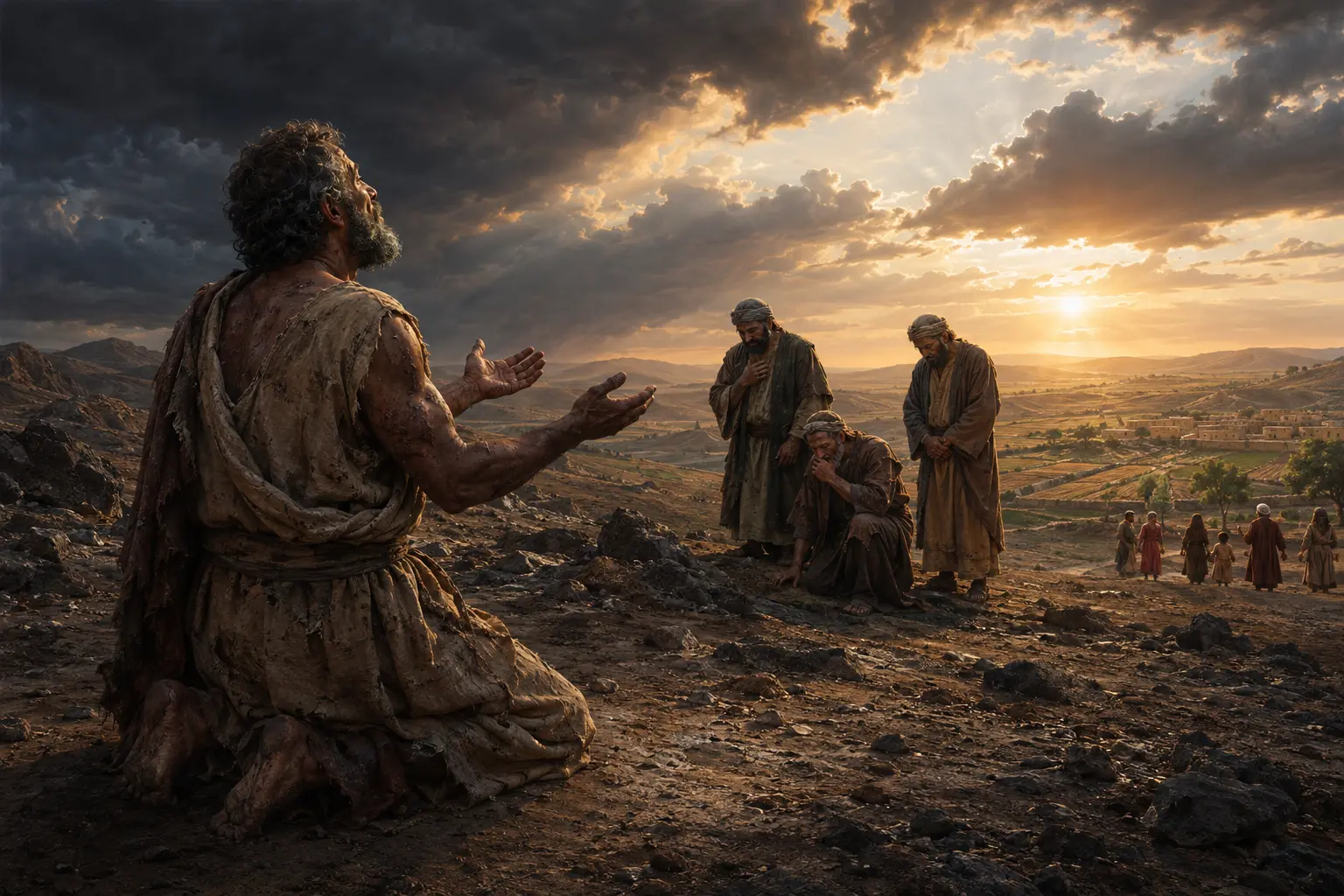
He will say, "I wish I knew where I could find him." He will search forward and backward, left and right, but God will not be found (23:3, 8–9). However, in that invisibility, Job will give a powerful confession: "He knows the way I go; when he tests me, I will come out like gold" (23:10).
Eliphaz told him to throw the gold in the dust and make God his gold. Job will respond with another golden image: he himself is in the mystical furnace, and he believes that God, although hidden, knows his way.
Job will not answer each accusation one after the other. He will not accept a false confession to get a quick peace. He will go straight to God's court, wanting to plead his case before a Judge whom he cannot find—but whom he still believes he knows.
14
9.0 Annotated Bibliography
Alter, Robert. The Wisdom Books: Job, Proverbs, and Ecclesiastes—A Translation with Commentary. New York: W. W. Norton, 2010. His translation preserves Eliphaz's dramatic shift in tone, from argument to accusation and then a call for restoration.
Clines, David J. A. Job 21–37. Word Biblical Commentary 18A. Nashville: Thomas Nelson, 2006. Provides a detailed analysis of Eliphaz's questions, the judicial nature of his charges, the challenges of interpretation in verses 8 and 30, and the combination of severity and promise in this speech.
Crenshaw, James L. Old Testament Wisdom: An Introduction. Louisville: Westminster John Knox, 2010. Helps situate this discourse within the broader wisdom of retribution, God's justice, and the experience of undeserved suffering.
Habel, Norman C. The Book of Job: A Commentary. Old Testament Library. Philadelphia: Westminster, 1985. Explains Eliphaz's argumentative strategies and how his speech uses conventional theology to place Job on the side of the wicked.
Hartley, John E. The Book of Job. New International Commentary on the Old Testament. Grand Rapids: Eerdmans, 1988. Divides Job 22 into accusations, arguments about God's actions, and calls to repentance; it also shows the danger of true words being used from the wrong perspective.
Newsom, Carol A. The Book of Job: A Contest of Moral Imaginations. Oxford: Oxford University Press, 2003. Helps to understand the dialogue as a conflict of moral attitudes where the system of friends is increasingly unable to give space to the innocent sufferer.
Walton, John H., and Tremper Longman III. How to Read Job. Downers Grove, IL: IVP Academic, 2015. A guide to reading the friend's speeches carefully—recognizing the grain of truth in them without accepting their perverse use against Job.

Be the first to leave a comment.